¶ Recent Updates |
|
¶ Background |
|
|
Portugal is a European country located on the Iberian peninsula on the western side of Spain, bordering the Atlantic Ocean. The country is divided into 18 districts and 2 autonomous regions and the national language is Portuguese. Portugal's government is headed by a Prime minister and President and within the legal system has a senate and house of representatives. The judicial branch is composed of a constitution and a supreme court. Portugal's laws and regulations have a hierarchy with five ranks. Laws and regulations in lower ranks must comply and not override laws in higher ranks.
As a member of the European Union, Portugal follows EU regulations and Directives, and must transpose EU Directives into national legislation. Portugal has 21 seats in the European Union. Portugal has been a member of the European Union since 1986. CLP and REACH regulations are regulated by the Agency for Competitiveness and Innovation (IAPMEI), Portuguese Environment Agency (APA) and General Directorate of Health (DGS). Biocidal and Plant Protection Products are regulated by the General Directorate of Food and Veterinary (DGAV) within the Ministry of Agriculture and General Directorate of Health (DGS) depending on the type of biocidal. Portugal has a National Gazette known as Diário da República: https://dre.pt/ |
Agency for Competitiveness and Innovation (IAPMEI) E-mail: reach+clp@iapmei.pt General Directorate of Health (DGS) Alameda D. Afonso Henriques, 45 – 1049 005 - Lisboa |
¶ Inventories |
|
|
See European Union pages |
|
¶ Substance Registration |
|
¶ REACH¶ Enforcement in PortugalThe obligations arising from the REACH regulation, regarding the registration, evaluation, authorization and restriction of chemicals were implemented in Portugal through the issuance of Decree-law 293/2009, of October 13th. The Portugal REACH Competent Authorities involved in the implementation of legislation have a direct role in the exchange of information regarding substance risks and compliance obligations by all natural or legal persons under the requirements of REACH. They also ensure compliance with the REACH and CLP Regulations. The competent national authorities responsible for REACH Enforcement are:
In Portugal, the Decree-Law no. 82/2003, last updated by Law 114/2015 of August 28, 2015, provides the penalty system for REACH non-compliance. These penalties are administrative. Some examples of the sanctions imposed are: When a company manufactures, imports or place on the market a substance that is not registered, the penalties range from 15000 € to 48000 €. When the substance without registration is an intermediate, the range is about 6000 € to 20000 €; The highest penalties level (up to 5,000,000 €) is set up for the absence of communication concerning the updating on tonnage of a notified substance under EU Directive 67/548/EEC (DSD); The penalties are in the range of 2000 – 144000 € foreseen for the violation to the obligations detailed in REACH article 14, concerning the chemical safety report and duty to apply and recommend risk reduction measures. Member States are responsible for the creation of national helpdesks to advise manufacturers, importers, distributors and users of chemicals, and other stakeholders on their responsibilities and obligations under the REACH and CLP Regulations. The Portugal national helpdesk, coordinated by the Innovation and Competency Agency according to Decree-Law 82/2014, is a free of charge service to help clarify the responsibilities and obligations of manufacturers, importers, distributors and users under the REACH and CLP Regulations, namely how they are defined and interpreted. The competent national authorities responsible for the REACH Helpdesk are:
|
Sources
Resources
*Not available in English IAPMEI - Agência para a Competitividade e Inovação, I.P. |
¶ Product Registration |
|
¶ Portugal Biocide RegistrationIn Portugal, national authorization for biocidal products (in parallel or sequentially) is the responsibility of the National Health Services (SNS) under the Directorate-General for Health (DGS) and the Directorate-General for Food and Veterinary Medicine (DGAV) in accordance with the mutual recognition procedural Decree-Law 121/2002 of May 3, 2002, updated by Decree-Law 85/2013 of June 26 and Decree-Law 140/2017 of November 10, which transpose the EU Regulation 528/2012, Biocidal Products Regulation (BPR). The Ministry of Health published on January 20 Decree-Law 9/2014, modifying the list of active substances that can be included in biocidal products, proceeding to the twelfth amendment of Decree-Law 121/2002, of May 3. On November 10, 2017, The Ministry of Health published Decree-Law 140/2017, ensuring the implementation of EU Regulation 528/2012 in the domestic legal order, applied to market availability and use of biocidal products. This regulation revoked Decree-Law 121/2002 and took effect on January 1, 2018. The classification, packaging and labeling of biocidal products must be in accordance with Regulation (EC) No. 1272/2008. For the safety data sheet (SDS) of each product, they must respect the rules defined in Annex II of Regulation (EC) No. 1907/2006 on Registration, Evaluation, Authorization and Restriction of Chemicals (REACH). The SDS should include the classifications and labeling according to Regulation (EC) No. 1272/2008. The label and SDS of biocidal products must be written in Portuguese for placement on the national market. The competent authorities responsible for biocidal products on the national level are:
The transitional period of Regulation 736/2013 of May 17, 2013, was extended from August 20, 2013, until December 31, 2024. During the transitional period, Ordinance 17980 of September 30, 1960, which controls pesticides imports, manufacturing, preparation and sale and any pesticide related products will be in effect. The Ordinance also mandates a sales authorization for pesticide type chemicals (not including biological products) before these are placed in the market. Besides sending documents, the application for the sales authorization is subject to a fee payment which must be made within 10 days from the date of submission of the request and a payment proof document must be submitted to the DGS. The labeling and packaging of these products are not subject to approval. The following documents are required when requesting a sale authorization:
After December 31, 2024, companies must apply for a biocidal product authorization according to the BPR. This application must be submitted via the R4BP 3 Register for Biocidal Products on the European Chemicals Agency (ECHA) website. This process is subject to the payment of a national fee per product type and use (professional or non-professional) which must be made within 30 days from the date of submission of the request, and the payment proof document must be made available through R4BP 3. After issuing the authorization for the product, the following documents must be sent to the DGS by mail:
Applicants may also request national authorization by mutual recognition, which can be: Mutual Recognition in Parallel - When the Portuguese General Directorate for Veterinary of the Ministry of Agriculture, as a competent authority, participates in the evaluation of the documentation as an involved member state. Mutual Recognition in Sequence - When the Portuguese General Directorate for Veterinary of the Ministry of Agriculture, as a competent authority, recognizes an authorization already granted by another Member State. They should also be submitted via the R4BP 3 Register and follow the same instructions regarding documentation above. The products that are authorized by the Directorate-General for Health on the national market, in accordance with the Biocidal Products Directive can be found on the ECHA website. |
Sources
Resources
*Not available in English Navigate to: EU Biocidal Products National Biocide Helpdesk of the Directorate-General for Health (DGS): Address: Alameda D. Afonso Henriques, 45 – 1049 005 Lisboa Directorate-General for Food and Veterinary (DGAV) of the Ministry of Agriculture: Address: Campo Grande, 50 1700-093 Lisboa |
¶ Plant Protection ProductsRegistration for Plant Protection Products (PPPs) in Portugal follows the European Union Regulatory framework published in EU Regulation (EC) No 1107/2009. Portuguese Law 26/2013 of April 11, 2013, transposed EC 128/2009 which established an action framework at a Community level to achieve a sustainable use of plant protection product. This Law was amended by Decree-Law 169/2019 on November 29, transposing Directive (EU) No. 2019/782 of 15 May 2019. This includes extensive risk assessments. Plant Protection Products (PPPs) can be marketed and used only if they have been authorized by the Directorate-General for Food and Veterinary (DGAV) in accordance with the provisions of Decree-Law 145/2015. This Decree-Law was published on July 31, 2015 by the Ministry of Agriculture and the Sea and ensures the execution in the internal legal order, of the obligations resulting from Regulation (EC) No. 1107/2009, of the European Parliament and of the Council, of October 21, 2009. It was amended by Decree-Law 59/2019, modifying article 23 of Decree-Law 145/2015 and last amended by Decree-Law 9/2021. ¶ Marketing AuthorizationFor the application of the authorization, the first step is to file Form 0, indicating the data relevant to your legal and tax identification and identifying the responsible(s) technician(s) or representative(s). Whenever the responsible technician is replaced or fails to perform the functions mentioned above, this occurrence must be reported, indicating his replacement. As specified in the Portugal PPP Procedures Manual, each application submitted to the DGAV should be composed of documentation that can be seen in the green box to the right. According to article 3 of Decree-Law 145/2015, DGAV provides the marketing authorization for each plant protection product or plant protection product adjuvant, which is indispensable for these products to be marketed in Portugal. The authorization titles are permanently available on the DGAV website and contain all relevant and updated information, namely the conditions of use, on each authorized product, excluding information that has been considered confidential. Each holder of an authorization must send to DGAV, by April 1st of each year, all data related to the quantities, expressed in kilograms, sold in the previous year, broken down by plant protection product and active substance. They must also provide information regarding the respective products, including the chemical composition to the Poison Information Center of the National Institute of Medical Emergency, I. P. The authorization must have a final answer within 45 working days in accordance with paragraph 7 of article 12 of Law 26/2013 and is valid for one year, renewable for equal periods. Law 26/2013 of April 11 regulates the activities of distribution, sale and application of plant protection products for professional use and adjuvants of plant protection products. It requires a technician who should be responsible for the sale of plant protection products, ensuring compliance with legislation. This technician should have higher education in agricultural or related sciences. Law 26/2013 was first amended by Decree-Law 35/2017 on March 24, had it second amendment on November 29 through Decree-Law 169/2019 and last amendment through Decree-Law 9/2021 on January 29. According to the Food and Veterinary Directorate General, the authorized PPPs must:
According to the Portugal PPP Procedures Manual, when submitting an application for market placement authorization of PPPs, the applicant must check in advance the following information:.
Applications for market placement authorization of PPPs and adjuvants must be submitted, in a separate letter, to the Directorate-General for Food and Veterinary, describing the type of authorization sought and briefly indicating the type of application and supporting documents sent along with the request. This request should be sent to the following address:
As specified in the Portugal PPP Procedures Manual, the DGAV response letters will indicate the process number corresponding to each request. For this reason, the applicant should include information in the heading of each submission letter:
The DGAV must be reported annually of any quality issues or unforeseen problems for the PPPs authorized to be placed in the Portuguese market. Fees - in accordance with Ordinance No. 86/2017, of February 27, updated by Dispatch 5173/2018 of May 23. 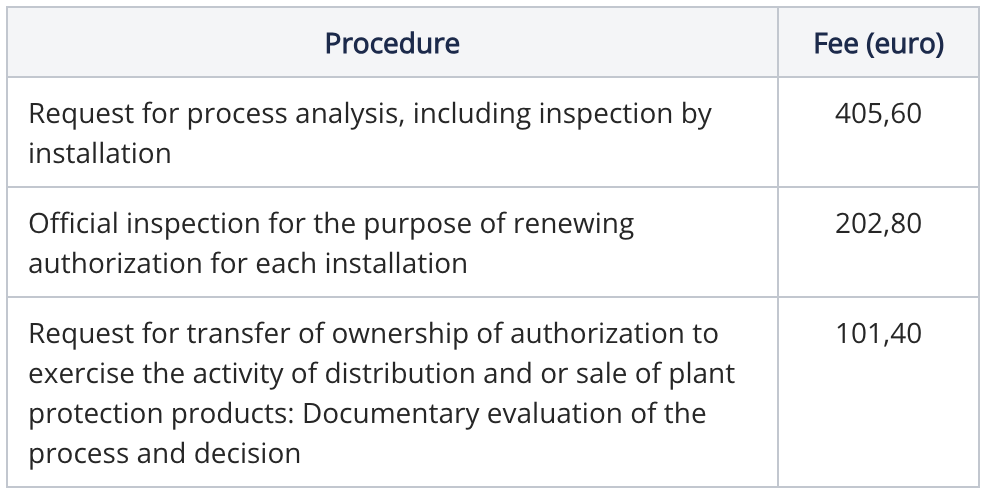
¶ Application of PPPs authorized for non-professional useBesides the PPP's authorized for professional use, there are also PPP's authorized for non-professional use at home, or on land surrounding, according to Decree-Law 101/2009, of 11 May, which regulates the activities of distribution and sale, of plant protection products and their application by end users. These products can be sold in commercial establishments, in spaces not intended exclusively for the sale of PPP's, however, the products must be placed in exhibitors properly identified and separated from other products intended for human and animal use. They can only be sold to those who are of legal age. On December 31, 2020, Decree-Law 101/2009 was amended by Law 75-B/2020 to include the prohibition of sale of any plant protection products containing glyphosate. For non-professional use, packages must have the following: a) Capacity or weight not exceeding 1 l or 1 kg, respectively; b) A child safety lock and include a tactile mark for the blind, if they are liquid products classified as harmful (Xn), sensitizing or irritating (Xi), or flammable (F), with the exception of aerosols and single-dose packaging; c) A system that allows and facilitates a safe and correct dosing of the product, if case applies; d) Contain the words "non-professional use" and "indoor plants / home garden line". For indoor plants, only PPP's exempt from toxicological classification are allowed which are ready to be applied or supplied in packages designed in such a way that they do not require contact with the product, in case it is necessary to prepare a syrup for its application; The following are not allowed: a) Plant protection products classified as very toxic (T+), toxic (T), explosives (E), corrosive (C) and oxidizing (O); or b) Plant protection products to which at least one of the following risk phrases have been assigned: R1, R4, R5, R6, R14, R15, R16, R17, R18, R19, R29, R30, R31, R32, R40, R41, R44, R48, R59, R62, R63, R64 or R68; ¶ Documentation required for each application
|
Sources
Resources
*Not available in English Navigate to: EU Plant Protection Products
|
¶ LabelingAll plant protection products placed on the market must have a label or contain all mandatory elements on the packaging. The label must be firmly attached to the primary packaging of the product and the information placed on the label or packaging must be clear and permanent and written in Portuguese. The information that should show in the label should be according to what is described in article 17 of Regulation (EC) No. 1272/2008 and dimensions of the label as well as pictograms must comply with that set out in point 1.2 of Annex I of this same Regulation. A guide for Labeling of Plant Protection Products can be found under Resources in this page. |
Sources
Resources *Not available in English |
¶ Notifications |
|
¶ C&L NotificationSee European Union page: C&L Notification ¶ Poison CentreSee European Union page: Poison Centres |
|
¶ Restrictions and Bans |
|
¶ Restrictions under REACHSee European Union page: Restrictions under REACH |
|
¶ Authorisation under REACHSee European Union page: Authorisation under REACH |
|
¶ Restriction of Hazardous Substances (RoHS)See European Union page: Restriction of Hazardous Substances (RoHS) In Portugal, Decree-Law 79/2013 of June 11, 2013, transposed EU Directive 2011/65 of the European Parliament and of the Council June 8, 2011, establishing rules on the restrictive use of hazardous substances in electrical and electronic equipment (EEE), for the protection of human health and the environment, including an environmentally comprehensive recovery and disposal process of WEEE. Decree-Law 79/2013 was published by the Ministry of Agriculture, Sea, Environment and Spatial Planning and became effective on June 12, 2013. It was last amended on April 5, 2023, by Decree-Law 23/2023 which transposed EU Directive 2021/647 and 2021/884, modifying annexes iii and iv, granting temporary exemptions for certain hazardous substances in EEE. For EEE Importers, information and documentation necessary to demonstrate EEE compliance with current regulation must be translated into Portuguese. Competent authority The competent authority responsible for compliance to Decree-Law 79/2013 is the Portuguese Environmental Agency (APA). |
Sources
*Not available in English |
¶ Persistent Organic Pollutants (POPs)See European Union page: Persistent Organic Pollutants (POPs) In Portugal, Stockholm Convention on Persistent Organic Pollutants was ratified through Decree No. 15 of June 3, 2004, issued by the Ministry of Foreign Affairs and establishes the mechanisms for implementing Regulation (EC) 850/2004 of April 29, 2004 through Decree-Law 65 of March 22, 2006. It was last amended by Decree-Law 9/2021. The Ministry of Environment and Spatial Planning is responsible for coordinating the process of preparing the National Implementation Plan for the Stockholm Convention with the involvement of other Ministries such as the Ministry of Economy and Innovation (includes Industry), Agriculture, Rural Development and Fisheries (includes Fisheries and Agriculture), Health and representatives of the Autonomous Regions of Madeira and the Azores. Competent authority The Environment Institute is, according to article 2 of Decree-Law 65/2006, the competent national authority to perform the administrative functions set out in Regulation (EC) 850/2004. Regarding inspection of compliance with what is established in this Decree-law, the Inspectorate-General for the Environment and Spatial Planning, the Food and Economic Security Authority, the police authorities and other competent entities as a result of the matter will be responsible for this function. |
Source
*Not available in English |
¶ Ozone Depleting SubstancesSee European Union page: Ozone Depleting Substances Portugal ratified the Montreal Protocol on August 8, 1988. This was published in Portugal's Official Gazette for the first time in Decree 20 of August 30, 1988. The obligations regarding these substances regulated by Regulation (EU) 2037/2000 were ensured by Decree-Law 119/2002 and the latest amendment to this law occurred on May 27, through Decree-Law 85/2014, which implements the European Union Regulation (EC) No 1005/2009. On February 27, the Ministry of Environment, Territorial Planning and Regional Development issued Decree-Law 35/2008 defining the minimum qualification requirements for the personnel involved in the maintenance and other services of refrigeration and air conditioning equipment, heat pumps, fire protection systems and extinguishers, including the detection of any leakage of substances, as well as recycling, recovery and destruction of controlled substances. On November 30, 2017, the Portuguese Environment Agency issued Decree-Law 145/2017 ensuring the implementation, in the national legal order, of Regulation (EU) No. 517/2014, on fluorinated greenhouse gases. The Decree includes requirements on labeling of gases and equipment covered by the Regulation, which should be in Portuguese language, once placed on the national market as well as other obligation of registration and communication to the Agency regarding data on purchase and sale of these gases. Communication with the Agency can be done through the electronic platform made available for that purpose on their website. On June 5, 2018, the Ministry of Foreign Affairs published Decree 16/2018 approving the Amendment to the Montreal Protocol, on Substances that Deplete the Ozone Layer, adopted in Kigali on October 15, 2016, setting different levels of consumption, aiming to progressively eliminate HFC, since, they may contribute to climate change. Competent authority The Portuguese Environment Agency is the competent authority responsible for the purposes of the regulations above. |
Sources
Resources
*Not available in English |
¶ SDS + Label |
|
¶ ClassificationSee European Union page: Classification ¶ Portugal Regulation and National HelpdeskThe execution in the national legal order of Regulation (EC) 1272/2008 of 16 December, on the classification, labeling and packaging of substances and mixtures is determined through Decree-Law 220/2012 of October 10. It was last amended by Decree-Law 9/2021 of January 29, regarding infractions. The Decree-Law 220/2012 designates as responsible for the application of CLP requirements the following national competent authorities, acting within the scope of their respective competences:
The national helpdesk, which is the responsibility of the member state to implement and offer, provides clarification on which responsibilities and obligations companies need to comply under the REACH and CLP Regulations. The website can be referred under Resources on this page. ¶ Safety Data SheetSee European Union page: Safety Data Sheet |
Sources Resources *Not available in English |
¶ LabelSee European Union page: Label In Portugal, labels in Portuguese are required. |
|
¶ Trade SecretsSee European Union page: Trade Secrets |
|
¶ Occupational Exposure LimitsSee European Union page: Occupational Exposure Limits ¶ Portuguese Occupational Exposure LimitsThe Portuguese Ministry of Economy under Decree-Law 71/2012 of March 2012 (last updated by Decree-Law 80/2014 of May 15) approves the Portuguese Institute of Quality (I.P.Q) as the organization to develop and regulate Portuguese Metrology and Quality standards to include the workplace Occupational Exposure Limits (OELs). The Portuguese OELs are based on the 2014 ACGIH TLV Values under the Portuguese Standard NP 1796/2014, however, a few occupational exposure limits have been updated through transposition of EU directives into national law, such as Decree-Law 24/2012, which has it's recent update through Decree-Law 1/2021. The Ministry of Work and Solidarity is responsible for occupational health and safety, including protecting workers against the risks arising from exposure to dangerous chemicals. Within the Ministry, occupational health and safety is assigned to the General-Directorate for Working Conditions. The regulatory framework on the protection of workers against the risks of exposure to chemical agents is in accordance to the transposition of EU community directives. Portuguese Decree-Law 24/2012 of February 6 consolidates the minimum requirements for the protection of workers from risks to safety and health due to exposure to chemical agents at work and also transposes Commission Directive EU 161/2009 implementation of Indicative Exposure Limits. Decree-Law 24/2012 was modified by Decree-Law 88/2015 of May 28, transposing Directive EU 2014/27 and was last updated by Decree-Law 1/2021 of January 6, which transposed Directive EU 2019/1831 establishing a fifth list of occupational exposure limit values. The protection of workers from risks related to exposure to carcinogens or mutagens at work is regulated by Decree-Law 301/2000, of 18 November, which transposes Directive 90/394/EEC, of the Council, of 28 June. It was updated by Decree-Law 35/2020 on July 13, transposing the EU directives 2017/2398, 2019/130 e 2019/983, establishing new limit values for carcinogens and mutagens. On December 9, it was updated by Decree-Law 102-A/2020. Later, on December 4, 2024, Law Decree 102/2024 made the fourth amendment to Decree-Law No. 301/2000 of 18 November, transposing Directive (EU) 2022/431. |
Sources
Resources *Not available in English |
¶ Transport |
|
|
See European Union page: Transport Decree-Law No. 41-A/2010, of April 29 regulates the land, road and rail transport of dangerous goods and transposes Directive 2006/90/EC (ADR 2009), of the Commission, of November 3, and Directive 2008/68/EC, of the European Parliament and of the Council, of September 24, into the internal legal order. It was amended by the following Decree-Laws:
The transport of dangerous goods includes loading and unloading operations, transfers from one mode of transport to another and stops required by the conditions of transport, carried out on roads in the public domain or any other roads open to public transit. The documents that must accompany dangerous goods during transport can be issued in electronic form and should be in Portuguese language. The authorities responsible for inspection of the transport of dangerous goods in the nation are the following: There is a special circulation permit authorization for heavy motor vehicles carrying dangerous goods on Sundays, national holidays and on weekends at certain times and roadways, due to Ordinance No. 281/2019, of 30 August which established restrictions in this regard. Resolution No. 969/2021 approves the permit authorization and a model can be found in annex I of the present regulation. |
Sources
Resources
*Not available in English |