¶ Recent Updates2026
2025
|
|
¶ Background |
|
|
The European Commission is the institution responsible for ensuring EU law is applied throughout all Member States. EU Regulations are the most direct form of EU law: as soon as they are passed, they have binding legal force throughout every EU Member State. Regulations are passed either jointly, by the EU Council and European Parliament, or by the EU Commission alone. National governments do not have to take action to implement EU regulations. Regulations are in this way different from Directives and Decisions. Directives are addressed to national authorities, laying out a specific end goal and specifying the date by which the national laws must be adapted. Directives are used to bring different national laws into line with each other, and are particularly common for subjects affecting the operation of the single market (e.g., product safety standards). Decisions apply in specific cases involving particular authorities or individuals. The official journal for EU Legislation is called EUR-Lex and can be found at http://eur-lex.europa.eu/homepage.html?locale=en
|
Explore EU Member States Austria | Belgium | Bulgaria | Czech Republic | Denmark | Finland | France | Germany | Greece | Hungary | Ireland | Italy | Netherlands | Poland | Portugal | Romania | Slovakia | Spain | Sweden
|
¶ Inventories |
|
¶ C&L InventoryThe Classification and Labelling Inventory (C&L) contains classification and labelling information for substances notified under CLP Article 40 and registered under REACH. The inventory also contains the list of harmonised classifications (Annex VI of the CLP), which are legally binding in the EU. The entries for each substance include the IUPAC nomenclature, the name as given in EINECS (if applicable), and the classification and labelling of the substance.
¶ Harmonised ClassificationsThe C&L Inventory includes the list of harmonised classifications. These classifications are from CLP Annex VI and are legally binding in the EU. When a harmonised classification is available it classification appears at the top, while the notified classifications can be found underneath.
¶ Notified ClassificationsThe Inventory also lists all classification and labelling information for substances that have been notified or registered. Although the C&L Inventory strives to reduce the number of classifications, this portion of the inventory may display many different classifications for the same substance. These variations could occur for several reasons. For example, substances could have slight differences, such as physical states or formulations, or notifiers could draw different conclusions due to discrepancies in the data used. Although ECHA includes these classifications in the C&L Inventory, they do not review or verify their accuracy. The notified classifications are organized as follows:
¶ |
Sources
Resources |
¶ EC InventoryThe EC Inventory is a consolidation of 3 lists: EINECS, ELINCS and the NLP list. Notification to these inventories is not required and the lists are static. However, presence on the inventory is still relevant for substance identification.
¶ EINECS: European Inventory of Existing Commercial Chemical SubstancesThe European Inventory of Existing Commercial Chemical Substances (EINECS) was published officially in English in 1988. It was later published in all nine EEC (European Economic Communities) languages in June 1990, and a corrigendum was published on March 1, 2002. EINECS is an inventory provided by the EEC of "existing substances" that were reported to be on the EU market between January 1, 1971 and September 18, 1981. This list is static by design, thus it is not possible to add substances. EINECS contains over 100000 entries and is now stored on the European Chemical Agency (ECHA) website as part of the consolidated EC inventory.
¶ ELINCS: European List of Notified Chemical SubstancesThe European List of Notified Chemical Substances (ELINCS) contains substances that were notified as new under the Dangerous Substance Directive 67/548/EEC notification scheme. As of June 1, 2008, the notification scheme was repealed and replaced by REACH. The publication of ELINCS as part of the consolidated EC inventory contains the name, EC number, CAS number, and a description, e.g. the trade name. Prior to consolidation, this inventory also contained classification information. For more than half, the authorities agreed to preserve confidentiality by omitting the full chemical name (and CAS number). Minor components and impurities were not mentioned in ELINCS unless there was indication that they contributed to the classification of the substance.
¶ NLP: No-Longer Polymers ListThe No-Longer Polymers List (NLP) is not considered an inventory. This list arose as an aid to navigating the special rules, notification requirements, and reporting requirements for existing substances under EU Directive 67/548/EEC as amended through the 7th amendment, EU Directive 92/32/EEC. The 7th amendment redefined polymers. In this new definition, molecular weight of the substance was taken into account, better aligning with criteria commonly used in the scientific community. This changed the regulation of many substances formerly considered polymers. As such, the NLP list contains substances that were:
These substances were not retrospectively subject to notification requirements; however, they now require registration under REACH. Note that the NLP list is not exhaustive. On a case by case basis, Competent Authorities allowed the "no-longer polymer" designation for substances not on the list that met the no-longer polymer criteria.
|
Sources EC Number Guide
ECHA uses EC numbers as the primary method of identification for substances in the EC inventory. Similarly, list numbers identify substances not in the inventory. List numbers have alphanumerical format and same length as EC numbers. A list number assigned by ECHA starts with 1, 6, 7, 8, 9, or a letter (e.g. 6XX-XXX-X or AXX-XXX-X). Unlike EC numbers, list numbers have no legal standing. |
¶ Substance Registration |
|
¶ REACHThe acronym REACH stands for Registration, Evaluation, Authorisation and Restriction of Chemicals. Under REACH, every substance manufactured or imported in the EU at quantities meeting or exceeding one metric ton per annum must be registered, except where explicitly exempted. Reach applies in all 27 EU member states, Norway, Iceland and Lichtenstein (European Economic Area, EEA). The European Chemical Agency (ECHA) manages the implementation of REACH; however, ECHA has no enforcement responsibilities. The enforcement of REACH is the responsibility of the individual states and their appointed national authority. Fines and penalties are defined in the national law of each country. Exempt From REACH:
|
Sources
Resources 
|
¶ Registration and Evaluation
¶ RegistrationRegistration under REACH is required if companies based in the EU* manufacture or import a substance in volumes above 1 tonne per year. To implement the regulation over time, there were varying deadlines for registration depending on the phase in status, tonnage per annum (tpa), and hazard characteristics of the substance in question. The final deadline passed on May 31, 2018; therefore, substances placed on the EU market for the first time in an average amount equal to or greater than 1 metric tons per annum are subject to registration immediately.
¶ How to registerRegistration is completed via the submission of a dossier to the European Chemicals Agency (ECHA). The depth of the dossier data is dependent on the annual tonnage of the substance, and to some degree, its hazard criteria. Annexes VI through X to the regulation specify these data requirements. For substances that exceed 10 tonne per year, a Chemical Safety Assessment (CSA) shall be conducted. A Chemical Safety Report (CSR) shall then be completed as part of the registration. Under certain conditions Exposure Scenarios (ES) need to be performed (REACH Article 14) and added to the Safety Data Sheet after the registration. Companies that register the same substance must submit their registration jointly. For that purpose, a Substance Information Exchange Forum (SIEF) will be established, and a lead registrant is appointed. The data and related costs for creating the lead dossier of the joint submission are shared among the companies. If the SIEF is already established, the company that wants to subsequently register that substance must gain access to the data by purchasing the so-called letter of access (LoA). The dossier must be prepared using the IUCLID6 software and submitted to ECHA via the official IT-system, REACH-IT. The responsibility for submitting a registration lies with the manufacturer or importers established in the EU*. Only EU based entities can submit a registration. However, non-EU manufacturer or formulators can register a substance by appointing a natural or legal person established in the EU as their Only Representative (OR) located in the EU. The OR submits the registration and fulfills the registration obligation of the importer. Registration is subject to a fee that has to be paid to ECHA. The fees are regulated by Commission Regulation (EC) No 340/2008 and depend on the company size and the tonnage range of the registration. *This also applies to non-EU members if they are part of the European Economic Area (Iceland, Liechtenstein, and Norway).
¶ Result of registrationAfter the registration is complete, ECHA assigns a registration number with the format 01-XXXXXXXXXX-XX-XXXX, where the last four digits are company specific. Certain information of the registration dossier is published on the ECHA webpage. A list of registered substances can be searched online, currently including over 22,000 unique entries and over 96,000 dossiers. Substances notified in accordance with Directive 67/548/EEC are considered as being registered for the manufacturer/importer that submitted the notification. Registration numbers have been assigned to all notifications and distributed upon request of the notification’s owner. Any REACH related submission to ECHA (e.g. pre-registration, inquiry), receives a list number if no official EC number has been assigned to that substance yet. These list numbers have no legal status, but have been published by ECHA to facilitate substance identification. List numbers have the format 6XX-XXX-X, 7XX-XXX-X., 8XX-XXX-X, 9XX-XXX-X, or AXX-XXX-X.
¶ REACH inquiryAn inquiry is required prior to registration for phase in substances that have not been pre-registered and for non phase in substances. The inquiry dossier is created using IUCLID and contains detailed substance identity information, including analytical information, that will be checked by ECHA to evaluate if the substance has been already registered by other companies. The potential registrant will have to wait for the outcome of the inquiry before submitting the registration or starting any testing on vertebrate animals. Information to be submitted for the inquiry includes:
What is a phase-in substance versus a non-phase-in substance? Phase-in substances fall into the following categories:
Substances that do not meet the criteria as phase-in substances are considered non-phase-in substances
What is pre-registration? Pre-Registration Manufacturers or importers placing a phase-in substance above one metric ton per year on the EU market had to pre-register their substance in 2008 to benefit from an extended deadlines of the actual registration. Pre-registrations enable the Agency to facilitate the formation of SIEFs, Substance Information Exchange Fora, platforms intended to become the vehicle for REACH's data sharing obligations for phase-in substances. The REACH deadlines for submitting registration dossiers after the pre-registration were set on the basis of the tonnage of the substances manufactured in and/or imported into the European Union and the date on which they were initially available on the market. After the last registration deadline on May 31, 2018, the pre-registrations are still valid. So if a pre-registration has been submitted, no inquiry is needed before submitting the registration.
¶ EvaluationEvaluation refers to the process coordinated by ECHA and the member states to review the information submitted via the registration dossier. The Dossier evaluation performed by ECHA includes:
After the submission ECHA may examine any registration dossier at any time to verify if the information submitted by registrants is compliant with the registration requirements. The outcome might be an additional information or testing request from ECHA. The substance evaluation performed by the Member State Competent Authorities reviews the adequacy of the dossier in relation to the substance data and if any regulatory action is required. Substances that are subject to evaluation are listed on the Community rolling Action plan (CoRAP). In addition, the Public Activities Coordination Tool (PACT) lists substances that are examined by the authorities to investigate potential need for regulatory risk management. It is possible, as an outcome of the evaluation process that more information is requested from the registrant.
|
Sources
REACH Helpdesk To support companies in complying with the regulation, each member states has set up their own national help desk as a first contact point for any REACH related questions: https://echa.europa.eu/support/helpdesks/
|
¶ Special Cases
¶ PolymersPolymers (as defined under REACH Article 3) are not subject to registration under REACH. However the monomer substance the polymer is made of needs to be registered if the following conditions are met:
¶ IntermediatesREACH requirements differentiate between isolated an non isolated intermediates. Non isolated intermediates are not intentionally removed from the equipment, e.g. the reaction vessel during the synthesis process. They are not subject to registration under REACH. Isolated intermediates do not meet the criteria of a non isolated intermediate. They are differentiated into on site isolated intermediates and transported isolated intermediates. Both types are subject to registration if manufactured/imported in volumes above 1 tonne per year, but can benefit from reduced information requirements if used under strictly controlled conditions as defined in the regulation. ¶ ArticlesECHA provides detailed guidance on deciding if an object can be considered an article with an integrated substance or as a combination of a mixture/substance and an article. If the object is a substance or mixture and an article, the substance (or substance in a mixture) exceeding one tonne per year is subject to registration. Substances that are an integrated part of an article are subject to registration if they are intentionally released from the article under normal or reasonable conditions of use and if the total amount of the substance present in all produced or imported article produced exceeds one tonne per year. The registration of a substance in articles is not required if the substance has already been registered for that use (Article 7(6)), either in the same supply chain or any other supply chain. ¶ Product Process Orientated Research (PPORD)Substance used in volumes above one tonne per year for the purpose of PPORD can be exempted from the registration obligation for a period of five years if a notification has been submitted to ECHA. The time period of 5 years can be extended upon request. ¶ Substance used in the Interest of DefenceSubstances used in the interest of defence can be covered by national exemptions of the Member States. A description of the individual national application procedure can be found on the European Defence Agency website.
|
Sources
Resources |
¶ Product Registration |
|
¶ Biocidal ProductsBiocide regulation refers to the biocidal active substance and the biocidal product. The biocidal active substances are mostly chemical compounds, but can also be microorganisms (e.g. bacteria). Biocidal products contain one or more biocidal active substances and may contain other non-active ingredients intended at synergistic effects or to produce physical characteristics like color or pH. Biocidal products manufactured or imported into the EU require a product authorisation. Product authorisation is an equivalent term for 'registration,' and is granted by each EU member state where the product will be used or sold. The Biocidal Product Regulation (BPR, EU Regulation (EU) 528/2012) and its delegated acts set out a regulatory framework for a harmonized approach to active substances approval at the EU level, and national authorisation procedures for Biocidal Products in the EU.
¶ What is regulated?
¶ Product Types1. Disinfectants: PT 1: Human Hygiene 2. Preservatives: PT 6: Preservatives for Products During Storage 3. Pest Control: PT 14: Rodenticides 4. Other Biocidal Products: PT 21: Antifouling Products Information requirements for active substances approval and for biocidal product authorisation are found in the Annex II and Annex III of the BPR, respectively.
Nanomaterials and articles that have been treated with biocidal product(s) are covered within the scope of the BPR. These types of products are subject to the active substance approval and national authorisation.
¶ What must be submitted?The BPR provides several options to obtain national authorisation. When a supplier intends to place a biocidal product in more than one member state, the supplier can select from the following authorisation options based on the application time and the overall cost that it can bear.
Union authorisation offers a product authorisation that will be effective throughout the EU market without the supplier applying to any specific member state. For authorisation through mutual recognition (whether in parallel or in sequence), the supplier must first identify the member states where the biocidal product will be sold and choose one competent authority to conduct the evaluation. For mutual recognition in parallel, the evaluation is conducted by the chosen competent authority and other concerned member states can engage in the evaluation process simultaneously by providing comments. Mutual recognition in sequence grants an authorisation for one country and other member states are asked by an applicant to recognize the authorisation.
¶ Submission of informationFor the approval of the active substance the Active Substance dossiers are to be created using IUCLID and submitted via the Register for Biocidal Products (R4BP). For the product authorization a Product Dosser is to be created in IUCLID and a Summary of Product Characteristics (SPC) is to be compiled via the SPC editor, which is required for each national authorisation. The product dossier(s) and the SPC are then submitted to ECHA through R4BP. ECHA has published numerous guidance documents to clarify the components of the BPR, and they are available from its website.
¶ Transitional PeriodThe Biocidal Product Regulation, which came into force on 1 September 2013, provides transitional measures in which each EU member state is allowed to enforce its own laws and regulations to control Biocidal Products before adopting the BPR measures in full. Consequently, suppliers of Biocidal Products may be required to comply with existing national authorisation procedures unique to the member state.
¶ Treated ArticlesArticles can only be treated with active substances that have been approved under the biocide regulation for that purpose (specific product category). The regulation also includes labeling requirements for articles that have been treated with or incorporate a biocidal product in case
Consumers can request information from the supplier on the biocidal treatment applied to the article. This information needs to be provided free of charge within 45 days.
|
Sources Resources
|
¶ Plant Protection ProductsPlant Protection Products (PPP) require authorisation/registration in the EU. The EU has developed a regulatory framework through Regulation (EC) 1107/2009 which lays down rules for the authorisation of Plant Protection Products (PPPs). The Regulation requires extensive risk assessments to be carried out before PPPs can be placed on the EU market and used.This process involves all Member States, the European Food Safety Authority (EFSA), and the European Commission (Commission).
¶ RegistrationEU Regulation (EC) No 1107/2009 lays down harmonised rules for the approval of an active substances and the placing on the market of Plant Protection Products (PPPs). The Regulation requires a risk assessments to be carried out before the active substance can be placed on the EU market and used.
If the substance is approved it will be added to the Pesticide Database on active substances. Active substances are approved for a maximum time of 10 years. After that time the approval needs to be renewed. More information on the responsible authorities can be found under the Member States. The Plant Protection Product authorisations should be submitted via the European Commission's Plant Protection Products Application Management System (PPPAMS). The relevant Rapporteur Member State is responsible for evaluating the application in the system. The PPPAMS is used in addition to the other electronic and manual processes of the Member States.
¶ PPP LabelThe labelling of a plant protection product must comply with the EU Plant Protection Products Regulation (EC) No 1107/2009, the CLP Regulation and the EU Regulation on labelling of plant protection products. The CLP regulation sets out special rules for the labelling of plant protection products in Annex II, part 4. The label must also include the statement EUH401 - To avoid risks to human health and the environment, comply with the instructions for use. Commission Regulation (EU) No 547/2011 contains specific requirements for the labelling of plant protection products, including standard phrases for special risks and safety precautions as well as the attribution criteria for those standard phrases and safety precautions. From January 1, 2028 Regulation (EU) 2026/1123 will repeal Regulation (EU) No 547/2011. The new Regulation (EU) 2026/1123 lays down updated labelling requirements for plant protection products and also introduces the requirements for digital labels. The label of a plant protection product shall not display misleading statements, in particular suggesting that the plant protection product is non-hazardous and must inform professional users about the conditions of use of the authorised plant protection product. The regulation also introduces a new pictogram and phrase “Hazardous to bees”. The Annexes contain the required standard phrases to be used on the plant protection product label.
|
Sources
Resources
|
¶ CosmeticsCosmetics Regulation (EC) No 1223/2009 establishes the framework for cosmetic products placed on the market in the EU. This Regulation replaced Cosmetics Directive 76/768/EEC. This Regulation includes a requirement for the "Responsible Person" to notify a cosmetic product prior to placement on the market. This can be done through the cosmetics product notification portal (CPNP). Definition of Cosmetic Product
Cosmetic products do not include medicinal products, medical devices, or biocidals. In addition, there are products for which it may not be clear whether they fall under the Cosmetics Regulation or other legislation (e.g. tooth floss that delivers a substance intended to clean and correct odours). Such products are considered borderline products, and their nature needs to be determined on a case-by-case basis. A guidance manual has been published by the Working Group on Cosmetic Products in order to assist in this decision.
¶ Cosmetic IngredientsThe responsibility for the safety of the substances used in cosmetic products lies with the manufacturer or importer of the cosmetic product. To support the safety of cosmetic products, Cosmetics Regulation (EC) No 1223/2009 sets restrictions, and authorizations of certain ingredients, as presented in Annexes II – VI of the Regulation.
Ingredients that have been classified as CMR are generally prohibited. Exceptions include substances classified as CMR 2 that have been deemed by the Scientific Committee on Consumer Safety (SCCS) as safe for use in cosmetic products, and are regulated in the Annexes of the Regulation. Substances classified as CMR 1A or 1B may be allowed in exceptional cases, if they comply with food safety requirements, there is no suitable alternative, and their conditions of use have been found to be safe by SCCS. Ingredients that fall under the Regulation’s definition of nanomaterials also have particular requirements in the Regulation in order to ensure a high level of protection to human health. A few authorized substances in nanomaterial form are included in the Annexes. For all other nanomaterial substances the Commission may request the opinion of the SCCS on the safety of the nanomaterial prior to authorizing their use.
¶ Who is the "Responsible Person"?The manufacturer* is responsible when the product is manufactured within the Community and the product has not been exported and imported back in. The importer is responsible when they have imported and placed a cosmetic product on the market. The distributor is responsible when they place a product on the market under their name or trademark or modify an existing product on the market in a manner that impacts compliance requirements. *If the manufacturer is not established in the Community, a person within the Community must be designated as the responsible person via written mandate. The designee must accept the mandate in writing. While this is required of manufacturers outside of the Community, manufacturers, importers, and distributors within the Community may also opt to designate a Responsible Person via written and accepted mandate if they wish. |
Sources Resources 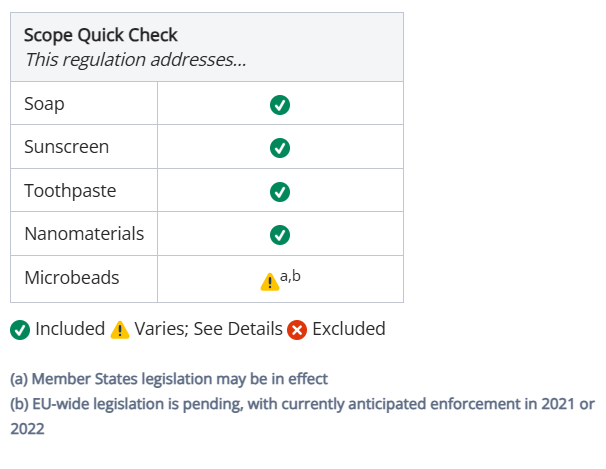 |
¶ What to SubmitAccording to Chapter III, Article 13 of the Regulation, the following shall be submitted electronically via the CPNP to the Commission prior to placement on the market:
Additionally, original labelling and a photograph of its corresponding packaging should be notified to the Commission.
¶ Products on the Market in a Different Member StateWhen a product is already on the market in one or more Member States and the distributor wishes to make it available in an additional Member State or States, if the distributor translates any element of the product label to comply with the national law of the additional Member State(s), then the distributor must provide the following to the Commission electronically:
¶ Products Previously on the MarketIf a distributor reintroduces a product in a Member State that was previously on the market prior to 11 July 2013 but has not been on the market since, the distributor shall provide the following information to the responsible person:
If notifications according to Article 7(3) and 7a(4) of Directive 7/768/EEC have not been carried out in the relevant Member State, the responsible person shall electronically provide via the CPNP to the Commission the information listed above ("What to Submit") .
¶ Keeping Information CurrentIf any information listed in this section and submitted to the responsible person or to the Commission changes, the responsible person or distributor must provide updated information without delay.
¶ Other Information regarding the CPNPAdditional information about using the CPNP for product notifications (per Article 13) can be found below and in the Guide to Using CPNP.
¶ Product Information FileA product information file should be kept for each product placed on the market and retained for 10 years after the product's last placement on the market. The file should include the following:
The file should be updated as needed. It must be readily accessible to the competent authorities of the Member State and should be available in a language easily understood by such authorities.
|
Resources |
¶ NanomaterialsThe presence and form of nanomaterials must be included in the cosmetic product notification. In addition, Chapter III, Article 16 of the Regulation requires certain information be submitted electronically via the CPNP to the Commission at least six months prior to placement on the market. If, at any time, the Commission has concerns about a nanomaterial's safety, it may request information from the SCCS regarding the use of the material in relevant cosmetic categories and exposure conditions. The Commission shall make this information public. Nanomaterials do not need to be notified if they are used:
Note that nanomaterials may not be used as colorants, UV-filters, and/or preservatives if not so listed in the Cosmetics Regulation. The Commission publishes a catalogue of nanomaterials used in cosmetics. This catalog shares information submitted through the CPNP, and is for information only. Definition of a Nanomaterial ‘Nanomaterial’ means an insoluble or biopersistent and intentionally manufactured material with one or more external dimensions, or an internal structure, on the scale from 1 to 100 nm.
¶ The Responsible PersonThe Responsible Person may designate another legal or natural person via written mandate to enter certain nanomaterial information, and shall inform the Commission of any such delegation. The Delegate may only submit certain information to the CPNP. The Responsible Person must complete certain information even if a Delegate has been designated. This information includes the estimate of the quantity of material contained in cosmetic products intended to be placed on the market per year. The Responsible Person completes the notification after the Delegate has completed data entry.
¶ What to SubmitThe CPNP notification must contain the following information about the nanomaterial(s) :
Each nanomaterial used must be notified including multiple nanomaterials in a single cosmetic product and/or different nanomaterials in differing shades (variations of color, fragrance and/or strength) of the same cosmetic product.
|
Resources |
¶ LabellingAll cosmetic products sold within the EU must be labelled according to the requirements of Chapter VI, Article 19 of the Cosmetics Regulation. Please refer to that section for detailed information, as the requirements are complex and to a degree ingredient dependent. Please note that cosmetic products packaged in aerosol dispensers have additional labelling rules as listed in the EU Aerosol Directive 75/324/EEC. Label requirements include:
As mentioned above, the label has to include any additional requirements laid out in the Annexes depending on product type, consumer, type of use etc. For example, fragrance allergens in concentrations above specific limits cannot be simply be referred to as 'aroma' or 'parfum' and need to be included by name on the label. The presence of nanomaterials has to be indicated by the word [nano] after the name of the ingredient. Elements of the label can also be mentioned on an enclosed leaflet, tape or card, if they cannot be contained directly on the label. Certain information may need to be translated into the official language/s of the EU country where the product is placed, depending on the requirements of the member State. Product claims are an important part of the labelling of a cosmetic product and need to be substantiated unless they are an obvious or clear exaggeration. The glossary of common ingredients names for use in the labelling of cosmetic products, listed in Commission Implementing Decision (EU) 2022/677, has been repealed by Commission Implementing Decision (EU) 2025/1175. The new glossary will apply from July 30, 2026.
|
Resources
|
¶ Serious Undesirable Effects (SUEs)To protect the health and safety of the consumers, Article 23 of the Regulation sets forth the requirement for communication of any serious undesirable effects (SUEs) arising from the product. If such an event occurs, the responsible person and distributors must immediately notify the competent authority of the Member State where the event occurred. To facilitate the implementation of this obligation and establish harmonized communication, the Commission together with EU countries and industry has established certain guidelines. This also ensures that such notifications are followed-up in a consistent manner by national authorities and distributors/responsible persons. The guidelines include SUE reporting protocol, a list of national contact points in charge of handling SUEs, a document explaining the administrative cooperation in the area of market surveillance, and SUE forms to be filled.
|
Resources |
¶ Notifications |
|
¶ C&L NotificationWhen the CLP entered into force, the requirement for the notification of classification and labelling moved from REACH to the CLP. According to Article 40 of the CLP, a substance must be notified to the C&L inventory by the EU based manufacturer/importer if:
The notification must be submitted to ECHA within one month of placing it on the market. This notification may also be completed by a "group" of manufacturers or importers. Submission of a Registration dossier, which includes the Classification and Labelling information, constitutes having fulfilled the C&L Notification requirement. The information to be notified to ECHA must include the following points:
According to Article 41, where the notification results in different entries in the C&L Inventory, notifiers and registrants will be required to "make every effort" to reach an agreed entry.
|
Sources
Resources 
|
¶ Poison CentresThe legal basis for the notification of formulations to a particular poison centre, national authority, etc., is set out in Article 45 of the CLP (EU Regulation (EC) 1272/2008) and the national legislation of those EU Member States where such products are placed on the market. Article 45 requires manufacturers or importers to submit information on hazardous mixtures to the designated body of the Member State where the mixture is placed on the market. The CLP Amendment Commission Regulation (EU) 2017/542 added an Annex VIII to harmonize the submission under Article 45. Annex VIII sets provisions to harmonize, in terms of format and content, the information relating to emergency health responses that companies placing hazardous mixtures on the EU market are required to submit to the Member state appointed bodies. ECHA has established a harmonized notification format for submitting the required information to poison centers. The ECHA Submission portal, is an online tool for EU based companies to prepare and submit information according to the harmonized format, which enables the appointed bodies to easily access the relevant information. The CLP identifies importers and downstream users placing certain hazardous mixtures on the market as responsible for the submission of the information. The importers and downstream users are also referred to as duty holders.
¶ Unique Formula IdentifierThe amendment also includes provisions for Unique Formula Identifiers (UFI): unique number codes that will be established and linked to a particular hazardous mixture. The UFI will have to be printed on the label or the packaging of the mixture to allow a quick identification of the specific chemical formulation of a product and a fast appropriate response in case of an emergency call. The UFI is created by a web application and UFIs can be generated one at a time or in bulk.
¶ Submission formatThe online tool and the new format will gradually replace the national requirements. Based on the draft tool, each submission will be tied to the UFI and also include:
¶ ImplementationAnnex VIII to CLP requires the submission of information prior the mixtures are placed on the EU market and applies to mixtures which are classified as hazardous according to the CLP Regulation based on their health or physical effects. Not classified mixtures are not subject to poison center submission obligations, however, in order to facilitate the appointed bodies and poison centers activities, it is encouraged to be notified on a voluntary basis.
|
Sources
Resources
|
¶ Substances in Articles
¶ Substance Notification to ECHASubstances on the Candidate List of Substances of Very High Concern (SVHC) for Authorisation require notification to ECHA if they are present in articles above 0.1% (w/w) and in total volumes above 1 tonne per year. The notification is due 6 months after a substance has been included on the Candidate List of Substances of Very High Concern for Authorisation. A notification is not required if the substance has already been registered for that use or exposure to human health or the environment can be excluded. The Notification to ECHA shall contain the following information:
The notification can be done online in REACH IT or using IUCLID. If an article contains an SVHC from the candidate list in a concentration above 0.1%, relevant safety information about this substance must be provided to the recipient of these articles (REACH Article 33). Upon request, this information must also be provided to consumers within 45 days.
¶ SCIP Database NotificationBased on the Waste Framework Directive, ECHA has set up a new database for information on "substances of concern in articles, as such or in complex objects (products)," SCIP. The SCIP database aims to increase awareness of hazardous substances in waste, better equipping waste operators, consumers, and regulators. From 5 January 2021 onwards, EU producers and assemblers, EU importers, and EU distributors of articles as well as any other actor who places articles on the market, should provide information to ECHA on the safe use of such articles that contain SVHCs from the Candidate List in a concentration above 0.1% w/w. The legal obligation also covers articles imported into the EU, including imports from internet sales. The information required to be submitted includes:
The dossiers will be submitted either online through the ECHA Submission portal or through a system-to-system (S2S) transfer from the company’s own system to the ECHA Submission portal. The submissions can be prepared in IUCLID (online or offline) or using an IUCLID-compatible dedicated format for SCIP submissions in the company’s own system.
|
Sources
Resources |
¶ Prior Informed Consent
¶ Export Notification of Substances Subject to PICRegulation (EC) No 689/2008 (Prior Informed Consent Regulation, PIC) implements the Rotterdam Convention on the prior informed consent procedure for certain hazardous chemicals and pesticides in international trade in the European Union. The regulation requires that exports of certain chemicals to non-EU countries must be notified to the designated member state authority.The list of chemicals affected is available in Annex I of EU Regulation (EC) No 689/2008. Exports of all chemicals, mixtures, or articles that contain one or more chemicals subject to PIC must be notified in advance, at least 35 days before the first export. The Notification is created and submitted via the IT system ePIC. ePIC enables the information exchange between industry users, authorities and custom. The required information is listed in Annex II of the PIC Regulation. Once notified, a unique identifier is assigned (reference identification number).
|
Sources PIC Regulation EU Regulation (EC) No 689/2008 Resources ECHA Guidance on the Implementation of the PIC Regulation 
|
¶ Restrictions and Bans |
|
¶ Restriction under REACHUnder REACH, the term "Restriction" refers to specified restrictions delineated in Annex XVII to the Regulation. The REACH Restrictions came into force June 1, 2009, repealing the Market and Use Directive (76/769/EEC). Restrictions are given for individual substances or a group of substances and their specific uses. The compounds that appear in Part 3 of Annex VI to the Regulation (EC) No 1272/2008 (CLP), classified as Category 1A and 1B carcinogenic, mutagenic and toxic to reproduction (CMR) and listed in appendices 1 - 6 of REACH Annex XVII, are generally restricted as a substance and in mixtures for consumer use (see entry 28, 29 and 30 of Annex XVII). The Annex XVII is amended on a regular basis. |
Sources
Resources |
¶ Authorisation under REACHUnder the authorisation requirement of REACH, manufacturers, importers, and downstream users will have to apply for the "authorisation" to use substances listed on Annex XIV to the Regulation (EC) No 1907/2006 (REACH) in the EU. Before a substance is subject to authorisation, it must be identified as a Substances of Very High Concern (SVHC) and added to the Candidate List of SVHCs for Authorisation. SVHCs may have the following hazard properties:
Once a substance is included in the Candidate List there are additional obligations for companies manufacturing, importing or using these substances. The final authorisation list (Annex XIV) is updated on a regular basis. Each substance is associated with a sunset date and a latest application date. After the sunset date, authorisation is required in order to use or place that chemical on the market. The latest application date marks the latest date when an application for authorisation needs to be submitted to be able to use the substance after the sunset date. The application for authorisation includes
While ECHA is responsible for the coordination of applications for authorisation, final decisions are made by the EU Commission. If an authorisation is granted, the applicant will receive an authorisation number that must be included on the label before placing the substance or the mixture containing the substance on the market. ¶ SVHCs in ArticlesIf an article contains an SVHC from the candidate list in a concentration above 0.1%, relevant safety information about this substance must be provided to the recipient of these articles (REACH Article 33). Upon request, this information must also be provided to consumers within 45 days. A notification to ECHA is required if the SVHC is present in articles above 0.1% and the total amount of the substance present in all articles produced or imported exceeds 1 tonne per year (REACH Article 7). Notification to the SCIP database is also be required for SVHCs present in articles about 0.1% (w/w).
|
Sources
Resources |
¶ Restriction of Hazardous Substances (RoHS)The Directive 2011/65/EU was published in the Official Journal on July 1, 2011 and deals with the restriction of certain hazardous substances in electrical and electronic equipment (EEE). Directive 2011/65/EU is considered a recast of the previous RoHS directive ("RoHS 1") and is therefore also called "RoHS 2." The electrical and electronic equipment affected are defined under categories listed in Annex I of the Directive. Definition
Categories
The restricted substances and their related thresholds are listed in Annex II of the directive. The following substances are restricted in all homogeneous materials in the EEE: 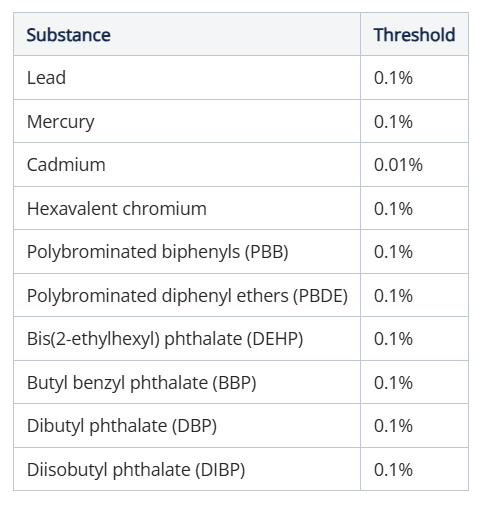 The restriction of the use of DEHP, BBP, DBP and DIBP were added to the annex under Directive 2015/863 and shall apply by July 22, 2019, for medical devices the restriction should only apply from 22 July 2021. The Directive does not apply to certain equipment defined in Article 2 (Scope). According to Article 2, the Directive does not apply to the following:
Exemptions are listed in Annex III and IV. Manufacturers can apply to the European Commission for exemptions to be listed in Annex III. Exemptions are valid for 7 years. Application requirements are defined in Annex V of the regulation. To show that the EEE is compliant with the applicable requirements, manufacturers draw up an EU declaration of conformity and affix a CE marking on the product before it is placed on the market. The content of the declaration is described in Annex VI of the directive. It should be noted that further Restrictions under REACH Annex XVII may apply to EEE. Additionally, manufacturers and importers may be subject to notification requirements if their EEEs contain substances on the Candidate List for Substances of Very High Concern. |
Sources Resources |
¶ Persistent Organic PollutantsPersistent Organic Pollutants (POPs) are a group of organic substances that are persistent to natural degradation processes and cause adverse effects to human health or the environment. Due to their persistence, POPs are eligible for long range transport. The Stockholm Convention on Persistent Organic Pollutants was ratified by the EU through the Council Decision 2006/507/EC. The Convention's goal is to eliminate and restrict the production and use of these substances. Regulation (EU) 2019/1021 repealed Regulation (EC) 850/2004, and is now the main legal text in the EU dealing with identifying, restricting, prohibiting, and managing the disposal of Persistent Organic Pollutants (POPs). The scope of Regulation (EU) 2019/1021 covers all POP substances, as well as products and mixtures containing POPs. This Regulation includes provisions for:
Under this Regulation certain substances are banned or their production and use in the EU is severely restricted. Several substances listed in the Annexes to this Regulation correlate directly with substances listed in the Stockholm Convention, while others may be found in the Protocol to the 1979 Convention on Long-Range Transboundary Air Pollution. Decisions taken under the POP Convention and implemented through the POP Regulation have priority over the REACH regulation (Restriction and Authorisation). Exemptions to the regulation are described in Article 4. The European Chemical Agency (ECHA) will work on scientific, technical and administrative tasks to identify and regulate POPs in the EU. |
Sources Resources |
¶ Ozone Depleting SubstancesThe European Union is a signatory to the United Nations Montreal Protocol on Substances that Deplete the Ozone Layer (ODS), and as a result, has adopted regulations for the reduction and eventual elimination of ozone depleting substances. Regulation (EC) No 2037/2000 on substances that deplete the ozone layer was originally adopted in 2000. This was later repealed by Regulation (EC) No 1005/2009, which accelerated the phase-out of hydrochlorofluorocarbons (HCFCs) by bringing the production ban forward, in line with decisions taken under the Montreal Protocol. In 2024, Regulation (EU) 2024/590 was adopted, replacing Regulation (EC) No 1005/2009. This new Regulation establishes a general ban on ODS in the EU, subject to limited exemptions. For these exempted uses, an ODS trade license is required, along with annual reporting obligations to the European Commission for undertakings that produce, place on the market, or use ODS where permitted.
|
Sources Regulation (EC) No 1005/2009 (repealed) |
¶ SDS + Label |
|
¶ ClassificationRegulation (EC) No 1272/2008 on the Classification, Labelling and Packaging of substances and mixtures (CLP) establishes a classification and labelling system in the EU in line with the Globally Harmonised System (GHS). As an EU Regulation it directly applies in all EU Member States. Due to subsequent Adaptations to Technical Progress (ATPs) the CLP will be in line with Revision 7 of the GHS as of October 17, 2020. The CLP replaced the Dangerous Substances Directive (DSD, 67/548/EEC) and Dangerous Preparations Directive (DPD, 1999/45/EC) and republished (in CLP Annex VI Table 3.2) all of the DSD harmonised classifications. Under the CLP, there continue to be harmonised classification and labelling elements which are mandatory to use. These are published in Table 3.1 of Annex VI to the CLP and contain the DSD list, translated into GHS, and subsequently determined harmonized classifications. ¶ Transitional PeriodThe transitional period between the DSD classification system and the GHS-based CLP classification ended on June 1, 2015. From June 1, 2015 substances and mixtures must have classification and labelling in accordance with the CLP. For mixtures placed on the market before the June 1, 2015 deadline, the deadline for relabelling and repackaging was extended to June 1, 2017. Direct conversions of the classification and labelling in accordance with the DSD and DPD into the GHS-style classifications using the conversion table in Annex VII of the CLP is permitted. The following types of substance are exempt from the CLP:
¶ ClassificationThe CLP requires the classification and labelling of substances and mixtures before placing them on the market in the EU. The import of a substance or mixture automatically constitutes "placing on the market." Substances not placed on the market or subject to Regulation 1907/2006 (REACH) should be classified by manufacturer/producer. The CLP requires the use of the harmonised classifications for substances listed in Part 3 of Annex VI. Substances are listed under their EC, CAS and Index number. The regulation cites several notes for substances in Annex VI that may have a significant impact on classification and labelling. These notes precede Table 3.1 in Annex VI. A harmonised classification can be suggested by Member states or Industry by submitting a Dossier. Substances with a harmonised classification still require a self classification for the hazard classes that are not covered by the entry in Annex VI. Substances that do not have a harmonised classification require self-classification by the manufacturer, importer or downstream user for all hazard classes. Mixtures must always be self classified by the downstream user. The CLP is in line with Revision 7 of the GHS but it did not adopt all of the hazard classes suggested by the GHS. A full listing of hazard classes and categories is given in Table 1.1 in Part 1 of Annex VI to the regulation. The hazard classes and categories suggested by the GHS that the CLP does not cover are:
Certain other hazards are captured by additional hazard statements mandated by the EU.
¶ Notification of ClassificationArticle 40 of the CLP requires notification of the Classification and Labelling information to the European Chemicals Agency (ECHA) for substances placed on the market in the EU. |
Sources
Resources   |
¶ Summary of ATPsAn Adaptation to the Technical Progress (ATP) is a major revision of the Annexes and certain Articles of the CLP regulation. 1st ATP Commission Regulation (EU) No 790/2009 Issued: August 10, 2009 Entered into force: September 25, 2009 The regulation brings the entries from the 30th ATP & 31st ATP of Directive 67/548/EEC into Annex VI of CLP, resulting in the update of harmonized classifications in annex VI of CLP. 2nd ATP Commission Regulation (EU) No 286/2011 Issued: March 10, 2011 Entered into force: April 19, 2011 Includes various scientific-technical changes to the Annexes to the CLP Regulation. Changes regarding labelling provisions, inclusion of new sub-categories, the revision of classification criteria. 3rd ATP Commission Regulation (EU) No 618/2012 Issued: July 10, 2012 Entered into force: July 31, 2012 Classification update for 16 substances. 4th ATP Commission Regulation (EU) No 487/2013 Issued: May 8, 2013 Entered into force: June 21, 2013 Applied to substances from December 1, 2014, mixtures from June 1, 2015. New classification and labelling criteria for chemically unstable gases and non-flammable aerosols. New rules on the labelling of products that are corrosive to metals. 5th ATP Commission Regulation (EU) No 944/2013 Issued: October 2, 2015 Entered into force: October 23, 2013 Applied to substances from December 1, 2014, mixtures from June 1, 2015 Classifications of over 40 substances in Tables 3.1 and 3.2 of Annex VI of CLP regulation. 6th ATP Commission Regulation (EU) No 605/2014 Issued: June 5, 2014 Entered into force: June 26, 2014 Applied to substances from December 1, 2014, mixtures from June 1, 2015 New statements in Croatian language since the Accession of the Republic of Croatia. Addition of substances to Annex VI list of harmonized classifications. 7th ATP Commission regulation (EU) No 2015/1221 Issued: July 24, 2015 Entered into force: August 13, 2015 The amended harmonised classifications apply from January 1, 2017. Updates the list of substances with harmonised classification and labelling in Part 3 of Annex VI to CLP Regulation. 8th ATP Commission Regulation (EU) No 2016/918 Issued: May 19, 2016 Entered into force: February 1, 2018 Changes in classification rules, test methods and labelling provisions. 9th ATP Commission Regulation (EU) No 2016/1179 Issued: July 19, 2016 The amended harmonised classifications apply from March 1, 2018. Table 3.2 removed as of June 1, 2017 Changes to the list of harmonised classifications in Annex VI: deletions of two substances and their classifications and amendments to existing classifications. Deletion of Table 3.2 from Annex VI. 10th ATP Commission Regulation (EU) No 2017/776 Issued: May 4, 2017 The amended harmonised classifications apply from December 1, 2018. Updates and additions to the list of substances with harmonised classification and labelling in Part 3 of Annex VI to CLP Regulation. Inclusion of harmonized Acute Toxicity Estimates (ATE). 11th ATP Commission Regulation (EU) 2018/669 Issued: April 16, 2018 Label requirements apply from December 1, 2019 Since Table 3.2 was deleted, Table 3.1 has been renamed to Table 3. The chemical names listed in Table 3 have been translated formally to the community languages. Suppliers should therefore revise the labelling and packaging of substances and mixtures to ensure that the new formal translations are used. 12th ATP Commission Regulation (EU) 2019/521 Issued: March 27, 2019 Label requirements apply from October 17, 2020 Changes to Annexes I - VI: align the CLP with the sixth and seventh revised editions of the GHS 13th ATP Commission Regulation (EU) 2018/1480 Issued: October 4, 2018 Label requirements apply from May 1, 2020 Changes to the list of harmonized classifications in Annex VI: 18 updates and 16 new entries 14th ATP Commission Regulation (EU) 2020/217 Issued: October 4, 2019 Label requirements apply from September 9, 2021 Changes to Annex I, II and VI (2 deletions, 12 updates and 17 new entries, notes added). 15th ATP Commission Regulation (EU) 2020/1182 Issued: May 19, 2020 Label requirements apply from March 1,2022 Changes to the list of harmonized classifications in Annex VI. 16th ATP Commission Regulation (EU) 2021/643 Issued: February 3, 2021 Requirements apply from May 10, 2021 Small phrasing changes to Notes J-R and 8-9, that provide considerations for specific entries to the Annex VI list. 17th ATP Commission Regulation (EU) 2021/849 Issued: May 11, 2021 Label Requirements apply from December 17, 2022 Changes to the list of harmonized classifications in Annex VI. 18th ATP Commission Delegated Regulation (EU) 2022/692 Issued: February 16, 2022 Label Requirements apply from November 23, 2023 Changes to the list of harmonized classifications in Annex VI. 19th ATP Commission Delegated Regulation (EU) 2023/1434 Issued: April 25, 2023 Addition of notes to Part 1, section 1.1.3.1, of Annex VI 20th ATP Commission Delegated Regulation (EU) 2023/1435 Issued: May 2, 2023 Label Requirements apply from July 31, 2023 Changes to the list of harmonized classifications in Annex VI. 21st ATP Commission Delegated Regulation (EU) 2024/197 Issued: October 19, 2023 Label Requirements apply from September 1, 2025 Changes to the list of harmonized classifications in Annex VI. 22nd ATP Commission Delegated Regulation (EU) 2024/2564 Issued: June 19, 2024 Label Requirements apply from May 1, 2026 Changes to the list of harmonized classifications in Annex VI. 23rd ATP Commission Delegated Regulation (EU) 2025/1222 Issued: April 2, 2025 Label Requirements apply from February 1, 2027 Changes to the list of harmonized classifications in Annex VI. |
|
¶ Cut-off Values/Concentration LimitsWhere test data is not available for a mixture, for health and environmental endpoints, the GHS allows for classification based on the hazards of the substances in the mixture. The GHS usually defines the concentration at which a hazardous substance causes a mixture containing that substance to be classified, for most hazards. These are known as Concentration limits / Cut-off values. Countries must additionally set the thresholds for mixture classification for certain hazards:
The European Union implements specific classification cut-off values and concentration limits for mixtures for certain hazard classes, prescribed in the CLP Regulation.
¶ SensitizationClassification 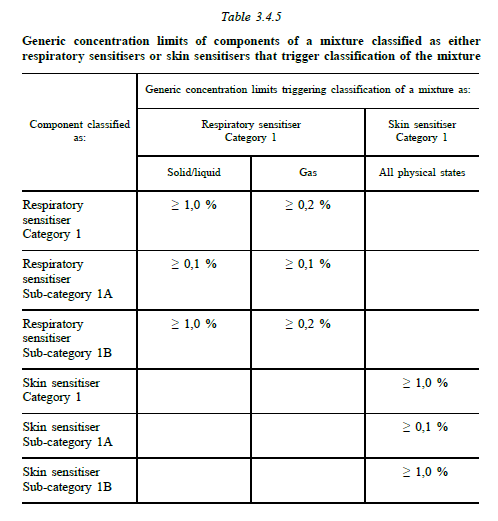 Elicitation 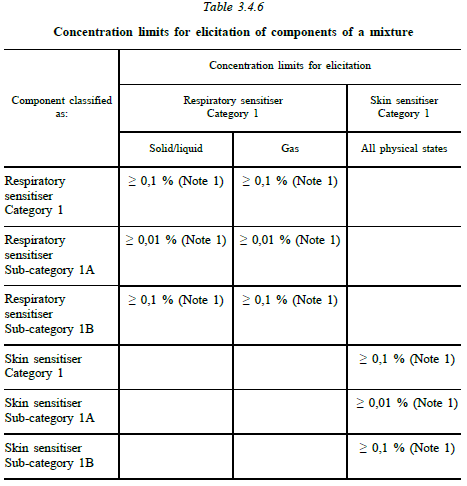 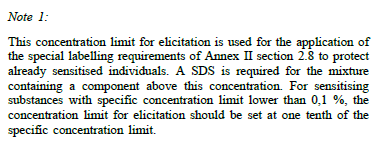
¶ Carcinogenicity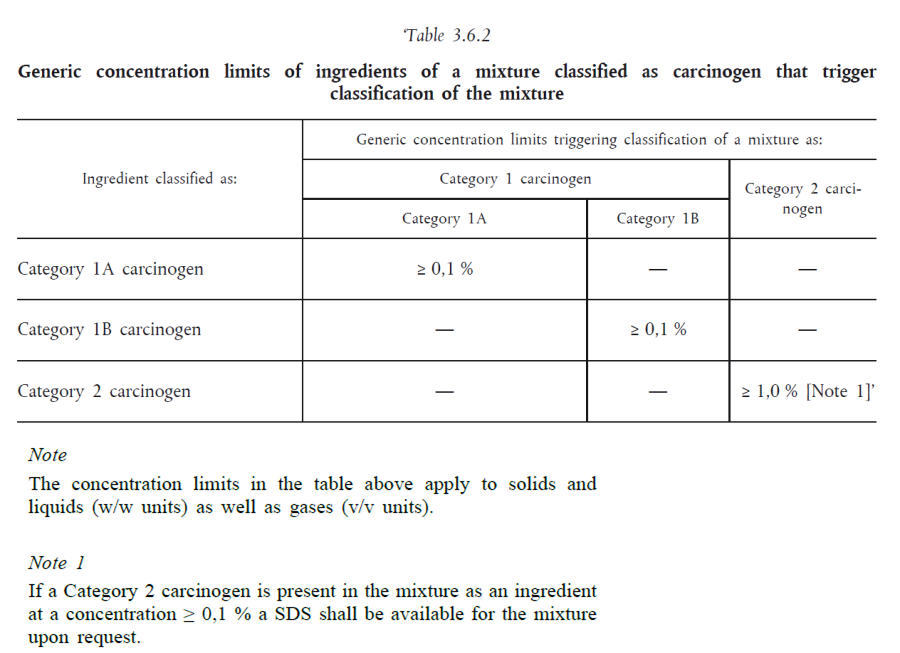 ¶ Reproductive Toxicity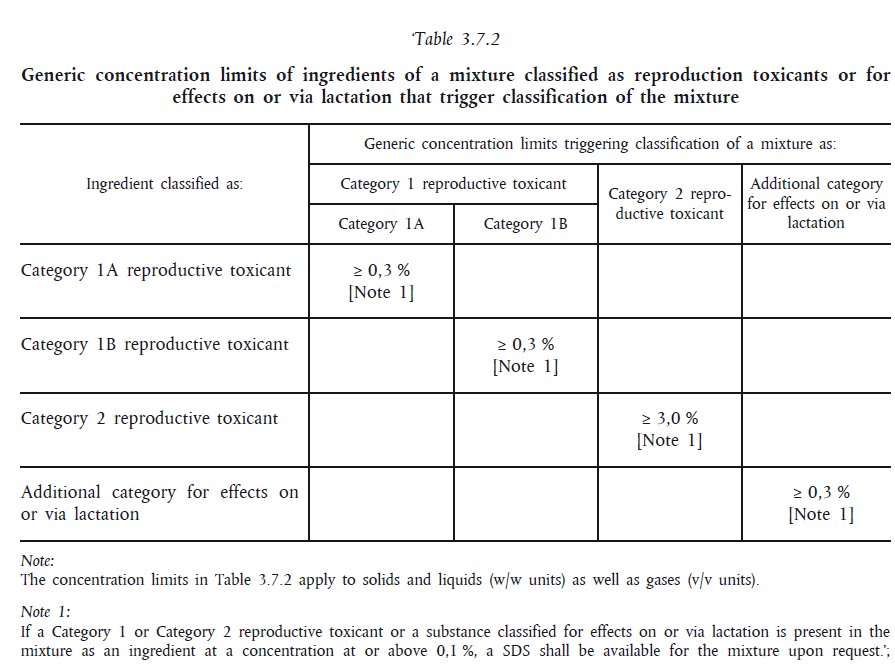
¶ Specific Target Organ Toxicity - Single Exposure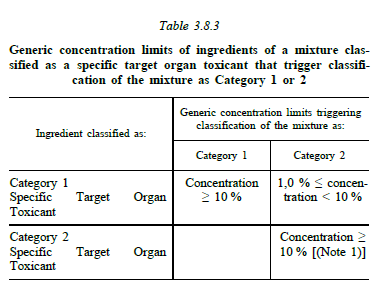 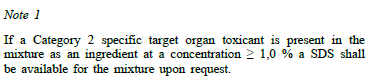
¶ Specific Target Organ Toxicity - Repeated Exposure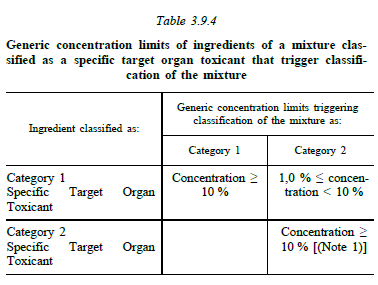 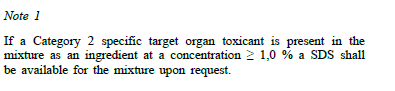
¶ Endocrine Disruptors- Human health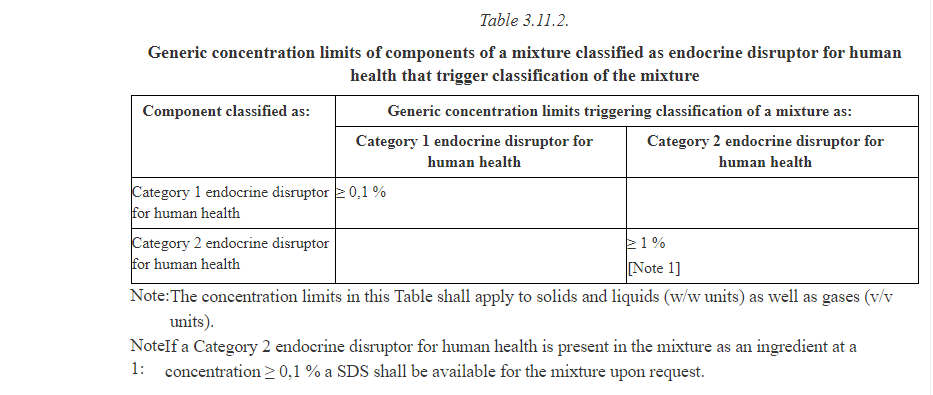
¶ Endocrine Disruptors - Environment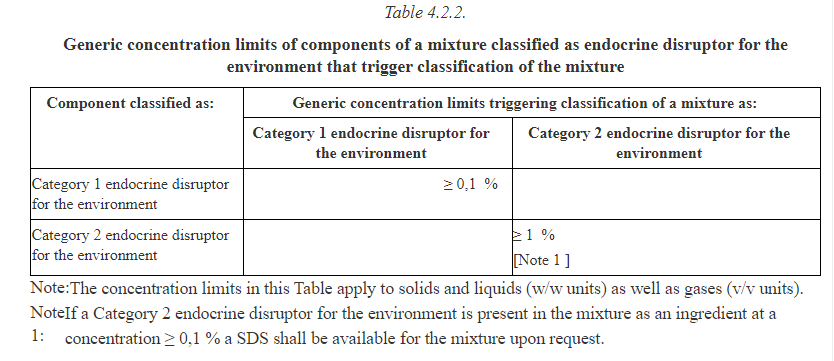
¶ Persistent, Bioaccumulative and Toxic or Very Persistent, Very Bioaccumulative (PBT, vPvB)A mixture shall be classified respectively as a PBT or vPvB when at least one component contained in the mixture has been classified respectively as a PBT or vPvB and is present at or above 0,1 % (weight/weight).
¶ Persistent, Mobile and Toxic (PMT) or Very Persistent, Very Mobile (vPvM)A mixture shall be classified as a PMT or vPvM where at least one of its components has been classified as a PMT or vPvM and is present at or above 0,1 % (weight/weight). |
|
¶ SDSEuropean Union Sections of the SDS The requirements for SDSs in the European Union result from a combination of the responsibilities under the REACH and CLP regulations. 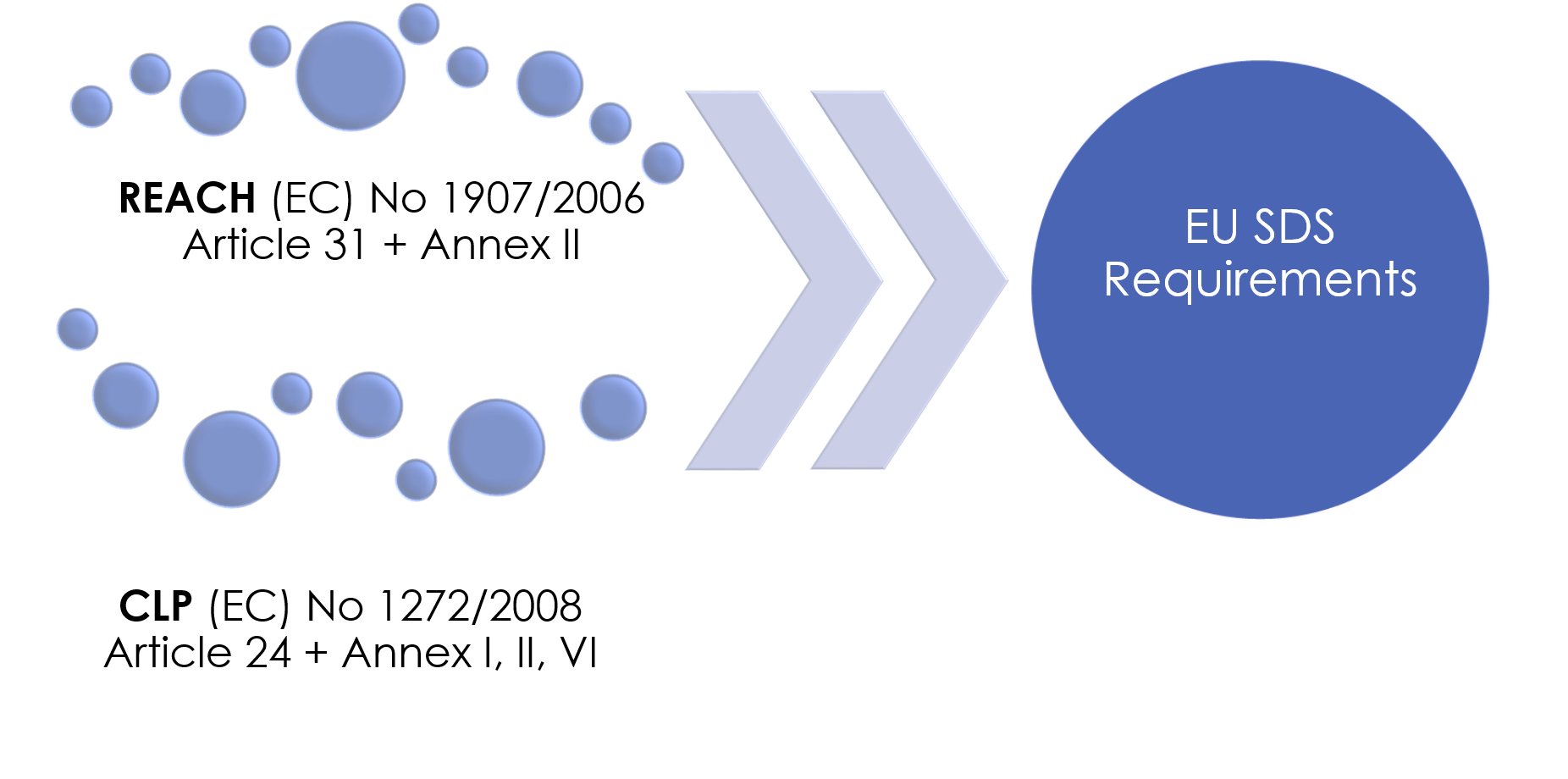
¶ When is an SDS required?Article 31 of the REACH Regulation states that a Safety Data Sheet (SDS) must be provided for a substance or mixture if any of the following three reasons apply:
For skin and respiratory sensitizers, CLP, Table 3.4.6 indicates additional requirements for providing a SDS:
According to REACH, Article 31, a SDS must be supplied if requested by the recipient of the substance or mixture if it contains:
SDS must be updated and re-issued without delay as stated in Article 31(9) of REACH on the following occasions:
An updated SDS must:
¶ What must the SDS include?REACH Annex II prescribes information contained in and the format of the SDS in the EU. The headings, subheadings as specified are required. Further subdivisions are acceptable but not required. REACH Annex II was last amended on June 18, 2020 introducing several changes to the SDS format. These changes came into effect on January 1, 2021. The updated ECHA SDS guidance confirms both new and updated SDSs can continue in old format until 31st December 2022. The SDS must be provided in the official language(s) of the Member State where the substance or mixture is being placed on the market. With regard to the language requirement, ECHA has published a summary of the required languages for Safety Data Sheets in EU Member States.
¶ Extended Safety Data sheet (eSDS)If a Chemical Safety Assessment (CSA) has been carried out as part of the REACH registration, and a Chemical Safety Report (CSR) was generated, then the relevant Exposure Scenarios (ES) shall be placed in an Annex to the SDS of the pure substance. This is known as the extended Safety Data Sheet (eSDS). Exposure scenarios describe how the exposure to a hazardous substances can be controlled during use. For mixtures, relevant information contained in incoming Exposure Scenarios of substances must be reflected in the SDSs of mixtures when available. |
Sources
Resources  |
¶ Label
¶ Labelling and PackagingThe result of a GHS classification is harmonized label elements including pictograms, signal words, hazard statements and precautionary statements. The content of the label is set out in Article 17 of the CLP. Due to the very specific and complex nature of potential requirements related to labels and packaging, please also refer to Titles III and IV and Annexes I and II of the CLP and the various guidance documents. ¶ Hazard PictogramIf several hazard pictograms are required for a hazardous substance or mixture, the precedence rules set out in Article 26 of the CLP should be applied. Transport labelling must appear on the outer packaging of hazardous substances and mixtures if they are “dangerous goods” according to the rules on the transport of dangerous goods. If a transport pictogram appears on a label, a GHS pictogram for the same hazard should not appear. ¶ Hazard StatementsCLP hazard labels must bear the relevant hazard statements, determined by the hazard category with in each hazard class. A full list of hazard statements (H-phrases) associated with the listed hazard codes is available in Annex III to the CLP. The CLP adds additional statements that should be applied when appropriate. These EUH phrases are listed in CLP Annex II with the criteria for their application. Some of examples of the hazard-based phrases are as follows:
In Part 2 of CLP Annex II, there are EUH phrases for mixtures containing certain types of substances, for example, lead, cyanoacrylates and active chlorine. These must also be applied where applicable. EUH phrases are considered part of supplemental label information. ¶ Precautionary StatementsA full list of precautionary statements (P-phrases) associated with the listed precautionary codes is available in Annex VI of the CLP Regulation. According to Article 28 of the CLP, not more than six precautionary statements shall appear on the label unless necessary to reflect the nature and the severity of the hazards. Instructions on how to reduce the number of precautionary statements on the label in compliance with the CLP regulation can be found in the Guidance on Labelling and Packaging in accordance with Regulation (EC) No 1272/2008. ¶ Unique Formular IdentifierThe Unique Formula Identifier, created for the harmonised poison centre submission shall be included on the label in accordance with Annex VIII of the CLP. ¶ LanguageThe label must be provided in the official language(s) of the Member State where the substance or mixture is being placed on the market. Multi-language labels are possible. As of December 1, 2019, the official translation of the chemical names from Table 3 of the CLP are required on the label. ¶ Special Label Requirements for DetergentsIn addition to the labelling obligations set out in the CLP Regulation, the Detergents Regulation (EC) No 648/2004 also requires that certain information be displayed on the packaging of detergent products intended for consumer use, including the product content of certain substance and specific allergenic fragrance ingredients. On March 2, 2026, Regulation (EU) 2026/405 on Detergents and Surfactants was published, repealing Regulation (EC) No 648/2004. This new Regulation will apply from September 23, 2029. Detergents and surfactants placed on the market before September 23, 2029 that comply with the old detergent Regulation (EC) No 648/2004 may continue to be made available without any time limit. Detergents and surfactants placed on the market between September 23, 2029 and September 22, 2030 that comply with the old detergent Regulation (EC) No 648/2004 may continue to be made available until September 23, 2030. |
Sources Resources
Other considerations... Substance/Mixtures subject to Authorisation under REACH “Holders of Authorisations” or Downstream users who have been granted authorisations must include the authorisation number on the label before placing the substance or mixture on the market for an authorized use. Detergents sold to the General Public Pre-defined weight percentage ranges shall be used to indicate the content of certain constituents (listed in Annex VII of the Regulation 648/2004) where they are added in a concentration above 0.2 % by weight. VOC content limit values for Paints and Varnishes The label shall indicate
EU Detergent regulation |
¶ Trade Secrets¶ Alternative Chemical NamesTo avoid disclosing the full composition of a mixture in a safety data sheet, a supplier may request the use of an alternative chemical name for a substance in accordance with CLP Article 24. In this case, 'supplier' may refer to any manufacturer, importer or downstream user or distributor placing a substance or mixture on the market. An alternate chemical name will only be granted where the substance is exclusively classified as the following:
An alternative chemical name will not be granted if there is a Community workplace exposure limit. From June 1, 2015, this process is mandatory in order to use an alternative chemical name on an SDS. Requests for the use of an alternative chemical name have to be created in IUCLID6 and submitted to ECHA through REACH-IT. According to ECHA, a non-EU manufacturer may supply confidential business information directly through REACH-IT to support a submission made by the EU importer. Alternate chemical name requests are subject to a per substance per product fee, which is dependent on the company size and number of mixtures in the request. This fee range is laid out in EU Regulation No 440/2010. |
Sources 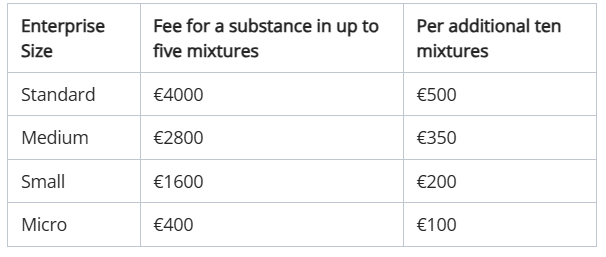 |
¶ Occupational Exposure LimitsThe EU Directive 98/24/EC establishes the workplace Occupational Exposure Limits (OELs), which must be disclosed in the EU SDS. The OELs for the EU Member State where the substance or mixture is placed on the market must also be included in the SDS. As an implementation of Directive 98/24/EC, four lists of indicative occupational exposure limit values have been published. Additionally, Council Directive 98/24/EC on the protection of the health and safety of workers from the risks related to chemical agents at work includes binding biological exposure indices. The occupational exposure limit value and biological limit values are required to be listed in Section 8 of the EU SDS. Another source of information on Occupational Exposure Limits from Member States is the European Agency for Safety and Health at work (EU-OSHA). |
Sources Lists of Indicative Occupational Exposure Values
Resources |
¶ Transport |
|
|
The United Nations Economic Commission for Europe (UNECE) is responsible for the European Agreement Concerning the International Carriage of Dangerous Goods by Road (ADR). The ADR is based on the 20th Revision of the United Nations Recommendations on the Transport of Dangerous Goods. The ADR is directly applicable in signatory countries. The signatory countries ("Contracting Parties") are: 27 European Union Member States Austria, Belgium, Bulgaria, Croatia, Cyprus, Czech Republic, Denmark, Estonia, Finland, France, Germany, Greece, Hungary, Ireland, Italy, Latvia, Lithuania, Luxembourg, Malta, Netherlands, Poland, Portugal, Romania, Slovakia, Slovenia, Spain and Sweden. 3 European Economic Area States Iceland, Liechtenstein, Norway 18 additional European or closely associated states Switzerland Albania, Andorra, Bosnia and Herzegovina, Montenegro Azerbaijan, Belarus, Kazakhstan, the Republic of Moldova, Russian Federation, Serbia, Tajikistan, the former Yugoslav Republic of Macedonia, Ukraine Morocco, Tunisia, Turkey, United Kingdom |
Sources Resources
|