¶ GHS Revision 8 |
¶ Implemented by RussiaThe following template is provided by the Federal State Unitary Enterprise "Russian scientific-research institute for standardization of materials and technologies" and is in agreement with the GOST 30333-2007. |
|
Title Page with Registration Stamp Proof of Safety Passport Registration is displayed |
|
|
Section 1: Identification of the Substance or Mixture and of the Supplier
|
Section 1: Identification of the chemical product and manufacturer or supplier information 1.1. Identification of chemical product 1.1.1. Technical name; 1.2. Information about manufacturer and/or supplier 1.2.1. Full official name of organization; |
|
Section 2: Hazards Identification
|
Section 2: Hazard(s) identification 2.1 Hazards of the product (information about classification of hazard according to the legislation of the Russian Federation (GOST 12.1.007-76) and GHS (GOST 32419-2013, GOST 32423-2013, GOST 32424-2013, GOST 32425-2013) 2.2 Information about precautionary labeling according to GOST 31340-2013 2.2.1. Signal word; Classification in accordance with the Russian Federation legislation GOST 12.1.007-76 and GHS. |
|
Section 3: Composition/Information on Ingredients Substance
Mixture
NOTE: For information on ingredients, the competent authority rules for CBI take priority over the rules for product identification. |
Section 3: Composition (information on components) 3.1 Information about the product as a whole 3.1.1. Chemical name (according to IUPAC); 3.2 Components (name, CAS and ЕС numbers, mass fractions (totaling 100%), MAC (Maximum Available Concentrations) or TSEL (Tentative Safe Exposure Level), hazard classifications and references to the sources of data). Below is Table 1 of the Letter. 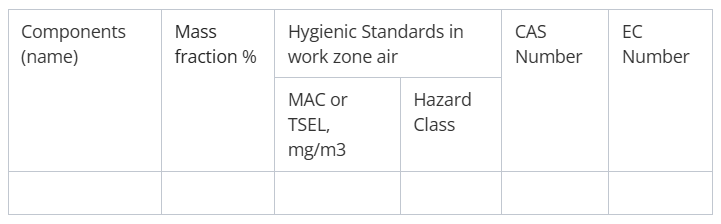
|
|
Section 4: First-Aid Measures
|
Section 4: First-aid measures 4.1 Observed symptoms 4.1.1. If inhaled; 4.2 Measures to provide first aid 4.2.1 If inhaled; |
|
Section 5: Fire-Fighting Measures
|
Section 5: Firefighting measures 5.1. General description of fire and explosion hazards (according to GOST 12.1.044-89); 5.4. Suitable fire extinguishing media; 5.5. Unsuitable fire extinguishing media; |
|
Section 6: Accidental Release Measures
|
Section 6: Accidental release measures 6.1. Measures to prevent harm to people, property and the environment in case of an accident or an emergency 6.1.1. General response to accidents and emergency situations; 6.1.2. Personal Protective Equipment for emergency situations (PPE for first responders). 6.2. Procedures for dealing with accidents and emergencies 6.2.1. Actions in case of leaks and spills (including measures for containment and clean-up, and to ensure protection of the environment); |
|
Section 7: Handling and Storage
|
Section 7: Handling and storage 7.1. Safety measures when handling chemicals 7.1.1. Systems of engineering safety control; 7.2. Requirements for safe storage of chemicals: 7.2.1. Conditions and limits of safe storage (including warranty, period of storage, shelf life, incompatible storage materials and substances); 7.3. Safety measures and recommendations for use and storage in domestic/residential settings. |
|
Section 8: Exposure Controls/Personal Protection
|
Section 8: Exposure controls/personal protection 8.1. Mandatory work zone concentration limits (MAC or TSEL); 8.2. Measures for limiting harmful substance concentration to below MAC or TSEL; 8.3. Personal protective equipment; 8.3.1. General recommendations; See Danger Classes - Occupational Safety Standards System and Occupational Exposure Limits for more information. |
|
Section 9: Physical and Chemical Properties
|
Section 9: Physical and chemical properties 9.1. Physical state (aggregate state, colour, odour); 9.2. Parameters characterizing the basic properties of the product (transition temperatures, pH, solubility, Log Kow (coefficient of n-Octanol/water) and other parameters specific to the type of product). |
|
Section 10: Stability and Reactivity
|
Section 10: Stability and reactivity 10.1. Chemical stability (for unstable products, the degradation products should be indicated); 10.2. Reactivity; 10.3. Conditions to avoid (such as static charge, vibration; include hazards resulting from contact with incompatible substances and materials). |
|
Section 11: Toxicological Information Concise but complete and comprehensible description of the various toxicological effects and available data used to identify those effects including:
|
Section 11: Toxicological information 11.1. General characteristics of exposure (assessment of health hazard (toxicity) and typical symptoms of exposure); 11.2. Routes of exposure (inhalation, ingestion, skin and eye contact); 11.3. Target organs, tissues and biological systems; 11.4. Information on hazard of direct contact with the product, as well as the consequences of such contact for example: irritation of upper respiratory tract, eyes or skin; skin-absorption and sensitizing actions); 11.5. Information on long-term effects of exposure (e.g. reproductive toxicity, carcinogenicity, mutagenicity, cumulative and other chronic effects); 11.6. Acute toxicity data: |
|
Section 12: Ecological Information
|
Section 12: Ecological information 12.1. General description of the effects on the environment (atmospheric air, water, soil, including symptoms of exposure); 12.2. Possible ways of release to the environment; 12.3. Most important characteristics of the environmental impact; 12.3.1. Hygienic standards (allowable concentrations in atmospheric air, water, including fishery waters, soils).
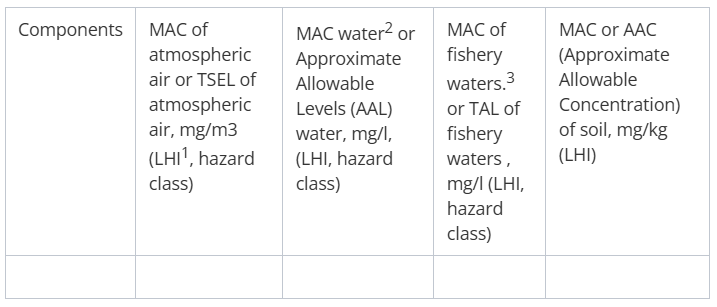 12.3.2. Ecotoxicity data (LC50, EC50, NOEC for fish, Daphnia magna, algae and other); 1 LHI – Limiting Hazard Indicator (токс. – toxicological; с.-т. (сан.-токс.) – sanitary-toxicological; орг. – organoleptic with interpretation of the nature of changes regarding organoleptic properties of water (зап. – changes the smell of the water, мутн. – increases turbidity, окр. – gives color to water, пена – causes foaming, пл. – forms a film on the water surface, привк. – gives the taste to water, оп. – causes opalescence); рефл. – reflexive; рез. – resorptive; рефл.-рез. –reflexive-resorptive; рыбхоз. – fishery (changes in commercial quality of aquatic organisms); общ. –general-sanitary). 2 - Water of water bodies for drinking and household uses; |
|
Section 13: Disposal Considerations Description of waste residues and information on their safe handling and methods of disposal, including the disposal of any contaminated packaging |
Section 13: Disposal considerations 13.1. Safety precautions when handling waste arising from use, storage and transportation; 13.2. Information about the places and methods of decontamination, recycling or disposal of waste, including packaging material; 13.3. Recommendations regarding removal of waste generated when products are used in household applications. |
|
Section 14: Transport Information
|
Section 14: Transport information 14.1. UN Number (according to the UN Recommendations on the Transport of Dangerous Goods); 14.2. Proper shipping name; 14.3. Appropriate transportation methods; 14.4. Classification of dangerous goods according to GOST 19433-88:
14.5. Classification of dangerous goods according to the UN Recommendations on the Transport of Dangerous Goods:
14.6. Transport labeling (symbols according to GOST 14192-96); 14.7. Emergency cards (for transportation by rail, sea and other ways). |
|
Section 15: Regulatory Information Safety, health and environmental regulations specific for the product in question |
Section 15: Information on national and international legislation 15.1. National legislation 15.1.1. Laws of the Russian Federation; 15.2. International conventions and agreements (e.g. whether the product is regulated by the Montreal Protocol, the Stockholm Convention and others). |
|
Section 16: Other Information Other information including information on preparation and revision of SDS |
Section 16: Additional information 16.1. Safety Passport Revision Information (for example, "First issue" or "SP has been reissued due to expiration of the original SP. The prior SP No… ." or "Changes have been made to the following sections… revision date..."); 16.2. List of sources used in creating SP (should also be referenced in appropriate sections above as footnote symbols). |
- On November 26, 2014 Federal Agency on Technical Regulating and Metrology has issued standard R 50.1.102-2014 "Preparing Safety passports for chemical products" explaining requirements of GOST 30333-2007 with numerous examples. link: http://meganorm.ru/Index2/1/4293764/4293764627.htm
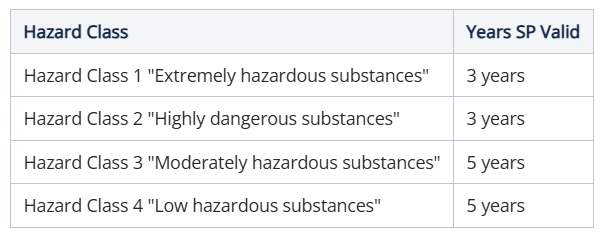
- The Russian Safety Passport is valid for 3 or 5 years, depending on the hazard class, according to the GOST 12.1.007-76: