¶ Recent Updates
|
|
¶ Background |
|
|
The Russian Federation (RF) came into existence after the breakup of the Soviet Union in December 1991. Russia had to reform its political system after nearly seventy-five years of Soviet rule. After the constitutional crisis of 1993, Russia adopted a new constitution in a referendum so that presently the fundamental law in the Russian Federation is the Constitution of the Russian Federation. The RF is now a federal, semi-presidential republic, comprised of 85 federal constitutional entities of 6 types with equal federal rights. The present system of government is a mixed presidential and parliamentary regime. The President, who is elected during a general election for a term of six years, is the Head of State. The President appoints the Prime Minister, regional governors, members of the Government and has control over the legislature, federal judges, justices of the Supreme and Constitutional Courts, Chairman of the Central Bank, and the Prosecutor General. The legislature – the Federal Assembly– is a permanently working body and consists of two separate chambers, the State Duma and the Federation Council. Russia belongs to the continental legal system. A written law, which was passed under the established legislative procedure, is the main legal source. About 10,000 laws, regulations, and other legal acts are passed in Russia annually. Federal Constitutional Laws form the group of the most important legislative acts. Statutes, which can be adopted only through the legislative process, are the dominant legal source in Russia. Decrees and directives of the Russian President establish a separate category of legal acts and do belong to category of subordinate legislation (sub-laws). These laws cannot contradict the Constitution and Federal laws. Universally acknowledged principles and standards of international law and international treaties of the Russian Federation are also a part of Russia's legal system. The laws of the Soviet Union are being reformed and replaced by the Russian Federation. Those that remain have a transitional function; where Russian Federation laws do not cover a legal area, Soviet Union laws and regulations are applicable. On November 1, 2013, "Basis of the state politics in area of ensuring of chemical and biological safety of the Russian Federation until 2025 and further perspectives" No.2573 was adopted. Customs Union - principal force of the Eurasian Economic Community (established in 2000 and existed till 2014) and now succeeded by the Eurasian Economic Union, came into existence on January 1, 2010. The founding states along Russia were Belarus and Kazakhstan. Armenia joined on January 2, 2015 and Kyrgyzstan joined on August 6, 2015. The Treaty about establishment of Eurasian Economic Union was signed on May 29, 2014. The Russian Federation became a member of Eurasian Economic Union on January 1, 2015, along with other members - Belarus (member from January 1, 2015), Kazakhstan (member from January 1, 2015), Armenia (member from January 2, 2015) and Kyrgyzstan (member from August 12, 2015). The Gazette, "Rossiyskaya Gazeta" was founded by the Government of the Russian Federation, and its first issue appeared on November 11, 1990. Documents published in the newspaper include federal constitutional laws, federal laws and codes, decrees of the President of the Russian Federation, resolutions and acts of the Government of the Russian Federation. The Gazette is available online: http://www.rg.ru/.The laws, regulations and other legal documents are published on the official internet-portal for legal information in Russia: http://www.pravo.gov.ru/ |
|
¶ Inventories |
|
|
A number of attempts to create an inventory of chemical substances in the country has been made in the past. However, none of them produced a functioning inventory or procedures to maintain it. With the introduction of the Technical Regulation 041/2017 by the Eurasian Economic Union (TR EAEU 041/2017) the process of inventory formation got a fresh start.
¶ Registry of Chemical Substances in the EAEUOne of the goals of the TR 041/2017 is formation of a union-wide inventory of chemical substances. Preliminary steps in this process include development of national inventories in each country-member of the EAEU. As of February 2021 those countries are: Armenia, Belarus, Kakakhstan, Kyrgyzstan, and Russia. In Russia, information-gathering activities started in late 2019. A government agency in charge of the process is the Ministry of Industry and Trade (Minpromtorg). A separate entity is assigned to help industry to comply with the requirements of the inventorying process - CIS Center. Any company doing business and located in Russia must notify the Ministry on substances it produces or imports and their respective volume. Instructions on the notification process and required information on substances are given on the CIS Center website. To aid organizations in compiling their own inventories, the CIS Center created a starter inventory with information on substances it contains. However, finding a chemical in this database did not eliminate the requirement for companies to notify on their own use of such chemical. The Ministry planned to complete the information gathering on all chemicals presently manufactured in and imported into Russia by the end of 2019. However, the deadline was extended to May 1, 2020, and then again to August 1, 2020. In June 2020 an interim inventory was published by the Ministry of Industry and Trade. At the time of publication it contained approximately 54,000 chemicals searchable by names, CAS and EC numbers. Even though every organization was still encouraged to notify the ministry on their own volume and use of chemicals, the publication allowed companies to focus on chemicals that were not yet published in the inventory. In December 2020 the Ministry of Industry and Trade announced completion of the inventory of chemical substances. It presently contains approximately 80,000 chemicals that can be searched via the portal. At this moment no substances can be added to the inventory as procedures for notification of new substances are still in a draft stage. In the future this national inventory is intended for inclusion into the inventory of chemical substances of the Eurasian Economic Community.
¶ Russian Register of Potentially Hazardous Chemical and Biological SubstancesA previous attempt to create an inventory was the Russian Register of Potentially Hazardous Chemical and Biological Substances (RRPHCBS), an institution created by the Russian Agency on Protection of Consumers' Rights (Rospotrebnadzor). It maintains a database of many substances produced in and imported into Russia. However, for the past several years the requirement to notify new substances to RRPHCBS has been removed. The registry still maintains the information on the substances it contains, and the industry is encouraged to use that information in SDS and classification of chemicals. It has also been proposed that this registry will be absorbed into the new national inventory that is presently being developed.
¶ Legislative BackgroundIn the last quarter of 1992 the Government of the Russian Federation decreed the state registration of chemical and biological substances that are potentially dangerous to human health and the environment. In addition, they mandated a uniform system for the Russian Federation - the Russian Register of Potentially Hazardous Chemical and Biological Substances. The Governmental Decree on the State Registration of Potentially Hazardous Chemical and Biological Substances No. 869 of November 12, 1992 was later replaced by the Russian Federation Decree of July 20, 2013 No. 609 "Introducing a federal register of potentially hazardous chemical and biological substances, changes and repeal of certain acts of the Government of the Russian Federation." This decree describes the current legal status of the Register, its goals, and principles of operation. The Technical Regulation "On Safety of Chemical Products", introduced by the Government Decree 1019, also mentioned the government registry of chemical substances and requirements to notify any new substance. Since the introduction of the Technical Regulation by the EAEU, the Russian Technical Regulation "On Safety of Chemical Products" has been withdrawn before entering into force. It was done by the Government Decree 761 on June 14, 2019.
¶ RRPHCBS ActivitiesFederal Budgetary Organization for Public Health - Russian Register of Potentially Hazardous Chemical and Biological Substances conducts the following activities: 1) collecting and analyzing the information about the potentially dangerous chemical and biological substances circulating in the territory of the Russian Federation and ensuring availability of this data for the government and general public; 2) ensuring inclusion of latest and reliable data on toxicity and hazards to human health and the environment; 3) maintaining and expanding the Federal register of potentially hazardous chemical and biological substances; 4) conducting research in the field of preventive toxicology, hygiene and chemical safety, according to the plan for the research-scientific works, approved by official documents; 5) interacting with other databases on chemical and biological substances of the Russian Federation and other countries, as well as with international organizations, participating in international efforts on assessment of potentially dangerous chemical and biological substances; 6) providing training to specialists at governmental and related institutions on using the databases of potentially dangerous chemical and biological substances, as well as on issues related to the registration of potentially dangerous chemical and biological substances; 7) providing scientific-methodological assistance to organizations in the area of monitoring and prevention of exposure to dangerous and socially significant chemicals involved in investigations of mass non-infectious diseases (poisonings); 8) participation in the development, formulation and implementation of regional and Federal programs on sanitary protection, chemical safety, emergency responses in situations caused by highly dangerous and socially significant toxic substances; 9) performing other functions according to the principles of international exchange of information on chemicals in international trade.
¶ Searching the Registered SubstancesOn the website of RRPHCBS, there is a section titled "Registered substances," which contains information regarding hazardous substances that have passed the State registration. Substances can be searched by one of several identifiers, such as CAS number, chemical name, trade name, etc. Basic information on substances is available free of charge, such as physical/chemical properties and references to toxicological/environmental research. Complete information on substances is available to registered users for a fee (20,000 Rubles annually or ~ USD 336) through an Automated Search System "Hazardous substances". Automated Search System "Hazardous substances" includes:
Two specific groups of substances within the database are separately noted:
The "Hazardous substances" system is a continuously updating electronic database. It contains information on more than 10,500 compounds, including the ones which have undergone the State registration in the Rospotrebnadzor system. Since October 28, 2009 the database has been registered as a National database with the registration number 2009620521.
¶ Other RegistersOther registers made available on the Rospotrebnadzor homepage are:
|
Definitions
Sources
Resources
*Not available in English |
¶ Registrations |
|
¶ Timeline of registration legislation and related obligationsNote: Sources not available in English
¶ 1992-1993
¶ 1995
¶ 1999
¶ 2000
¶ 2004-2005
¶ 2007-2009
¶ 2010
¶ 2013
¶ 2014-2015
¶ 2016
¶ 2019
¶ 2020
|
|
¶ State Registration¶ BackgroundState Registration is required by a combination of:
Following requirements of these regulations along with the Federal Law "On environmental protection" the Ministry of the Environment of the Russian Federation issued an instruction No.37-2-7/435, 01-19/22-22 "On the order of state registration of potentially dangerous chemical and biological substances" on May 25, 1993. This instruction describes registration procedure for chemical and biological substances. It entered into force on the day of its publication on July 1, 1993 in issue No. 124 of "Russian News" (Российские вести). According to the Instruction, a potentially dangerous chemical and/or biological substance is considered to be an individual substance (compound) of natural or synthetic origin that is capable of creating adverse effects on human health and the environment during its production, use (including household use), transportation, and processing. The state registration is required for all individual chemical and biological substances (compounds) of natural and artificial origin, including those in mixtures, which are manufactured, imported, and/or used in the territory of the Russian Federation. Substances that have impurities in their composition, formed during production and use, are registered as individual substances.
¶ When is registration required?According to Article 43 of the Russian Federation Law No. 52-FZ, the state registration is required for:
The state registration is not required for:
State registration is aimed at the following goals:
¶ How to registerChemical and biological substances that are presently absent from the state register, must be registered prior to the start of their production. The registration process consists of:
Documentation to be submitted for registration should contain:
The decision on registration is based on the information provided by an applicant. The applicant is responsible for the correctness of the data. ¶ Receiving a Registration Certificate
¶ Provisional Registration CertificateTemporary registrations (valid for 3 years) will be issued for substances for which there is incomplete information at the time of registration, but for which the properties and scope of usage indicate insignificant hazard. A provisional certificate of registration and state registration number will be issued in the case of a temporary registration. Completeness of the application is determined in each case by specialists of the Register in accordance with the existing regulatory guidance documents. If the applicant does not gather and submit the missing data within the three year period, the provisional certificate of registration expires.
¶ Registration CertificateAssigning a number of state registration and the issuance of a Registration Certificate (Annex 2 of the Instruction) is based on the expert conclusion of the specialists of the Register and approval by the Director of the Register. Required documents will be reviewed within 30 days. Once a registration number is assigned, the Register issues a certificate on state registration in accordance with the form in Annex 2 of the Instruction, and the information card according to the form in Annex 3. Information about the registration is published in the newsletter of the Register. The certificate of registration may be suspended by the Register at any time if new information on hazardous properties of the substance becomes available. The new information could also cause the substance to be banned. An applicant would be notified within 10 days of the decision and it would be published in the newsletter of the Register. The Register guarantees the confidentiality of information about the substance that is a commercial secret, if it does not endanger the health and safety of the environment. An appeal against a decision of the Register shall be submitted no later than 30 days from the date of decision. The appeal will be reviewed within 30 days. Production, import or use of non-registered substances is prohibited. Each substance needs to be registered only once and the registration costs are borne by the first registrant only.
|
Sources
Resources *Not available in English |
¶ Unified ListNote: The Customs Union is presently comprised of the Russian Federation, the Kazakhstan Republic, the Belorussian Republic, the Republic of Kyrgyzstan, and the Republic of Armenia Registration of products must be performed in accordance with the Customs Union Agreement on Sanitary Measures, the Russian Federation Resolution No. 322 "On the approval of the Federal Service for Surveillance on Consumer Rights Protection and Human Wellbeing" on June 30, 2004 (last amended on April 24, 2018) and Treaty on the Eurasian Economic Union. Under Russia's current legislation, the registration of certain products is performed in order to identify the properties of products that pose a threat to human life and health and prevent such products from circulating in the country. The Customs Union Commission Decision "On the application of sanitary measures in the Customs Union" on May 28, 2010 No. 299 approved:
The Unified list identifies which products must be registered. State registration of a product results in a document certifying that the products or the goods have passed the State registration and comply with the hygienic standards and sanitary rules. The registration is valid across the Customs Union and its requirements are obligatory for the executive authorities of Eurasian Economic Union members, as well as for business organizations and individuals. The Unified List of goods which are subject to sanitary-epidemiological supervision (control) at the customs border and the customs territory of the Customs Union includes 3 groups of products: ¶ Group 1 - Goods subject to sanitary-epidemiological supervision (control):It is not required to provide any documents at control points for the types of products listed in this group. Also, the stamp 'Import allowed' is not required. However, for this list, a voluntary certificate with no expiration can be obtained, the 'Expert conclusion of Rospotrebnadzor'. Customs authorities may request this measure, if there is a reason to doubt the quality of imported goods into the territory of the Russian Federation. In practice, it is a question of reputation; most large companies are asking their suppliers to provide an 'Expert conclusion of Rospotrebnadzor.' After applying, the "conclusion"/certificate could take about 2-3 weeks. Group 1 includes:
¶ Group 2 - Products subject to State registration:Registration is required for this group of products and the certificate of registration is needed at control points. Subject to the State registration are those products, referred to in the drop-down list below, included in corresponding groups of the customs codes and produced in the territory of the Customs Union for the first time, as well as products imported into the Customs Union territory for the first time. Group 2 includes:
State registration of products is the only way to register goods produced in the territory of the Customs Union. This registration is required for manufacturing, storage, transport and sale of products. Registration of manufacturing is a lengthier process than registration of foreign-produced goods, in part because compliance with national hygienic and sanitary standards is examined. After the compliance has been ascertained, the product is recorded in the register and the Certificate of the State registration is issued. The manufacturer or Russian importer can apply for the Certificate. It is more advantageous to make the Certificate in the name of the manufacturer, since the Certificate does not expire and can be used by other importers. The registration process takes about 5-7 days for consumer goods and 1 month for industrial chemical products. For the purposes of this group, the Russian Customs tariff code and the name of the goods are also required. Raw materials and active ingredients intended by the manufacturer exclusively for the production of perfume-cosmetic products, household chemicals, crop protection agents, disinfectants, dis-insectants, dis-infestation products, as well as raw materials for the pharmaceutical industry are not subject to the State registration. The import and circulation of Group 2 products (goods), must be accompanied by a document confirming their safety in accordance with paragraphs 17 and 30 of the “Regulations on the procedure of state sanitary and epidemiological supervision (control) over individuals and transport vehicles, crossing the customs border of the Eurasian Economic Union, controlled products (goods), moved through the customs border of the Eurasian Economic Union and the customs territory of the Eurasian Economic Union.” According to paragraphs 17 and 30 of the Regulations:
With the Decree of Federal Service for Surveillance on Consumer Rights Protection and Human Wellbeing No. 290 on July 20, 2010 "On state registration of products by territorial bodies" (last amended on September 19, 2011), the territorial organizations of Rospotrebnadzor are presently in charge of work related to the State registration of the products.
¶ Documentation that needs to be submitted for the State registration (to Rospotrebnadzor)1) The applicant is responsible for the authenticity of documents submitted for the purpose of issuing a document certifying the safety of products (goods); 2) Translations of the documents that the manufacturer submits in foreign languages must be certified in accordance with the legislation of a member state where the State registration is conducted. For controlled goods manufactured in the territory of the Customs Union:
For controlled goods manufactured outside of the Customs Union:
The application form is available on the website.
¶ Changes to the Certificate of State RegistrationThe Certificate of the state registration of products (goods) should be reissued without additional or repeated tests in the following cases:
Applications to amend the Certificate of state registration must be submitted using the same application form with the additional note "Amendments to the certificate". When changes are made to the Certificate of state registration, the Certificate is reissued by assigning numbers and dates corresponding to the time of reissue. Changes to the Certificate of the state registration must be submitted within 30 days of the application's submission. After amending the Certificate, the previously issued Certificate of the state registration shall be returned to the Rospotrebnadzor. If there is a change in production location, the certificate does not need to be renewed. The basis for the assigning Group II or Group III of controlled goods for import and circulation in the customs territory of the Customs Union is the information contained in the vehicle (transport) and/or commercial documents or in the letter of the manufacturer of products.
¶ Charges for state registration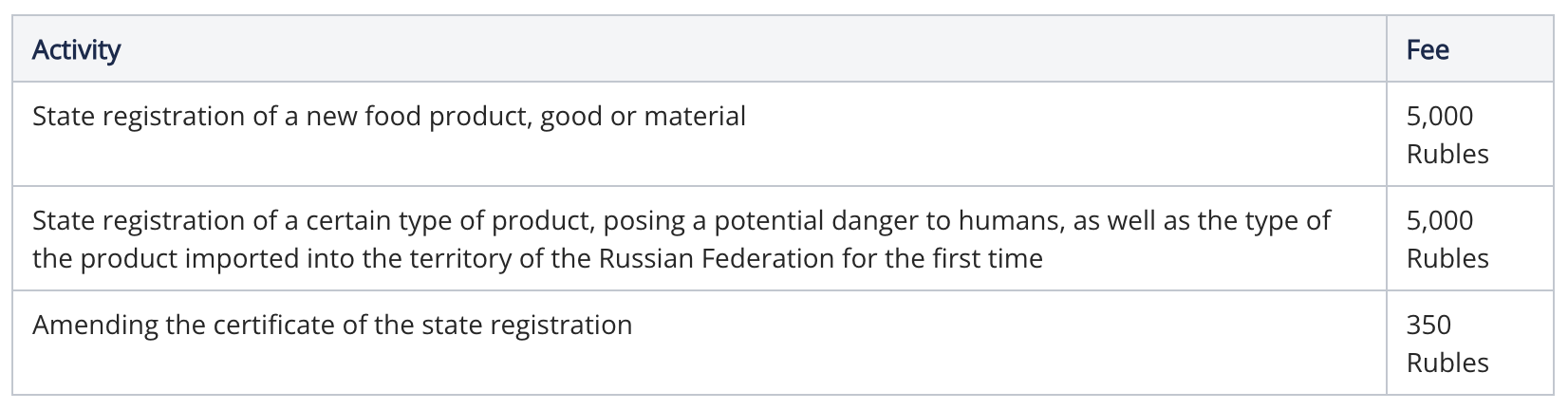 The payment for state registration should be done according to the form online (first document)
¶ Group 3 - Goods that do not require submission of evidence on state registration, regardless of the tariff code, in accordance with the List of goods subject to State registration:Group 3 includes:
|
Sources
Resources
*Not available in English |
¶ Technical regulations of the Customs Union (CU) and Eurasian Economic Union (EAEU)Products subject to technical regulations may need to undergo a certification by an authorized entity or registration with the government. Examples of Technical Regulations that may require product registration include: 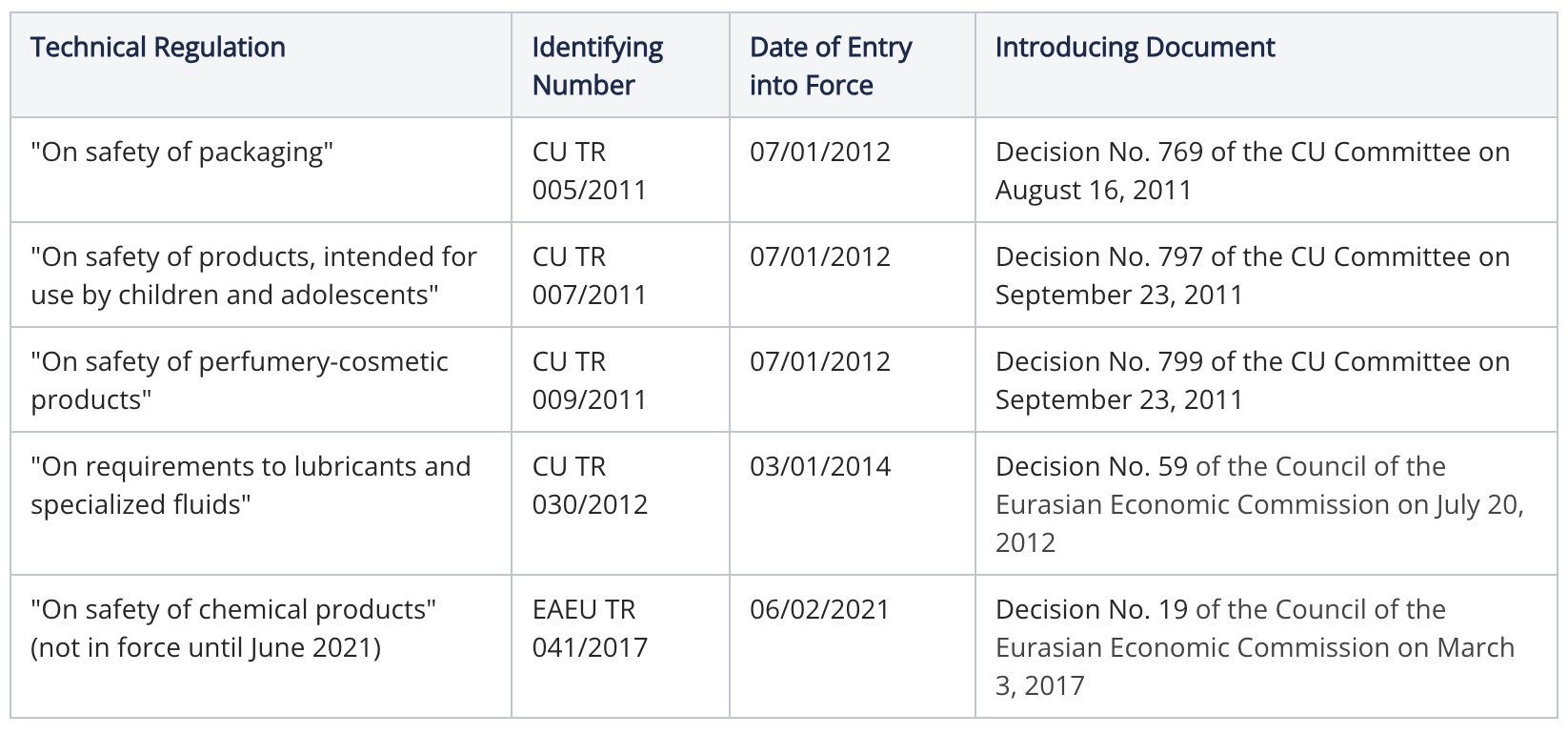 Please note that as of 2016, all technical regulations are introduced by the Eurasian Economic Union (EAEU) instead of the Customs Union (CU). EAEU is a parent organization of the CU. In addition, Decision of the Customs Union Commission No. 299 lists products that are subject to sanitary control and require government registration and/or certification of conformity. Additional decisions specify application forms and steps that need to be taken in order to register a product. The list is periodically updated, the most recent update was issued on May 10, 2018. A number of certification schemes has been introduced by the Eurasian Economic Union. For some schemes documentation provided by a product manufacturer is sufficient, while other schemes require extensive testing of products by a third party lab and sometimes inspection of a whole manufacturing process. Each technical regulation specifies the certification scheme applicable to products in the scope of that regulation. Certification schemes are described in Decision No. 621 of the Customs Union Commission issued on April 7, 2011. A complete list of active Technical Regulations is available on the CU website.
|
Sources
Resources
*Resource not available in English |
¶ Declaration of ConformityThe Russian Federation Governmental Decree No. 942 previously specified the form to be used to declare conformity for products placed on the Russian market for the first time, included in the Unified list of products. However, this Decree was repealed by Resolution of the Russian Federation No. 1419, when Federal law No. 160-FZ came into force. Resolution No. 982 "On approval of the single list of products subject to mandatory certification, and a common list of products, conformity of which is established by acceptance of the declaration of conformity" remains in force. Resolution No. 982 contains two lists of products subject to declaration of conformity: a list of products subject to mandatory certification and a list of products requiring a declaration of conformity. All agricultural and food products that are on the list require a declaration of conformity. The appearance of the declaration of conformity that is placed on the label is discussed in the hazard communication section.
|
Sources
*Not available in English |
¶ Notifications |
|
¶ National inventory of chemicals as a part of the EAEU chemical registryIn October 2019, Ministry of Industry and Trade began accepting notifications of chemicals manufactured in and imported into Russia. This is the first step in developing a national inventory as required by the Technical Regulation of the Eurasian Economic Union TR EAEU 041/2017 "On Safety of Chemical Products." The notification is required for and can only be done by organizations maintaining physical presence (offices, manufacturing facilities, etc.) on the territory of the Russian Federation. Foreign manufacturers selling products to customers in Russia can do notification only through a designated representative within Russia. The initial deadline of December 31, 2019 for submitting notifications was postponed until May 1, 2020 and then again until August 1, 2020. After completion of the initial phase any substances not present on the inventory will need to undergo a more complex process of notification and hazard assessment. Exact procedures of such future notification are not yet finalized, but a draft has been proposed. Drafts of these documents related to notification and inventory formation have been published on legal portal of the EAEU. In June 2020 an interim inventory was published by the Ministry of Industry and Trade. It contains approximately 54,000 chemicals and is searchable by names, CAS and EC numbers. Even though every organization is still encouraged to notify the ministry on their own volume and use of chemicals, the publication allows companies to focus on chemicals that are not yet published in the inventory. In December 2020 the Ministry of Industry and Trade announced that the initial notification process of chemicals was completed. The inventory has been posted on the Ministry website. As of January 2021 it contains approximately 80,000 substances that can be searched by names and identifiers CAS and EC numbers. Although there has not been an official announcement regarding future notification process, it is reasonable to expect that from now on any notifications will require significantly more information about chemical substances than during the initial process.
¶ Ecological ExpertiseFor new chemicals, a conclusion on their ecological safety must be issued in accordance with the Federal Law No. 174-FZ of November 23, 1995 "On ecological expertise" Article 11 Item 5. The organization responsible for ecological expertise is The Federal Supervisory Natural Resources Management Service (Rosprirodnadzor). This agency works under the umbrella of the Ministry of Natural Resources and Environment of the Russian Federation. According to Federal Law No. 174-FZ, Article 14, the documents to be submitted for ecological expertise are:
According to this Federal law, Article 14, Item 2, the ecological expertise is performed after prepayment of fees by the entity requesting the expertise. The fee is determined by the Federal agency in charge of the ecological expertise. Conclusion on ecological expertise is issued according to Article 18 of the Federal Law. According to Article 14, Item 3, the ecological expertise begins no later than 15 days after receipt of payment and submission of the complete package of required documentation. In certain cases, described in items 7.1 and 7.3 of Article 11 and item 4.1 of Article 12, the expertise shall begin in 3 days. The state ecological expertise should be completed in three months. This time period can be extended by one month at the request of the customer.
|
Sources
Resources
*Not available in English |
¶ Notifying to the Russian Register of Potentially Hazardous Chemical and Biological SubstancesIn addition to product registration, the following information on a new chemical substances used in a product may be submitted to the Russian Register of Potentially Hazardous Chemical and Biological Substances. However, it is presently not mandatory, since regulations requiring such notification are no longer in force, including the Government Decree No. 1019 "On technical regulations on safety of chemical products":
|
Sources
*Not available in English |
¶ Restrictions and Bans |
|
|
The Russian Federation participates in many international treaties, such as the Stockholm Convention on persistent organic pollutants, the Montreal protocol on ozone depleting substances, and others. The government agency in charge of technical work related to ratification of environment-oriented international treaties is the Ministry of Natural Resources and Environment. The Ministry describes its work and the status of many treaties on its page "International Cooperation."
¶ Restrictions in the Customs UnionBeing a part of the Customs Union along with Armenia, Belarus, Kazakhstan and Kyrgyzstan, Russia follows restrictions and bans on import and export established by the legislation of the Customs Union. A comprehensive list of restricted substances and goods was approved by the Eurasian Economic Commission in 2012 and last amended in 2013. The regulation is published on Eurasian Economic Commission web site. Relevant groups include the following:
|
Sources
*Not available in English |
¶ Ozone Depleting SubstancesThe Russian Federation is a party to the United Nations Montreal Protocol on Ozone Depleting Substances, and has therefore adopted regulations for the control and reduction of ozone depleting substances. The main regulation is the Government Decree No. 228 issued on March 24, 2014 "On measures of government regulation of use and circulation of ozone depleting substances." It lists procedures for accounting the substances at all stages of their circulation: manufacturing, storage, use, recycling, and incineration. The document also provides the list of substances subject to the regulation. The list includes all substances appearing in the UN Montreal protocol, except those in the Annex F. The substances from the Annex F were added to the regulation in 2020 by the Government Decree N 333 issued on March 25, 2020. The regulation enters into force on January 1, 2021. In addition to the National legislation, Russia follows regulations established by the Customs Union. The countries participating in the Eurasian Economic Community agreed to certain control measures when transporting ozone depleting substances between the countries and in trade with the third parties. The rules are described in the Customs Union Agreement "On movement of ozone depleting substances within the Eurasian Economic Community." They mostly deal with accounting and informing of quantities of the substances. A separate decision of the Eurasian Economic Commission lists procedures for import and export of ozone depleting substances as well as substances for which import and export is prohibited. The regulation can be accessed on the Eurasian Commission website (Customs Union Decision N 99). Specific substances and products containing those substances are also included in the single list of goods subject to prohibitions or restrictions on import or export by the Customs Union member states (chapters 1.1 and 2.1).
|
Sources
*Not available in English |
¶ Persistent Organic Pollutants (POPs)The Russian Federation ratified the Stockholm Convention on Persistent Organic Pollutants in 2011 by introduction of the Federal Law No. 164-FZ "On Ratification of Stockholm Convention on Persistent Organic Pollutants." This ratification applies only to the original list of substances included in the 2009 publication of the convention. The law also specifies that any amendments to the annexes A, B or C will become applicable to the Russian Federation only after ratification of such amendments. In 2014, Government Decree N 720 (issued on July 30, 2014) assigned certain jurisdictions related to Russia's obligations from the Stockholm Convention to a number of government agencies. It also stipulated establishing a "Coordination Center of the Russian Federation" tasked with coordination of efforts on reducing POPs in Russia. In September 2016, the Ministry of Natural Resources and Environment advised the government to ratify amendments to the Convention annexes issued by 2013. In September 2017, the Ministry of Natural Resources and Environment assigned the Novosibirsk Institute of Organic Chemistry as "Coordination Center of the Russian Federation" for work related to Stockholm Convention. The institute is planning to coordinate the relevant work within Russia, communicate on behalf of Russia with the Convention and the UN as well as share expertise and technologies with other countries.
|
Sources
Resources
*Not available in English
|
¶ Restriction of Hazardous Substances (RoHS)Russia's equivalent to the RoHS Directive exists at the level of Eurasian Economic Union legislation. Technical Regulation of the EAEU 037/2016 "On restriction of hazardous substances in electronics" was introduced in August 2016 and came into effect March 1, 2018. The regulation was modeled after the EU RoHS 2 Directive (2011/65/EU) and is aimed at improving trade between countries of the Customs Union and the European Union. The regulation limits content of certain elements and compounds in electronics, household appliances and certain industrial products. The substances and their limits are listed in the Annex 2 of the Technical Regulation and follow that of Annex II of 2011/65/EU: 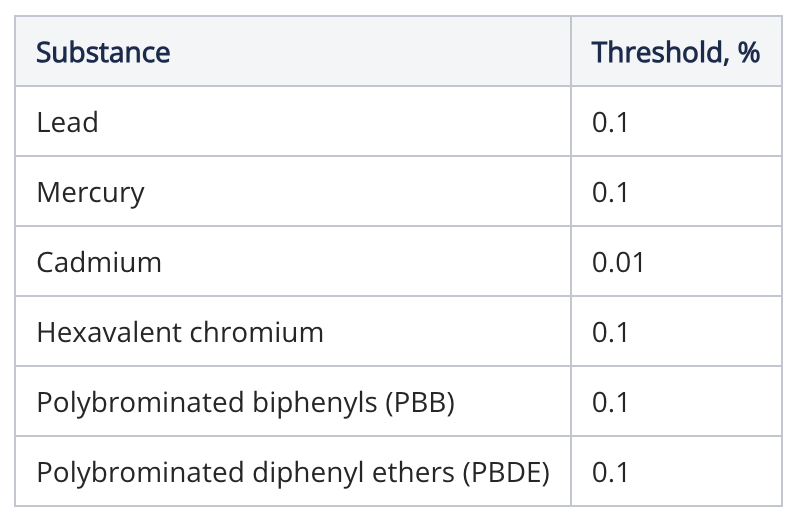 Products and devices covered by the restrictions are listed in the Annex 1 of the regulation. The list is more detailed and contains more specific descriptions of products than those in the corresponding Annex I of the EU Directive. Annex 3 of the Technical Regulation, describing specific exemptions to the requirements is largely similar to the corresponding Annex III of the EU Directive. However, few additional items are introduced and time limits for most of items are not established.
|
Sources
*Not available in English |
¶ SDS + Label |
|
|
When a product's hazards are classified according to the GHS or another system, the result is communicated via a Safety Data Sheet (SDS) and a label. Along with the training that facilitates their understanding, these are the basic elements of hazard communication. Multiple standards exist in Russia regarding Hazard Communication, covering SDSs, labelling and classification of chemical substances, mixtures, and provisions for pesticides. These standards are GOST standards, which were developed by the government of the former Soviet Union. The word GOST (Russian: ГОСТ) is an acronym for gosudarstvennyy standart (Russian: государственный стандарт), which means state standard. Presently GOSTs are considered international standards. As such they are effective in a number or countries. The list of countries adopting a particular standard is published along with a standard and varies from standard to standard. GOST 32419-2013 "Classification of chemicals. General Requirements" is adopted by Armenia, Kyrgyzstan, Moldova, Russia and Tajikistan. GOST 30333-2007 "Chemical production safety passport. General requirements" is adopted by Azerbaijan, Belarus, Kazakhstan, Moldova, Russia, Tajikistan and Uzbekistan. GOST 31340-2013 "Labeling of chemicals. General requirements" is adopted by Armenia, Belarus, Kyrgyzstan, Russia, Tajikistan, and Uzbekistan. Standards labeled GOST R are effective only in Russia. GOST 31340-2022 Labelling of chemicals. General requirements is adopted by Armenia, Belarus, Kazakhstan, Kyrgyzstan, Russia, and Uzbekistan. GOST 32419-2022 Chemical hazard classification. General requirements* is adopted by Armenia, Belarus, Kazakhstan, Kyrgyzstan, Russia, and Uzbekistan. The GOST standards are updated periodically. The table below shows the evolution of current standards on classification, SDS and labeling: their predecessors, time in force and planned successors. 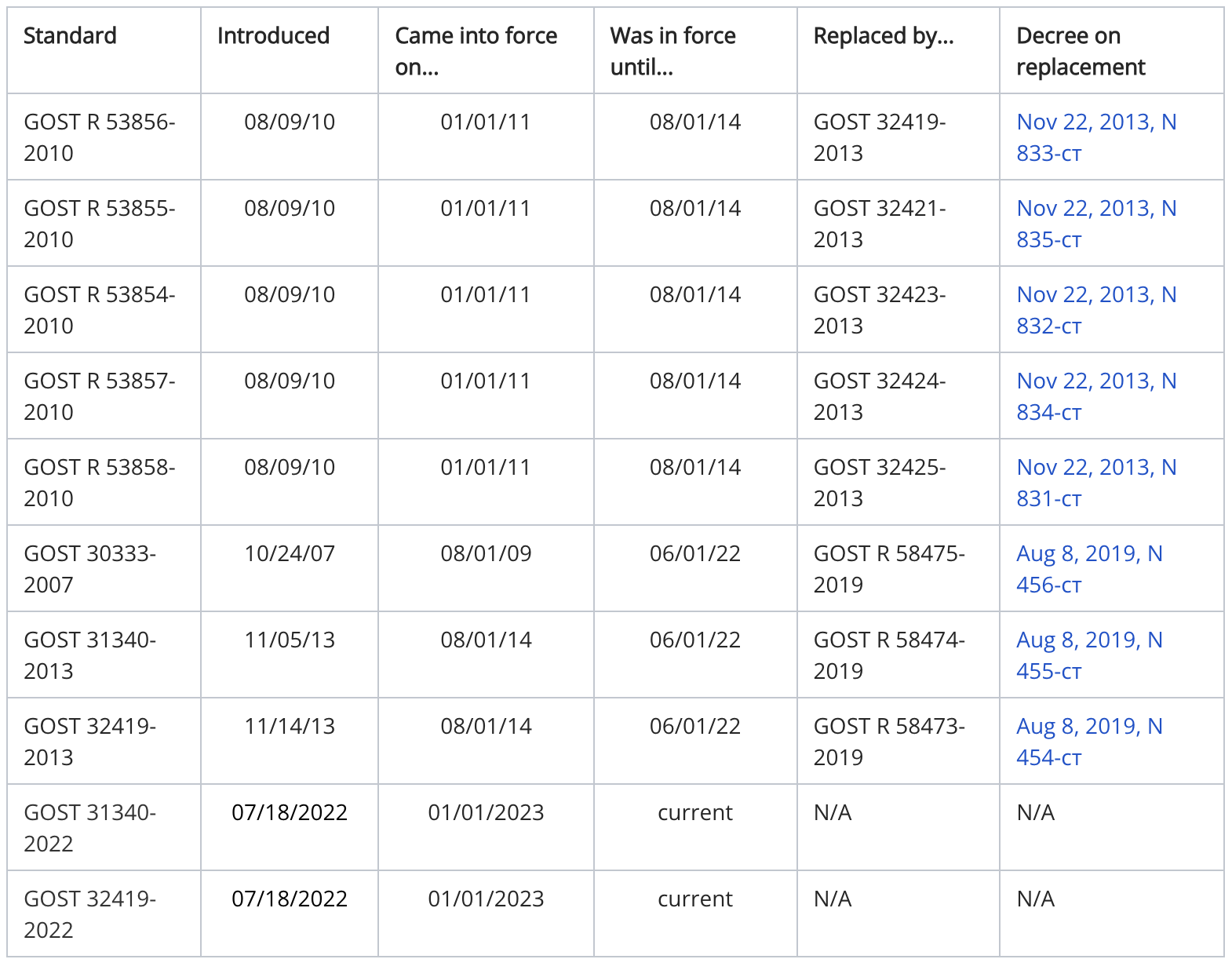 |
|
¶ Hazard ClassificationGOST 32419-2022 specifies the requirements for the hazard classification of chemical products based on UN GHS Revision 7 and replaces GOST 32419-2013. All potential hazards of chemical products are conditionally divided into three groups, including the following types:
The criteria for classification of chemical products are set out in Section 5. A Government decree introducing a Technical Regulation "On safety of chemical products" was passed on October 7, 2016. It describes a hazard classification process similar to that of GOST 32419-2013 and fully implements GHS Rev. 4. The regulation will become active July 1, 2021, at which point the requirements described in the regulation along with all referenced GOST standards will become mandatory. The Federal State Budgetary Institution "Russian Institute for Standardization" (FGBU "RST") registered order to put into effect as national standard GOST 32419-2022, establishing requirements for hazard classification in accordance with the 7th revised edition of the UN-GHS Recommendations. To ensure a smooth transition of the industry to the updated requirements, the introduction of the above standards is scheduled for January 1, 2023. GOST 32419-2022 entered into force on January 1, 2023. It complies with UN Recommendations ST/SG/AC.10/30/Rev.7 GHS for Hazard Classification of Chemical Products (Chapters 1.3, 2.1–2.17, 3.1–3.10, 4.1, 4.2, annex 8).
¶ Physical/Chemical HazardsTypes:
¶ Health HazardsTypes:
For tested mixtures of known composition, which are classified based on experimental data, the mixture should be reclassified with regard to health effects if:
Permitted deviations from the original concentration of the component (Table 1, GOST 32423-2013 Health Hazard Classification of chemical mixtures) 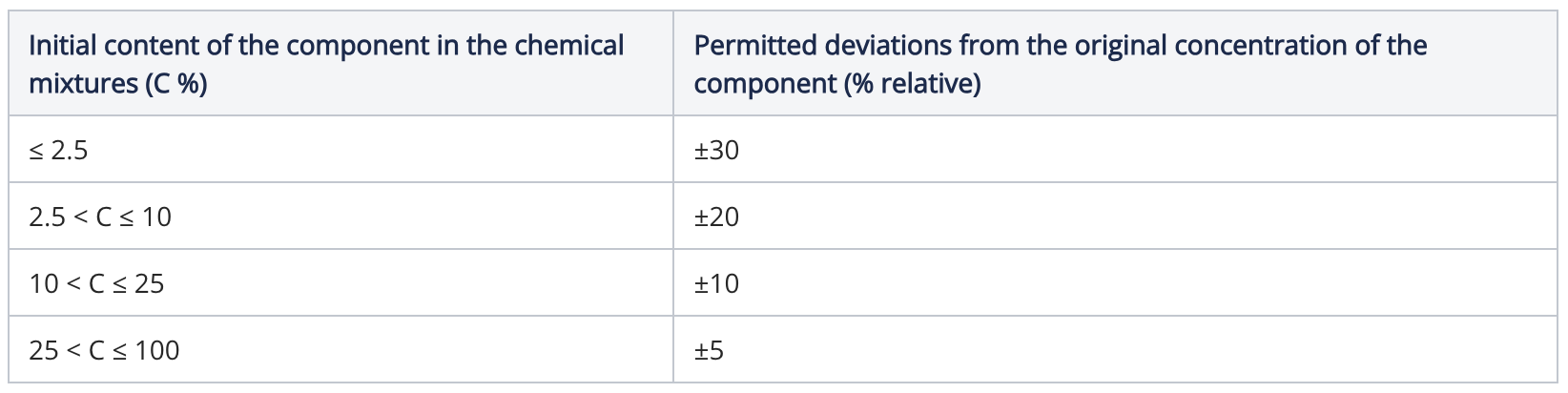 In cases where the mixture of chemicals has been studied/tested and sufficient experimental data is available in order to carry out the hazard classification, this product shall be classified in accordance with the criteria set out in GOST 32419-2022 – Chemical hazard classification. General requirements.
¶ Environmental HazardsTypes:
¶ SubstancesGOST 32424-2013 adopts the environmental hazards of GHS: acute and chronic toxicity to the aquatic environment, and ozone depleting chemicals. The classification of ozone-depleting chemicals is carried out on the basis of the Government Decree No. 228. The most recent amendment on June 3, 2016 (Decree No. 503) placed quantitative restrictions on certain substances from July 1 to December 31, 2016. The substances in question are indicated in Group I of List C of the Unified list of goods subject to bans or restrictions on the import to or export from the Customs Union in trade with third countries, as approved by decision of the Board of the Eurasian Economic Commission on August 16, 2012 N 134 On normative legal acts in field of non-tariff regulation, according to the attached Appendix. The text was published on June 8 and came into force 7 days after the publication (on June 15th). This regulation came into force replacing of the Regulation on Requirements for Import and Export of Ozone-destroying Substances and Products Containing Them in the Russian Federation, adopted by the Decision of the Government of the Russian Federation No. 563 of May 8, 1996 (with corresponding amendments).
¶ MixturesGOST 32425-2013 specifies the requirements for the environmental hazard classification of chemical mixtures. The standard corresponds to UN GHS Revision 4 and has replaced the GOST R standard 53858 2010 which was based on UN GHS Revision 2. The same principles regarding deviation from the original composition apply. In cases where the mixture of chemicals has been studied and there is sufficient experimental data to determine that a chemical product is hazardous to the aquatic environment, it should be classified in accordance with the criteria set out in GOST 32419-2022 - Chemical hazard classification. General requirements. ¶ ExemptionsThe GOST 32419-2022 standard does not apply to:
The GOST 32424-2013 standard does not apply to:
The GOST 32425-2013 standard does not apply to:
|
Sources
*Not available in English |
¶ Occupational Safety Hazard ClassesGOST 12.1.007-76 "Occupational Safety Standards System. Noxious Substances. Classification and General Safety Requirements" determines hazard classes for occupational exposure limits. This standard establishes general safety requirements for production, storage and use of harmful substances contained in raw materials, finished and semi-finished products as well as in industrial wastes, but does not apply to harmful substances which contain radioactive or biological components (bacteria, microorganisms). The GOST 12.1.007-76 defines a harmful substance as a substance that when in contact with the human body (when safety standards are violated), causes an injury, occupational disease, or alterations in health that can be diagnostically detected immediately after exposure or at a later date or in the future generations.
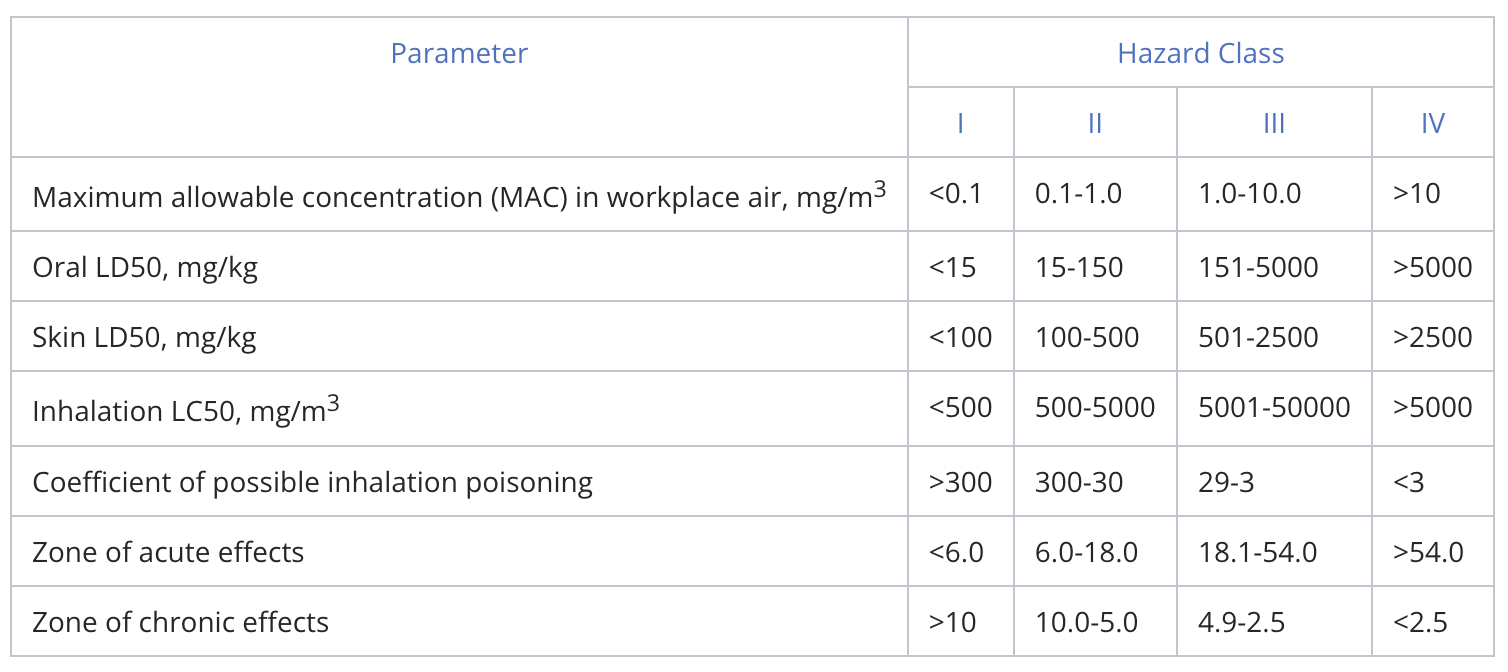 The hazard classes are to be assigned according to the above table. There are four hazard classes, the meaning and definitions of these classes are:
|
Sources
*Not available in English |
¶ Pesticide ClassificationGOST 17.1.3.04-82 "Nature protection. Hydrosphere. General requirements for surface and underground water control against pollution by pesticides" was published on March 25, 1982 and describes classification of pesticides. This Standard specifies general requirements for the protection of surface water and groundwater from contamination by pesticides during storage, transportation, and use of pesticide containing products. It does not apply to maritime waters. There are different classification schemes in the GOST, taking into consideration different effects:
The standard also provides:
|
Sources
*Not available in English |
¶ Cut-off Values/Concentration LimitsWhere test data is not available for a mixture, for health and environmental endpoints, the GHS allows for classification based on the hazards of the substances in the mixture. The GHS usually defines the concentration at which a hazardous substance causes a mixture containing that substance to be classified, for most hazards. These are known as Concentration limits / Cut-off values. Countries must additionally set the thresholds for mixture classification for certain hazards:
Russia is implementing specific classification cut-off values and concentration limits for mixtures for certain hazard classes, prescribed in GOST 32423-2013.
¶ Sensitization7.4. Classification of chemical product mixture hazard having a sensitizing action A mixture can be classified as chemical product, having a sensitizing action, if it contains one or more components that have this type of hazard in a concentration equal to or greater than the limits specified in Table 7. An example of the classification of the hazard of chemical products mixtures having a sensitizing action is given in Appendix A. Table 7 - The concentration limits of components included in composition of the mixture, allowing it to classify as having a sensitizing action 
¶ Carcinogenicity7.6 Classification of chemical product mixture hazard containing carcinogens A mixture can be classified as a carcinogen, if it contains one or more components having this type of hazard in concentration equal to or exceeding the limits indicated in Table 9. Table 9 - The concentration limits of components included in composition of the mixture, allowing it to classify as a carcinogen 
¶ Reproductive Toxicity7.7 Classification of chemical product mixture hazard acting on the reproductive function A mixture can be classified as a chemical product, affecting the function of reproduction, if it contains one or more components that have this type of hazard in a concentration equal to or exceeding the limits given in Table 10. An example of the classification of chemical product mixture hazard, affecting the function of reproduction is given in Appendix A. Table 10 - Concentration limits of the components included in composition of the mixture, allowing it to classify as acting on reproductive function 
¶ Specific Target Organ Toxicity - Single Exposure7.8 Classification of chemical products mixture hazard, having a selective toxicity to the target organs and/or systems by a single exposure A mixture can be assigned to one of three chemical product hazard classes having a selective toxicity to the target organs and/or systems by a single exposure, if it contains one or more components that have this type of hazard in a concentration equal to or greater than the limits specified table 11. Table 11 - Concentration limits of the components included in the composition of the mixture, allowing it to classify as having a selective toxicity to the target organs and/or systems by a single exposure 
¶ Specific Target Organ Toxicity - Repeated Exposure7.9 Classification of chemical product mixture hazard, which has a selective toxicity to the target organs and/or systems by a repeated/prolonged exposure A mixture can be related to one of two chemical product hazard classes having a selective toxicity to the target organs and/or systems by a multiple/prolonged exposure if it contains one or more components having this type of hazard in a concentration equal to or exceeding the limits listed in table 12. Table 12 - Concentration limits of the components included in composition of the mixture, allowing it to classify as having a selective toxicity to the target organs and/or systems by a repeated/prolonged exposure 
|
|
¶ Safety Data SheetSections of the Safety Data Sheet
GOST 30333-2022 applies to the Safety Passport (SDS) developed for chemical products released into circulation. The SDS is a mandatory component of the technical documentation for chemical products, is included in the accompanying documentation for chemical products and is intended to provide the consumer (purchaser) with reliable information about the safety of use, storage, transportation and disposal of chemical products for industrial or domestic use. According to GOST 30333-2022 SDS is not required for:
¶ Format RequirementsSafety data sheets must be written in the Russian language. According to GOST 30333-2022, the SDS must consist of a title page and 16 sections containing details about the hazards associated with a product. Requirements for the SDS are detailed in the Annex A of GOST 30333-2022. The requirements for the Safety Passport are described and compared to the standard GHS Rev. 8 sections here. In January 2015 a document summarizing recommendations on composition of safety passports was issued: R 50.1.102-2014 "Compilation and execution of safety data sheet of chemical products". These recommendations also provide examples of what should be included in each section of the SDS. An independent organization Coordinating Informational Service Center (CIS) assists businesses in authoring and registering Safety Passports. The CIS provides templates of Safety Passports on its website.
¶ Covering Multiple ProductsA single Safety Passport can describe a product, produced according to a specific procedure, including brand variations. Separate SPs should be made in the following cases:
|
Sources
Resources
*Not available in English Implementation History
|
¶ Safety Passport RegistrationAccording to GOST 30333-2007 all Safety Passports need to be registered with an appropriate governmental agency (Chapter 4, item 4.2.9: "Before issuing or reissuing due to additions or corrections the Safety Passport should be registered"). The Federal State Unitary Enterprise "Russian scientific-research institute for standardization of materials and technologies" is the responsible government body for registering Safety Passports. A separate organization has been created to handle Safety Passport registration - Coordination Information Center.
¶ Registration Steps
If the SP fails to meet the requirements, the documents are returned and corrective action is requested. A submission of revised documentation does not require an extra charge. The SP should be submitted in a paper format to the address listed on the application form and Coordination Information Center website: SP Department contacts.
¶ Information to submitThe following documents should be submitted for all products. When templates are available, they are provided here: (website of the Coordination Information Center of "All-Russian scientific-research institute for standardization of materials and technologies", registration documents page).
Format of submission:
Additional documentation required for Imported Materials The following items should be provided in addition to the general documentation:
Additional documentation required for Pesticides and Agrochemicals The following items should be provided in addition to the general documentation:
Additional documentation required for Water Treatment Reagents The following items should be provided in addition to the general documentation:
Additional documentation required for Explosive Substances The following items should be provided in addition to the general documentation:
¶ Changing the registrationAn SP registration must be renewed if:
In the case of the legal entity's reorganizing in the form of division or spin off (when the new entity is not a legal successor of the previous one), that involves receiving a new OKPA code, new initial registration of SP is performed, the former registration of SP terminates. If the legal address or ownership changes, while maintaining OKPA code, the SP is renewed. The OKPA is a code from the Russian nationwide classifier of enterprises and organizations. The title page cannot change unless registration is renewed. The following must be submitted:
|
Sources
Resources *Not available in English |
¶ Labelling
Federal State Unitary Enterprise "All-Russian scientific-research institution of standardization of materials and technologies" published a letter explaining procedures for creating SDS labels on July 31, 2014. The letter indicates that SDS authors should take the new GOST 31340-2013 into consideration, especially concerning section 2.2 of SDS, for which it is necessary to provide a signal word, hazard symbols, hazard statements and H-codes. Government Decree No. 1019 "On technical regulations on safety of chemical products" will make this mandatory July 1, 2021. The standard described identification of chemical products, hazard pictograms, signal words, hazard statements, precautionary measures, and labeling for different kinds of chemical products. Annex A provides examples of arrangements for label elements and Annex B provides pictograms for individual protection measures. On November 26, 2014 the Federal agency on technical regulation and metrology issued the standard R 50.1.101-2014 "Guidance on the selection of precautionary statements for the labeling in accordance with GOST 31340–2013" to assist companies in labeling. The Federal State Budgetary Institution "Russian Institute for Standardization" (FGBU "RST") registered order to put into effect as national standard GOST 31340-2022 (Preventive labelling of chemical products. General requirements) establishing requirements for precautionary labelling in accordance with the 7th revised edition of the UN-GHS Recommendations. To ensure a smooth transition of the industry to the updated requirements, the introduction of the above standard was scheduled for January 1, 2023 (order of Rosstandart No. 640-st dated July 18, 2022). GOST 31340-2022 entered into force on January 1, 2023. It complies with UN Recommendations ST/SG/AC.10/30/Rev.7 GHS for Chemical Hazard Communication through Label Development (Chapters 1.4, 2.1–2.17, 3.1–3.10, 4.1, 4.2, annex 1, 3, 7). The requirements for the classification and labeling of products in terms of hazards due to physical and chemical properties, the impact on human body as well as names of the types of hazards have changed in a the new standard.
GOST 31340-2022 does not apply to:
|
Sources
|
¶ Certificate of ConformityIn order to implement the Federal Law N 184 "On Technical Regulation," Government Decree N 943 was issued on September 18, 2012. It specifies labeling requirements for products placed on the market for the first time. The requirement applies to all products that are subject to mandatory certification or conformity declaration.
¶ Prior certificates of conformityThe Decree states that the certificates of conformity or declarations of conformity issued prior to the date of the Decree publication remain valid until the date indicated in those certificates. Products and/or packaging which were placed on the market in the territory of the Russian Federation according to the aforementioned documents (certificates, declarations) are not subject to relabeling
Labeling new products Labels on products released to the market for the first time, must include the statement: "This product is released for the first time." If a product is sold by a retailer, this information must be present on packaging and available to the consumer. This statement (and additional information discussed below) must be present on labels for one year following the start of product manufacturing. Labeling of new products must include the following additional information (along with information required by other legislation of the Russian Federation, when applicable). This information must be present on the consumer package, label, package-insert, and/or the accompanying documents placed in each package or attached to each individual package. Additional required information
Labeling of new products that are not intended for children or are harmful to children's health or development should contain the information about the danger of its use in the presence of children, or by children themselves. Labeling of new products that illustrates a possible use of the product should be accompanied by a statement: "Possible use (application) of the product." All required label information should be marked in a clear, understandable and accessible way. The label should be durable enough to be visible throughout the expected service life of the product. Information regarding non packaged (bulk) goods handled and sold by retail organizations should be provided to the customer, including the end consumer, in any manner that allows for a reasonable choice of such products.
|
Sources
*Not available in English |
¶ Trade SecretsIn regard to Trade Secrets, GOST 30333-2007 contains the following note (item 3, Table A.1, Annex A):
Section 5 of Federal law #98 describes types of information that cannot be regarded as a trade secret. Information that cannot be trade secret Item 4 of section 5 lists the following:
In practice: the manufacturer or importer is required to provide 100% composition of a material to the Federal State Unitary Enterprise "Russian scientific-research institute for standardization of materials and technologies" for verification of the hazardous characteristics of the product. Basic hazardous components should be indicated in the text of the Safety Passport. It is not allowed to withhold the components that determine the hazardous properties of the chemical product and all hazardous components must be registered in the Safety Passport. Other components could be omitted, but complete composition is absolutely necessary to evaluate the hazardous properties of the product as a whole.
|
Sources
*Not available in English |
¶ Occupational Exposure LimitsThe main document dealing with occupational exposure to harmful substances in the Russian Federation is the Hygienic Normative 2.2.5.3532-18 "Maximum Allowable Concentrations (MAC) of Harmful Substances in the Workplace Air." The document was introduced by Decree #25 by Chief State Sanitary Officer of the Russian Federation on February 13, 2018. The majority of the limits set in the document are based the previous normative, Hygienic Normative 2.2.5.1313-03 and its amendments. The following two laws provide the legal basis for the Normative:
The office of the Chief State Sanitary Physician of the Russian Federation belonged to the Ministry of Health until 2004; however, it presently exists under the Department of Consumer Protection (Rospotrebnadzor). The regulation refers to the GOST 12.1.007-76 "Noxious substances. Classification and general safety requirements". Hygienic Normative 2.2.5.3532-18 applies to all workplaces, regardless of their location (buildings, mines, open areas, vehicles etc.). The standards are used as a guidance in designing buildings, technological processes, equipment, and ventilation. The standards should be followed to ensure the safety of the industrial environment and to prevent adverse effects of hazardous chemicals on workers' health. The standards are based on comprehensive domestic and international research in areas of toxicology, hygiene, and epidemiology. |
Sources
*Not available in English |
¶ Transport |
|
| See European Union page: Transport | |