¶ Recent Updates2026
|
|
¶ Background |
|
|
The Parliamentary Branch of the Canadian Government is considered the legislative branch of the Government. Through Parliament, Acts are enacted. These Acts are law and may also be supported by subordinate legislation. Subordinate legislation may be in the form of Regulations or Rules. Regulations are law and are issued in order to carry out the Acts. The Regulations tend to contain specific requirements and/or information. Parliament can delegate its authority to other governmental agencies. The Canadian Environmental Protection Act, 1999 (CEPA, 1999) is an Act which is jointly administered by Environment and Climate Change Canada and Health Canada. Under CEPA, 1999, numerous Regulations, Ministerial Orders, Guidelines, etc., exist. Canadian law requires scientific information on any new substance to be submitted for assessment prior to use, manufacture and/or import of that new substance. However, many substances were in existence and in use prior to these laws being enacted. To address these "existing" substances, CEPA, 1999, mandated that all substances on the Domestic Substances List be categorized to determine which of these substances presented the greatest potential for exposure or were persistent, bioaccumulative and inherently toxic. These substances required additional assessments/research/control measures. This led to the formation of the Chemicals Management Plan (CMP) under which chemicals are assessed and managed using multiple tools. Individual provinces and/or territories may also issue additional Acts and/or Regulations governing chemicals management within their respective Province and/or Territory. Bill S‑5, the Strengthening Environmental Protection for a Healthier Canada Act, received Royal Assent on June 13, 2023. The Bill modernizes CEPA,1999 by formally recognizing the right to a healthy environment and by, strengthening Canada’s chemicals management regime. It also increases transparency into the administration of CEPA, plus introduces new requirements related to the assessment of toxic substances, updates gathering of information, etc. One requirement of the Ministers of the Environment and of Health is the development, consultation and publication of the Plan of Priorities. The Plan includes timelines for a "multi-year, integrated plan for the assessment of substances as well as other activities that support the management of substances." The Workplace Hazardous Materials Information Systems (WHMIS) is Canada's Hazardous Communication Standard and is implemented with federal, provincial and territorial legislation. The Hazardous Product Act (HPA) and associated regulations (Hazardous Products Regulations (HPR), etc.) detail labelling and SDS requirements for suppliers and are administered by Health Canada. Guidance documentation may also be issued. Each provincial/territorial or federal agency responsible for occupational health and safety (OH&S) establishes employer WHMIS requirements (within the respective jurisdiction).
|
|
¶ Inventories |
|
¶ Domestic Substances List (DSL)The Canadian Environmental Protection Act, 1999 (CEPA, 1999), Section 66, authorizes the Minister of the Environment to maintain a list of substances that were, between January 1, 1984 and December 31, 1986:
This list is known as the Domestic Substances List (DSL). The DSL is a dynamic list. If the Minister learns that a substance not included on the original DSL meets the requirements, the substance can be added to the DSL. Similarly, if the Minister learns that a substance on the DSL does not meet the requirements, it can be deleted from the DSL. The additions and/or deletions are done through amendments, and if necessary, corresponding amendments to the Non-Domestic Substances List (NDSL), that are published in the Canada Gazette. The DSL consists of a non-confidential and a confidential part as well as subsections. Substances on the non-confidential part are identified by CAS number, EC number or ATCC number. The confidential part does not contain CAS numbers and the name used is generic. A substance is considered "existing" if it is on the DSL. A substance is considered "new" if:
For "new" substances, the manufacturer or importer must provide all the information prescribed in Section 81 of CEPA, 1999 and per the New Substances Notification Regulations (Chemicals and Polymers) or per Section 106 of CEPA, 1999 and per the New Substances Notification Regulations (Organisms) and pay the prescribed fee(s) as detailed in the New Substances Fees Regulations. Although, per CEPA, 1999, the DSL is the sole criteria for determining if a substance is considered "new" or "existing," other laws may also apply in terms of determining notification requirements. All substances are still subject to any other laws and/or regulations that are in force for the substance and/or use in Canada. NOTE: In March 2026, the Ministers of the Environment and of Health, published information about structural changes to the DSL. These changes, which split Part 2 of the DSL (Chemicals and Polymers Subject to SNAc Requirements that are Identified by their CAS Registry Numbers) into two separate Divisions. Division 1 will contain substances subject to individual SNAc requirements meaning that the SNAc provisions are applied to each individual substance. Division 2 will contain substances that are subject to standardized SNAc requirements meaning that the requirements are applied to a group or groups of substances. In addition, the Ministers are creating a "Schedule 1" - Information Concerning Significant New Activities in Respect of Which a Substance is Subject to Subsection 81(3) of the Act. This Schedule will increase consistency across the SNAc Orders. The information contained in Schedule 1 may be referred to in future SNAc Orders. NOTE: In August 2026, the Canadian Environmental Protection Act, 1999 (CEPA), as amended by the Strengthening Environmental Protection for a Healthier Canada Act in 2023, enabled the Minister of the Environment to add R-ICL substances to the DSL, and the first batch of 656 R-ICL substances meeting eligibility criteria was added to the DSL. |
Sources Resources |
¶ Non-Domestic Substances List (NDSL)CEPA, 1999, Section 66, also authorizes the maintenance of a second list called the Non-Domestic Substances List (NDSL). When the DSL was established, there was recognition that there were many substances in international commerce that were not included on the DSL, so a second list, the NDSL, was created. The NDSL is based on the US EPA Toxic Substances Control Act (TSCA) Chemical Substances Inventory. As the substances on the NDSL have been in international commerce for years, there is an assumption that toxicological information is available for these substances. As such, new substance notification requirements are reduced for NDSL listed substances. Like the DSL, the NDSL is a dynamic list. Updates occur based on the annual TSCA revisions from 5 or more years prior. Substances that have TSCA imposed restrictions on manufacture and/or import are not normally added to the NDSL. Also, substances removed from the DSL may be added to the NDSL, and substances on the NDSL may move to the DSL. Amendments are published in the Canada Gazette. Note that the NDSL is NOT a direct adaptation/adoption of the annual TSCA list. The NDSL consists of both a non-confidential and a confidential part. Substances on the non-confidential part are identified by CAS number. The confidential part does not contain CAS numbers and the names used are generic.
|
Sources |
¶ Substance Registration |
|
|
Although Canada does not have substance registration requirements, they do have potential Notification requirements. This includes new substance notification for substances that are not listed on the DSL or are listed on the DSL with certain notations. |
|
¶ Product Registration |
|
¶ PesticidesDifferent aspects of consumer product safety are governed by Health Canada. Among other responsibilities, Health Canada is responsible for evaluating new pesticides, determining any human health and environmental risks of these pesticides, and determining the value of the pest control product. Pesticides and pesticide products fall under Health Canada's Consumer Product Safety Pest Management Regulatory Agency (PMRA). Pesticide products are regulated by the Pest Control Products Act and Pest Control Products Regulations. This includes substances in pest control products, as well as micro-organisms, chemicals, or polymers used in pest control products. Pest control products are required to be registered and evaluated prior to use and/or manufacture. A detailed packet of information is required for registration. This includes general information about the product, electronic copies of the label, test data, and more. In certain cases, samples of the product and/or its active ingredients may be required. The full list of required information can be found in the Application for Registration section of the Pest Control Products Regulations. There are several fees associated with the registration of pest control products that vary in cost and can be found in the Pest Control Products Fees and Charges Regulations. These Regulations, "except section 6, come into force on the day on which they are registered or on April 1, 2017, whichever is later" and, section 6 became effective on April 1, 2018 (the Regulations were registered on 3 February 2017 and published in the Canada Gazette in February 2017). These Regulations prescribe the various fees associated with the registration of pest control products. In addition, they repeal the Regulations Prescribing the Fees to be Paid for a Pest Control Product Application Examination Service Provided by or on behalf of Her Majesty in Right of Canada, for a Right or Privilege to Manufacture or Sell a Pest Control Product in Canada and for Establishing a Maximum Residue Limit in Relation to a Pest Control Product. Pesticide registrations must be renewed at least every 5 years. Other than the Act and Regulations, Health Canada's PMRA site also has policies, guidelines and codes of practice that provide additional information on pesticide registration and control.
|
Sources
Resources |
¶ FertilizersThe Fertilizers Act and Fertilizers Regulations are listed in Schedule 2 and Schedule 4 of CEPA, 1999. As such, if a substance/product is covered under the provisions of this Act, notification/registration occurs per this Act and Regulation. Per the Fertilizers Act, no person is allowed to sell or import into Canada a fertilizer or supplement "unless the fertilizer or supplement (a) has, in accordance with the Regulations, been approved by the Minister or registered; (b) conforms to prescribed standards; and (c) is packaged and labelled in accordance with the regulations." Substances that fall under this Act may include new fertilizers (chemicals) and new supplements (organisms) or micro-organisms, chemicals or polymers found in fertilizers. Registration information is described in Section 5 of the Fertilizers Act and in the Fertilizers Regulations. The Fertilizers Regulations were amended in 2020 which made the registration process more flexible and less costly. The amended regulations do not require a specific format for the application; however, the registration information must be sufficient to support the identity of the product as a fertilizer or supplement and to substantiate the product's safety. Guidance materials are provided to assist applicants and registrants in fulfilling the registration obligations. The transition period for the amended regulations is three years in which the registrants can comply with either the old regulations or the amended regulations. The transition period ended on October 26, 2023. The Canadian Food Inspection Agency is responsible for the administration and enforcement of the Fertilizers Act and Fertilizers Regulations.
|
Sources |
¶ PrecursorsHealth Canada, under the Controlled Drugs and Substances Act, regulates the manufacture, distribution, and disposal of controlled drugs and substances within Canada. The Office of Controlled Substances (OCS), in collaboration with the Canadian Government, ensures that drugs and controlled substances are not diverted for illegal use. This is accomplished through developing legislation, regulations, and policies that support control of illicit substances. Among other responsibilities, the OCS oversees "licensing manufacturers and distributors of drugs and controlled substances and issuing import/export permits when necessary" and "managing an exemption process that allows individuals with legitimate scientific or medical reasons to possess a controlled substance." One aspect of the Controlled Drugs and Substances Act deals with precursor chemicals. According to Health Canada, "precursor chemicals are chemicals that are essential to the production of a controlled substance." Although there are many legitimate uses for precursor chemicals, they can also be used to manufacture illegal drugs and substances. The Precursor Control Regulations, under the Controlled Drugs and Substances Act, governs the production, distribution, packaging, transporting, delivery and sales of Class A and Class B precursors. Class A precursors are essential components for the manufacturing of illicit substances and have license and import/export permit requirements. Class A precursors include both natural and synthetic forms of the substances. Class B precursors are primarily solvents and reagents used in the manufacturing of illicit substances and have registration and export permit requirements. Class B includes synthetic forms. Both classes have recordkeeping and reporting obligations. Both classes also include preparations and/or mixtures, unless otherwise specified. Certain substances are exempt from the Controlled Drugs and Substances Act under the Regulations Exempting Certain Precursors and Controlled Substances from the Application of the Controlled Drugs and Substances Act. NOTE: Health Canada's new Controlled Substances Regulations (CSR) came into force on October 1, 2026. The CSR merges several existing rules including those under the CDSA and Cannabis Act into one modernized framework. The CSR streamlines oversight and improves clarity across activities involving narcotics, controlled drugs, targeted substances, and restricted drugs, listed in Schedules I to IV of the CSR. |
Sources
Resources |
¶ CosmeticsDifferent aspects of consumer product safety are governed by Health Canada. Among other responsibilities, Health Canada is responsible for setting safety rules for cosmetics and this is primarily done through the Food and Drugs Act and the Cosmetics Regulations. The Act and Regulations apply to cosmetic products that are used in professional establishments, to products used in bulk at institutions such as schools, to 'handmade' products sold at craft fairs and to home-based businesses. A cosmetic is "any substance used to clean, improve or change the complexion, skin, hair, nails or teeth." Cosmetics include items such as nail polish, make-up, perfume and skin cream (referred to as 'beauty preparations') as well as deodorants, shampoos, soaps and shaving creams (referred to as 'grooming aids').
It is also important to note that although personal care products, which are those products that are designed for use in daily grooming and/or cleaning, are normally considered a cosmetic, the product may be legally classified as a drug. This is dependent on ingredients and any claims made by the product - if the claim is made that the product is intended to prevent or treat a disease, it is legally classified as a drug and would be regulated as such. As an example - if an antiperspirant claims to reduce normal underarm perspiration and the directions for use, ingredients, etc. support that claim, it would be classified as a cosmetic. However, if the claim is that it used for hyperhidrosis, it would be regulated as a drug. There are also cases in which products may have characteristics of both a cosmetic and a drug which are more difficult to classify. In instances such as these, Health Canada will conduct assessments and consultations. Not all products that may seem to be cosmetics are actually classified as such. These products are still managed under Health Canada although different departments may be involved. Below are just a few examples of such products.
¶ Requirements for Cosmetics to be sold in Canada
¶ Labels
¶ Notification RequirementsHealth Canada must be notified of any cosmetic that is sold in Canada via the Cosmetic Notification Form (CNF). Under Section 30 of the Cosmetics Regulations, the manufacturer and importer must make notification to Health Canada within 10 days of the first day they sell the cosmetic in Canada. And, if a change is made that affects any information on the CNF, it must be amended and resubmitted. The CNF details the product information that must be supplied to Health Canada, including the name, address and contact information of the manufacturer, importer, distributor and formulator, the ingredient disclosure including the concentration of each ingredient, the form and function of the cosmetic, etc. Changes would include those to the product name, cosmetic formulation, company name and/or contact information or if sale is discontinued. Currently, there is no fee associated with the notification. The manufacturer and importer are responsible for ensuring their product meets all of the requirements for a cosmetic as detailed in the Food and Drugs Act and the corresponding Cosmetic Regulations. "Submission of the CNF does not constitute approval for sale by Health Canada, agreement that the product is classified as a cosmetic nor that the product complies with all legislative requirements." "Test-marketed cosmetics must meet all requirements of the Food and Drugs Act and the Cosmetic Regulations." Per Health Canada, "There are no exemptions for test-marketing." Note: Health Canada is implementing new regulations that will require cosmetic manufacturers to disclose specific fragrance allergens directly on product labels (new and existing products). The amendments, which were published in the Canada Gazette, Part II in April 2024 as SOR/2024-63, to the Cosmetic Regulations introduced the requirement to disclose in the initial phase certain fragrance allergens on cosmetic labels when present above a specified limit by April 12, 2026. All new and existing cosmetics must identify 24 fragrance allergens when exceeding:
In the next phase new cosmetic products must disclose complete list of 81 allergens (aligning with EU Annex III) by August 1, 2026. All cosmetics on the Canadian market must disclose the complete list of 81 fragrance allergens by August 1, 2028. Health Canada updated the Cosmetic Notification Form (CNF) on March 6, 2026, revising Product Ingredients Section 5 by renaming the checkbox previously labeled “Fragrance Allergen” to “Fragrance allergen present above the disclosure threshold.” The Cosmetic Notification Form was updated on October 6, 2025. The changes are made to Sections 4 and 5, a checkbox is added for fragrance allergens. Health Canada published an updated guidance document titled “Evidence of safety requirements for tooth whitening products containing peroxide and peroxide-generating compounds” in September 2024. This document outlines the specific evidence of safety data that manufacturers and importers must maintain and submit upon request to demonstrate compliance with the Food and Drugs Act and the Cosmetic Regulations for cosmetic tooth whitening products containing peroxides or peroxide‑generating compounds. Proposed amendments to Cosmetic Regulation Health Canada is proposing to update the Cosmetic Ingredient Hotlist. The proposal includes additions, changes to the conditions for existing entries, and changes to include new substance identifiers or make minor corrections. Consultation closed on February 17, 2026.
|
Sources
Resources
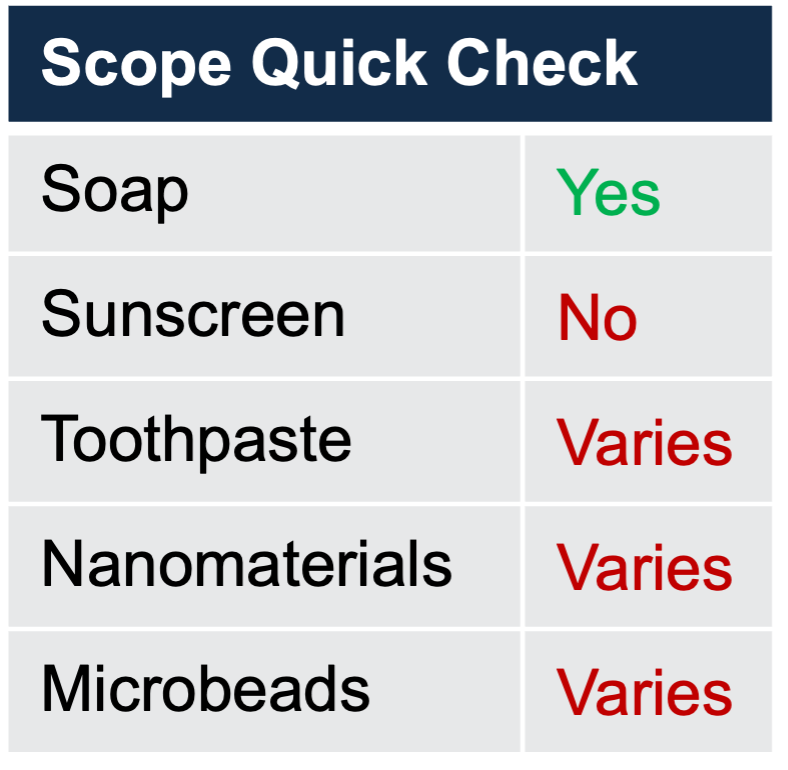 |
¶ NanomaterialsNanomaterials potentially require notification under the Canadian Environmental Protection Act, 1999 (CEPA, 1999) and the New Substance Notification Regulations. Health Canada has developed a working definition for nanomaterials, and according to the working definition "nanoscale means 1 to 100 nm inclusive." There are potential exceptions to this size range and information may be requested from an individual department. If an application or product contains a nanomaterial or nanoproduct, the supplier/manufacturer is asked to self-identify. Although there is not currently a specific regulation for nanotechnology-based cosmetics, all ingredients must meet the requirements within existing legislation. Manufacturers, formulators, etc. may request a pre-submission meeting to discuss the potential safety impacts of the nanoproduct. On March 5, 2026, the Framework for the Risk Assessment of Manufactured Nanomaterials under the Canadian Environmental Protection Act, 1999 was published. This document establishes a framework for the risk assessment of nanomaterials under CEPA, including both existing nanomaterials on the DSL, and new nanomaterials notified under the New Substances Notification Regulations (Chemicals & Polymers). The framework discusses the nanomaterial-specific considerations for risk assessment, such as:
|
Sources |
¶ Microbeads in ToiletriesMicrobeads in Toiletries are addressed under CEPA, 1999 and the subsequent Microbeads in Toiletries Regulations. This regulation, governed by Environment and Climate Change Canada, "prohibits the manufacture, import and sale of certain toiletries including non-prescription drugs and natural health products that contain plastic microbeads." Toiletries include "any personal hair, skin, teeth or mouth care products for cleansing or hygiene, including exfoliants."
|
Sources |
¶ BiocidesThe Biocides Regulations were registered on May 31, 2024, and published in the Canada Gazette, Part II on June 19, 2024. The regulations introduce a single regulatory framework in Canada for biocides under the Food and Drugs Act and came into force on May 31, 2025. Under these regulations, biocides include both surface disinfectants and surface sanitizers. Biocides must undergo a pre‑market assessment by the Natural and Non‑prescription Health Products Directorate (NNHPD) before they can be imported, sold, or advertised in Canada. A market authorization application containing evidence of safety, efficacy and quality or any additional information requested under the regulations must be submitted. The Minister of Health must issue authorization if:
Authorized biocides receive an 8‑digit identification number from NNHPD which must appear on the product label and indicates that product is authorized for sale in Canada. The Regulatory Operations and Enforcement Branch (ROEB) conducts inspections and enforces compliance. The Marketed Health Products Directorate (MHPD) monitors post‑market safety, communicates risks, reviews adverse data and implements risk management measures. ¶¶ Products that are Unaffected by the Biocide RegulationsProducts that would continue to be regulated under the PCPA:
Products that would continue to be regulated under the FDR:
Products that would continue to be regulated under the Medical Devices Regulations:
Products that would continue to be regulated under the Canadian Consumer Product Safety Act (CCPSA) and the Hazardous Products Act:
|
Sources |
¶ Notifications |
|
|
In addition to requirements for general industrial chemicals, Navigator currently covers requirements for pesticides, biocides/biocidal products, and cosmetics. This means that requirements that pertain specifically to food contact materials, pharmaceuticals, etc., are not covered here.
¶ New Substances
According to CEPA, 1999, a substance is considered "new" if:
The required information for new chemicals and polymers is as per Part 5, Sections 80-89 of CEPA, 1999 and as stipulated in the NSNR (Chemicals and Polymers), while the required information for new organisms is as per Part 6, Sections 106 - 115 of CEPA, 1999 and as stipulated in the New Substances Notification Regulations (Organisms) – NSNR (Organisms). All chemicals/polymers (biochemicals/biopolymers), organisms and nanomaterials are also subject to any other laws and/or regulations that are in force for the substance and/or their use in Canada. |
Sources |
¶ Chemicals and PolymersThe NSNR (Chemicals and Polymers) covers the notification requirements for chemicals, biochemicals, polymers, and biopolymers that are considered "new" to Canada, whether manufactured or imported. The Regulations are designed to prevent the introduction of a new substance into the Canadian marketplace prior to an assessment of its potential toxicity and if needed, the implementation of appropriate risk management tools. They provide specifics for the information to be submitted, when the information must be submitted and the timeframe for the Government to complete the assessment. The assessment may be carried out by the Minister of the Environment and Climate Change and/or the Minister of Health. Information requirements are dependent not only on the quantity manufactured and/or imported but also on whether a substance is on the NDSL or not (NDSL listed substances require notification but information requirements are reduced). It is also dependent on whether the substance to be notified is a chemical/biochemical or a polymer/biopolymer. Examples of required information includes, but is not limited to:
Complete details for information requirements can be found in the Act and corresponding Regulations. If the notifier is not a Canadian resident, a Canadian agent or Canadian Importer of Record must be identified as "authorized to act on their behalf to whom any notice or correspondence may be sent and that is required to keep the information and any supporting data." There are provisions for proprietary and/or confidential business information. *A New Substances Notification Advisory Note (2015-03) was issued in regards to replacing the term "Material Safety Data Sheet (MSDS)" with "Safety Data Sheet (SDS)." The Note provides guidance for the NSNR (Chemicals & Polymers) as well as for the Guidelines. This change is due to the implementation of the revised Hazardous Products Act (HPA) and corresponding Hazardous Products Regulations (HPR). Exceptions Exceptions are stipulated in Part 5 of CEPA, 1999 and the NSNR (Chemicals and Polymers). They include, but are not limited to:
|
Resources |
¶ NanomaterialsThe New Substances Program Advisory Note 2014-2 – Assessment of Nanomaterials under the New Substances Notification Regulations (Chemicals and Polymers) is an advisory note issued by Environment and Climate Change Canada that requires manufacturers and/or importers to provide information as per the NSNR (Chemicals and Polymers). It also defines five classes of substances that information in regards to particle size/particle size distribution may be requested. In order to identify nanoscale materials, Environment and Climate Change Canada is using the "Working Definition for Nanomaterial" as defined by Health Canada. Working Definition for Nanomaterial: "(1) having one or more dimensions (or internal or surface structure) at the nanoscale (1-100 nanometers inclusive); or As part of the Canada-U.S. Regulatory Cooperation Council Nanotechnology Initiative, 5 classes based on chemical composition were identified as classes in which the nanoscale form of a substance has a greater likelihood of behaving differently than the non-nanoscale form of the substance. These classes currently include:
Similar to other substances, any nanomaterial that is either manufactured in or imported into Canada that is not listed on the DSL is considered "new" and is subject to notification. Also, a nanoscale form of a substance that is listed on the DSL is considered "new" if the nanoscale form has a unique structure or molecular arrangement. If the nanoscale form of a substance does not have a unique structure or molecular arrangement, is listed on the DSL and does not have any other "flags," it is considered "existing," and notification is not required. The Government continues to research the health and safety of nanomaterials as well as participate in efforts on an international level. On March 5, 2026, the Framework for the Risk Assessment of Manufactured Nanomaterials under the Canadian Environmental Protection Act, 1999 was published. This document establishes a framework for the risk assessment of nanomaterials under CEPA, including both existing nanomaterials on the DSL, and new nanomaterials notified under the New Substances Notification Regulations (Chemicals & Polymers). The framework discusses the nanomaterial-specific considerations for risk assessment, such as:
|
Resources |
¶ OrganismsManufacturers and importers of animate products of biotechnology (living organisms, their parts and products) designated as "new" may be required to submit information to the Minister of the Environment and Climate Change prior to exceeding regulatory trigger quantities. Retail products that contain micro-organisms, biochemicals or biopolymers are considered "biotechnology products" and may be subject to notification. Substances are defined in CEPA, 1999 and include both inorganic and organic matter, whether it is animate or inanimate. As with substances, an organism is considered "new" if it is not specified on the DSL or is specified on the DSL with significant new activity provisions associated with it. The NSNR (Organisms) covers the notification requirements for living organisms that are considered "new" to Canada, whether manufactured or imported. The Regulations are designed to prevent the introduction of a new substance into the Canadian marketplace prior to an assessment of its potential toxicity and if needed, the implementation of appropriate risk management tools. They provide specifics for classes/groups of substances, the information to be submitted, when the information must be submitted and the timeframe for the Government to complete the assessment. The assessment may be carried out by the Minister of the Environment and Climate Change and/or the Minister of Health. Similar to the NSNR (Chemicals and Polymers), information requirements are divided into different schedules, dependent on the notification group of the living organism. Note that if the notifier is not a Canadian resident or the corporate headquarters is not located in Canada, a Canadian agent or Canadian Importer of Record, must be identified who is "legally responsible for the import of the organism and for providing the notification to Environment Canada….any correspondence regarding the notification will be sent to the agent…" There are provisions for proprietary and/or confidential business information. Exceptions There are exceptions for notification, as specified in Part 6 of CEPA, 1999 and in the NSNR (Organisms). They include, but are not limited to:
|
Resources |
¶ FeesPer Section 328 of CEPA, 1999, the New Substances Fees Regulations, and subsequent amendments, allow for the NSNR program to implement a "cost recovery" program. The New Substances Fees Regulations apply to chemicals and polymers. There are provisions for initial fees, subsequent fees, final fees, reductions, maximum fees and fees for other services. Three schedules provide tables for assessment fees based on the applicable notification schedule and annual sales and a table for other fees. As of 2019, the New Substances Notification fees will be adjusted annually. The adjusted fees become effective on April 1st of each year and are based on the Consumer Price Index. The table of adjusted fees can be found on ECCC's New Substances website.
|
Sources |
¶ Significant New Activity Notices
Significant New Activity Definition Significant new activity is defined as "any activity that results or may result in the entry or release of the substance into the environment in a quantity or concentration that, in the Ministers' opinion, is significantly greater than the quantity or concentration of the substance that previously entered or was released into the environment; or the entry or release of the substance into the environment or the exposure or potential exposure of the environment to the substance in a manner and circumstances that, in the Ministers' opinion, are significantly different from the manner and circumstances in which the substance previously entered or was released into the environment or of any previous exposure or potential exposure of the environment to the substance." The SNAc Notice details "activities" that are considered new for a specific substance and information that must be provided to the Ministers prior to commencement of the significant new activity. The Notice applies to anyone wanting to manufacture or import substances into Canada that meet the notification requirements and definitions, per the specific SNAc for a substance. The Notice allows the Minister to obtain additional information about and assess the potential health and environmental risks associated with a new substance and its proposed activities prior to commencement of use / manufacture / importation of the substance. Information requirements may vary from SNAc Notice to SNAc Notice. SNAc Notices, Rescinding orders, and Modifications to SNAcs are published in the Canada Gazette. SNAcs may be issued for new or existing substances. If SNAc provisions are applied to an "existing" substance, i.e., – a substance on the DSL, an amendment to the DSL is made to indicate this and the substance(s) is "flagged." Additional information may also be issued via an Advisory Note. The Substances Management Advisory Note 2014-01 gives detailed information about the application of SNAcs to "Special Category" substances. The term "Special Category" substances is defined in the NSNR (Chemicals and Polymers) and in the associated guidelines. These include:
All of these are defined in more detail in the Regulations. The wording of each SNAc will give an indication of whether or not these substances are subject to the Notice or Order. NOTE: In March 2026, the Ministers of the Environment and of Health, published information about structural changes to the DSL. These changes, which split Part 2 of the DSL (Chemicals and Polymers Subject to SNAc Requirements that are Identified by their CAS Registry Numbers) into two separate divisions. Division 1 will contain substances subject to individual SNAc requirements meaning that the SNAc provisions are applied to each individual substance. Division 2 will contain substances that are subject to standardized SNAc requirements meaning that the requirements are applied to a group or groups of substances. In addition, the Ministers are creating a "Schedule 1" - Information Concerning Significant New Activities in Respect of Which a Substance is Subject to Subsection 81(3) of the Act. This Schedule will increase consistency across the SNAc Orders. The information contained in Schedule 1 may be referred to in future SNAc Orders. All substances are still subject to any other laws and/or regulations that are in force for the substance and/or use in Canada.
|
Resources
|
¶ Restrictions and Bans |
|
¶ Ozone Depleting SubstancesThe Government of Canada is a signatory to the United Nations Montreal Protocol. They signed the Protocol in September 1987 and ratified it in June 1988. They also specify permit requirements for export, import, allowed uses, etc. and they define criteria for halocarbon alternatives. The Regulations are applicable to "companies exporting, importing, manufacturing, selling and using ozone-depleting substances and hydrofluorocarbons (HFCs)." Companies who import, sell and use methyl bromide must also comply with these regulations. The Regulations Amending the Ozone-Depleting Substances and Halocarbon Alternatives Regulations were published on October 18, 2017. The amendments came into force 180 days after the date of publication, except for subsections 11(2) and 14(2) which came into force on January 1, 2019. The amendments "will control HFCs through the phase-down of consumption of bulk HFCs complemented by controls on specific products containing or designed to contain HFCs, including refrigeration and air-conditioning equipment, foams and aerosols." The complete text of the amendments can be found in the "Amendments not in Force" section of the Regulations. Various aspects of the life cycle of ODS are also controlled through legislation, code of practices for certain industries, etc. The Regulations Amending the Ozone-Depleting Substances and Halocarbon Alternatives Regulations were published on September 2, 2020. The amendments are in force. The expiry of allowances for HCFCs and HCFC‑123 applies as of January 1, 2020, and January 1, 2030, respectively. The amendments also revise the Canadian HFC consumption baseline from 19 118 561 to 18 008 795 tonnes of CO2e (equivalent). |
Sources
Resources
|
¶ Persistent Organic Pollutants (POPs)The Government of Canada is a signatory to the Stockholm Convention on Persistent Organic Pollutants (POPs). They signed and ratified it in May 2001. POPs may also be managed through other legislative instruments including policies, etc. The Government of Canada released the final version of the Update to Canada’s National Implementation Plan under the Stockholm Convention on Persistent Organic Pollutants (POPs), in April 2013, covering 9 new POPs listed to the Convention in 2009. And in May 2022, Canada ratified another five POPs. The amendments entered into force on August 1, 2022. Canada’s plan for implementing its obligations for these five additional POPs is addressed in the National Implementation Plan (NIP) update. |
Sources
Resources
|
¶ Restriction of Hazardous Substances (RoHS)Unlike the EU RoHS Directive, Canada does not have a single piece of legislation that governs the restriction of hazardous substances in electrical and electronic equipment. Under Environment and Climate Change Canada (ECCC), toxic (hazardous) substances are managed and controlled with a variety of mechanisms including legislation (Acts and/or Regulations), Codes of Practice, Management Policies, etc. Detailed information can be found on ECCC's Management of Toxic Substances website.
|
Resources
|
¶ Toxic SubstancesUnder and within the Canadian Environmental Protection Act, 1999 (CEPA, 1999), numerous Schedules and Regulations are enacted that govern control of toxic substances. These include, but are not limited to, CEPA, 1999 Schedule 1 (List of Toxic Substances), the Virtual Elimination List and the Prohibition of Certain Toxic Substances, 2012. Additionally, certain regulations establish substance specific controls, such as the Products Containing Mercury Regulations and the Prohibition of Asbestos and Products Containing Asbestos Regulations. List of Toxic Substances CEPA, 1999, Schedule 1 is a list of substances that have been deemed to be "toxic," as defined in the Act. Per Section 93(1), regulations or other legislative requirements may be made for these substances, including, but not limited to, quantities and/or concentrations that the substance may be contained in a product, the partial or total prohibition of a substance or the products containing the substance, etc. Under Bill S-5, Strengthening Environmental Protection for a Healthier Canada, Schedule I was divided into two parts. Part 1 identifies those toxic substances of the highest concern that are either persistent and bioaccumulative and inherently toxic (PBiT), carcinogenic, mutagenic or toxic for reproduction (CMR) or pose a high risk. Part 2 substances identify other substances of lower concern in order to prevent pollution. Virtual Elimination List Recommendation can also be made to add substances deemed as "toxic" to the Virtual Elimination List. This means that the release of such a substance into the environment as a result of human activity must be reduced to below the level of quantification. This applies to the substance released "either alone or in combination with other substances from any source or type of source." Prohibition of Certain Toxic Substances The Prohibition of Certain Toxic Substances, 2012 (and subsequent amendments) prohibit the manufacture, use, sale, offer for sale or import of certain toxic substances, including products containing the substance(s). This Regulation includes Schedules covering Prohibited Toxic Substances, Prohibited Toxic Substances Unless Present in Manufactured Items, and Prohibited Products as well as very specific permitted uses, concentration limits and reporting thresholds. Summary of Schedules
Note: The Prohibition of Certain Toxic Substances Regulations, 2025, came into force on June 30, 2026, and like the 2012 Regulations, prohibits the manufacture, use, offer for sale or import of certain toxic substances, including products containing the substance(s). This Regulation contains four Schedules:
Products Containing Mercury The purpose of the Products Containing Mercury Regulations is to "prohibit the manufacture and import of products containing mercury or any of its compounds." There are exemptions defined within the regulations, and in some cases (i.e. - lamps) limitations instead of prohibitions are defined. In February 2017, a Code of Practice for the 'Environmentally Sound Management of End-of-Life Lamps Containing Mercury' was published. Unless otherwise noted in Section 2, the Regulations apply to mercury and any of its compounds, and any mercury-containing product. There are exceptions to the Regulations, including waste, veterinary biologic (as defined in the Health of Animals Act, Section 2(1)), food, drug or cosmetic (as defined in the Food and Drugs Act, Section 2), etc. Some of the exceptions include batteries and button cell batteries, depending on the concentration of mercury (See Section 2 of the Regulations for more details). Prohibition of Asbestos and Products Containing Asbestos In force as of December 30, 2018, the purpose of the Prohibition of Asbestos and Products Containing Asbestos is to "prohibit the import, sale and use of asbestos and the manufacture, import, sale and use of products containing asbestos in Canada, with a limited number of exclusions." Unless otherwise noted, the Regulations apply to asbestos, processed asbestos fibers, products containing asbestos or processed asbestos fibers, and asbestos mining residues. There are a limited number of specific 'non-applications' and exclusions defined in the Regulations. Note that toxic substances may also be controlled by a variety of other legislative tools and they are also managed under the Chemicals Management Plan (CMP) and the Toxic Substances Management Policy. |
Sources
Resources
Note that toxic substances may also be controlled by a variety of other legislative tools and they are also managed under the Chemicals Management Plan (CMP) and the Toxic Substances Management Policy. |
¶ SDS + Label |
|
¶ Classification
¶ Workplace Hazardous Materials Information System (WHMIS)WHMIS is Canada's national hazard communication standard created in 1988 and amended in 2015 and 2022. WHMIS encompasses the standards established by the Hazardous Products Act (HPA), the Hazardous Products Regulations (HPR), the Hazardous Materials Information Review Act (HMIRA) and the Regulations (HMIRR). 2022 Amendments In December 2022, two amendments were published in the Canada Gazette revising the HPA and HPR. The updates aligned HPR with the 7th Revision and certain provisions of the 8th Revision of the GHS Purple Book. Upon amending the HPA and HPR, WHMIS 2015 will be referred to as "WHMIS". The main changes in the hazard classes include:
WHMIS 2015 Amendments In 2015, the HPR was amended to align with the Revision 5 of the United Nations' GHS. Since then, the hazard communication standard was known as WHMIS 2015. The amended HPR repealed and replaced the Controlled Products Regulation and repealed the Ingredient Disclosure List. It also aligned, to a degree, Canada with the US HCS 2012. The HPR also introduced prescribed classifications for certain substances. The prescribed classifications are listed in Schedule 4 of the HPR. Subsections 2(3) to 2(5) detail their use. For example, only certain endpoints are addressed, and the substances must still be evaluated according to the criteria of the other hazard classes. The 2015 version of HPR is now referred to as "former HPR". The amended HPR did not adopt from the following "building blocks" from GHS:
The HPR includes classes not covered under GHS:
Biohazardous Infectious Materials also generate the need for an appendix to the SDS. The HPR is not a direct adaptation of GHS and all classification (s), Safety Data Sheet and label (s) must be in compliance with Canadian legislation.
Exemptions under the HPA and HPR include but aren't limited to:
(Detailed information and definitions are provided in Part 5 of the HPR)
¶ Transition period of the 2022 Amended HPRA 3-year transition period, that commenced on December 15, 2022 and ended on December 14, 2025, was identified in the amendments. As the transition period has ended, all suppliers must comply with the amended HPR. The hazard classification, safety data sheet and label of a hazardous product must be fully compliant with the current version of the HPR. Although Health Canada is committed to focusing on education for compliance with the HPR until the end of the applicable U.S. transition period (November 19, 2027), they still retain the authority to compel and enforce compliance with the HPR at any time. In Canada, employer requirements are typically handled at the provincial and/or territorial level. The respective local governmental agency will have the latest, most up-to-date information, including guidance for the transition phase. |
Sources
Resources
|
¶ WHMIS Hazard Classes |
|
¶ Cut-off Values/Concentration LimitsWhere test data is not available for a mixture, for health and environmental endpoints, the GHS allows for classification based on the hazards of the substances in the mixture. The GHS usually defines the concentration at which a hazardous substance causes a mixture containing that substance to be classified, for most hazards. These are known as Concentration limits / Cut-off values. Countries must additionally set the thresholds for mixture classification for certain hazards:
Canada implemented specific classification cut-off values and concentration limits for mixtures for certain hazard classes, prescribed in the Hazardous Products Regulations (under the Hazardous Products Act).
¶ SensitizationPart 8 - Health Hazard Classes; Subpart 4 - Respiratory or Skin Sensitization 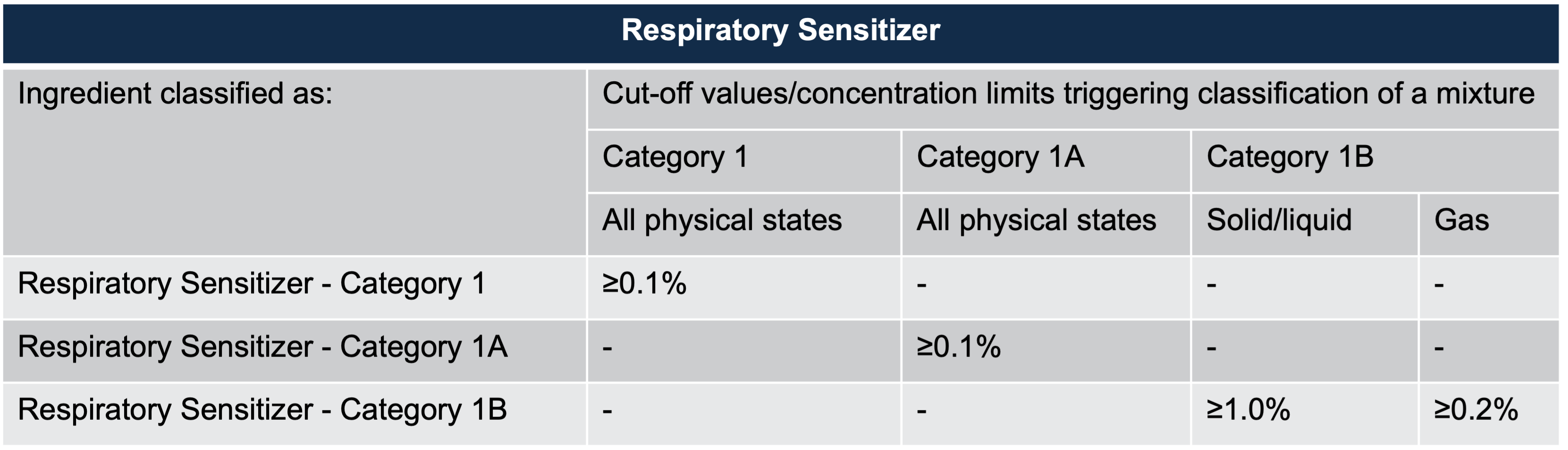 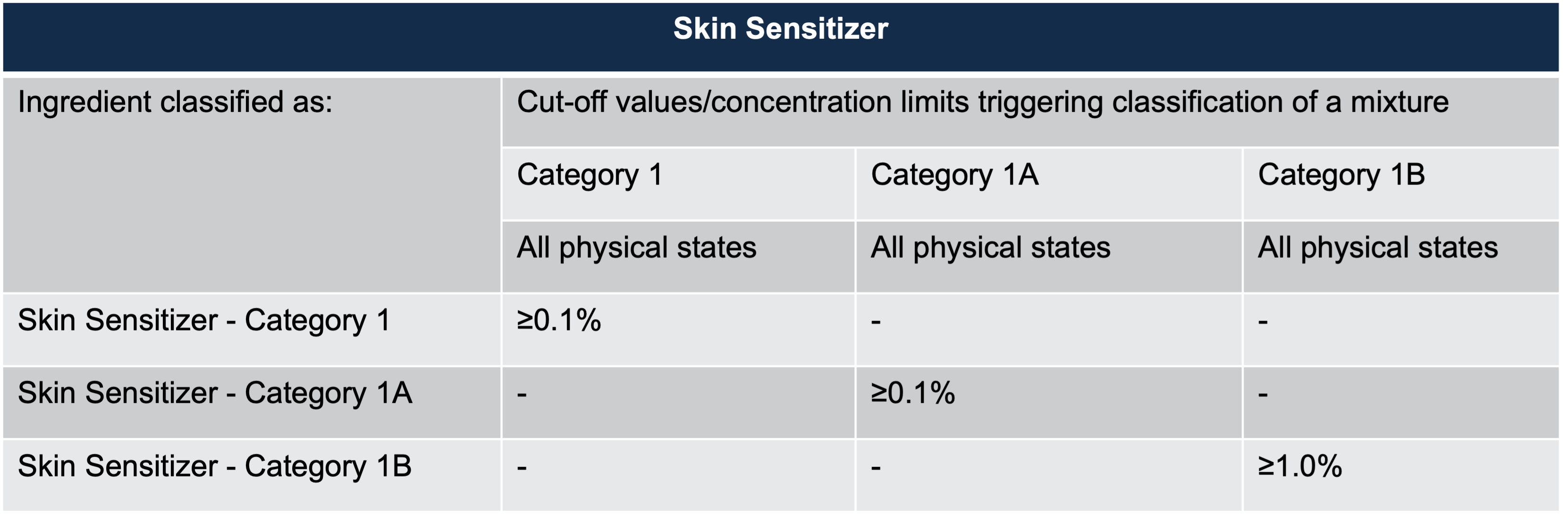
¶ CarcinogenicityPart 8 - Health Hazard Classes; Subpart 6 - Carcinogenicity 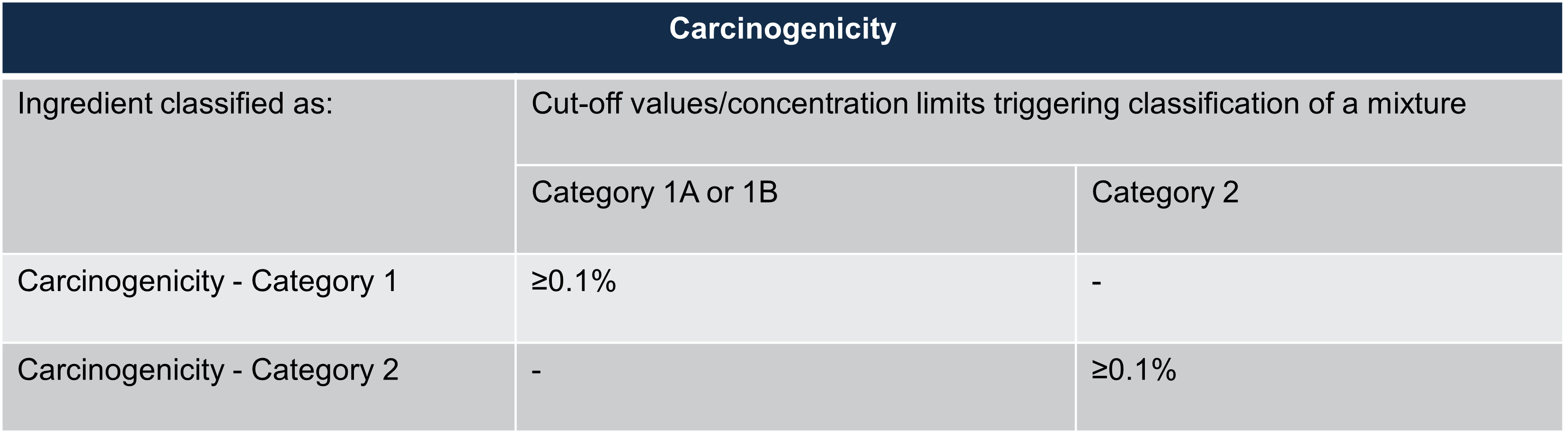 ¶ Reproductive ToxicityPart 8 - Health Hazard Classes; Subpart 7 - Reproductive Toxicity 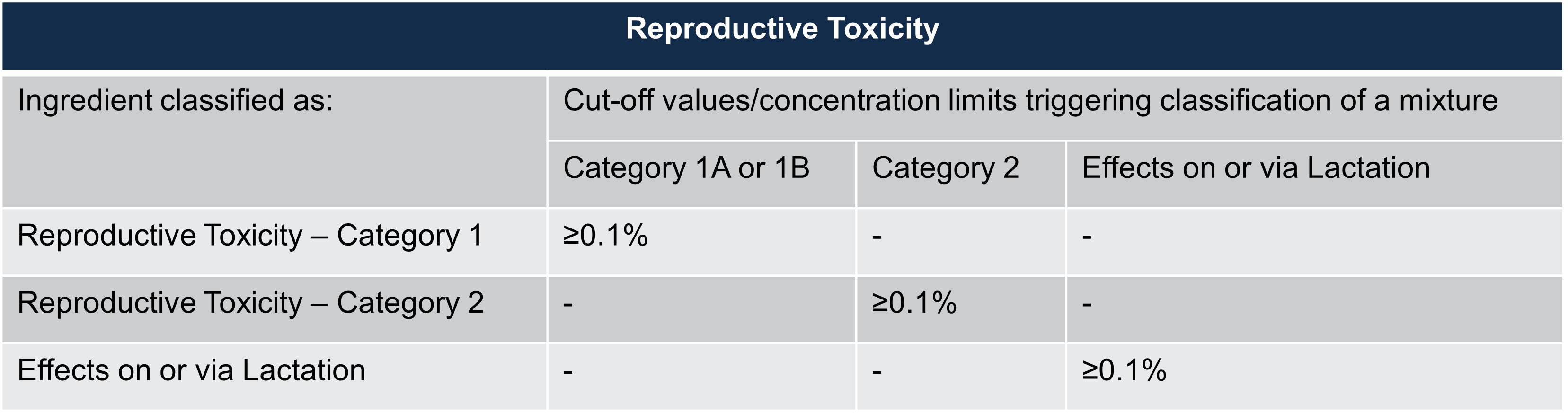 ¶ Specific Target Organ Toxicity - Single Exposure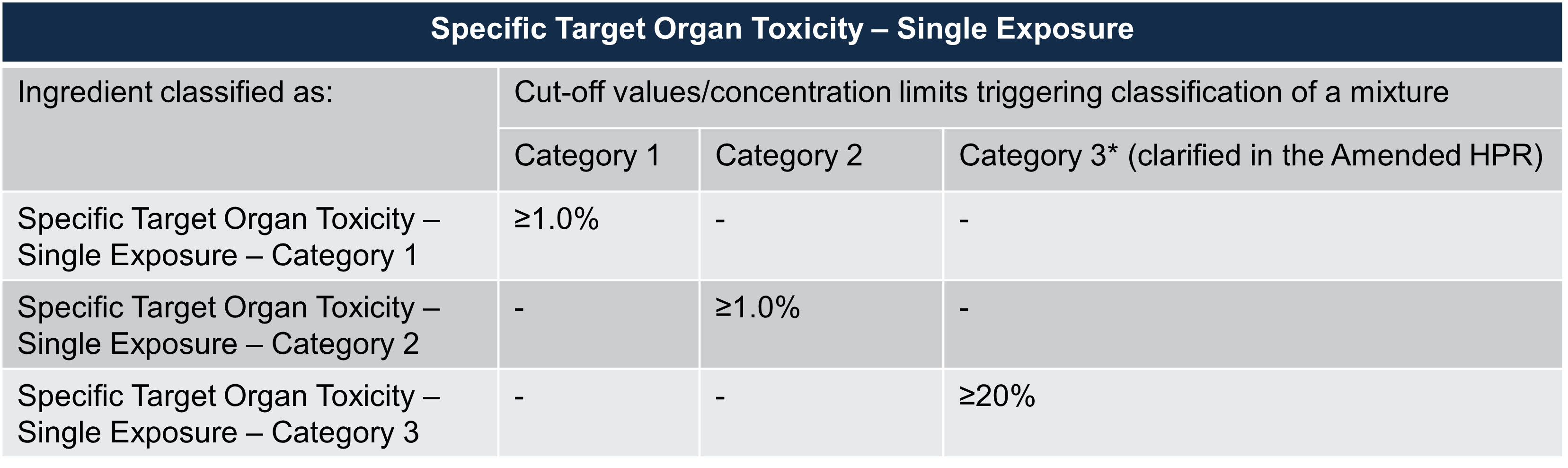 ¶ Specific Target Organ Toxicity - Repeated Exposure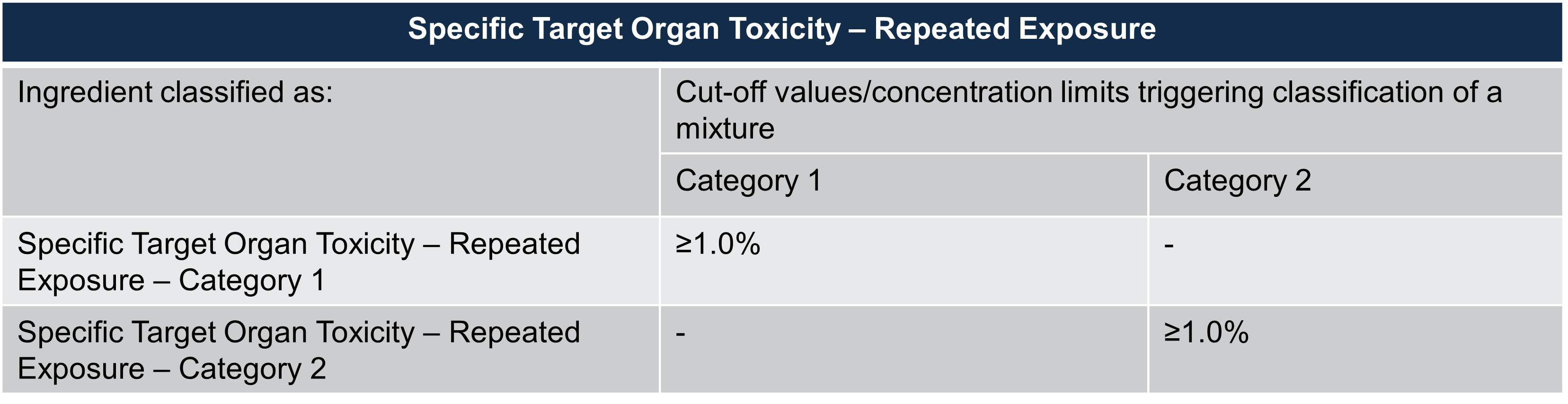
|
|
¶ SDS
A hazardous product may be a product, mixture, material or substance that meets the hazard criteria specified in the HPR and is for products that are for use, handling or storage in a workplace. In Canada, a Safety Data Sheet (SDS) is required for any and all hazardous products that are imported or sold for use in a workplace and for any hazardous product that may be created in the workplace. The HPA requires suppliers of hazardous products to provide labels and SDSs. WHMIS SDS (per the 2022 amended HPR) In the amended HPR, Part 4, Safety data sheet, was updated to better align with Part 3, Labelling, in terms of combining hazard statements and precautionary statements, and deletion of non-applicable precautionary statements. The key changes in SDS requirements in the amended HPR include the following:
WHMIS 2015 SDS Part 4 of the HPR details the Safety Data Sheet (SDS) requirements for hazardous products. It also details the additional requirements for hazardous products classified as Biohazardous Infectious Materials. Schedule 1 gives the information elements for the SDS including the heading for each section and specific information requirements for each section of the SDS. Schedule 2 details the information elements for a biohazardous infectious material appendix to the SDS. The SDS is to be provided for all hazardous products, imported, sold or manufactured, for use in a workplace. All information is to be current and accurate at the time of sale or importation. If information is not available or applicable for a section, a statement to that effect must be present. The information provided on the SDS and label for the product identifier and initial supplier identifier must be the same. Part 6 of the HPR details additional requirements. This includes disclosure of information to health professionals, inspectors, etc. SDSs and labels must be provided in both English and French. For SDSs, the information may appear either on one bilingual SDS or in 2 separate unilingual parts that make a single bilingual SDS.
|
|
¶ LabelThe HPA requires suppliers of hazardous products to provide labels and SDSs. The HPA also defines criteria for sale and/or import for hazardous products containing asbestos. It includes prohibitions in regard to selling and/or importing hazardous products that may have SDSs, labels or packaging that contain false and/or misleading information or create false impressions about the hazards of the substance. The HPR provides the details of the labelling requirements for hazardous products in Part 3 and identifies their symbols and pictograms in Schedule 3. These are in line with GHS with the exception of the Biohazardous Infectious Materials symbol which was carried over from WHMIS 1988. WHMIS Label (per the 2022 Amended HPR) The amendments in hazard classes and categories result in modifications of labelling information to be disclosed on the labels. Therefore, the labelling provisions for the following hazard classes need to be reviewed and followed carefully:
The amended HPR clarifies the label exemptions for certain laboratory samples. The amendments also provide greater clarity on labelling of small-capacity containers (100 ml or less). WHMIS 2015 Label Label elements for the categories especially adopted by Canada are listed in Schedule 5, including Combustible Dusts, Simple Asphyxiants, Pyrophoric Gases, Physical Hazards Not Otherwise Classified, Biohazardous Infectious Materials and Health Hazards Not Otherwise Classified. Part 6 of the HPR details additional requirements. This includes disclosure of information to health professionals, inspectors, etc. SDSs and labels must be provided in both English and French. For labels, the information can appear as a single bilingual label or as two unilingual groups of information that form a single bilingual label. Labelling requirements specific to cosmetics may be found on the cosmetics page.
|
Sources
|
¶ Trade SecretsIn Canada, a supplier can file a trade secret claim with Health Canada under the provisions of the Hazardous Materials Information Review Act (HMIRA) to request an exemption from the requirements under the HPA and HPR to disclose specific information on chemical composition of their products. HPR amendments in 2022 In December 2022, the HPR was amended to align with Rev. 7 and certain provisions of Rev. 8 of the UN GHS. The only modification in the Trade Secret provisions (subsections 4.4.1 and 4.5) is that the amended HPR allows for the use of narrower concentration ranges that fall within the concentration ranges prescribed for the disclosure of hazardous ingredients on safety data sheets. HPR Amendments in 2018 The final Regulations Amending the Hazardous Products Regulations were published on April 18, 2018 and adopt prescribed concentration ranges that may be used on the SDS. This addresses industry's concern when the ranges allowed under the CPR were not initially brought forward to the HPR, creating the need to file trade secret claims to avoid disclosing the exact formulation of the product. As the HPR originally stood, to conceal the identity or concentration of an ingredient which would otherwise be required to be disclosed on the Safety Data Sheet, a claim had to be filed with Health Canada. Please see Highlights of the Amendment for more details. Regardless of the concentration confidentiality provisions, trade secret applications are required to conceal the identity of an ingredient which would otherwise be required to be disclosed on the Safety Data Sheet - a claim must be filed with Health Canada in accordance with the information below. The Hazardous Materials Information Review Act and corresponding Hazardous Materials Information Review Regulations deal with claims and appeals related to the disclosure of confidential business information (CBI). They also provide the criteria for determining the validity of a claim for exemption. The SDS must include an indication of the trade secret claim status including the date of filing or decision (whichever is the latter) and the claim registry number. More information is in the Technical Guidance on the Requirements of the Hazardous Products Act and the Hazardous Products Regulations - WHMIS 2015 Supplier Requirements "When a trade secret claim is filed with Health Canada to protect the chemical name, the supplier must include in the SDS:
Once the claim has been approved, the SDS must indicate that an exemption has been granted, the date of the decision granting the exemption and the claim registry number." "In the circumstance where a concentration or concentration range is protected, suppliers are encouraged to disclose a replacement concentration range on the SDS that encompasses the true concentration or true concentration range, subject to the following conditions:
¶ Using Concentration RangesThe published amendment replaces Section 4.5 of the HPR and officially adopts the use of the 13 listed concentration ranges. The prescribed ranges are: (a) from 0.1 to 1%; Either the actual concentration or one of the prescribed ranges is permitted on the safety data sheet (SDS). As in most countries, when a concentration range is used to protect the actual concentration of a component, a statement to the effect that the actual concentration range is withheld as a trade secret has to be provided. Special provisions are described for cases where an actual concentration varies, and therefore, is a range itself. If the actual range is between 0.1% and 30% and is not included entirely within one of the prescribed ranges, up to two of the ranges from (a) to (g) could be combined. Ranges cannot be combined if the actual concentration range does not include any value within the prescribed range. For example:
If the actual range is included entirely within multiple of the prescribed ranges, any of these prescribed ranges are acceptable. For example, an actual range of 0.7-1% would fall entirely within range (a) and within range (b), so either range may be used. HMIRA claims still need to be filed for the use of ranges to protect CBI that are not one of the prescribed ranges. Additionally, HMIRA claims are needed anytime a company wishes not to disclose the CAS registry number of a hazardous substance that is required to be disclosed on the SDS based on the criteria in the HPR. As a reminder, Section 4.4 of the HPR requires that the classification and information on the SDS must reflect the most hazardous concentration listed for the hazardous substance(s) present in a product.
|
Sources
Resources
On October 21, 2017, in addition to the publication of the proposed amendments to the HPR, a Notice of intent for possible amendments to the Hazardous Materials Information Review Act and the Hazardous Products Act was published, with a comment period ending on November 20, 2017. This Notice addressed topics that will be under future review by the Agency, including concerns regarding CBI claims for carcinogens, mutagens, reproductive toxicants and respiratory sensitizers (CMRRs). Organized labour has requested that Health Canada adopt a similar approach to the EU "whereby suppliers would not be allowed to submit a CBI claim in respect of a substance or ingredient that is a CMRR.” This exclusion for CMRRs is, at this time, only a topic for future review and Health Canada has committed to reviewing these concerns. |
¶ Application Process
¶ Claim SubmissionThe trade secret application process consists of submitting an online application form with the required documents, including:
NOTE that the online application form and the accompanying user guide have been updated. The change is to facilitate streamlining the application and review process. Per the HPR, ingredient disclosure requirements differ for a product that is defined as a substance versus mixtures. As such, there is now a requirement for the claimant "to specify whether the product is a "substance" or a "mixture", as defined by the HPA. For a "substance," there is an additional requirement to identify "whether it is the substance or a stabilizing additive, stabilizing solvent or impurity."
¶ Claim RegistrationAfter the claim is submitted, Health Canada will issue an invoice number and gives the applicant 30 days to complete the payment, so the claim will be registered. Claim registration fee is prescribed in sections 4, 5 and 7 of the Hazardous Materials Information Review Regulations (HMIRR). Fees are adjusted annually, and the amount depends on the business size and the number of claims filed at one time.
¶ Claim ValidationA registered claim is reviewed to ensure it meets the validity criteria outlined in section 3 of the Hazardous Materials Information Review Regulations (HMIRR). The following criteria are checked in the validation process:
The exemption is valid for 3 years, unless a suspension or cancellation affect the decision. The applicant must inform Health Canada if any changes in the composition of the product occurs during the exemption period. After that time period either a new application has to be made or the CBI status has to be dropped on the SDS. The claim applies to a particular product, irrespective of company. As such, it is not necessary to reapply in the case of a company change (such as a merger). However, Health Canada requests that documentation be submitted in such cases. To file an HMIRA claim, complete disclosure of the composition to Health Canada is needed. Health Canada wants to know what the ingredient is to allow use of a different name. Additionally, the generic names used must follow a set of guidelines available upon request from Health Canada - trade names or "Trade Secret Ingredient" are not sufficient. From UL’s regulatory experts' experience, Health Canada has not accepted incomplete compositions. This poses a challenge to industry when the trade secret is owned by an upstream supplier who does not directly ship to Canada. When approached regarding this issue (prior to the Order in Council and subsequent amendment), Health Canada suggested that in such cases, both suppliers submit applications to Health Canada, including a brief explanation that the trade secret information is submitted to be part of the review of the imported product.
|
Claim Application Information pages:
Application form: Claim for exemption under the Hazardous Materials Review Act CBI Review Timeline April 2024 - Health Canada has announced new timelines for reviewing CBI requests. The timeline includes issuing a registry number and responding on the validity of the claims. The allocated time is based on the number of claims:
Health Canada will partially refund submission fees if the turnaround timeline is not met. |
¶ What must be disclosed in Section 3?The information to be included in Section 3 of the Safety Data Sheet is as follows (Section 3 of Schedule 1 of the HPR (Information Elements on Safety Data Sheet)
¶ WHMIS 2015(1) In the case of a hazardous product that is a material or substance, (a) its chemical name; (2) In the case of a hazardous product that is a mixture, for each material or substance in the mixture that, individually, is classified in any category or subcategory of a health hazard class and is present above the concentration limit that is designated for the category or subcategory in which it is classified or is present in the mixture at a concentration that results in the mixture being classified in a category or subcategory of any health hazard class, (a) its chemical name; (d) its concentration*.
¶ WHMIS (per 2022 Amended HPR)(1) In the case of a hazardous product that is a material or substance, (a) its chemical name; (2) In the case of a hazardous product that is a mixture, for each material or substance in the mixture that, individually, is classified in any category or subcategory of a health hazard class and is present above the concentration limit that is designated for the category or subcategory in which it is classified — regardless of whether the material or substance contributes to the classification of the mixture as a hazardous product — or is present in the mixture at a concentration that results in the mixture being classified in a category or subcategory of any health hazard class, (a) its chemical name; *Sections 4.4.1 and 4.5 of the HPR clarify what may be used where "the concentration of a material or substance in a hazardous product is required to be provided on a safety data sheet" and the use of either the actual concentration or the prescribed concentration ranges.
|
|
¶ Occupational Exposure LimitsThe Hazardous Products Regulations (HPR), under the Hazardous Products Act (HPA), details information to be included on the Safety Data Sheet (SDS). Per Schedule 1 (Information Elements of Safety Data Sheets), Occupational Exposure Limits (OELs) or biological limits and the source of those values are to be listed in Section 8 - Exposure Controls/Personal Protection. It is recommended to use the OELs issued by the provincial Occupational Health and Safety agencies.
|
|
¶ Transport |
|
|
Transport Canada, as part of the Government of Canada, is responsible for the Transportation of Dangerous Goods Regulation (TDG). The TDG is based on the 19th Revision of the United Nations Recommendations on the Transport of Dangerous Goods. |
Source Resources |