¶ Recent Updates2026
2025
|
|
¶ Background |
|
|
There are 26 ministries under the State Council in China. The following authorities are in charge of safety supervision and administration of the manufacture, storage, sale and transportation of chemical products: the Ministry of Emergency Management, the Ministry of Ecological Environment, the Ministry of Agriculture and Rural Affairs, the Ministry of Transport, the Ministry of Public Security, and the National Health Commission. China's regulatory system is divided into four levels. The highest level are laws enacted by the People's Congress; the second level are regulations enacted by the State Council in accordance with the law; the third level are measures issued by the Ministries and the fourth level are national standards, which are issued by the Standardization Administration of China. Some standards are mandatory and some are recommended. New chemicals and hazardous chemicals are regulated under separate legislation in China. New chemicals are regulated under the Measures on Environmental Management of New Chemical Substances (China REACH) by the Ministry of Ecological Environment. A registration certificate is required before a new substance can be put on the Chinese market. Hazardous chemicals are regulated under the Regulations on the Safety Management of Hazardous Chemicals (Decree No. 591 of the State Council) by the Ministry of Emergency Management. Manufacturers, importers, users, sellers and storage units of hazardous chemicals must comply with the licensing and registration requirements. On December 27, 2025, the Standing Committee of the National People's Congress approved the Hazardous Chemicals Safety Law which is China’s first legislation dedicated solely to the management of hazardous chemicals. The new law will fully replace the “Regulations on Safe Management of Hazardous Chemicals” (Decree No. 591) on May 1, 2026, and serves as the legal basis for hazardous chemical safety in China. On March 12, 2026, China’s National People’s Congress approved the Ecological and Environmental Code with an effective date of August 15, 2026. The code consists of five parts and 1242 articles, covering pollution prevention and control, ecological conservation, and green and low-carbon development, etc. Part 2 Pollution Control provides rules specifically for chemical substance risk controls, including the new chemical substance registration requirement (Article 644-652). Part 5 contains legal liability for violation of the regulations on chemical substance risk controls (Article 1204-1207). The China Ministry of Ecological Environment Publications, including laws and policies in English can be found at: https://english.mee.gov.cn/Resources/publications/. |
|
¶ Inventories |
|
¶ Inventory of Existing Chemical Substance (IECSC)¶ IECSC-2013The latest consolidated version of the Inventory of Existing Chemical Substances (IECSC) was published in January 2013 by the former Ministry of Environmental Protection of the People's Republic of China (MEP, replaced by Ministry of Ecological Environment in March 2018). IECSC-2013 contains the 1995 core inventory along with 11 supplements (1996, 2000, 2002, 2003, 2004, 2005, 2007, 2008, 2009, 2010 and 2013). IECSC-2013 includes substances manufactured or imported into China before December 2012. IECSC-2013 has over 45000 chemical substances. The majority are listed with a CAS number, and those without (~8500) are assigned a unique serial number. Of substances without CAS numbers, almost half have names marked as confidential. The MEP has released two versions of IECSC-2013, a PDF version and a PC software version. Both provide information on Chinese chemical name, English chemical name, molecular formula, and CAS number or serial number. The PDF version can be downloaded for free from the MEE website, while the PC software version can be purchased from the China Solid Waste and Chemicals Management Centre of Ministry of Ecology and Environment of China (MEESCC). ¶ SupplementsSeveral supplements to the inventory have been published. These supplements add chemicals to the inventory that have been registered under the Measures on the Environmental Management of New Chemical Substances (China REACH) and are therefore now regulated as existing chemicals in China. These substances are part of the IECSC inventory, but have not yet been published in a consolidated version. 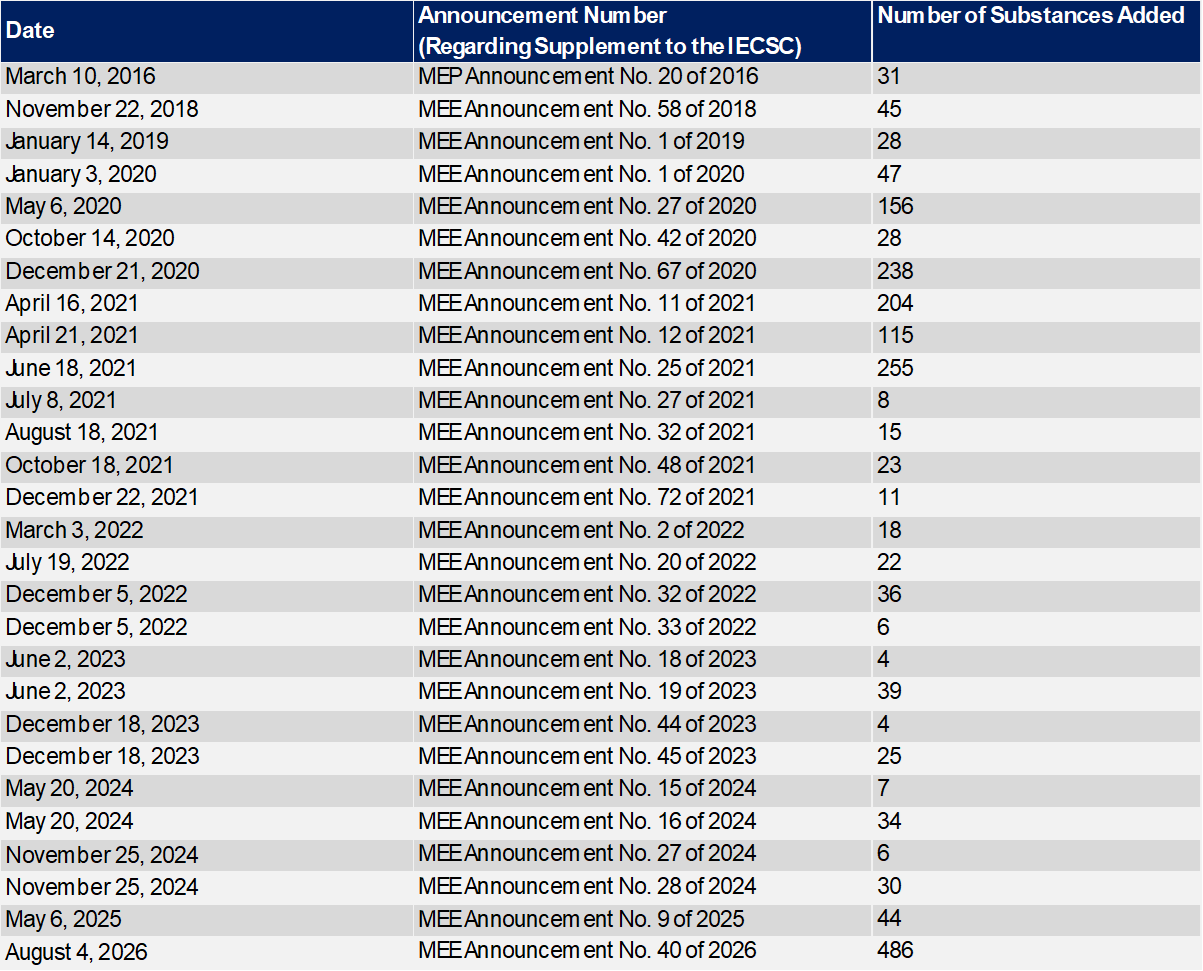
¶ Searching the InventorySubstances not listed on the inventory are considered new chemical substances. Companies must submit a new chemical registration with the MEE under China REACH before they can place these on the Chinese market. If a substance cannot be found on the inventory, submission of a formal search request to the MEESCC is recommended. This affirmation process prevents applicants from notifying an existing substance that may be listed without a CAS Number or as a confidential substance. The applicant should submit the request electronically through the New Chemical Substance Affirmation Software, downloadable from the MEESCC website. The request should include the CAS number, Chinese and English chemical name, molecular structure and formula of the substance in question. MEESCC charges 3000 RMB per substance to check the inventory status. |
Sources
Resources *Not available in English
|
¶ Substance Registration |
|
¶ Registration of New Chemical SubstancesOn April 29, 2020, the Ministry of Ecology and Environment (MEE) issued the Measures on New Chemical Substance Registrations for Environmental Management under Ministry Order No. 12, which took effect on January 1, 2021. On October 26, 2026, MEE issued revised Measures under Ministry Order No. 40, replacing Order No. 12. The revised Measures took effect upon publication. The Measures regulate the production and import of new chemical substances in or to China. Manufacturers or importers must obtain the applicable environmental management registration certificate before producing or importing a new chemical substance. Chemical substances not listed on the Inventory of Existing Chemical Substances (IECSC) are considered new. Substances listed on the IECSC that are subject to new-use environmental management are also managed as new chemical substances when they are intended for industrial uses other than the permitted uses.
¶ Who Can Register?Applicants must be manufacturers or importers of new chemical substances that are legally registered in China and capable of independently assuming legal liability. Foreign manufacturers and exporters can no longer apply through a Chinese agent.
¶ Registration TypeThe new measures prescribe three types of registrations of new chemical substances:
¶ Trade SecretApplicants may request trade secret protection for information submitted with a registration application. The request must be supported by materials demonstrating the need for protection. Information that may significantly affect environmental or public health interests may not be protected. Identifying information, such as the name of a new chemical substance, may be protected for up to five years from the date of first registration.
¶ Guidance on New Chemical Substance RegistrationsOn November 16, 2020, in order to implement MEE Order No. 12 and provide detailed instructions on new chemical registrations, the MEE issued the Guidance on New Chemical Substance Registrations for Environmental Management, which replaced the Guidance issued by the former MEP in 2010. The requirements below are based on the Guidance on New Chemical Substance Registrations for Environmental Management issued in 2020. As of October 2026, updated guidance implementing the revised Measures has not yet been issued. This following information will be updated when new guidance becomes available. The Guidance contains the following eight chapters:
¶ Information to Submit - Regular RegistrationRegular Registration Application Form Part I: Registrant information
Part II: Basic information on the regular registration
Part III: Information on the registered substance
Part IV: Exposure information of the registered substance
Part V: Inherent properties of the registered substance
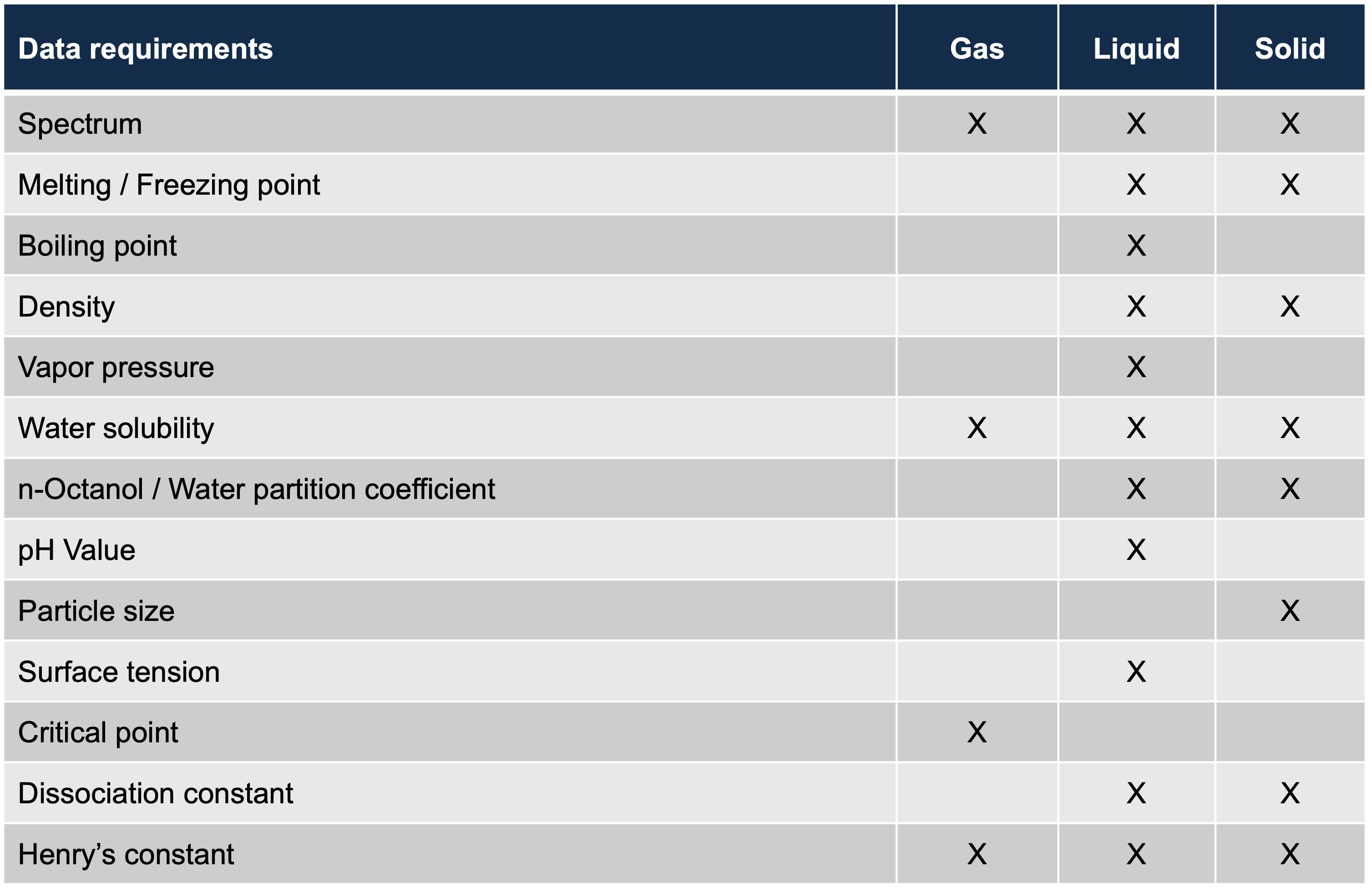
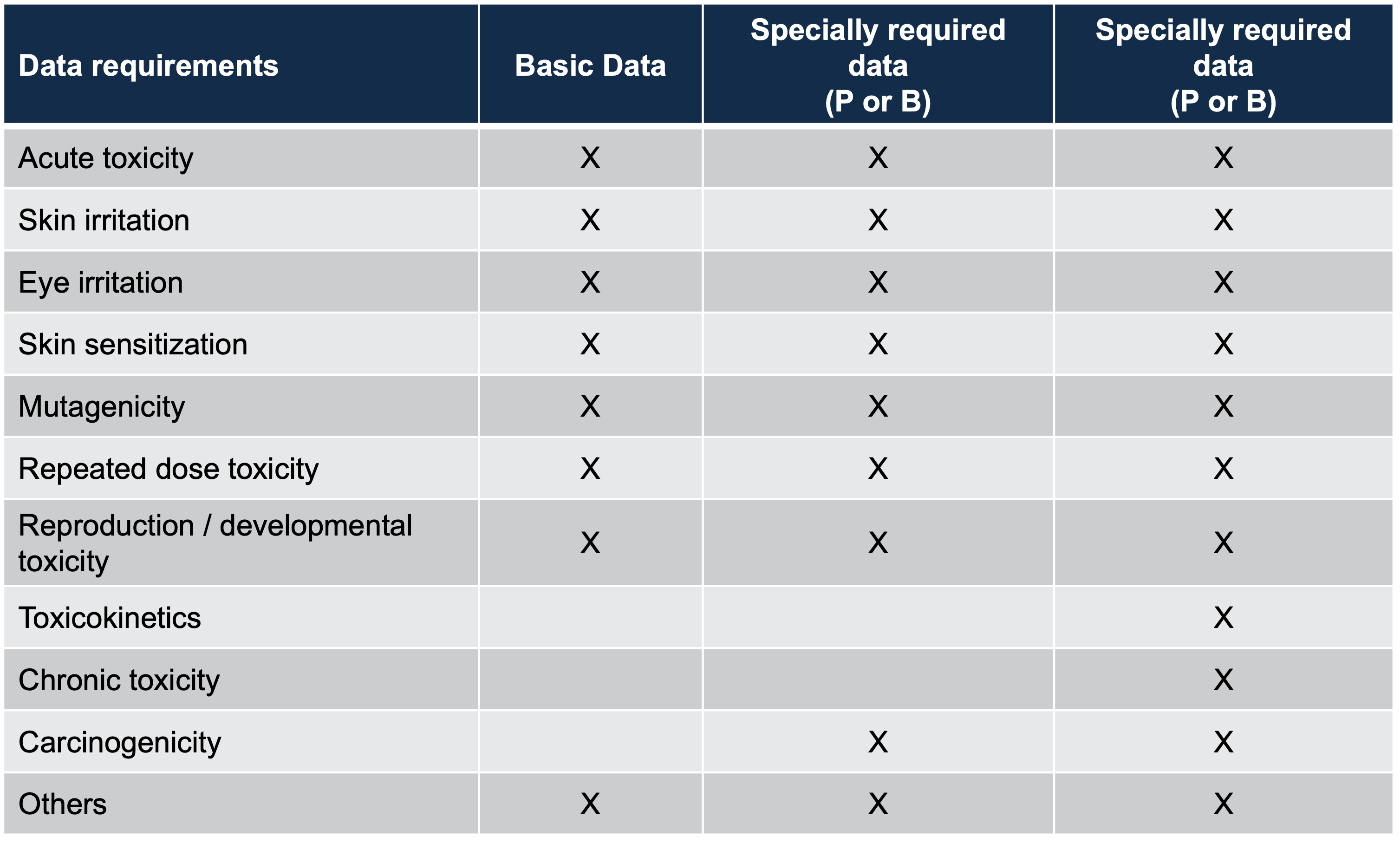
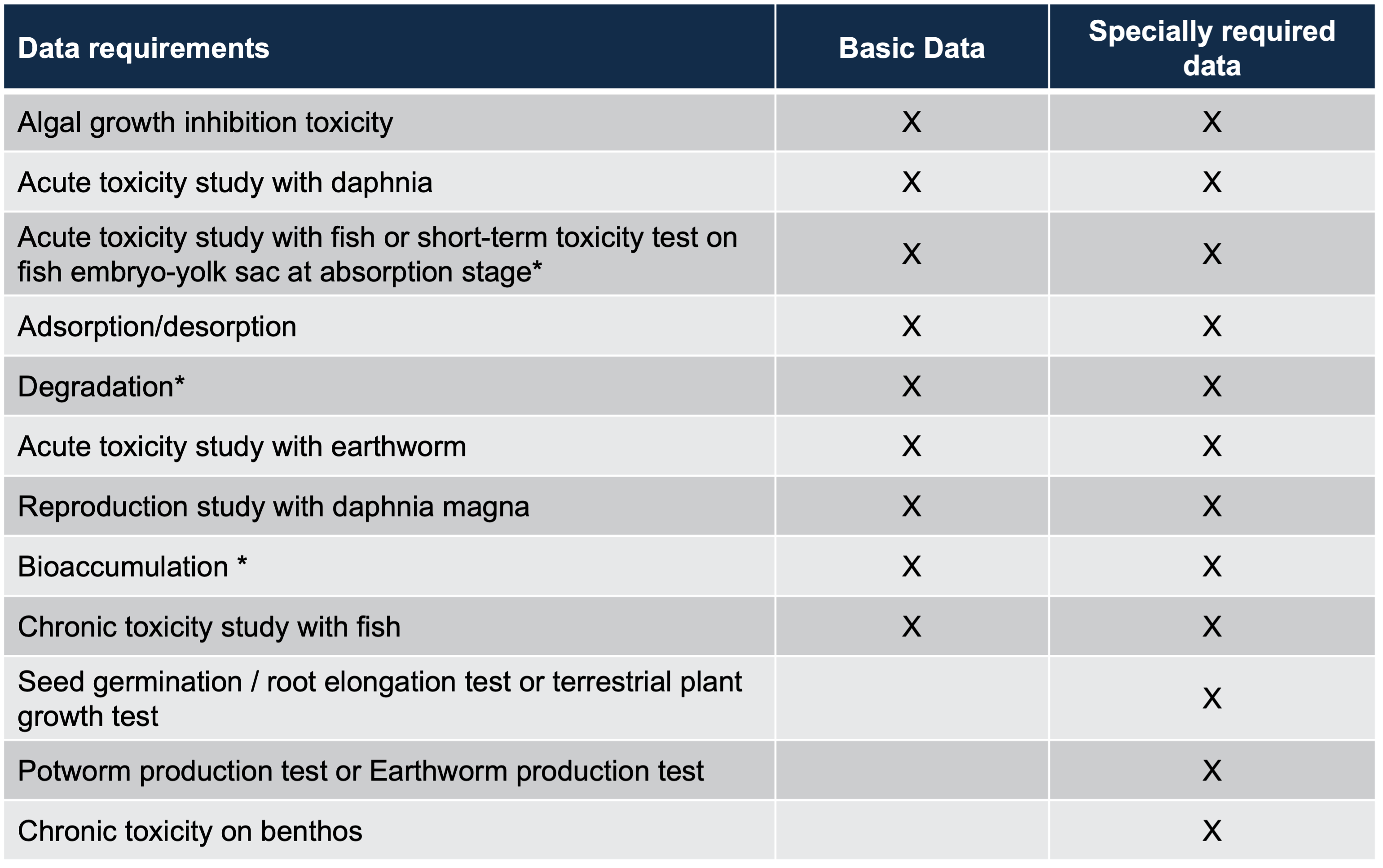 * Ecotoxicology test shall be done using test species from China Part VI Other information
Part VII Special Conditions
¶ Attachments
¶ Information to Submit - Simplified RegistrationRegular Registration Application Form Part I: Applicant information
Part II: Basic information on the registration
Part III: Chemical information
Part IV: Exposure information of the registered substance
Part V: Inherent properties of the registered substance
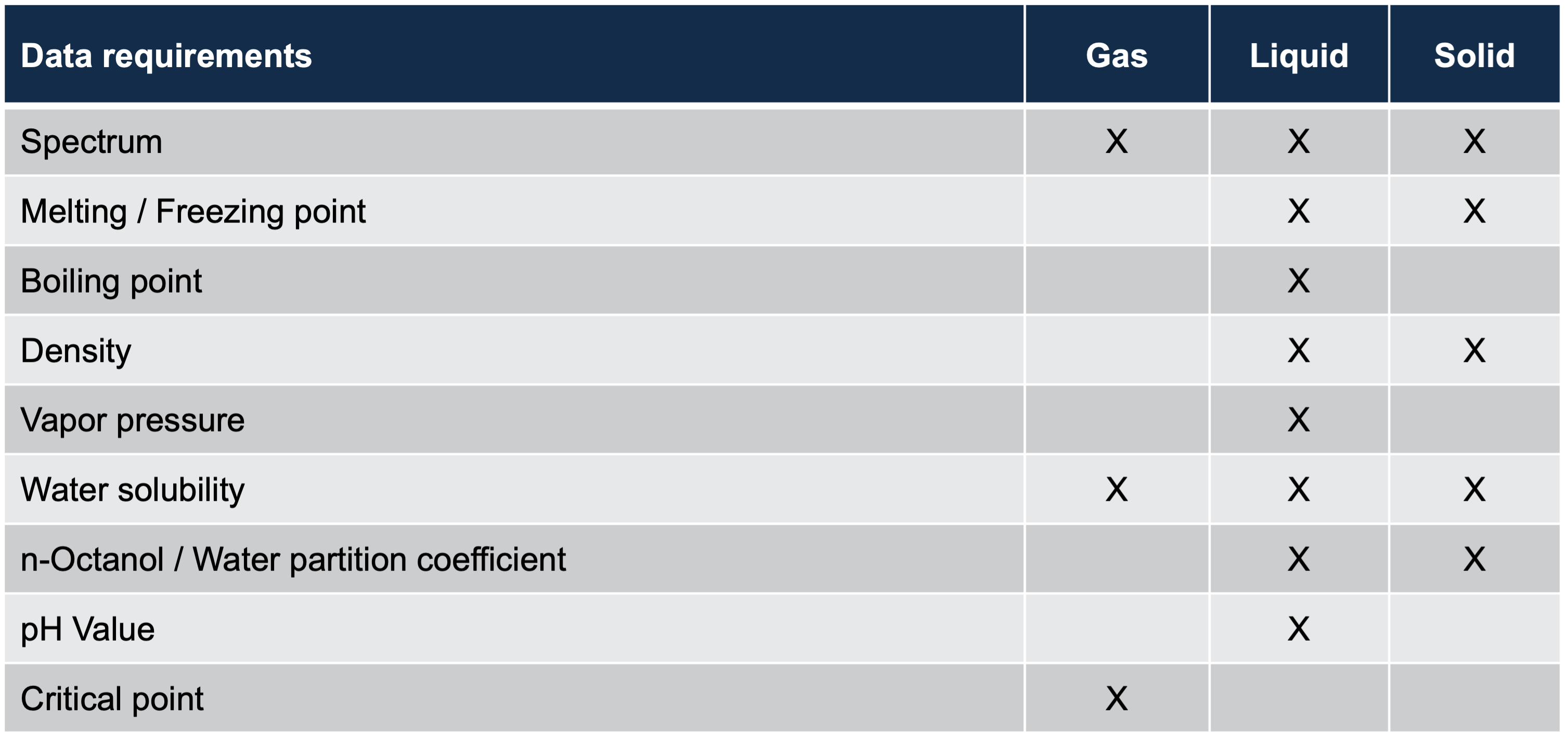
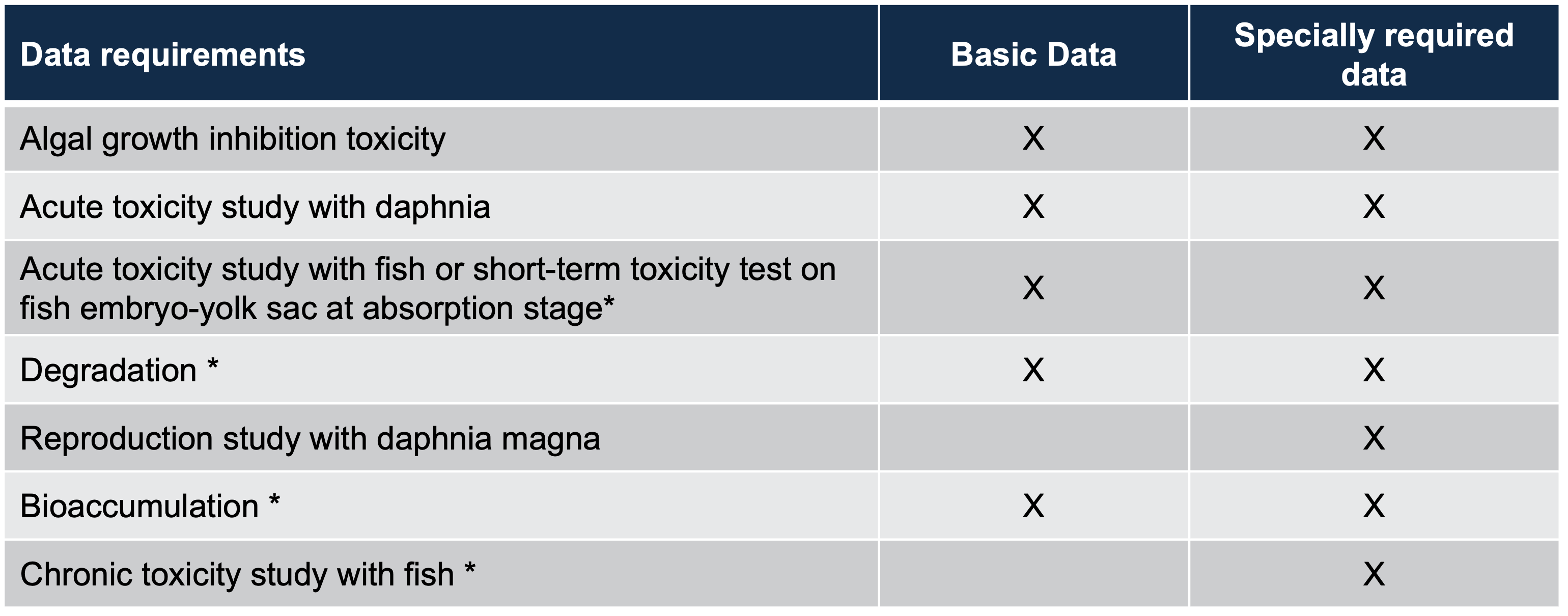 * Ecotoxicology test shall be done using test species from China Part VI Other information
Part VII Special Conditions
¶ Attachments
¶ Information to Submit - Record FilingRecord Filing Application Form Part I: Applicant information
Part II: Basic information on the Record filling
Part III: Special requirements for 2% polymer and polymer of low concern
Part IV: Physical and chemical, toxicological and eco-toxicological properties (if any)
¶ Attachments
¶ More about polymer of low concernPolymers of low concern shall meet one of the following conditions:
Record filing is a reporting process to MEE. Activities can be carried out immediately after submitting complete record filing materials.
¶ ExclusionsThe following five polymers are excluded from the record-keeping filing and are subject to simplified or regular registrations
¶ ExemptionsThe following chemical substances are exempt from the new chemical registration requirements:
¶ Procedure and Timeline
¶ Regular Registration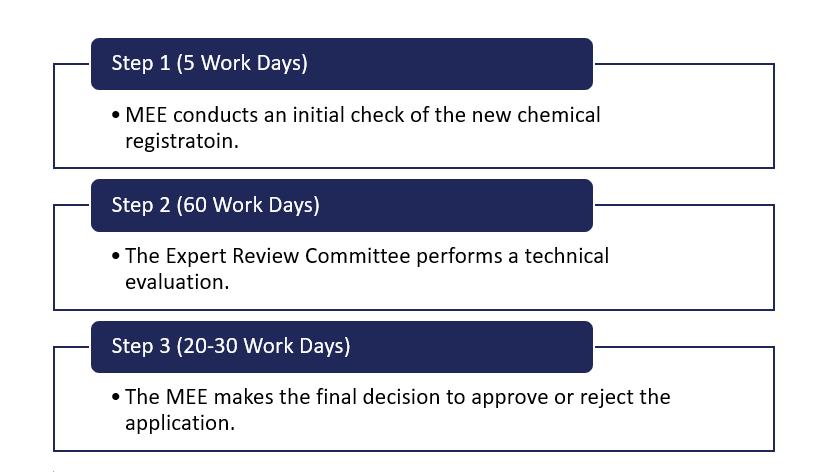
¶ Simplified Registration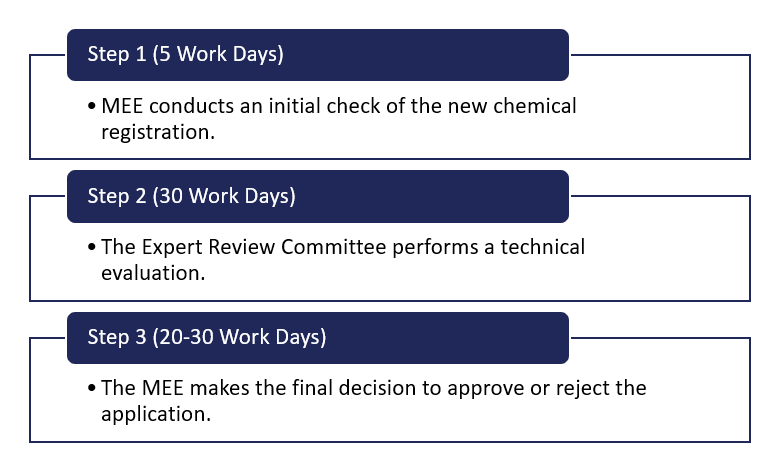
¶ Record KeepingApplication material and activity record (such as first activity report, annual report etc.) should be kept for a minimum of 10 years for regular registrations and simplified registrations, and a minimum of 3 years for record filing.
¶ Application FeeThe MEE doesn't charge a fee for processing new chemical registrations.
¶ SubmissionApplicants should submit application materials through the online registration system of the MEE Service Platform. When the applicant does not have the information about the new chemical substance, the information may be submitted at once by a third party.
¶ Key Changes Introduced by MEE Order 40The revised Measures are intended to implement relevant provisions of China’s newly adopted Ecological and Environmental Code and strengthen the registration framework for new chemical substances. Key changes include:
|
Sources
Resources *Not available in English
|
¶ Registration of Hazardous Chemicals with SAWSThe Measures for the Administration of Registration of Hazardous Chemicals (2012) were issued under the SAWS Order 53 and came into force on August 1, 2012. According to the measures, registration is required for chemicals classified as hazardous in accordance with the China GHS standards. Chinese manufacturers and importers of hazardous chemicals must register their products with the National Registration Center of Chemicals (NRCC) prior to manufacture or import. Registration is mandatory for two types of hazardous chemicals:
The new Hazardous Chemicals Safety Law introduces an exemption to the hazard chemical registration requirement. Hazardous chemical products used in research and development, trial production and trial sales can be exempted from the registration if they are produced and released in low quantities and pose low exposure risks. However, the law doesn't specify quantitative thresholds or administrative procedures for applying the exemption. Implementation measures covering the exemption are expected to be formulated by the Ministry of Emergency Management in conjunction with other agencies. ¶ Catalogue of Hazardous Chemicals (2015)On March 9, 2015, the former State Administration of Work Safety (SAWS, replaced by the Ministry of Emergency Management), jointly with nine other administrative departments, published the Catalogue of Hazardous Chemicals (2015). On May 1, 2015, the new Catalogue replaced the Catalogue of Hazardous Chemicals (2002). The 2015 Catalogue contains 2,828 entries that are classified as hazardous chemicals, including 148 chemicals with acute toxicity, according to the 4th revised edition of UN GHS. Hazardous chemicals in the new Catalogue include pure chemicals as well as mixtures. However, chemicals with the following less hazardous categories are not included in the new Catalogue:
Manufacturers and importers of hazardous chemicals listed in the Catalogue shall register with the National Registration Center for Chemicals. In November, the Ministry of Emergency Management (MEM) released MEM Announcement No. 8 of 2022 to replace "Diesel fuels (with closed-cup flashpoint <=60℃)" with "Diesel fuels" for entry 1647 of the Catalogue. All diesel fuels, irrespective of their flashpoints, will be regulated as hazardous chemicals starting from January 1, 2023. On April 16, 2026, the Ministry of Emergency Management published Announcement No. 3 of 2026 on the Addition of 5 Chemicals to the Catalogue of Hazardous Chemicals. The newly added chemicals become subject to full hazardous chemical control, including the requirements on production license and operation license, mandatory registration with the National Registration Centre of Chemicals, and hazard communications.
¶ Other hazardous chemicals with unknown hazard propertiesFor chemicals with unknown physical hazard properties, the SAWS published Measures for the Administration of Physical Hazard Identification and Classification of Chemicals (SAWS Order 60) in July 2013. The Measures entered into force on September 1, 2013. Three types of chemicals with unknown hazard properties are subject to physical hazard identification and classification:
On December 27, 2016, Chemical's Physical Hazards Identification and Classification Technical Committee released the Catalogue of Chemicals Exempted from Physical Hazard Identification and Classification. Except for the chemicals listed on this Catalogue, any hazardous chemicals with unknown physical hazard properties shall be evaluated by a SAWS-approved institution in China prior to registration. On November 14, 2016, the SAWS announced the first batch of approved testing institutions that may conduct physical hazard identification for chemicals. The institutions appearing on this list are authorized to provide identification reports for chemicals with unknown physical hazards. The approval is for three years and the accredited institutions include: 1. China Academy of Safety Science and Technology (中国安全生产科学研究院) Chemical manufacturers/importers should compile a Hazard Classification Report, based on the Identification Report provided by one of the approved institutes, and submit the Report to NRCC for evaluation and registration. ¶ Required DocumentsIn April 2013, the NRCC launched a new online registration system, called HazChem Registration Information Management System. Required registration information to be submitted to NRCC via the registration system includes:
*What is a major hazard installation? *Major hazard installation refers to a unit that manufactures, processes, uses or stores hazardous chemicals in quantities equal to or exceeding the threshold values specified in the national standard GB 18218-2018 (Identification of Major Hazard Installations for Hazardous Chemicals). In addition to the registration information provided online, registrants shall submit the following paper documents to the local registration office:
*More about emergency response phone number *The emergency phone number should be accessible 24/7. The phone should be a landline phone in a fixed office in China. The professional answering the call should be familiar with hazardous properties of the chemical products and emergency response procedures, and be able to answer questions accurately. NRCC provides State Emergency Consulting Hotline for chemical accidents (0532-83889090) with an annual service fee. Chemical companies may apply to NRCC to subscribe to the emergency hotline service.
¶ Registration Procedures and TimelinesRegistrants shall submit their applications via the online registration system and submit registration documents to their local hazardous chemical registration offices. Within 20 business days from receipt of the documents, the local registration office shall evaluate and forward qualified applications to NRCC. NRCC will issue or reject a registration certificate within 15 business days. The registration certificate is valid for 3 years and must be renewed 3 months prior to the certificate's expiry date.
¶ Registration FeeThe NRCC doesn't charge a fee for processing hazardous chemical registrations.
¶ Inspection Rules for Imported Hazardous ChemicalsOn April 7th, 2023, General Administration of Customs (GAC) released an announcement on Further Strengthening the Inspection and Supervision of Imported Hazardous Chemicals (GAC No. 29 of 2023). The Announcement becomes effective on April 13th, 2023. According to the Announcement, the consignee or agent of imported hazardous chemicals shall submit the following information onto the "China International Trade Single Platform" for declarations of hazardous chemicals, including:
In addition, the consignee or agent need to upload the required materials in the announcement of the General Administration of Customs No. 2020 of 129 (Announcement on Issues Related to the Inspection and Supervision of Import and Export of Hazardous Chemicals and Their Packaging), including:
|
Sources Measures for the Administration of Registration of Hazardous Chemicals* (SAWS Order 53) Measures for the Administration of Physical Hazard Identification and Classification of Chemicals* (SAWS Order 60) Identification of Major Hazard Installations for Hazardous Chemicals* (GB 18218-2018) The First Batch of Approved Institutions for Chemicals’ Physical Hazard Identification* (SAWS Announcement No. 7 of 2016) Catalogue of Hazardous Chemicals (2015)* Catalogue of Chemicals Exempted from Physical Hazard Identification and Classification* Resources
*Not available in English |
¶ Registration of Toxic Chemicals for Import/ExportImporting or exporting toxic chemicals on the Catalog of Severely Restricted Toxic Chemicals requires a Customs Clearance Notification prior to import or export. In October 2023, the Ministry of Ecological Environment of the People's Republic of China (MEE) released Announcement No. 32 of 2023, jointly with the Ministry of Commerce and the General Administration of Customs, on releasing the Catalog of Severely Restricted Toxic Chemicals (2023). The new Catalog replaced the Catalog published under Announcement No. 60 of 2019 and became effective on October 18, 2023. Restricted chemicals in the Catalog include:
Importers/Exporters must apply to the MEE for the Clearance Notification for Environmental Management on the Import/Export of Toxic Chemicals. The Customs of the People's Republic of China shall examine and clear the import or export of toxic chemicals included in the Catalog according to the Clearance Notification signed and issued by the MEE. Applications of Import Clearance Notification shall be submitted online through the National Integrated Online Government Services Platform. The required application documents include:
There is no fee charged for the application of Import/Export Clearance Notification. The total processing time shall be no more than 20 working days from the receipt of the completed application materials. The Clearance Notification is valid for 6 months. |
Sources Catalog of Severely Restricted Toxic Chemicals (2023)* Resources National Integrated Online Government Services Platform*
*Not available in English |
¶ Product Registration |
|
¶ PesticidesRegulations on Pesticide Administration were first promulgated by the State Council of China in 1997 and revised in 2001. On March 16, 2017, the State Council published the newly updated Regulations on Pesticide Administration (Decree No. 677 of the State Council of China) with an effective date of June 1, 2017. Companies manufacturing or importing pesticide products must register with the Institute for the Control of Agrochemicals under the Ministry of Agriculture and Rural Affairs. The registration of the pesticides domestically produced or imported for the first time shall be conducted in two stages: Field test stage: The developer should apply for a field test to apply for a pesticide registration. The test may only be performed after the application is approved. Pesticides at this stage cannot be sold. Registration stage: The manufacturer may apply for the registration once a pesticide has been proven ready for commercial distribution. Production and distribution of the pesticide may only commence after the Pesticide Registration Certificate is issued by the Ministry of Agriculture and Rural Affairs. Registration requires the following documents:
The timeline for processing a pesticide registration is 20 work days for preliminary review by the agricultural authority at the provincial level and 9 months for the technical evaluation of the product chemistry, toxicology, efficacy, residue, environmental impact, and labeling ect., by the Ministry of Agriculture and Rural Affairs. A registration Certificate is valid for 5 years and shall be renewed 3 months before the expiry date. Temporary registration stage has been cancelled by the Regulations on Pesticide Administration (2017). The application fee for registration of pesticides was cancelled on April 1, 2017 under the No. 20 [2017] of the Ministry of Finance.
¶ Testing LaboratoriesAccording to Article 16 of the Measures for the Management of Pesticide Registrations, the registration testing report shall be supplied by Chinese laboratories approved by the Ministry of Agriculture and Rural Affairs, or overseas laboratories that have a mutual recognition agreement with the relevant Chinese Authority. However, the tests for efficacy, residue, environment, and others tests that are closely related to environmental conditions and Chinese specific species shall be conducted in China. The database of approved testing laboratories is available from the Institute for the Control of Agrochemicals, Ministry of Agriculture (ICAMA) website: China Pesticide Information Network. ¶ LabelingIn addition to registration requirements, pesticides must adhere to certain labeling requirements. According to the Regulations on Pesticide Administration, packages must have labels or directions for use that include the following information:
Requirements on the traceable electronic information code According to the Notice published by the former Ministry of Agriculture (MOA, replaced by the Ministry of Agriculture and Rural Affairs in March 2018), MOA Announcement No. 2579: Administrative Provisions on 2D Barcodes on Pesticide Labels, pesticide labels must include a traceable electronic information code. The code shall be presented in the form of a barcode compliant with the following requirements:
The requirements on the barcode come into force on January 1, 2018. Pesticide manufacturers and enterprises that export pesticides to China shall set up a tracking systems for their pesticide products. The tracking website for searching production batches, quality inspection and other information can be viewed on a PC or a mobile phone.
¶ Implementation MeasuresThe MOA published the following five supporting measures for implementation of the new Regulations on June 21, 2017 under the Ministerial Orders:
The new measures came into effect on August 1, 2017.
|
Sources
*Not available in English
|
¶ Drug PrecursorsAccording to the Provision on the Management of Import and Export of Precursor Chemicals, precursor chemicals are "main raw materials and chemicals that can be used for drug making listed in the Regulations on the Administration of Precursor Chemicals." Precursor chemicals are divided into three categories:
The detailed classification and types of precursor chemicals are listed in the Table annexed to the Regulations on the Administration of Precursor Chemicals. Anyone who manufactures any Category I precursor must acquire a license from the China Food and Drug Administration (CFDA) (pharmaceutical precursor chemicals) or the Work Safety Administration at the provincial level (non-pharmaceutical precursor chemicals) prior to production. Anyone who manufactures any Category II or Category III precursor must report information to the Work .Safety Administration at the city level for their records within 30 business days of production. Import and export enterprises must have a license for importing/exporting the regulated precursor chemicals from the the competent commerce department. Required application documents include:
The competent commerce department accepting the application for the import or export of precursor chemicals shall, within 20 days from the date of receipt of the application materials, examine the application materials, and conduct on-site inspection when necessary. For the import of pharmaceutical precursor chemicals in Category I, the consent from the Food and Drug Administration Department of the State Council shall be obtained before the relevant competent commerce department makes the approval decision.. There is no fee charged for application of the license.
|
Sources
*Not available in English |
¶ CosmeticsChina Cosmetics are regulated by the National Medical Products Administration (NMPA) under the Cosmetic Supervision and Administration Regulation 2020. ¶ Definition"Cosmetics" refers to chemical products in daily use that are applied on the external part of the human body such as skin, hair, nails and lips, by way of rubbing, spraying or other similar methods for the purposes of cleaning them, protecting them, improving or changing the appearance. Cosmetics are divided into the categories of special cosmetics and ordinary cosmetics. Cosmetics that are used for hair dyeing, hair perming, spot removal and whitening, UV protection, and hair loss prevention, and cosmetics that claim new effectiveness are called special cosmetics. All cosmetics other than special cosmetics are called ordinary cosmetics.
¶ New Ingredient RegistrationNew cosmetic ingredients not listed in the Inventory of Existing Cosmetic Ingredients in China (IECIC) must be registered with the NMPA prior to their first use in cosmetic products. Cosmetic products that contain a new ingredient not listed on IECIC or a prohibited ingredient specified in Safety and Technical Standards for Cosmetics 2015 won't be approved by the NMPA. On October 8, 2026, NMPA published the Announcement on the Implementation of the Revisions to the Safety and Technical Standards for Cosmetics. The revisions include updates to the lists of prohibited, restricted, and permitted cosmetic ingredients, revised limits for microorganisms and harmful substances, and updated testing methods. The revisions take effect on January 1, 2027.
¶ Required application materials
¶ Application feeNMPA doesn't charge a fee for the application. ¶ Annual reportNMPA requires an annual report for the first 3 years after the new ingredient is used in a cosmetic product. If there is no safety issue, the ingredient will be added to the IECIC.
¶ Registrations for Cosmetic ProductsThe state implements registration management for special cosmetics and record management for ordinary cosmetics. Special cosmetic products must be registered with the NMPA prior to manufacture or import. Domestic ordinary cosmetics shall be notified to the drug administration in the province, autonomous region, or municipality where the applicant is located before being put on the market. Imported ordinary cosmetics shall be notified to the NMPA prior to the import. Overseas cosmetics applicants shall appoint a Chinese legal entity for cosmetics registration and record-filing, assisting in the monitoring of cosmetic adverse reactions, and implementing product recalls. ¶ Required application materials
¶ Application feeNMPA doesn't charge a fee for the application. ¶ Animal TestingAnimal testing may be waived for ordinary cosmetics, e.g. makeup, moisturizer, shampoo, and perfume. However, animal testing is still required for the following two types of ordinary cosmetics:
Animal testing is required for special cosmetics, e.g. sunscreens and hair dying products.
¶ SoapSoaps without efficacy claims are not regulated as cosmetics under the Regulations. Soaps with efficacy claims, such as whitening and sun protection, are required to register as special cosmetics and obtain a registration certificate. ¶ ToothpasteToothpastes are regulated as ordinary cosmetics under the Regulations. State Administration for Market Regulation (SAMR) promulgated Provisions for Toothpaste Regulation under SAMR Decree No. 71 in 2023. Production, marketing and supervision of toothpaste in China should comply with Provisions. New toothpaste ingredients shall be registered or filed according to the degree of risk. New toothpaste ingredients with functions such as preservative, colorant should be registered with NMPA, while other new toothpaste ingredients shall be subject to filing management under the Provisions. Toothpaste shall be filed with the NMPA or the local Drug Supervision and Administration Department prior to importation or production. |
Sources
*Not available in English 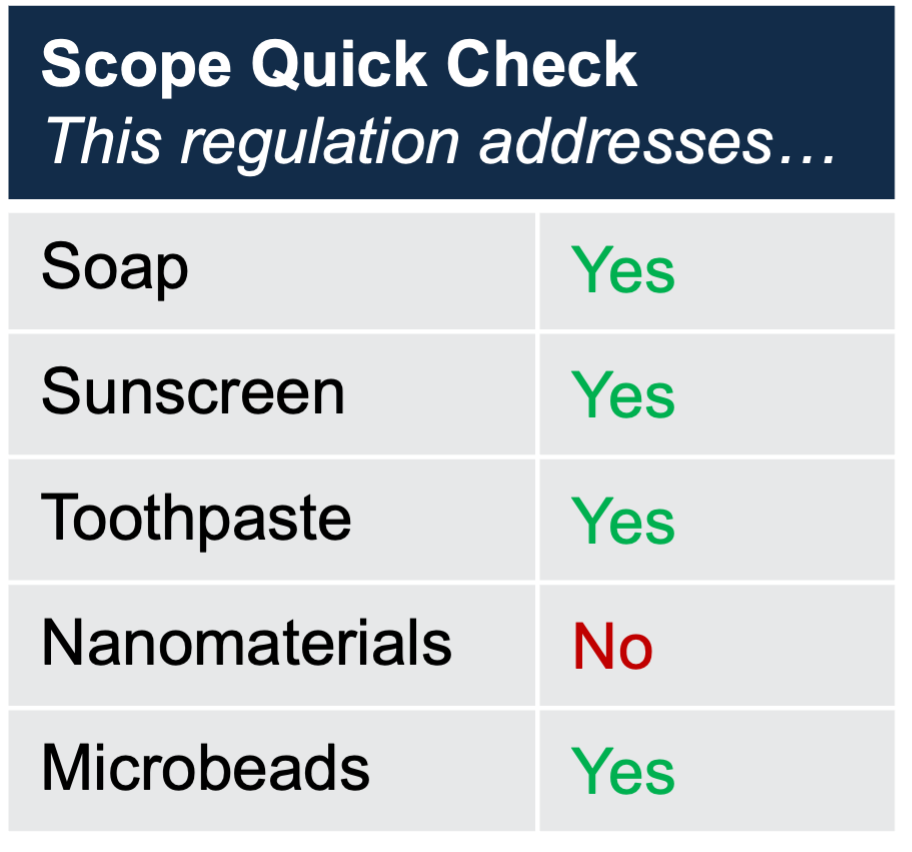 |
¶ LabellingMeasures for the Administration of Cosmetic Labeling On June 3, 2021, China’s National Medical Products Administration (NMPA) released the Measures for the Administration of Cosmetic Labeling (the “Measures”), which describe requirements on labeling of cosmetic products. NMPA encourages the registrant or filer of cosmetics to label the product in accordance with the new Measures from date of publication of this announcement, and the new requirements will come into force on May 1, 2022. The cosmetics label should contain the following contents:
For products with packaging boxes, the Chinese product name and expiry date of the product should also be marked on the container that directly contacts the product. The label must be in Simplified Chinese, but other languages may be used together with the Chinese. Except for registered trademarks, the size of the Chinese fonts on the label should be equal to or larger than the font size of other languages. For small size cosmetic products with the net content not greater than 15g or 15mL, the following information should be provided on the sales packaging:
Other information can be indicated in the instructions attached to the products. |
Sources
*Not available in English |
¶ Provisions on Children's Cosmetic ProductsOn October 8, 2021, the NMPA issued the Provisions on the Supervision and Administration of Cosmetics for Children in order to strengthen the supervision of children's cosmetic products and ensure that the products are safe for use on children. Children’s cosmetics refer to cosmetics that are suitable for children 12 years of age or younger and have the functions of cleansing, moisturizing, body conditioning, and sun protection. According to the Provisions, the cosmetics registrants and record-filing applicants are responsible for the quality, safety and efficacy claims of children's cosmetic products. Research and development of children’s cosmetics should follow the principles of science and necessity and be based on children's physiological characteristics and possible application scenarios. Cosmetics for children should be labelled with children's cosmetics logos prescribed by the NMPA on the display surface of the sales package. On December 1st, 2021, the NMPA announced the exclusive children’s cosmetics logo named “Little Golden Shield”:  Introductory words such as "Caution" or "Warning" should be used and warning phrases such as "Use Under Adult Supervision" should be marked on the visible side of the sales package. The Provisions require that the registrants, record-filing applicants, and entrusted manufacturers should take measures to avoid the confusion of the properties, smell, and appearance of cosmetics for children with these of food, drugs, and other products, in order to prevent accidental ingestion and misuse. Labels for children’s cosmetic products shall not contain words such as ”food grade” or ”edible” or use food related patterns. For registrations or record-filing applications, children's cosmetic products must be labelled in accordance with the Provisions from May 1, 2022. For children’s cosmetics that have already been registered or filed, the new labelling requirements must be complied with after May 1, 2023. Other rules of the Provisions came into force on January 1, 2022.
¶ MicrobeadsOn November 6, China’s National Development and Reform Commission (NDRC) released the Catalogue for Guiding Industry Restructuring (2024 version), which took effect on February 1, 2024. The Catalogue consists of three categories: “encouraged industries”, “restricted industries”, and “obsolete industries.” Addressed under the obsolete industries category, cosmetic products containing plastic microbeads are banned from import, manufacture and sale.
|
Sources
Resources
*Not available in English |
¶ Notifications |
|
|
China’s new substance registration process, often referred to as China REACH, requires registrants to submit different types of notifications. Full details on these notifications are available on the Registration of New Chemical Substances page.
|
|
¶ Restrictions and Bans |
|
¶ Ozone Depleting SubstancesChina ratified the Montreal Protocol in 1991. The Regulations on the Administration of Ozone Depleting Substances were formulated to fulfill the obligations of the Protocol. The regulations apply to the production, import/export, trade, and use of ozone depleting substances in China. According to the Regulations, China will set a national annual limit on production, import/export and use of Ozone Depleting Substances (ODS). Ozone depleting substances refer to substances having a destructive effect on the ozone layer and are included in the List of Controlled Ozone Depleting Substances, which was formulated by the Ministry of Ecological Environment, jointly with the National Development and Reform Commission and the Ministry of Industry and Information Technology in Announcement No. 44 of 2021 on October 8, 2021. Production and use of ozone depleting substances are subject to volume control and quota management by the State. Any enterprise that intends to manufacture or use ozone depleting substances shall submit an application to the Ministry of Ecological Environment for the production or consumption quota of the next year. The Administrative Measures for the Import and Export of Ozone Depleting Substances was published in accordance with the Regulations to strengthen the administration of the import and export of ODS with an effective date of March 1, 2014. On March 21, 2025, the Ministry of Ecology and Environment, the Ministry of Commerce, and the General Administration of Customs jointly issued the amended "Administrative Measures for the Import and Export of Ozone Depleting Substances" which took effect on May 1, 2025. Any enterprise that intends to import or export an ODS listed in the Catalogue of Ozone Depleting Substances Subject to Import and Export Control must apply for import or export quotas with the National Management Office of ODS Import & Export, complying with the requirements in the measures. China is gradually reducing and eventually will phase out ozone depleting substances used in refrigerants, foaming agents, fire extinguishing agents, solvents, cleaning agents, processing aids, pesticides, aerosols, expanders etc. |
Sources
*Not available in English |
¶ Persistent Organic Pollutants (POPs)China ratified the Stockholm Convention on Persistent Organic Pollutants in June 2004 and has set out the National Implementation Plan (NIP) to reduce the presence of Persistent Organic Pollutants (POPs) and meet the obligation under the convention. The NIP also covers the implementation of the convention by Hong Kong Special Administrative Region and Macao Special Administrative Region. The lead agency for implementation of the Stockholm Convention in China is the Ministry of Ecological Environment (MEE); the ministries involved in POPs management include: the Ministry of Commerce, the Ministry of Agriculture and Rural Affairs, the National Health Commission, and the General Administration of Customs, etc. China doesn't have a law specifically on POPs management; however, there are several regulations, Catalogs controlling POPs, including:
The MEE, jointly with several other administrations, have published three Announcements Regarding Prohibition of Production, Distribution, Use and Import and Export of Persistent Organic Pollutants, including:
In May 2024, the MEE published a white paper titled "Control of Persistent Organic Pollutants in China (2004-2024)". The paper summarizes China's achievements and experiences with controlling POPs from 2004 to 2024. |
Sources
|
¶ Restriction of Hazardous Substances (RoHS)China's Administrative Measures on the Control of Pollution Caused by Electronic Information Products (China RoHS 1) was promulgated by the Ministry of Industry and Information Technology (MIIT) on February 28, 2006, and took effect on March 1, 2007. On January 21, 2016, the MIIT and seven other ministries promulgated the second version of China RoHS, titled Administrative Measures on Restriction of the Use of Certain Hazardous Substances in Electrical and Electronic Products (China RoHS 2) with an effective date of July 1, 2016. The amended Measures expands product scope from electronic information products (EIP) to electrical and electronic products (EEP).
¶ DefinitionElectrical and electronic products (EEP) refer to devices and accessory products which are dependent on electric current or electromagnetic fields for operation, and generate, transfer and measure such currents and fields, with a voltages rating not exceeding 1000 volt for alternating current and 1500 volt for direct current. Power generation, transmission and distribution equipment are excluded. ¶ Concentration LimitsOn August 1, 2025, the Standardization Administration of China published GB 26572-2025 (Requirements for restricted use of hazardous substances in electrical and electronic products). GB 26572-2025 replaces GB/T 26572-2011 (Standards on Requirements of Concentration Limits for Certain Restricted Substances in Electrical and Electronic Products) with a two year transition period and becomes mandatory on August 1, 2027. GB 26572 stipulates the maximum permissible concentrations of hazardous substances in electrical and electronic products. GB 26572-2025 expands the scope of restricted hazardous substances from six to ten substances, with the addition of four phthalates (BBP, DBP, DEHP, DIBP). The following are the restricted substances and their related thresholds in the EEP: 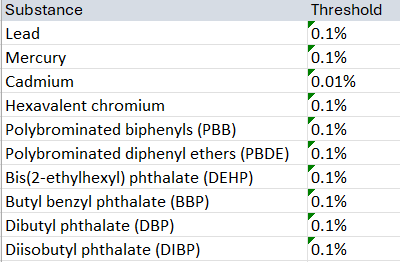
In general, the maximum concentration values are the same as EU RoHS, but the classification method is slightly different. EEP in China are classified and sorted into three categories: EEP-A, EEP-B, or EEP-C with each category considered mutually exclusive: EEP-A: Each homogeneous material composing EEP; Unlike EU RoHS which applies to all EEP unless exempted, under China RoHS 2, the hazardous substance restriction limits only apply to the EEP listed on the Compliance Management Catalogue for Restricted Use of Hazardous Substances in Electrical and Electronic Products. The MIIT published the first editions of the Compliance Management Catalog and the Exemption List for Restricted Substances in the Compliance Management Catalog on March 15, 2018. On May 28, 2026, the MIIT published the Compliance Management Catalog (2026 Edition) and its Exemption List to replace the first editions published in 2018. The Compliance management Catalog expands the scope of regulated products by adding more household products, healthcare products and newly developed consumer products, such as lamps, microwave ovens, blood pressure monitors, smart watches, and robot vacuum cleaners, etc. Requirements for the newly added product categories will take effect from August 1, 2027. The testing methods of harmful substances in electrical and electronic products shall be carried out in accordance with the GB/T 39560 series standards (Determination of certain substances in electrical and electronic products).
¶ LabellingAccording to GB 26572-2025, EEP shall be marked with a green logo or an orange logo, depending on the presence of any restricted substances at or above the threshold limit. The product should also include a hazardous substance disclosure table to indicate if the components contain any hazardous substance at or above the threshold limit. Note: On May 16, 2016, the MIIT has published a frequently asked questions (FAQ) document on China RoHS 2 to address questions on scope, requirements and penalties etc. |
Sources
*Not available in English |
¶ SDS + Label |
|
¶ ClassificationTwenty-eight GHS classification standards, titled Rules for classification and labelling of chemicals (GB 30000.2-2013 ~ GB 30000.29-2013), are aligned with UN GHS Revision 4. These standards became effective November 1, 2014 and replaced GB 20576-2006 through GB 20602-2006, which were based on the 1st edition of the UN GHS. On June 30, 2025, GB 30000.30-2025 for desensitized explosives, aligned with UN GHS Rev. 10, was published with an effective date of July 1, 2026. Codes and subtitles of the 29 GHS classification standards
Hazard classes and categories established by the 28 National Standards 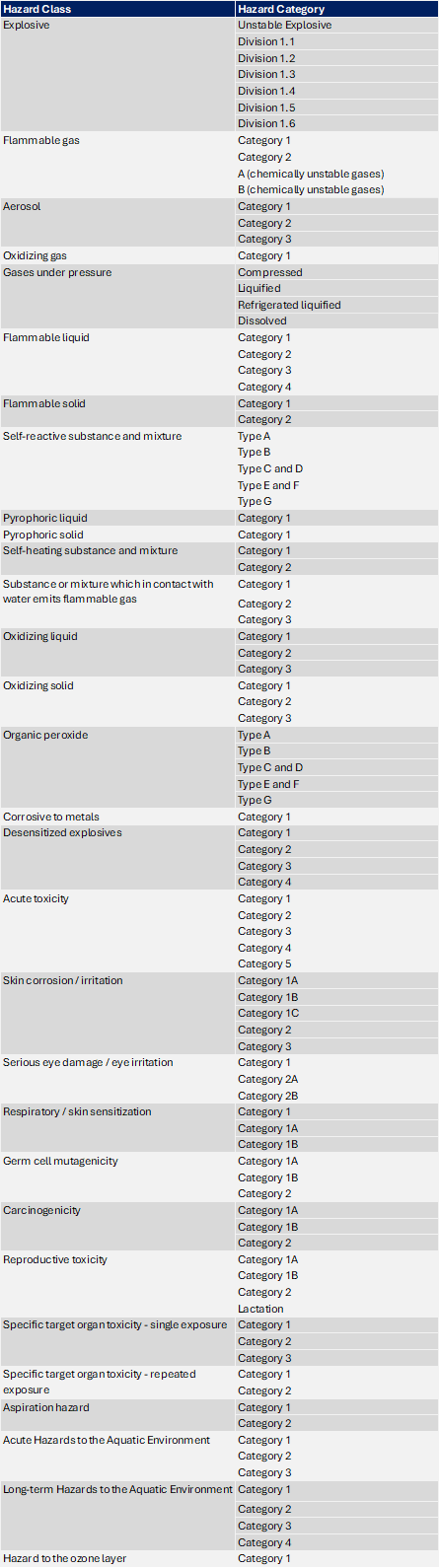 ¶ Mandatory ClassificationsOn September 2, 2015, China's former State Administration of Work Safety (SAWS, replaced by the Ministry of Emergency Management) published the 'Guidance for the Implementation of the Catalogue of Hazardous Chemicals (for trial)'. The guidance provides GHS hazard classifications for all 2,828 chemicals listed in the Catalogue of Hazardous Chemicals (2015). The basis for the hazard classifications is the 29 new GHS classification standards. However, the Guidance does not cover all classifications under the UN GHS. The following less hazardous categories are not included in the Guidance:
Please note that chemicals with the above less hazardous categories do not meet criteria for inclusion in the Catalogue of Hazardous Chemicals, however, they are still subject to SDSs and labelling requirements since these categories have been adopted by GB 30000.2-2013 ~ GB 30000.29-2013. Adoption of the classifications from the Chinese Guidance is mandatory and effective immediately upon publication. Manufacturers and importers of hazardous chemicals shall assign hazard statements, signal words, pictograms and precautionary statements for a hazardous chemical on the basis of the hazard classification information provided in the Guidance and in accordance with GB 30000.2-2013 - GB 30000.29-2013 and GB 30000.30-2025. Companies may include additional hazard categories or more stringent hazard classifications. For classifications with an asterisk in the entry, the minimum classifications provided in the Guidance should be used, but you may classify in a more severe hazard category in cases where sufficient data for the classifications are available. In December, the Ministry of Emergency Management (MEM) released MEM Notification No. 2022-300 to replace "Diesel oils (with closed-cup flashpoint <=60℃), flammable liquid category 3" with "Diesel oils, flammable liquid category 3" for entry 1647 of the Guidance. All diesel fuels, irrespective of their flashpoints, will be classified as flammable liquid category 3 starting from January 1, 2023. Where test data is not available for a mixture, for health and environmental endpoints, the GHS allows for classification based on the hazards of the substances in the mixture. The GHS usually defines the concentration at which a hazardous substance causes a mixture containing that substance to be classified, for most hazards. These are known as Concentration limits / Cut-off values. Countries must additionally set the thresholds for mixture classification for certain hazards:
China published concentration limits / cut-off values in Rules for Classification and Labelling of Chemicals (GB 30000.2-2013 ~ GB 30000.29-2013); however, they did not specify which of the values provided for the above hazards as options by the GHS should be used.
¶ Related License and Registration RequirementsIn the Catalogue of Hazardous Chemicals (2015), most of the chemicals are listed without a concentration limit, therefore it is often unclear whether a mixture containing a listed hazardous chemical is subject to the license and registration requirements under the Regulations on the Safe Management of Hazardous Chemicals in China (Decree 591). The Guidance clarifies that a chemical product is considered a hazardous chemical and therefore subject to hazardous chemical management if the main components are listed in the Catalogue, and the total mass or volume percentage of the main components is greater than or equal to 70%. The only exception is when the chemical product is classified as non-hazardous under the Measures for the Administration of Physical Hazard Identification and Classification of Chemicals (SAWS Order 60) and other relevant provisions . For chemicals containing listed hazardous components at less than 70%, or chemicals with unknown hazards, manufacturers and importers should classify the chemical in accordance with SAWS Order 60. If the classification result is hazardous, the chemical will be subject to the registration requirement.
|
Sources
*Not available in English
|
¶ Cut-off Values/Concentration LimitsWhere test data is not available for a mixture, for health and environmental endpoints, the GHS allows for classification based on the hazards of the substances in the mixture. The GHS usually defines the concentration at which a hazardous substance causes a mixture containing that substance to be classified, for most hazards. These are known as Concentration limits / Cut-off values. Countries must additionally set the thresholds for mixture classification for certain hazards:
China published concentration limits / cut-off values in Rules for Classification and Labelling of Chemicals (GB 30000.2-2013 ~ GB 30000.29-2013); however, they did not specify which of the values provided for the above hazards as options by the GHS should be used.
¶ Sensitization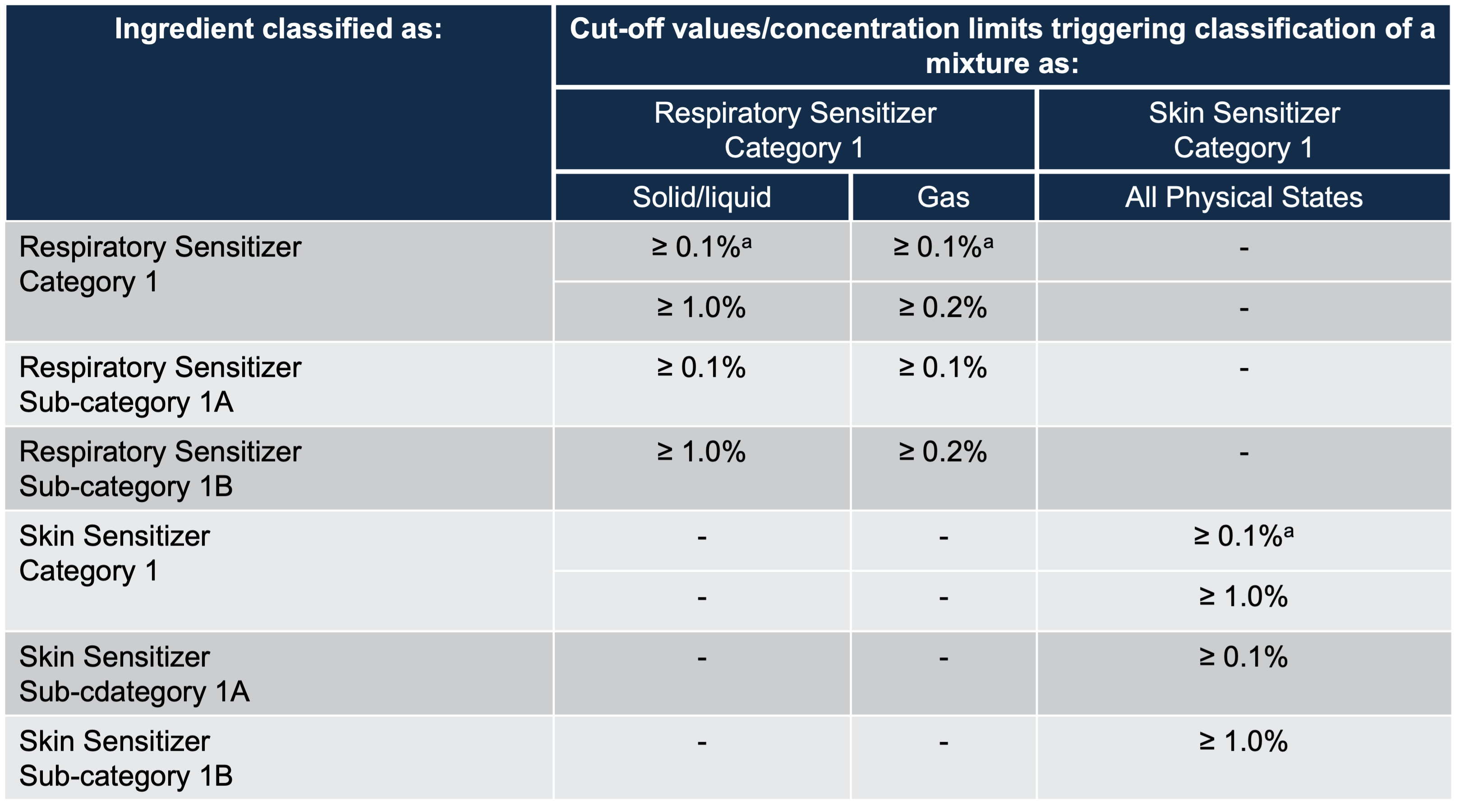 a Some competent authorities may require SDS, as described in GB/T 16483. For mixtures containing a sensitizing ingredient at concentrations between 0.1% and 1.0% (or between 0.1% and 0.2% for a gaseous respiratory sensitizer), supplemental labelling shall be provided. While the current cut-off values reflect existing systems, all recognize that special cases may require information to be conveyed below that level.
¶ Carcinogenicity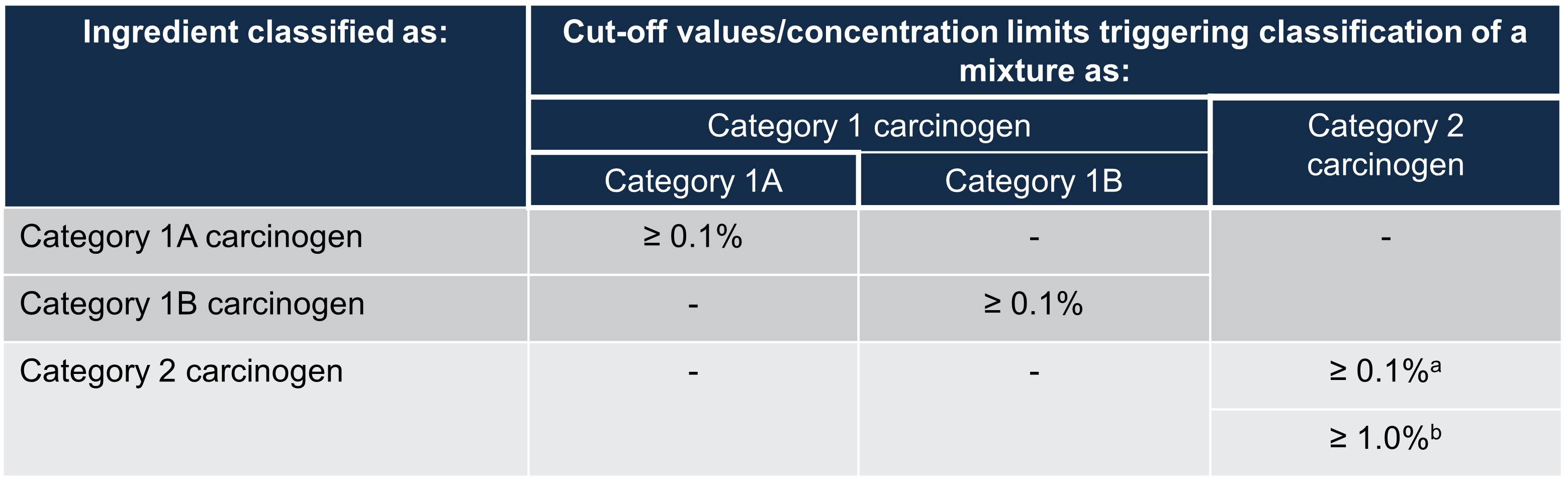 a If a Category 2 carcinogen ingredient is present in the mixture at a concentration between 0.1% and 1%, every regulatory authority would require information on the SDS for a product (GB/T 16483). However, a label warning would be optional. Some authorities will choose to label when the ingredient is present in the mixture between 1.0% and 10%, whereas others would normally not require a label in this case. b If a Category 2 carcinogen ingredient is present in the mixture at a concentration ≥ 1%, both an SDS (GB/T 16483) and a label would generally be expected.
¶ Reproductive Toxicity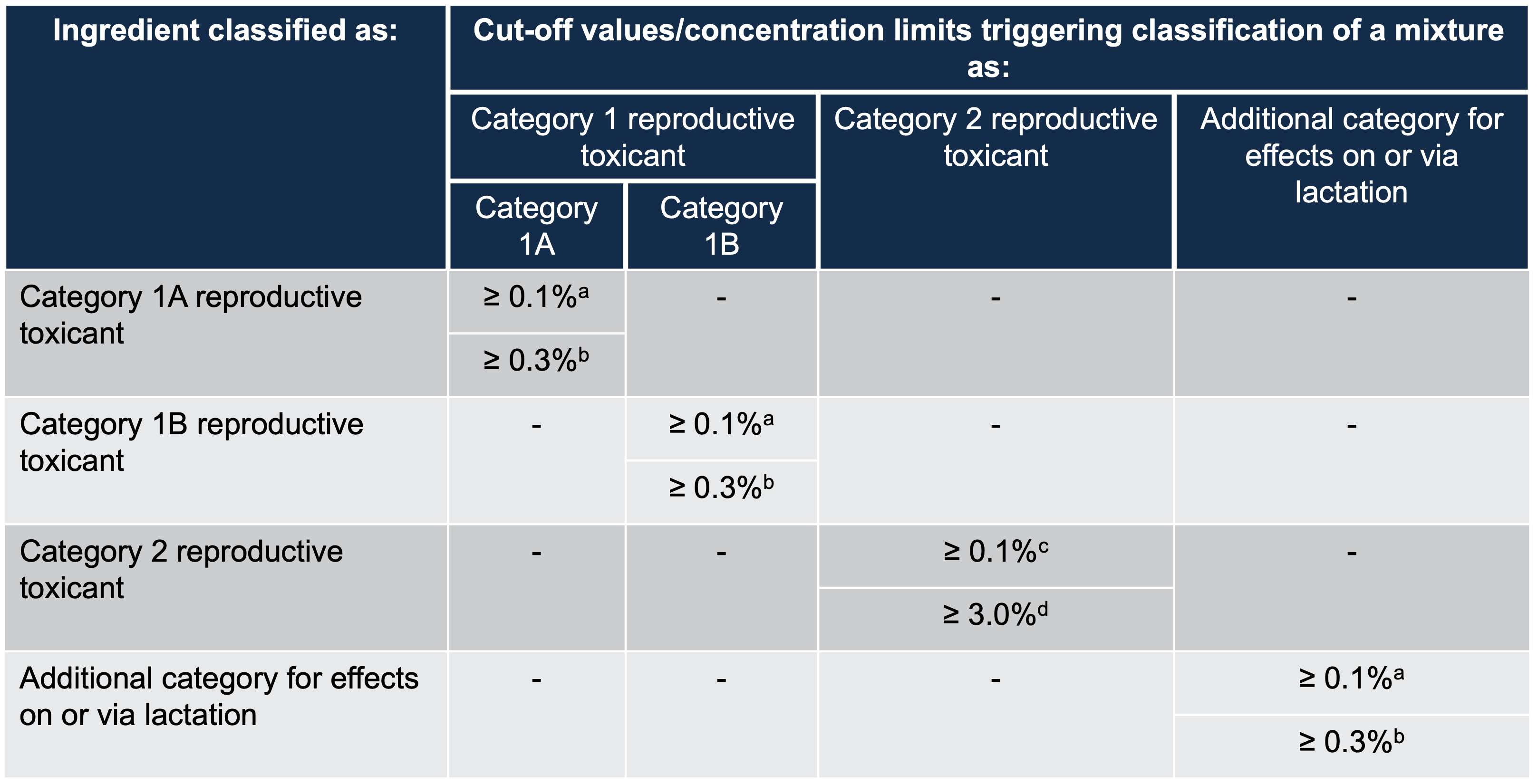 a If a Category 1 reproductive toxicant or substance classified in the additional category for effects on or via lactation is present in the mixture as an ingredient at a concentration between 0.1% and 0.3%, every regulatory authority would require information on the SDS for a product. However, a label warning would be optional. Some authorities would require a label, whereas others would not require a label. b If a Category 1 reproductive toxicant or substance classified in the additional category for effects on or via lactation is present in the mixture as an ingredient at a concentration ≥ 0.3%, both an SDS and a label would generally be expected. c If a Category 2 reproductive toxicant is present in the mixture as an ingredient at a concentration between 0.1% and 0.3%, every regulatory authority would require information on the SDS for a product. However, a label warning would be optional. Some authorities would require a label, whereas others would not require a label. d If a Category 2 reproductive toxicant is present in the mixture as an ingredient at a concentration of ≥ 3.0%, both an SDS and a label would generally be expected. e This compromise classification schedule involves consideration of differences in hazard communication practices in existing systems. It is expected that the number of affected mixtures will be small; the differences will be limited to label warnings, and the situation will evolve over time to a more harmonized approach.
¶ Specific Target Organ Toxicity - Single Exposure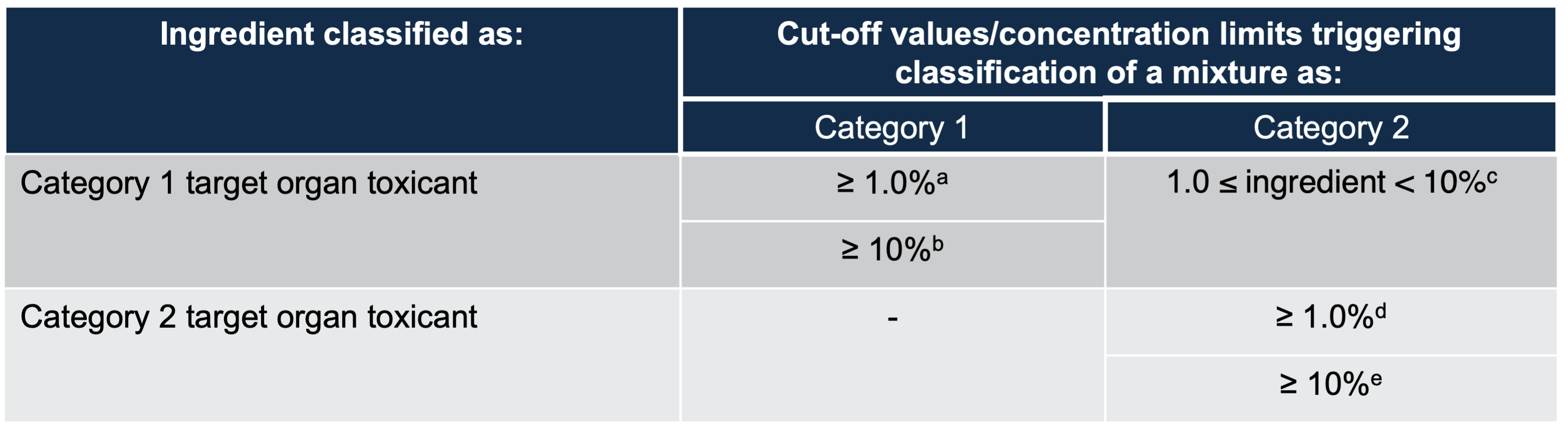 Note: This compromise classification schedule involves consideration of differences in hazard communication practices in existing systems. It is expected that the number of affected mixtures will be small; the differences will be limited to label warnings, and the situation will evolve over time to a more harmonized approach. a If a Category 1 specific target organ toxicant is present in the mixture as an ingredient at a concentration between 1.0% and 10%, every regulatory authority would require information on the SDS for a product (GB/T 16483). However, a label warning would be optional. Some authorities would choose a label when the ingredient is present in the mixture between 1.0% and 10%, whereas others would not require a label in this case. b If a Category 1 specific target organ toxicant is present in the mixture as an ingredient at a concentration ≥ 10%, both an SDS (GB/T 16483) and a label would generally be expected. c If a Category 1 specific target organ toxicant is present in the mixture as an ingredient at a concentration between 1.0% and 10%, some authorities classify this mixture as a Category 2 specific target organ toxicant, whereas others would not. d If a Category 2 specific target organ toxicant is present in the mixture as an ingredient at a concentration between 1.0% and 10%, every regulatory authority would require information on the SDS for a product (GB/T 16483). However, a label warning would be optional. Some authorities would choose a label when the ingredient is present in the mixture between 1.0% and 10%, whereas others would not require a label in this case. e If a Category 2 specific target organ toxicant is present in the mixture as an ingredient at a concentration of ≥ 10%, both an SDS (GB/T 16483) and a label would generally be expected.
¶ Specific Target Organ Toxicity - Repeated Exposure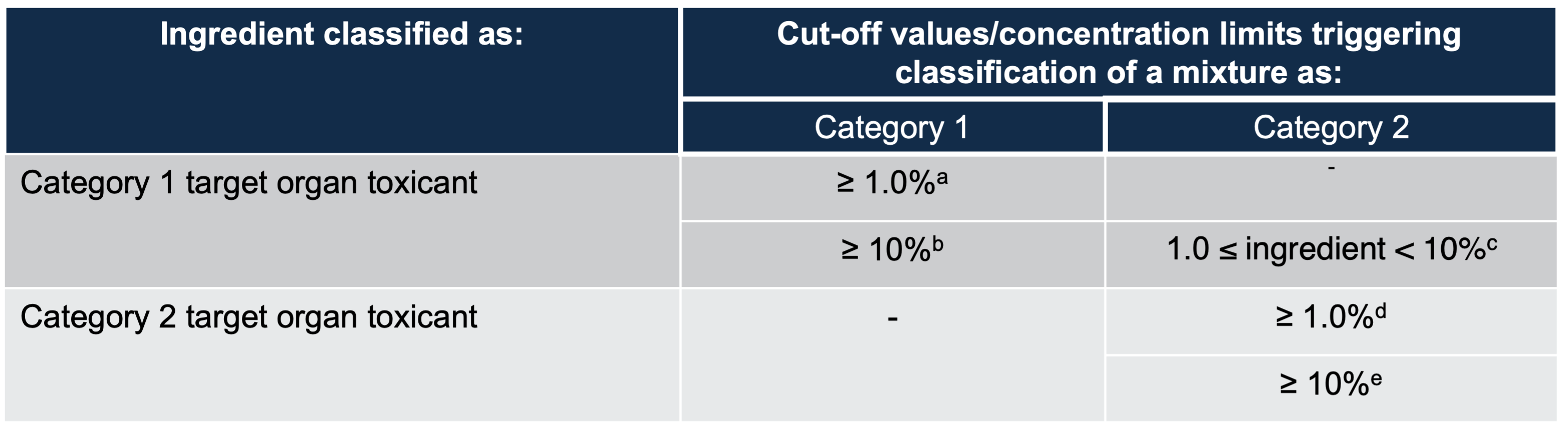 Note: This compromise classification schedule involves consideration of differences in hazard communication practices in existing systems. It is expected that the number of affected mixtures will be small; the differences will be limited to label warnings, and the situation will evolve over time to a more harmonized approach. a If a Category 1 specific target organ toxicant is present in the mixture as an ingredient at a concentration between 1.0% and 10%, every regulatory authority would require information on the SDS for a product (GB/T 16483). However, a label warning would be optional. Some authorities would choose a label when the ingredient is present in the mixture between 1.0% and 10%, whereas others would not require a label in this case. b If a Category 1 specific target organ toxicant is present in the mixture as an ingredient at a concentration ≥ 10%, both an SDS (GB/T 16483) and a label would generally be expected. c If a Category 1 specific target organ toxicant is present in the mixture as an ingredient at a concentration between 1.0% and 10%, some authorities classify this mixture as a Category 2 specific target organ toxicant, whereas others would not. d If a Category 2 specific target organ toxicant is present in the mixture as an ingredient at a concentration between 1.0% and 10%, every regulatory authority would require information on the SDS for a product (GB/T 16483). However, a label warning would be optional. Some authorities would choose a label when the ingredient is present in the mixture between 1.0% and 10%, whereas others would not require a label in this case. e If a Category 2 specific target organ toxicant is present in the mixture as an ingredient at a concentration of ≥ 10%, both an SDS (GB/T 16483) and a label would generally be expected.
|
|
¶ Safety Data SheetsSafety data sheets should be prepared in accordance with two National Standards: SDS for Chemical Products - Content and Order of Sections (GB/T 16483-2008) and Guidance on the Compilation of Safety Data Sheet for Chemical Products (GB/T 17519-2013). GB/T 16483-2008 is based on the second revised edition of the UN GHS and came into force on February 1, 2009. GB/T 17519-2013 serves as a supplement document to GB/T 16483-2008 by providing more detailed guidelines on the preparation of SDS and introducing a more specific format and content requirements. GB/T 17519-2013 has an enforcement date of January 31, 2014. The SDS must be in Simplified Chinese and follow the prescribed format including sections and subsections. ¶ SDS Format RequirementsThe Header of the first page should include
All other pages should specify the chemical name, revision date and the SDS code. The page number should include the total number of pages (e.g., "page 1 of 3"), or indicate whether there is a page following (e.g., "End of SDS"). The number should be printed in the middle or right side of the footer.
¶ SDS UpdatesAccording to Article 15 of Decree 591, manufacturers should update the safety data sheet and safety label in a timely manner if new hazard information of the hazardous chemical is received.
¶ Phrase and Codification of Hazard StatementsOn December 31, 2015, the Standardization Administration of China (SAC) announced the approval of a recommended National Standard, GB/T 32374-2015: Phrase and Codification of Chemical Hazard Statements (化学品危险信息短语与代码), with an effective date of January 1, 2017. The standard was developed by the former State Administration of Work Safety (SAWS, replaced by the Ministry of Emergency Management) of China and is based on the fourth revised edition of the UN Globally Harmonized System of Classification and Labelling of Chemicals (GHS). It consists mainly of the following three parts:
On August 23, 2024, GB/T 32374-2015 was repealed by China National Standard Announcement No. 19 of 2024. For detailed information on hazard statements, precautionary statements and their codes, refer to GB 30000.2-2013 ~ GB 30000.29-2013 (Rules for classification and labelling of chemicals).
¶ Cut-off Values for MixturesSDSs should be provided for mixtures based on the cut-off values/concentration limits of the hazardous ingredients. GB 30000.1 includes the table of cut-off values/concentration limits for each health and environmental hazard class: 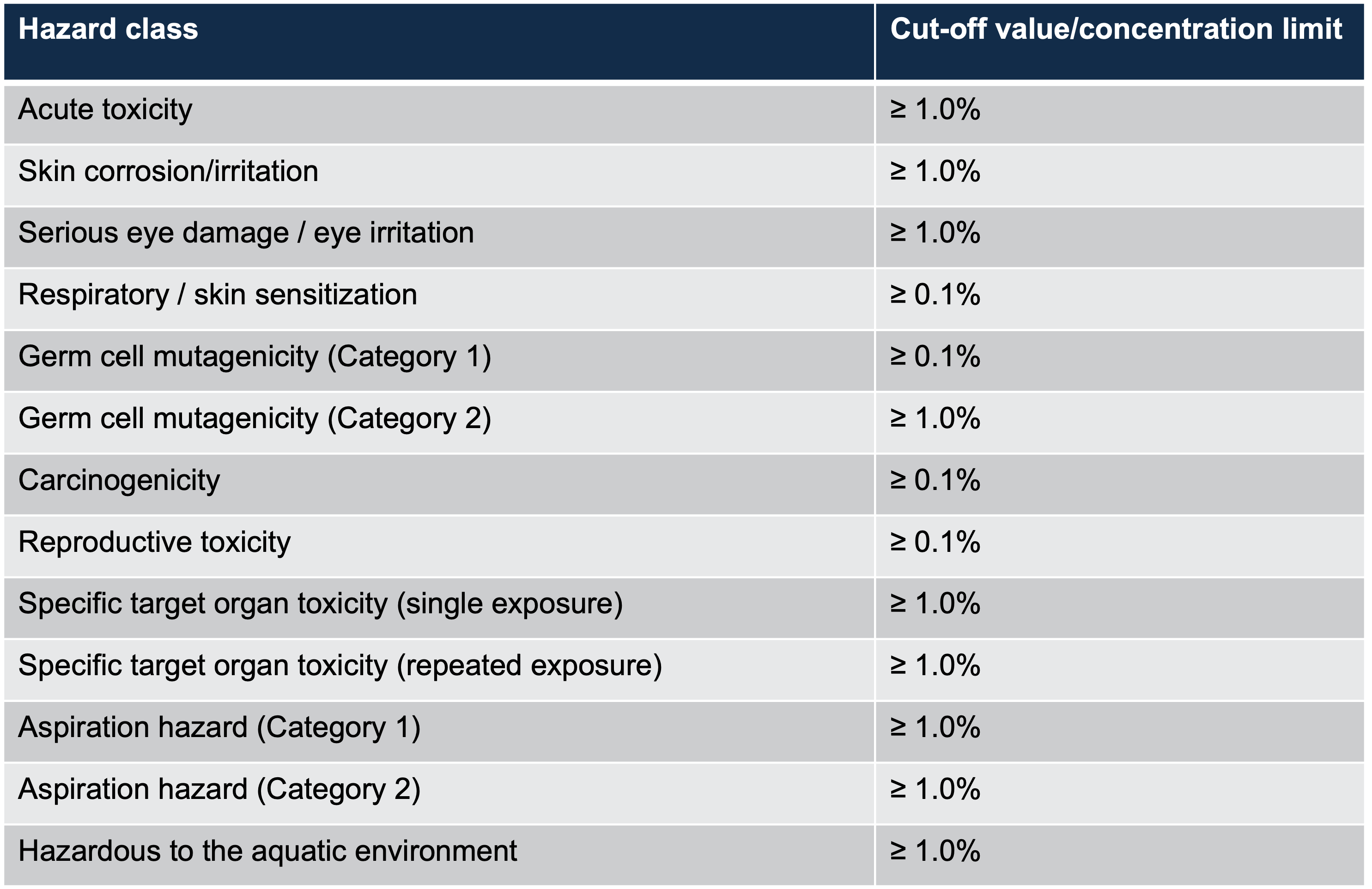
|
Sources
*Sources not available in English |
¶ LabelGeneral Rules for Preparation of Chemical Safety Label (GB 15258-2009), conforming to GHS labeling rules, was made effective on May 1, 2010 with one year transition period. From May 1, 2011, only GHS labels may be used in China. Safety labels must be in Simplified Chinese. Foreign language translations may be included but must be smaller than the Chinese. Chemical names shall be in both Chinese and English.
¶ Label ElementsRequired label elements include:
Note 1: The following additional statement(s) shall be included if applicable: "x% of the mixture consists of ingredient(s) of unknown acute (oral/dermal/inhalation) toxicity"; "x% of the mixture consists of ingredient(s) of unknown hazards to the aquatic environment". The label must include at least one 24-hour emergency phone number, which is located in China, for chemical accidents. It must be a phone number in China, and be answered by an emergency professional available 24-hours a day. ¶ Precedence for the Allocation of Signal WordsIf the signal word “Danger” applies, the signal word “Warning” should not appear. ¶ Precedence for the Allocation of SymbolsFor substances and mixtures covered by GB 12268-2025 (List of Dangerous Goods), the precedence of symbols for physical hazards should follow the rules of GB 12268-2025 (List of Dangerous Goods). For chemicals which are not listed in GB 12268-2025 (List of Dangerous Goods), the following hazard categories shall always be the primary hazards: explosives, flammable gases, flammable aerosols, oxidizing gases, gases under pressure, self-reactive substances and mixtures, combustible substances and organic peroxides. For health hazards, the following principles of precedence apply:
¶ Precedence for Allocation of Hazard StatementsThe assigned hazard statements shall be listed in order of physical hazards, health hazards and environment hazards. To avoid redundancy in the information conveyed by hazard statements, the following precedence rules may be applied:
¶ Label SizeThe following are the minimum label dimensions for different container size:  If a container is smaller than 100mL, a simplified label can be used. Compared to a regular label, a simplified label doesn't require precautionary statements; all other information is still required. ¶ Layout of Label ElementsChemical name should be eye-catching, marked clearly and located at the top of the label in Chinese and English. The signal word shall be located below the name of the chemical, and must be eye-catching and clear. The color of the pictogram is usually a black symbol on a white background with a red square border. If it is for domestic use, the color of the square border can be black. Hazard statements give a concise description of the hazard characteristics of the chemical and should be located below the signal word. Precautionary statements are generally placed under the hazard statements, and should include Preventive Measures, Accident Response, Safe Storage and Waste Disposal. There shall be a black border added along the edge of the label, with a space equal to or greater than 3 mm remaining outside of the border, and the width of the border shall be equal or greater than 1 mm. For label elements and layout, please refer to the following label sample provided by General Rules for Preparation of Chemical Safety Label (GB 15258-2009): 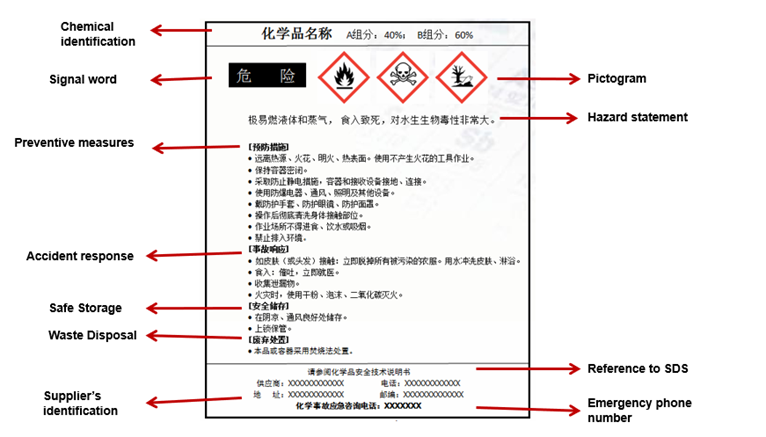
¶ Small ContainersThere is an allowance for labeling small containers (<100mL) with reduced information in China and the content of a simplified label should include:
Compared to a regular label, a simplified label doesn't require precautionary statements, all other information is still required. There is no requirement on the size of simplified labels. 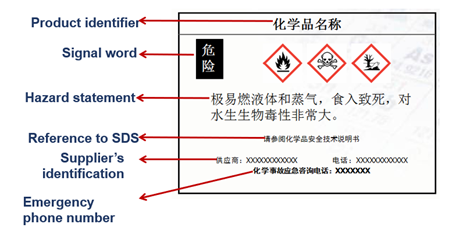
¶ Tactile WarningsIf tactile warnings are included in the label, they should comply with GB/T 35259-2018 (Packaging - Tactile Warnings of Danger - Requirements).
¶ Requirements under the Anti-Terrorism LawOn Dec 27, 2015, the Standing Committee of National People's Congress passed the first Anti-Terrorism Law of the People's Republic of China, aiming to promote national security and protect its citizens from terrorists. The new legislation took effect on January 1, 2016. The law contains provisions that impose new obligations on manufacturers and importers for monitoring hazardous chemicals. Article 22 of the law requires manufacturers and importers to:
Companies not compliant with the new requirements are subject to a fine of up to 100,000 yuan. The principle responsible personnel are punishable by a fine of up to 10,000 yuan. Detailed provisions on the digital tracking tags or monitoring system have not been published yet.
¶ Precautionary Label for Workplace of ChemicalsOn November 27, 2023, the Standardization Administration of China (SAC) published a recommended National Standard GBT 30000.31 (Specification for Classification and Labelling of Chemicals - Part 31: Precautionary Label for Workplace of Chemicals). The new Standard will become effective on June 1, 2024. The new standard applies to work sites that may expose workers to chemicals, including work activities such as manufacture, shipping, storage of chemicals, and the waste disposal, maintenance and cleaning of chemical equipment and containers. A workplace precautionary label should be fixed at the entry/exit of the workplace, outside walls of the workplace, reaction vessel, pipelines of hazardous chemicals or other easily noticeable areas. Label elements should be written in Chinese and be consistent with the content in the SDS of the product. Labels should contain the following:
Compared to the precautionary labels for chemicals under GB 15258-2009 (General Rules for Preparation of Precautionary Label for Chemicals), a workplace label does not require supplier information, but it does require personal protective equipment pictograms to be included. There should be a yellow and black diagonal striped border added along the edge of the label, and the width of the border should be greater than 3 mm. The size of the precautionary label used in workplaces should be greater than 80 cm x 60 cm or 60 cm x 90 cm. For label elements and layout, please refer to the following label example provided by GBT 30000.31: 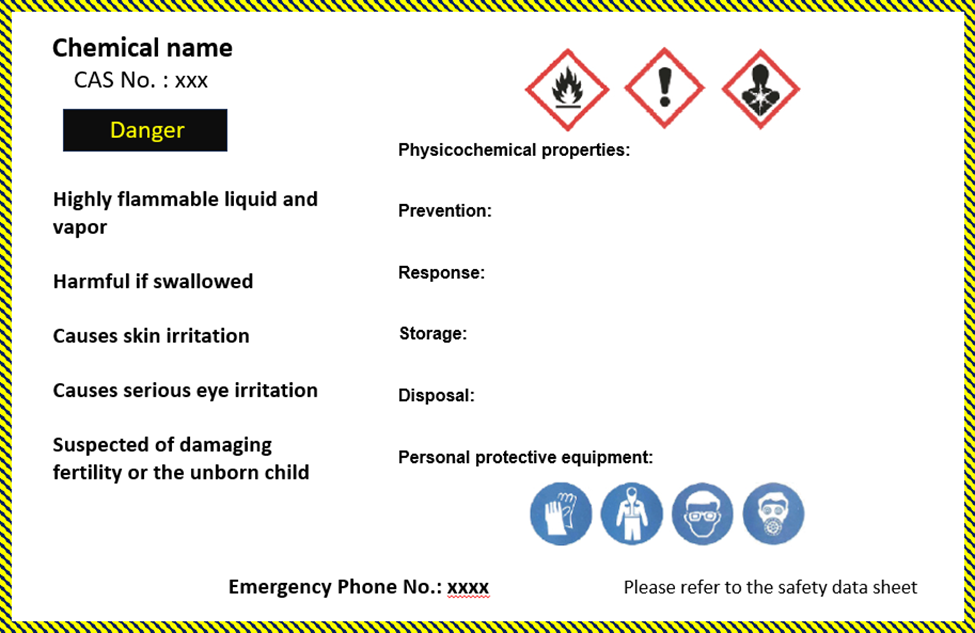
|
Sources
*Not available in English |
¶ Trade SecretsThe following National Standards have rules proscribing disclosure of trade secrets for hazardous chemicals:
|
Sources
*Not available in English |
¶ Occupational Exposure LimitsSince 2007, inhalation exposure of chemical, physical, and biological agents are regulated by: GBZ 2.1-2007 Occupational exposure limits for hazardous agents in the workplace - Chemical hazardous agents; and GBZ 2.2-2007 Occupational exposure limits for hazardous agents in the workplace - Physical agents. On April 1, 2020, GBZ 2.1-2007 and GBZ 2.2-2007 were replaced by GBZ 2.1-2019 Occupational exposure limits for hazardous agents in the workplace - Chemical hazardous agents; and GBZ 2.2-2019 Occupational exposure limits for hazardous agents in the workplace - Physical agents. GBZ 2.1-2019 provides occupational exposure limits for 358 hazardous chemicals, 49 kinds of dust, 3 types of biological agents and 28 biological limit values in Table 1 to Table 4 of the standard:
Three categories of Occupational Exposure Limits for chemical substances are adopted in GBZ 2.1-2019:
GBZ 2.1-2019 is a mandatory national standard that employers shall comply with to protect workers exposed to airborne concentrations of hazardous chemical agents in the workplace. |
Sources
*Not available in English
|
¶ Transport |
|
|
The Ministry of Transport of the People's Republic of China is responsible for the JT/T 617 Regulations concerning road transportation of dangerous goods. JT/T 617 is based on the 18th Revision of the United Nations Recommendations on the Transport of Dangerous Goods. |
Sources Resources
*Not available in English |