¶ Recent Updates2025
¶ Background |
|
|
In the Republic of India, national laws are made by the federal government and state-level laws can be made by the state governments. Federal laws have to pass through Parliament, which is comprised of two legislative houses. State laws have to pass through the state lower house and state upper house. At the federal level, a Bill becomes an Act when it passes through the houses of Parliament and is assented to by the President. The official gazette of India is published in Standard Hindi and English. Legislative and administrative measures addressing chemicals management in India can be described as highly fragmented. The country currently has a multiplicity of chemical control regulations that fall under the purview of various ministries and statutory boards. These regulations largely relate to the minimization of health and safety hazards in the workplace as well as the prevention, control and abatement of chemical discharge to the environment. Other than a few categories of chemicals (notably pesticides, drugs, ozone-depleting substances and food additives), there are no specific Indian legislations pertaining to the registration, restriction or prohibition of chemical substances nor is there a comprehensive and coherent framework on the classification and labeling criteria for general industrial chemicals. An additional challenge exists for the industry in the form of legal instruments that may be relevant to chemical management even though such regulations do not appear to specifically target chemicals. One such example is the Central Motor Vehicle (CMV) Rules that addresses hazard communication requirements for road transport of chemicals in India. The Ministry of Chemicals and Fertilizers had proposed a Draft National Chemical Policy, the initial draft of which was made available to the public and industry for comments from March 29, 2012 to May 23, 2012. The draft was subsequently updated and 'finalised' in 2014. The draft policy discussed several issues regarding the chemical industry in India, i.e., the importance of research and development, technology improvement, safety and sustainability, pollution and environment, effluent or waste disposal and treatment and green chemicals. Cognizant that India lacks a comprehensive system in chemical control, the draft policy proposed the implementation of an EU REACH-like legislation within India. The creation of a national chemical inventory was also mooted. With the proposals, a consolidation of the current law and regulations to streamline the control of chemicals and the creation of a national-level competent authority akin to the European Union's European Chemicals Agency (ECHA) can be anticipated. |
Official Gazette |
¶ Inventories |
|
¶ Chemicals Inventory of India – ChemIndia portal
The Department of Chemicals and Petrochemicals (DCPC) launched a chemical inventory platform – ChemIndia to support the Central Board of Indirect Taxes and Customs (CBIC) and chemical importers/exporters with the mandatory product declaration requirements. DCPC considers this platform as “one of the major ambitious projects” as it aims to collect, compile and analyze real-time data on a monthly or annual basis. With its high security and validation aspects, the platform is expected to support a seamless data collection process. The ChemIndia website provides several features as follows:
DCPC believes that the chemical inventory will provide plenty of benefits for all stakeholders, including industrial sectors and policy makers. The availability and collection of chemical data will ensure a comprehensive understanding of India market insights. Companies and their units can register in the portal to report and submit their chemical data such as description of chemicals, monthly production, annual installed capacity, sales and purchases of chemicals. ¶ Formulation of Draft National Chemical and Petrochemical PolicyIn 2012, the Department of Chemicals and Petrochemicals (DCPC) of the Ministry of Chemicals and Fertilizers prepared the first draft of the National Chemical Policy. The draft was subsequently updated and circulated for consultation to other Indian governmental agencies and industry consortia in 2014. As a policy document, the draft lacks the force of law but nonetheless specifies the goals and planned activities of the Ministry of Chemicals and Fertilizers to "set up a 'National Chemical Centre' for acting as a repository of chemical industry information" and also to "put in place a robust framework for promoting safety and security of chemical facilities across the value chain". Sections 5.5.2 and 5.5.3 of the draft explicitly mention India's need to "consolidate and update various applicable Acts and Rules governing the chemical sector" and to "have a proper chemical management framework" on the inventorization of chemicals. There are unconfirmed reports that work on chemicals inventorization had already commenced. However, since the draft policy needs to be finalized and presented to Parliament prior to the oft-lengthy process of transposition into enforceable laws, it is likely that the legal framework for the inventory and for the reporting and registration of new and existing chemicals will not happen anytime soon. ¶ Preparation of National Action Plan for Chemicals (NAPC)On April 5, 2017, under the World Rank-aided Capacity Building for Industrial Pollution Management (CBIPM) Project, the Ministry of Environment, Forest and Climate Change (MoEF&CC) issued an Office Order to announce the formation of the National Coordination Committee responsible for building the NAPC. In the announcement, the National Coordination Committee shall propose policy framework on chemical registration and chemical views on international regulations such as Stockholm Convention, Rotterdam Convention, etc. The project was supposedly due on September 15, 2017, however, any information on NAPC has not yet been officially announced. |
Sources Resources |
¶ Substance Registration |
|
| Currently, there are no substance registration requirements in India. | |
¶ Product Registration |
|
¶ PesticidesIn India, pesticides must be registered before they are imported or manufactured. The Insecticides Act regulates the import, manufacture, sale, transport, distribution and use of insecticides, rodenticides, fungicides, herbicides, etc (referred to as ‘insecticides’ under the Act). The Act was promulgated in 1968 and last amended on October 27, 2016 by gazette notification S.O. 3385(E), which added more controlled insecticides to the schedule of the Act. To implement the Act, the Insecticides Rules were promulgated in 1971 and its most recent significant amendment was the Insecticides (Amendment) Rules 2015. According to Section 9 of the Insecticides Act on the registration of insecticides, there are three types of insecticides registration:
The provisional registration for a new insecticide is valid for 2 years. Once all the required documents are submitted, the general registration certificate can be issued. If an insecticide is registered in India, any other person desiring to import or manufacture the insecticide can apply for registration immediately after the commencement of the original registration. The registration fee for 9(3) and 9(3b) is 5,000 rupees for each insecticide and for registration of 9(4) the fee is 2,500 rupees. The time to obtain a certificate of registration varies. It can take more than 6 months to obtain a certificate for the registration 9(4). For the registration 9(3) and 9(3b), it can take 1-3 years or longer. Potential registrants may look up the registration status of pesticides in an online database maintained by the CIBRC. The import of sample quantities of insecticides for Research, Test and Trial (RTT) purposes is exempted from the insecticide registration requirement. In cases where the insecticide is imported for non-insecticidal purposes, an import permit would be necessary from the CIBRC. The CIBRC may, while granting a registration or import permit, spell out the conditions for import which could include reference to the source of import. When such references are stipulated, no insecticide shall be imported from a source other than that specified on the certificate of registration or the permit. A manufacturing license is required to manufacture insecticides in India. The application fee is 2,000 rupees for each insecticide and a maximum of 20,000 rupees for all insecticides for which the license is applied. A license is also required to sell, stock, exhibit for sale or distribute insecticides in India. The application fee is 500 rupees for each insecticide and a maximum of 7,500 rupees for all insecticides for which the license is applied. Such licenses are valid for 2 years. The CIBRC provides a List of Forms online where applicants can download the appropriate applications. |
Sources
Resources
Contact Information Central Insecticides Board & Registration Committee Companies can find the email addresses and telephone numbers of the CIBRC officers at http://ppqs.gov.in/contactus |
¶ BIS CertificationManufacturers (Indian or foreign) whose products are regulated under the Compulsory Certification Order are required to be certified by the Bureau of Indian Standards (BIS). Foreign manufacturers can nominate an Indian Resident to be an Authorized Indian Representative (AIR) when submitting the application. Product Certification includes two schemes: Scheme 1 – Indian Standards Institution (ISI) and Scheme 2 – Compulsory registration scheme (CRS). 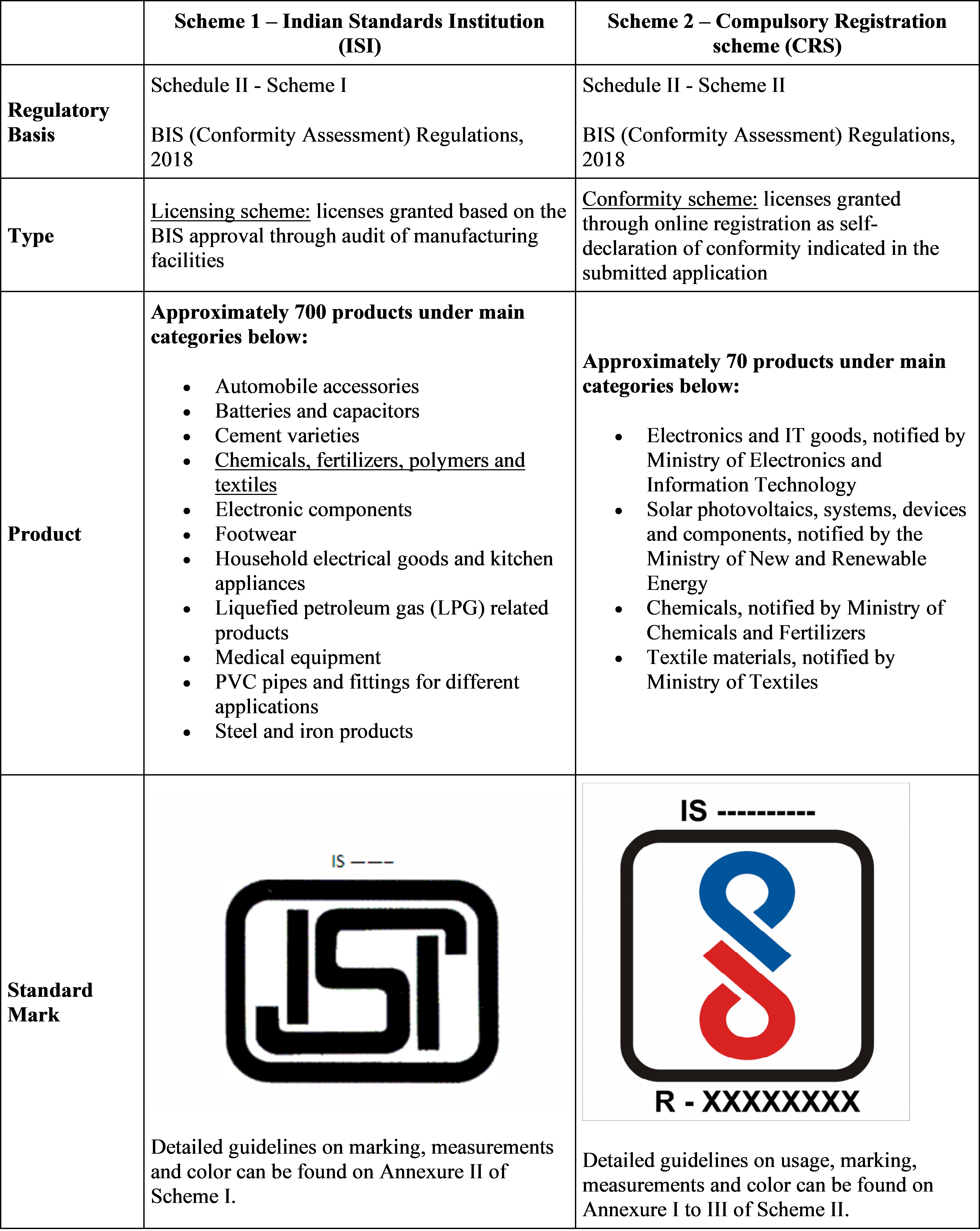 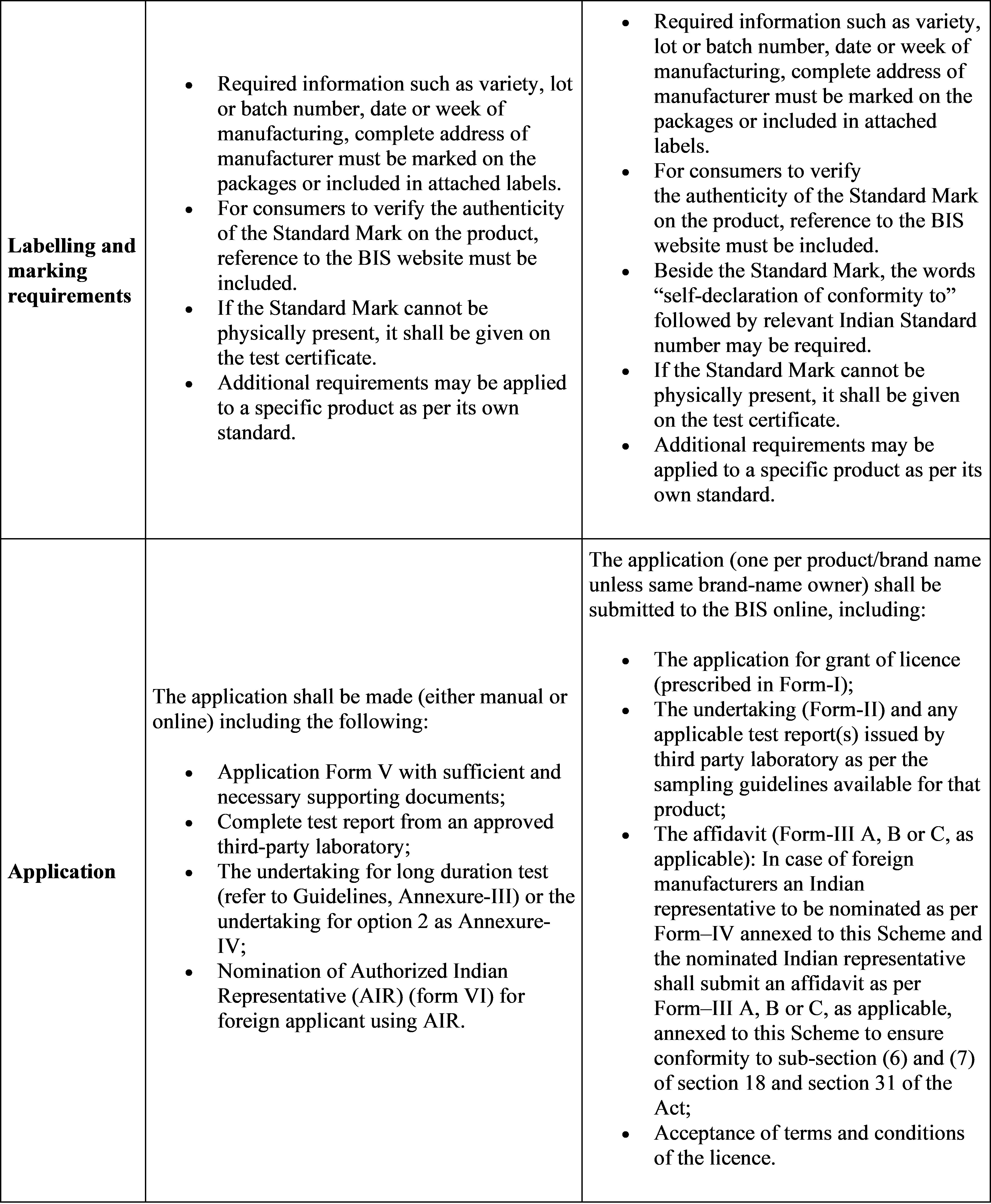 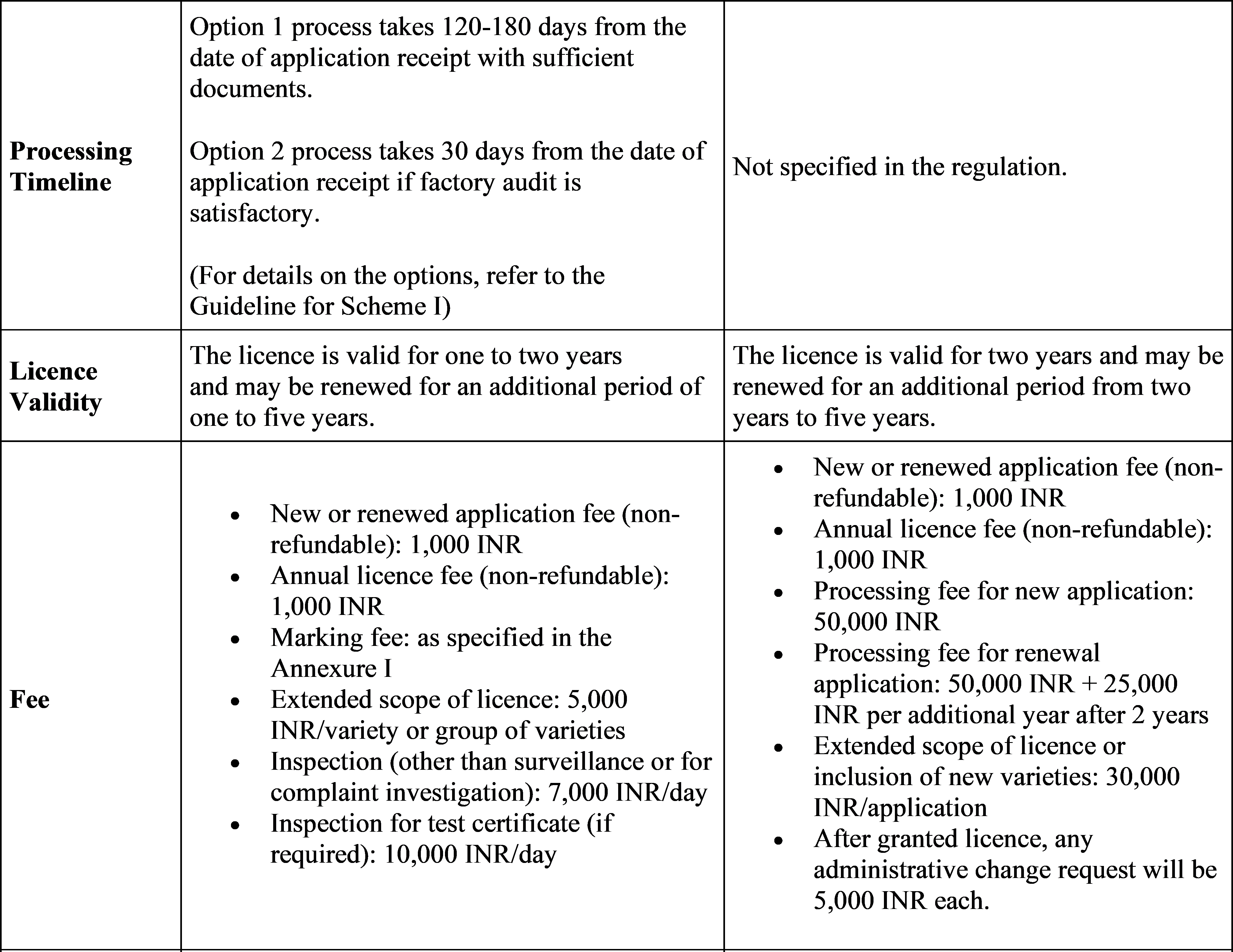 |
Sources
Resources
Contact Bureau of Indian Standards Contact details can be found at https://www.bis.gov.in/index.php/product-certification/product-certification-contact-us/
|
¶ CosmeticsIn India, cosmetics are regulated under the Drugs and Cosmetics Act, 1940 and Rules 1945 and their amendments. The regulations was last amended by the Cosmetics Rules, 2020, effective from December 15, 2020. The Central Drugs Standard Control Organization (CDSCO) under the Ministry of Health and Family Welfare is the National Regulatory Authority of India responsible for licensing cosmetics products. The Bureau of Indian Standards (BIS) is responsible for any standardized specifications of cosmetics products. ¶ Definition of CosmeticsSection 3(aaa) of the Drugs and Cosmetics Act, 1940 defines cosmetics as any article intended to be rubbed, poured, sprinkled or sprayed on, or introduced into, or otherwise applied to, the human body or any part thereof for cleansing, beautifying, promoting attractiveness or altering the appearance, and includes any article intended for use as a component of cosmetic. ¶ Prohibition of Cosmetics Importation/ManufactureThe Cosmetics Rules, 2020 introduced certain prohibitions for import of cosmetics, as follows:
¶ Registration and Notification RequirementsNew cosmetics The Cosmetics Rules, 2020 define "new cosmetics" as "a cosmetic which contains a novel ingredient which has not been used anywhere in the world or is not recognized for use in cosmetics in any National or International literature." Before the registration of importing or manufacturing new cosmetics in India, the applicant must seek prior permission from the Central Licensing Authority (CLA). An application for obtaining prior permission includes:
If the CLA is satisfied with the application, they will issue a prior permission in Form COS-3, which will then be submitted in the registration application for import and manufacture of the cosmetics. New/Not-yet-registered cosmetics An Import Registration Certificate must be obtained prior to import of a cosmetic product by the manufacturer, the authorized agent of the manufacturer, the authorized subsidiary of the manufacturer in India, or any importer in India. The applicant shall submit an online application through the SUGAM portal of the CDSCO. Applicants can prepare a single application for one or more cosmetics manufactured by the same manufacturer, provided that the intended products are produced in one factory or multiple factories functioning as one unit. A full application must include:
If the CLA is satisfied with the application, they will issue an Import Registration Certificate (as prescribed in Form COS-2) within the targeted timeframe of 90 days. Otherwise, the CLA may reject the application and provide reasons in writing within 6 months from the submitted date. The applicant may appeal to the Central Government within 45 days and the Government, if deemed necessary, can pass orders to respond within 90 days from the appeal date. Unless being suspended or cancelled by the CLA, a granted Import Registration Certificate remains valid in perpetuity, provided that the certificate holder completes paying the retention fee of $1000 within 5 years. If the holder fails to pay the retention fee on time, the registration certificate holder must pay an additional late fee of 2% per month within 180 days or the Registration Certificate is subjected to be cancelled. In case of changes in the constitution of the registration holder or the overseas manufacturer, a new application must be made within 180 days and the existing registration remains valid until the new one is issued or rejected by the CLA. In case of changes in labelling, composition, or testing of the registered product or its specifications, the registration holder must inform the CLA within 15 days with an undertaking of compliance to required BIS standards. In case of change in name or address of a registration holder or overseas manufacturer, an application of amendment must be submitted online for CLA's prior approval within 60 days. Already registered cosmetics Any person or entity can import an already registered cosmetic by making an online application including Form COS-4 and an undertaking in the Sixth Schedule. After consideration, the CLA will grant an Import Registration Number (in Form COS-4A), which is valid for 3 years unless suspended or cancelled. If not satisfied, the CLA will reject the application and provide reasons in writing within 6 months from the submitted date. If the importer fails to comply with any of the conditions of the Import Registration Number issued in Form COS-4A and fails to provide plausible reasons, the CLA can pass a written order to suspend or cancel the import registration number for certain period. Exemptions The Twelfth Schedule of the 2020 Rules states that the following categories of cosmetics can be imported without an import registration certificate, provided that the cosmetics shall not be used for domestic sale:
¶ LabellingThe Cosmetics Rules, 2020 require that a cosmetics product must follow the below labelling requirements to be sold or distributed in India. Cosmetics must also comply with any applicable labelling requirements in the BIS standards for specific product types. In all cases, the ingredients shall be listed in descending order of weight and volume if the corresponding concentrations are more than 1%, and in any order if concentrations are at most 1%. On both the inner and outer labels:
On the inner or outer labels:
On the outer labels:
On the inner labels:
On the label of unit pack for imported cosmetics:
If a cosmetic has only one label, it must contain all required information. ¶ Special Provisions for Certain ProductsSoaps
If the importer fails to comply with any of the conditions of the Import Registration Number issued in Form COS-4A and fails to provide plausible reasons, the CLA can pass a written order to suspend or cancel the import registration number for certain period. Hair dyes Any hair dyes containing Paraphenylenediamine or other dyes, colors and pigments shall be labelled with the following legend in English and local languages on both the inner and the outer labels: Each package shall also contain instructions in English and local languages on the following lines for carrying out the test: Toothpaste
|
Sources Resources
Contact Information Central Drugs Standard Control Organization (CDSCO) Phone: 91-11-23236965/23236975 (Drugs Controller General) Fax: 91-11-23236973 E-mail: dci@nic.in. |
¶ Notifications |
|
¶ Hazardous ChemicalsThe Manufacture, Storage and Import of Hazardous Chemical (MSIHC) Rules 1989 were promulgated by the Ministry of Environment and Forests and were last amended on January 19, 2000. Although these rules generally only apply to entities within India, companies exporting hazardous chemicals to India may need to provide necessary documentation and data to ensure the importer's compliance. According to the MSIHC Rules, an occupier shall submit a written report pursuant to Rule 7(1) or a safety report pursuant to Rule 10(1) to the relevant concerned authorities at least 90 days before undertaking any industrial activity with hazardous chemicals. An activity in which subsequently there is or is liable to be a threshold quantity or more of an additional hazardous chemical, which means any chemical listed in Schedule 1, 2 or 3 of the Rules, shall be deemed to be a different activity and shall be notified accordingly. Any person responsible for importing hazardous chemicals in India shall provide at the time of import or within 30 days from the date of import to the concerned authorities information pertaining to:
Any person importing hazardous chemicals shall maintain the records of the hazardous chemicals imported as specified in Schedule 10:
The following table lists the concerned authorities as well as the conditions under which they need to be notified: Chief Controller Imports & Exports under the Import & Exports (Control) Act, 1947
Central Pollution Control Board or State Pollution Control Board (or Committee) under the Environment (Protection) Act, 1986
Chief Inspector of Factories appointed under the Factories Act, 1948
Chief Inspector of Dock Safety appointed under the Dock Workers (Safety, Health and Welfare) Act, 1986
Chief Inspector of Mines appointed under the Mines Act, 1952
|
Sources
Resources Contact Information Hazardous Substances Management (HSM) Division |
¶ Mandatory Product DeclarationThe Indian Central Board of Indirect Taxes and Customs (CBIC) issued Circular No. 15/2023-Customs to mandate some submission of selected information for several chemical-related products, which previously have been declared voluntarily by importers. The mandatory declaration, previously set to be effective on July 1, 2023, was extended to October 1, 2023, per the requests of several trade associations’ representatives and the Department of Chemicals and Petrochemicals. The mandatory declaration officially became effective from October 15, 2023. Circular 15 requires additional qualifiers for both import and export declaration, as follows:
The mandatory declaration resulted from consultations with various ministries such as the Department of Chemicals and Petrochemicals, Ministry of AYUSH (Ayurveda, Yoga, and Naturopathy, Unani, Siddha and Homoeopathy) and the Directorate General of Foreign Trade (DGFT). The additional requirement aims to reduce queries and improve the assessment efficiency as chemical products can be associated with many common names or brand names, creating confusion for custom officers and delays in clearance. Using IUPAC name and CAS number, a unique identification to each chemical substance, gradually aligns to other global majority requirements. On September 30, 2023, CBIC issued Circular 23/2023-Customs with some additional clarification for the imports of chemical-related products, as follows: 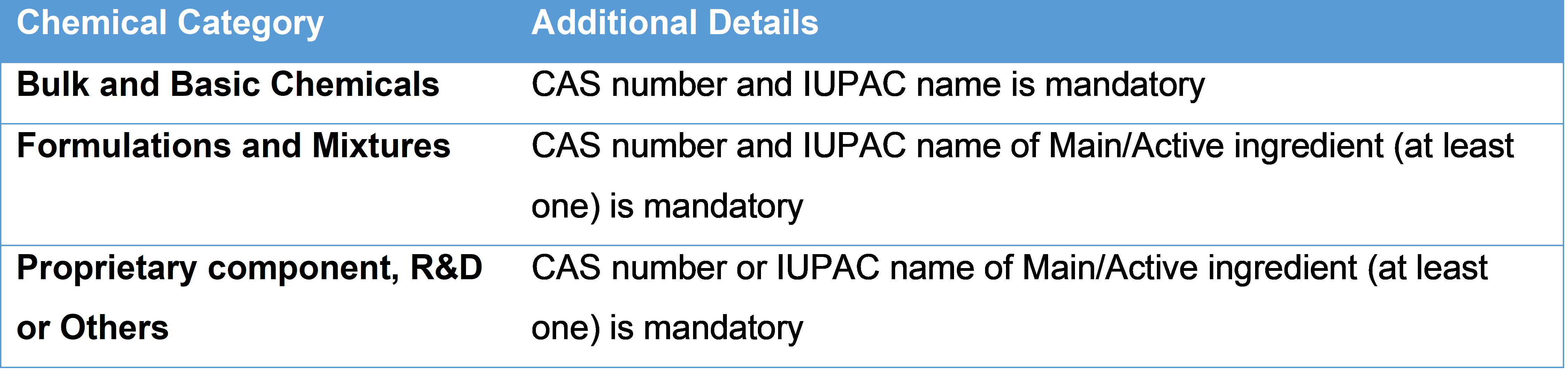
In the case of confidentiality reasons, where none of the ingredients were provided to the importers by the supplier, the Bill of Entry must include the below self-undertaking statement:
|
Sources
Contact Information Central Board Of Indirect Taxes & Customs |
¶ Restrictions and Bans |
|
|
Substance restrictions and bans in India largely result from its obligations as a signatory to multilateral environmental agreements or its trade-defense response to similar technical regulations in other countries. ¶ Persistent Organic Pollutants (POPs)India is signatory to the three major multilateral environmental agreements with overlapping coverage on Persistent Organic Pollutants (POPs), namely:
While it is intuitively clear that the Stockholm Convention in its entirety is relevant to POPs, it is important to note that POPs wastes can be found listed in Annexes I and VIII of the Basel Convention and that a large part of the industrial chemicals and pesticides in Annex III of the Rotterdam Convention are also targeted for elimination or restriction by the Stockholm Convention. As such, the management of POPs in India falls under the purview of several governmental authorities, each with its own specific or incidental measures on POPs controls as shown in the table below: 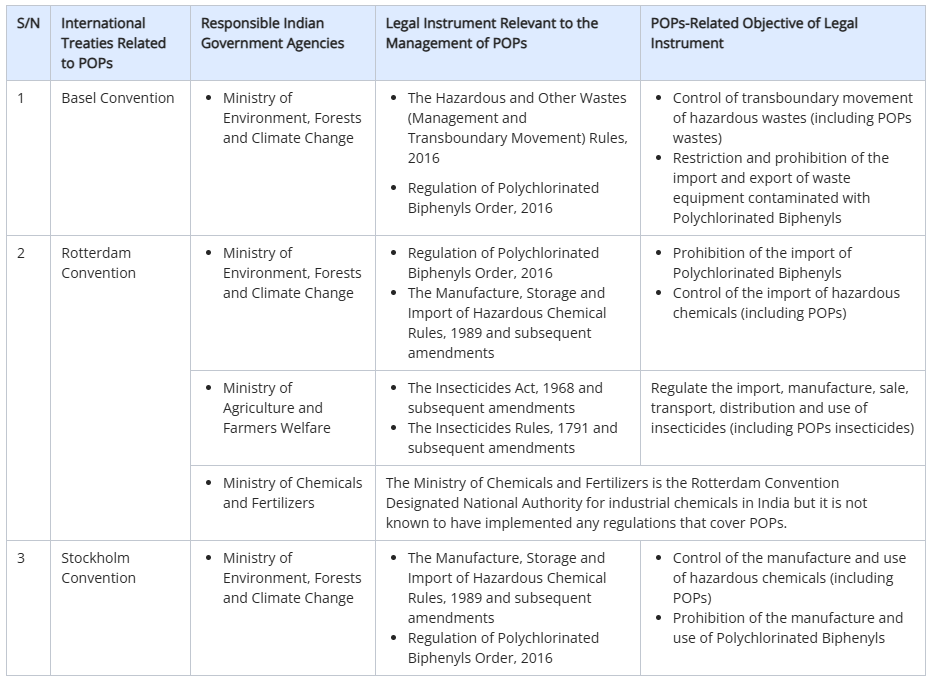 |
Sources
Resources |
¶ Ozone Depleting SubstancesIndia acceded to the Montreal Protocol on Substances that Deplete the Ozone Layer in 1992. As the national coordinating body responsible for implementing the Montreal Protocol, the Ministry of Environment, Forest and Climate Change has established an ‘Ozone Cell’ directorate as the National Ozone Unit (NOU) in India and has also rolled out regulations to control ozone depleting substances (ODS). The Ozone Depleting Substances (Regulation and Control) Rules, 2000 were promulgated on July 19, 2000 and were last amended on March 13, 2014. The controlled substances in Annexes A, B, C and E of the Montreal Protocol are transposed to Schedule I of the Rules. In addition to listing down the substances, Schedule I also included specific Group numbers (originally I through VIII) to which the substance belongs. Amendment S.O.1561(E), dated September 18, 2007 added a Group IX ozone depleting substance to the Schedule. It is worthwhile to note that the group nomenclatures found in Schedule I of the Indian Rules on ODS are more similar to those found in Annex I of the European Union’s Regulation (EC) No 1005/2009 on Substances that Deplete the Ozone Layer than the Montreal Protocol. However, although the group nomenclatures in the Rules and in the Montreal Protocol are different, the categorizations are actually similar: 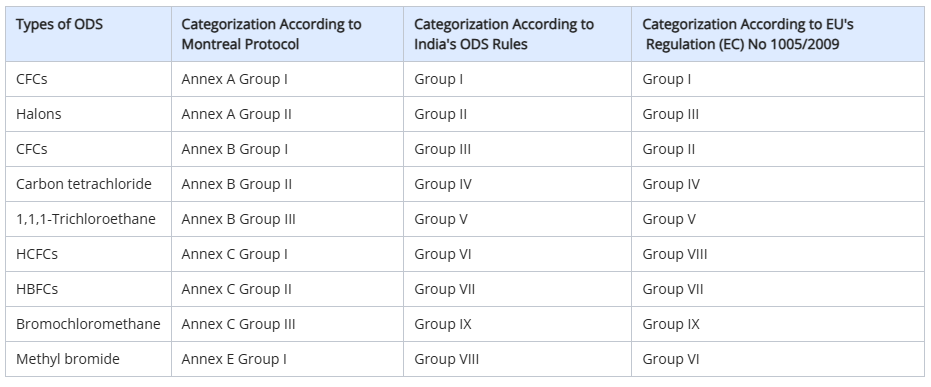 The Rules set out measures to regulate and eventually eliminate the use, production and trade of ODS in India such as:
|
Sources
Resources |
¶ Restriction of Hazardous Substances (RoHS)Unlike the European Union with its separate directives on RoHS and WEEE (Waste Electrical and Electronic Equipment), India has amalgamated its requirements on substance restrictions and end-of-life management of electrical and electronic equipment (EEE) into a single regulation – the E-waste (Management and Handling) Rules 2011. The 2011 Rules were promulgated on May 12, 2011 by the Ministry of Environment and Forests (currently renamed to the Ministry of Environment, Forest and Climate Change) and came into effect on May 1, 2012. They were subsequently superseded by the E-Waste (Management) Rules, 2016 published on March 23, 2016 with an effective date of October 1, 2016. On March 22, 2018, the E-Waste (Management) Amendment Rules, 2018 were published to revise several rules and provide new Schedule III and III(A) of E-Waste collection target. In a similar fashion to the EU's RoHS and WEEE, the applicability of the Rules is restricted to a defined set of EEE which at present only forms a subset of the categories found in Annex I of the two European Directives. The Rules also do not apply to micro enterprises as defined in the Micro, Small and Medium Enterprises Development Act, 2006. Micro enterprises
The majority of the Rules is actually devoted to stipulating the responsibilities of manufacturers, producers, collection centres, consumers (including bulk consumers), dealers, e-retailers, refurbishers, dismantlers and recyclers in the management of e-wastes; while requirements specific to substance restrictions are primarily found in Chapter V. Section 16(1) of Chapter V of the Rules states that:
The term 'producers' in the Rules is similar to 'economic operators' in the EU RoHS and refers to supply chain actors that place EEE on the market. Among the various amendments of EU RoHS, the RoHS-like requirements of the Rules bear the closest resemblance to Directive 2011/65/EU especially in terms of the applications exempted from the maximum concentration values requirements. In addition to specific applications listed in Schedule II of the Rules, the following are also exempted from the substance restriction requirements of the Rules:
The Rules devolve the enforcement of substance restriction provisions to the Central Pollution Control Board (CPCB) and the State Pollution Control Boards or Committees. CPCB has been mandated to prepare guidelines on the implementation of the Rules. The Implementation Guidelines for E-Waste (Management) Rules, 2016 were finalized in October 2016 and featured an interesting semblance to the EU’s RoHS in the form of referencing EN 50581 for demonstrating RoHS compliance. EN 50581 Article 7 of EU Directive 2011/65/EU mandates manufacturers to draw up and maintain 'technical documentation' that will demonstrate conformity of their products with the requirements of RoHS. EN 50581 was thus developed by CENELEC (European Committee for Electrotechnical Standardization) to provide guidance to the industry on the suitable content for such 'technical documentation'. These include but are not limited to:
With RoHS-like requirements only making up one chapter of the Rules, there are more differences than similarities between India’s attempt at RoHS and the EU RoHS. India RoHS lacks the EU RoHS’ provisions for the periodic review and, where necessary, the amendment of the restricted substances and the exempted applications. Unlike the EU that has implemented time limitations for the exempted applications in Annex III of 2011/65/EU, India appears to permit exemptions listed in Schedule II of the Rules to be claimed indefinitely. The scope of the categories of EEE covered by EU RoHS and India RoHS are also different, with the latter comprising of a smaller and more specific subset of the former. Also noteworthy is the specific exclusion of 'used lead acid batteries' from the scope of the Rules, thereby subjecting all other batteries used in covered EEE to the requirements of the Rules. This is in contrast to the EU where batteries fall within the remit of the Batteries Directive and are excluded from the scope of the EU RoHS. For the industry, however, the most significant divergence between the two jurisdictions’ implementation of RoHS would undoubtedly be the different purposes of technical documentation with respect to compliance controls. The EU RoHS Directive obliges producers to maintain technical documentation for up to 10 years following the placing on the market of EEE and to ensure that they are made available to authorities upon request. Technical documentation in the EU is thus intended as a post-market surveillance tool to help the authorities evaluate product conformity. In India, however, technical documentation for RoHS is required as part of the pre-market approval process for covered EEE. Section 2.2 of the Implementation Guidelines for E-Waste (Management) Rules, 2016 requires such technical documentation to be submitted to CPCB as part of an 'Extended Producer Responsibility - Authorization' procedure prior to the placing of covered EEE on the market. If enforced, this can be expected to bring as much administrative burdens to the authorities as the industry players. The E-Waste (Management) Rules, 2016 also requires the producers to implement EPR individually - setting up their own collection center and/or take-back systems - or collectively - involving in a Producer Responsibility Organization (PRO) and/or e-waste exchange. The details for PRO can be found in CPCB's 2018 guidelines under the 2018 Amendment Rules. Extended Producer Responsibility - Authorization Extended Producer Responsibility ('EPR') provisions in the Rules are WEEE-like stipulations that require producers of covered EEE to ensure the proper collection and management of e-wastes generated from their products. Producers of EEE listed in Schedule I of the Rules shall submit the following to CPCB before placing their products on the market:
When granted, the Extended Producer Responsibility - Authorization shall be valid for five year and need to be renewed 120 days before the expiration date. Producers must retain records (Form 2 of the 2016 Rules) and file annual returns for their activities of the previous year (Form 3 of the 2016 Rules) to the CPCB prior to June 30. |
Sources
Resources |
¶ SDS + Label |
|
¶ Classification¶ GHS ImplementationRequirements for classification, SDS and workplace labelling for chemicals are currently stipulated under the Manufacture, Storage and Import of Hazardous Chemical (MSIHC) Rules. India has not yet implemented the Globally Harmonized System of Classification and Labeling of Chemicals (GHS). The implementation of GHS in India is anticipated to be a part of its National Chemical Policy, which at present still remains in draft form. While there is no definite timeline on when India will adopt GHS, industry may opt to implement GHS classification, labeling and SDS on a voluntary basis. ¶ Classification in accordance with the MSIHC RulesMSIHC Schedule 1 part 1: Hazard criteria for acute toxicity: 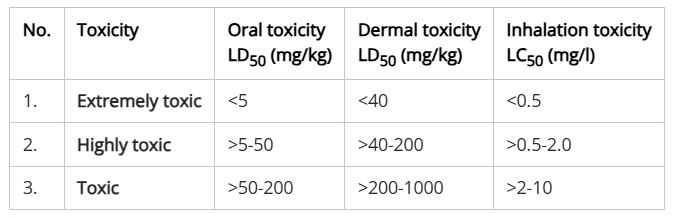 MSIHC Schedule 1 part 1: Hazard criteria for Physico-chemical effects 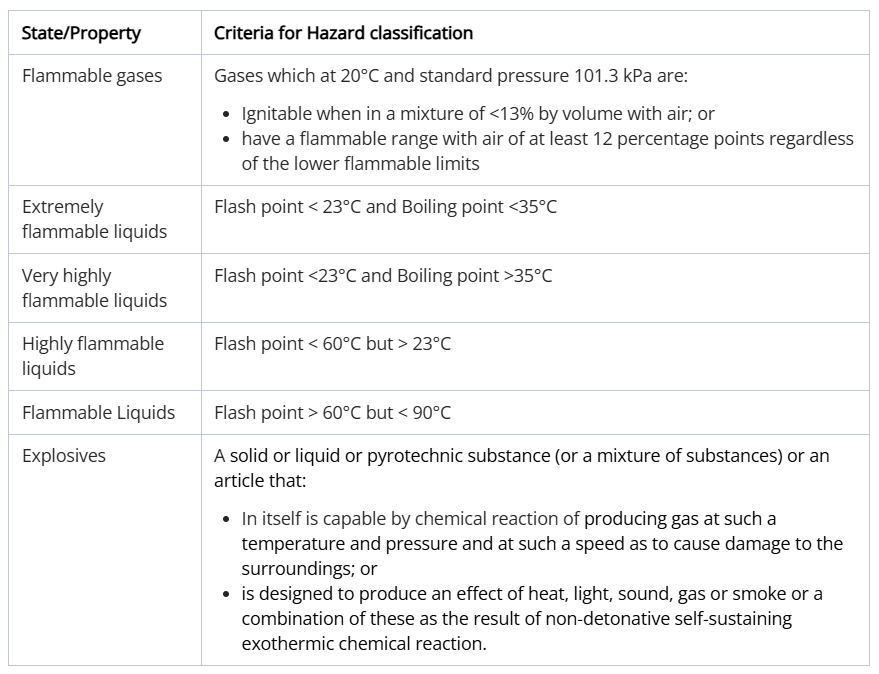 Products with these hazards must meet the SDS and Labelling provision made in MSIHC rules. |
Sources
Resources |
¶ SDSA (Material) Safety Data Sheet is required for all products which contain classified chemicals as per the criteria provided in MSIHC Schedule 1, Part 1: Hazard classification criteria for acute toxicity, flammability and explosivity. Schedule 9 (Rule17) of MSIHC specifies that an (M)SDS is required to have a minimum 10-section format, including:
The language for the (M)SDS should be English. Section 9 of the (M)SDS requires the emergency contact information. India also recognizes the ISO 11014-1/ ANSI Z400.1 16-section format (M)SDS. Such 16-section (M)SDSs are widely accepted and employed within the Indian industry even though there is no legal requirement for their implementation. SDSs in GHS-format are not yet mandatory in India but may be used on a voluntary basis. Companies wishing to employ a 16-section (M)SDS for India may consider referencing the following Indian regulations or international treaties in Section 15 where applicable:
The Central Pollution Control Board of India has compiled (M)SDSs for 708 hazardous, toxic and/ or flammable chemicals, available on compact discs. These (M)SDSs are in the 10-section format. |
Sources
Resources
|
¶ LabelLabelling is required under Rule 17 of the MSIHC Rules, which states that every container of a hazardous chemical (as defined in Part I of Schedule 1 or listed in Part II of Schedule 1) must be clearly labelled or marked to identify:
|
Sources
|
¶ Trade SecretsAt present there are no provisions contained within the Manufacture, Storage and Import of Hazardous Chemical Rules, 1989 and its year 2000 amendments on what information can be considered trade secret or Confidential Business Information (CBI). |
Sources
|
¶ Occupational Exposure LimitsThe Factories Act establishes the workplace Occupational Exposure Limits (OELs) that are required to be disclosed in Section 5 (Health Hazard Data) of the (M)SDS. Schedule 2 of the Act contains the maximum permissible threshold limits of exposure of a list of chemicals and toxic substances. Article 41F of the Act empowers the government to amend Schedule 2 to adapt to any scientific proof obtained from specialized institutions or experts in the field. |
Sources
|
¶ Transport |
|
|
In India, the transportation of dangerous goods by roads is mainly regulated under the Central Motor Vehicles Rules (CMV Rules), 1989 and its amendments. The CMV Rules are aligned to UN Recommendations on the Transport of Dangerous Goods - Model Regulations and currently administered by the Department of Road Transport and Highways under the Ministry of Road Transport and Highways. According to Rule 129 of the CMV Rules, all vehicles transporting dangerous or hazardous goods shall display a distinct and appropriate class label on an 'Emergency Information Panel' (EIP) at designated positions on the vehicle. Within the context of the CMV Rules, "dangerous or hazardous goods" refer to goods of dangerous or hazardous nature to human life specified in or classified under Tables I, II and III to Rule 137 of the CMV Rules and its fourth amendment (2005), while class labels are set out in column 3 of the Table I to Rule 137. In addition, Rule 129 requires every package containing dangerous or hazardous goods to be distinctly marked with the appropriate class labels. Packages that contain goods listed in Table III in Rule 137 (amended in the fourth amendment, 2005) shall display distinct labels to indicate the hazards. The Emergency Information Panel (EIP)
|
Sources
Resources Ministry of Road Transport and Highways |