¶ Recent Updates2026
|
|
¶ Background |
|
|
The United Mexican States is a federally constitutional republic located on the North America continent with great influence in the Central American region as the second largest economy and chemical producer in Latin America. Chemical substances and products are governed by a number of overlapping laws and regulations and fall under the jurisdiction of six different regulatory agencies: the Health Secretariat (SSA), the Secretariat of Agriculture, Livestock, Rural Development, Fisheries and Food (SAGARPA), the Secretariat of the Environment and Natural Resources (SEMARNAT), the Secretariat of the Economy (SE), the Secretariat of Communications and Transport (SCT), and the Secretariat of Labor and Social Welfare (STPS). As a result, the legislative structure overseeing chemical substances is one of the most complicated and often confusing subjects of Mexican environmental law. The two most important pieces of legislation governing chemical substances and products are the General Health Law (Ley General de Salud) and the Regulation under the General Health Law Regarding the Sanitary Control of Activities, Facilities, Products and Services (Reglamento de la Ley General de Salud en Materia de Control Sanitario de Actividades, Establecimientos, Productos y Servicios), also known as Health Control Regulation. The current chemical control legislative format in the Republic of Mexico is:
The jurisdiction of the legislative format for chemical control presented above applies to the entire Mexican territory. Nevertheless, as new federal environmental laws are passed, each of the 31 states in Mexico enacts Laws, Regulations, and Standards applicable to environmental issues. For more information regarding Mexican environmental legislation, please visit the Official Federal Gazette: http://dof.gob.mx/ |
Official Gazette |
¶ Inventories |
|
¶ Mexican National Chemicals Inventory (INSQ)The National Institute of Ecology and Climate Change (Instituto Nacional de Ecología y Cambio Climático - INECC) published the Mexican National Chemicals Inventory (INSQ) in November 2012. The INSQ aims to provide a sound basis for the protection of human health and the environment from the risks associated with the use of listed chemicals, which are available on the market in Mexico. It has also been developed in order to provide a tool for tracking competitiveness and trade of chemicals between North American countries. The National Chemicals Inventory incorporates chemical substances and mixtures which have been manufactured or imported in Mexico since 2009. The final list of chemicals was reduced from 35,000 chemicals to 5,852 by eliminating duplicate entries. This was accomplished by comparing chemical names and synonyms with those included in other national inventories, such as the US EPA's TSCA Inventory and Canada's Domestic Substance List (DSL), as well as by checking against the SciFinder database. Mexico's National Inventory provides data for chemicals produced in and imported into Mexico, listed by CAS number, including their synonyms, formula and molecular structure data, as well as ecotoxicological data, such as their bioaccumulation factors, environmental persistence and toxicity in aquatic organisms. ¶ National Registry of Chemical Substances (RNSQ)The National Registry of Chemical Substances (Registro Nacional de Sustancias Químicas - RNSQ) was created in Mexico to replace the INSQ due to its failure to meet international standards and the country's needs in chemical safety. The INSQ is voluntary, lacked comprehensive information, and is not widely utilized. In contrast, the RNSQ is mandatory for manufacturers, importers, and distributors of chemical substances, requiring detailed information about the substances and their risks. However, the implementation of the RNSQ has been gradual, and to date, there is only a proposal from 2014 without full publication or an actual list of chemicals. At the moment, work has not been resumed to further advance the design and implementation of the RNSQ, so at this time there is no timeframe in which it will be implemented. Currently, there are no import restrictions if a substance appears in the Mexican chemical inventory. There is no inventory notification or registration requirements. The National Inventory Project created a voluntary pilot program for substance registration, which started in March 2016, in an effort to register all substances manufactured and imported in Mexico. The inventory was last updated in 2014 under this project. However, in early 2017 INECC publicly stated that there will be no publication of the 2014 update and will temporally delay any advances of the National Inventory Project due to budgetary problems |
Source
|
¶ Substance Registration |
|
|
Currently, there are no substance registration requirements in Mexico. ¶ National Inventory ProjectIn April 2017 ANIQ confirmed that the National Inventory Project has been suspended due to lack of funds by the competent authorities in charge of the program. As part of the Mexican government Chemical Inventory initiative of 2014, a new program was developed in 2015 for the registration of all substances manufactured and imported in the national territory of Mexico. This program is called the National Inventory Project. The National Inventory Project has been developed in collaboration between the National Institute of Ecology and Climate Change (INECC) and the Industrial Chemical National Association of Mexico (ANIQ). The criteria of this voluntary substance registration programs is:
Some of the substance registration process activities, include:
The following substance information will be considered under the project:
The company or legal entity who enters the substance in the market is the responsible party. There is one registration per substance and the competent authority is in charge of the register system. All substances must be registered but not all substances may be regulated. Food, Drugs, and Cosmetics may not require registration.
|
|
¶ Product Registration |
|
¶ DrugsThe General Health Law and the Health and Sanitary Control Regulation defines pesticides, fertilizers and toxic substances. It establishes a registration, licensing and permit regime for pesticides, fertilizers and toxic substances and provides labelling standards for chemical substances.
The Sanitary Requirements of the Ministry of Health mandates manufacturers and importers to register controlled drugs and controlled generic drugs using the COFEPRIS registration website. For the registration of generic drugs, the website provides information on drug interchangeability requirements and criteria, a list of reference drugs and susceptibility drugs to be incorporated in the generic drug catalog, interchangeability testing and special testing, and information on Authorized Third Parties performing interchangeability testing. For the registration of new molecules, generic drugs, vaccines, or orphan drugs the manufacturer or importer must submit an application dossier. If the registration falls into the category of "new molecule", the manufacturer or importer has to request a meeting with the New Molecule Committee before submitting the application. The average application could take between one and four years to be reviewed and approved. However, with changes to third party authorizations, timelines have decrease substantially to just months. The authorization is for five years and renewals must be filed at least 6 months prior to the expiration. Fees will be assessed based on the COFEPRIS evaluation of the drug formulation and vary from submission to submission. The submission dossier structure depends on the type of product to be registered. The types of products are:
The Dossier must include the following for each of the types of products mentioned above:
The legal and administrative information includes:
There is also required information for Quality, Pre-Clinical Studies, Clinical Studies, and Bioavailability and/or bioequivalence. The COFEPRIS registration website provides manufacturers and importers with information related to lists of current Sanitary authorizations for allopathic, homeopathic, herbal and vitamin supplements, and herbal remedies and treatments, grouped according to the year they were given authorization. Lastly, information on health registrations, revocations and veterinary vaccines licensed in Mexico can also be found on the COFEPRIS webpage. |
Sources
Resources *Not available in English |
¶ Pesticides
The last update to this Law was on June 22, 2017. On February 13, 2014, a new Decree was promulgated reforming and repealing several dispositions of the Regulation for the Registration, Authorization of Import and Export and Export Certificates for Pesticides, Fertilizers and Toxic Substances and Hazardous Materials. This new Decree regulates the conditions and procedures under which the Ministry of Health, through COFEPRIS, the Ministry of Environment and Natural Resources, and the Ministry of Agriculture, Livestock and Rural Development, Fisheries and Goods, exercise the legal powers conferred upon them concerning registration, import and export licenses and export certificates for pesticides, plant nutrients and toxic or hazardous substances and materials. Its enforcement will be impartial under the principles established in the Federal Law for the control of chemical substances susceptible for the manufacture of chemical weapons. |
Sources
*Not available in English |
¶ Notifications |
|
¶ Chemical Precursors and Essential ChemicalsThe President of the United States of Mexico and the Mexican Congress published the Federal Law for the Control of Chemical Precursors and Chemical Products and Machinery Essentials for the Production of Capsules, Tablets, and/or Pills in the Official Federation Journal, on December 26, 1997. This law has been adopted without prejudice to the provisions of the General Health Law and other applicable standards and in the absence of specific provisions under the Law, these should be supplemented with the Federal Law of Administrative Procedure. The last published update to this Federal Law in the Official Federation Journal was on May 3, 2023.
Carriers have specific reporting requirements within 30 days of the first transport activity. Importers and exporters of chemical precursors or essential chemicals will need to register in the National Drug System of the Federal Commission for the Protection Against Sanitary Risk (COFEPRIS) and provide:
The registration of each controlled activities is required to be maintained for a minimum of three years. The registration cost will be assessed at the time of the registration in the National Drug System. To import or export of chemical precursors or essential chemicals that do not require authorization, license or permit under the applicable provisions, prior notification must be provided to the Ministry of Health with five days before the date when the operation is planned or as specified by international treaties which Mexico is a member. Import or export of precursor chemicals can only be made by customs agents determined by the Ministry of Health. In no case can Import or export of precursor chemicals be made by mail or courier. |
Sources Please refer to "Texto Vigente" to download the most updated version of the Federal Law for the Control of Chemical Precursors and Chemical Products *Source not available in English |
¶ Restrictions and Bans |
|
¶ Ozone Depleting SubstancesOn September 16, 1987, the Office of the President of the United States of Mexico signed and approved the Montreal Protocol submitting a letter to the UN Secretary General. On December 29, 1987, the Montreal Protocol was approved by Mexican congress and the approval was published on January 25, 1988. On December 2, 1990, a Decree was published promulgating the ratification of the Montreal Protocol and making it effective on the day of its publication. Currently, the Secretariat of Environment of Mexico (SEMARNAT) has a dedicated web page for the Montreal Protocol in Mexico. |
Sources *Not available in English |
¶ Persistent Organic Pollutants (POPs)On January 7, 2003, the President of the United States of Mexico ratified the Stockholm Convention and on February 10, 2003, Mexico submitted the ratification letter to the UN Secretary General. On May 17, 2004, the ratification was promulgated in the Mexican Official Gazette becoming effective the day of its publication. |
Sources *Not available in English |
¶ Restriction of Hazardous Substances (RoHS)Currently, Mexico does not have a Law restricting hazardous substances in electronic products like EU RoHS. However, On September 27, 2010, Mexico published voluntary standards NMX-J-634-ANCE-2010 for testing of Lead, Mercury, Cadmium, Hexavalent chromium, PBB, and PBDE in electronic products. The standards became effective on November 27, 2010. |
Sources *Not available in English |
¶ SDS + Label |
|
|
When a product's hazards are classified according to the GHS or another system, the result is communicated via a Safety Data Sheet (SDS) and a label. Along with the training that facilitates their understanding, these are the basic elements of hazard communication. |
¶ Hazard Communication
|
Sources *Not available in English |
¶ Sections of the Safety Data Sheet |
|
¶ Fluids in PipesNOM-026-STPS-2008 was promulgated by the Secretariat of Labor and Social Prevention in November 2008 and published in August 2009. It applies nationally for workplaces. The Secretariat of Labor and Social Prevention is the competent authority responsible to update the standard. For correct interpretation of the present standard, NOM-018-STPS-2015 must be used. The scope of the standard is to establish the health and safety requirements regarding workplace signs and colors and for the identification of fluids conducted in pipes. This NOM partially coincides with ISO 7010:2003 (Graphical symbols - Safety Colours and Safety Signs - Workplaces and Public Areas). Exemptions
|
Sources *Not available in English |
¶ Lead LabellingOn May 2, 2014, the Mexican Ministry of Health published the official standard, "NOM-004-SSA1-2013 - Environmental Health. Sanitary Specifications and Limitations for Use of Lead Compounds." This standard establishes limits and specific sanitary requirements for national and/or imported products containing lead as a compound without chemical changes and/or processes to prevent harmful effects to human health. Part of the included sanitary requirements under NOM-004-SSA1-2013, is compliance to the Sanitary Labelling Specifications of NOM-003-SSA1-2006 for paints, inks, varnishes, lacquers and enamels containing lead and lead compounds. On January 27, 2020, Draft Standard PROY-NOM-003-SSA1-2018 on health and labeling requirements of paints and related products was published in the Official Journal of Mexico. With the entry into force of this Draft Standard, the Official Mexican Standard NOM-003-SSA1-2006, Environmental Health, would become obsolete. It would establish the label and other related health requirements applicable to paints, inks, varnishes, lacquers and enamels. NOM-003-SSA1-2006 was published on August 4, 2008, and is a mandatory standard for all legal entities manufacturing or importing paints, inks, varnishes, lacquers and enamels. There are mandatory statements for lead based products, such as:
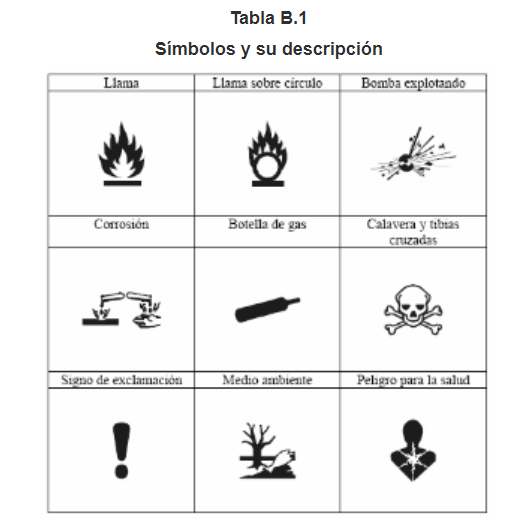
Informative Appendix A includes pictograms for all products listed in the aforementioned standard, except those manufactured for school use. Informative Appendix A also provides theory methodology for the calculation of lead content in formulations. NOM-003-SSA1-2006 5.2.1 statements b) ¡PRECAUCION! PRODUCTO INFLAMABLE MANTENGALO APARTADO DE ALTAS TEMPERATURAS, CHISPAS Y FLAMAS; c) PROHIBIDO UTILIZAR ESTE PRODUCTO EN LA ELABORACION, ACABADO O IMPRESION DE JUGUETES, OBJETOS SUSCEPTIBLES DE LLEVARSE A LA BOCA, DE ARTICULOS PARA USO DOMESTICO Y/O ESCOLARES USADOS POR NIÑOS, ASI COMO EN LA PINTURA DE INTERIORES DE CASAS HABITACION, RESTAURANTES, AREAS DE JUEGOS INFANTILES, ESCUELAS Y GUARDERIAS; d) PROHIBIDA SU VENTA A MENORES DE EDAD; e) NO SE DEJE AL ALCANCE DE LOS NIÑOS; f) EN CASO DE INGESTION, NO SE PROVOQUE EL VOMITO. SOLICITE ATENCION MEDICA DE INMEDIATO. EVITE EL CONTACTO DIRECTO; g) APLIQUE EN ESPACIOS CON VENTILACION ADECUADA; h) CONTIENE COMPUESTOS DE PLOMO, DISOLVENTES Y SUSTANCIAS TOXICAS, CUYO CONTACTO O INHALACION PROLONGADA O REITERADA ORIGINA GRAVES DAÑOS A LA SALUD; i) CIERRE BIEN EL ENVASE DESPUES DE CADA USO. |
Sources *Not available in English |
¶ Trade SecretMexico does has a general business CBI law under a border governmental Information Transparency Law. It was initially promulgated by the senate under a presidential order as an open Freedom of Information Law. It mandates all federal government agencies including the presidential office to provide information regarding governmental activities to the public. However, it does provides exclusions for confidential information in Article 14 of the same. It was initially published in June 2002 and it was last updated in May 20, 2021. The text is found in Chapter III, page 6, Article 14, Line I of the official law. Please refer to Article 14, it states:
The above text refers to the general concept of the Law when it pertains to confidential commercial information. However, under the current Mexican GHS standard NOM-018-STPS-2015, Appendix E, paragraph C, SDS information Guide, Section 3, it describes the requirements for Confidential Commercial Information or ICC, as follows:
|
Source Please refer to "Texto Vigente" to download the most updated version of the Federal Law of the Transparency and Access of Public and Governmental Information. *Not available in English |
¶ LabelOn October 9, 2015, NOM-018-STPS-2015, The Harmonized Identification and Hazard Communication and Risk System of Workplace Hazardous Chemicals, was published under the GHS 5th Revision of the UN Purple Book. On October 19, 2018 it completely repealed and replaced NOM-018-STPS-2000, its updates and authorizations. Product markings and labelling must comply with Section 8 of the 2015 NOM for all hazardous substances and mixtures handled at the workplace according to the Harmonized Identification and Hazard Communication and Risk System. All labels must be in Spanish. 
|
Source Five Appendices: A – Health and Physical Hazard Communication Elements B – Health and Physical Hazard Pictograms C – Health and Physical Hazards, Hazard Statements, H Phrases D – Health and Physical Hazards, Precautionary Statements, P Phrases E – SDS Authoring Instructions Guide I – (Not Mandatory) PPE Letters and Symbols Guide II – (Not Mandatory) Training Questioner A black border pictogram, when used internally in the workplace, along with the black symbol and white background, can substitute for the red border pictogram.-SCFI-2006 |
¶ Occupational Exposure LimitsOn April 28, 2014, NOM-010-STPS-2014 updated and replaced NOM-010-STPS-1999 (second revision), Environmental, Health, and Safety Conditions in the Workplace. This standard provides the Occupational Exposure Limits (OEL) information related to Safety and Hygiene Conditions in Workplaces Where Chemical Substances Able to Contaminate the Work Environment are Handled, Shipped, Processed or Stored. The Standard was promulgated by the Secretariat of Labor and Social Prevention on December 2013 and published on April 28, 2014. The transition period for the standard to become mandatory was two years from the date of its publication. Some of the most relevant updates to the standard were:
NOM-010-STPS-2014 applies nationally to workplaces where hazardous chemicals are handled, used, stored, or transported. The Secretariat of Labor and Social Prevention is the competent authority responsible for updating the standard.
Appendix I, Table I.1 Maximum Permissible Exposure Limits contains approximately 764 chemicals. This information must be listed in section 8 of the Safety Data Sheet. The standard also covers:
|
Sources *Not available in English |
¶ Biological Exposure Indices
The Ministry of Health under the Federal Commission for the Protection of Sanitary Risks established a five year program from 2007 to 2012 for the development of a national strategy to improve NOM-010-STPS-1999 regarding maximum occupational exposure limits. The new standard allows employers to monitor all substances present in workplaces where chemicals are handled, transported, processed, or stored. This determination may be of the same chemical(s) or its metabolite(s) or a biochemical characteristic change induced by another substance. In most cases, the measurement can be performed based on urine, blood, or exhaled air samples taken from the workers during a defined time frame. |
Sources *Not available in English |
¶ Workplace Safety
Appendix A under Table A1 of the standard provides information to determine the threshold of hazardous chemical substances present or available in the workplace. The following must be considered when determining thresholds:
|
Sources
*Not available in English |
¶ Transport |
|
|
The Secretary of Communications and Transport promulgated NOM-002-SCT-SEMAR-ARTF/2023 on the list of the most commonly transported substances and materials. It replaced and repealed NOM-002-SCT2/2011 which previously replaced NOM-002-SCT2/1994. This Official Mexican Standard is mandatory for consignors, carriers and recipients of dangerous substances and materials, transported by road, air and maritime communication. The purpose of this NOM-002-SCT-SEMAR-ARTF/2023 is to identify and classify the most commonly transported hazardous substances and materials, listed in Appendix A, according to their class, risk division, secondary risk, and number assigned by the United Nations. NOM-002-SCT-SEMAR-ARTF/2023 establishes instructions and guidelines for the use of containers and packaging, intermediate bulk containers (IBCs), large containers and packaging, portable tanks, multiple-element gas containers, and bulk containers. It aims to determine the appropriate safety conditions, considering the hazardous characteristics of the dangerous goods, as well as the specifications that must be met to ensure that the dangerous goods are contained and transported in optimal safety conditions. Shippers, carriers, and consignees of dangerous goods must comply with the protocols set forth in NOM-002-SCT-SEMAR-ARTF/2023 by February 16, 2024. In conclusion, NOM-002-SCT-SEMAR-ARTF/2023 establishes a comprehensive framework for dangerous goods transportation in Mexico. It includes important regulatory annexes that cover:
Mexico has substantially modernized its dangerous goods transportation framework. The former draft standards PROY-NOM-002-SCT/2020 and PROY-NOM-043-SCT-SEMAR-ARTF-2022 have been approved and are now in force as NOM-002-SCT-SEMAR-ARTF/2023 and NOM-043-SCT-SEMAR-ARTF-2023, respectively. These standards update Mexico's requirements to align more closely with current UN Model Regulations regarding dangerous goods classification, transport documentation, packaging instructions, and operational controls. The draft PROY-NOM-003-SCT-SEMAR-ARTF-2021 on markings, labels, and placards remains an important pending element of the modernization effort. NOM-043-SCT-SEMAR-ARTF-2023 – Dangerous Goods Transport Document The draft PROY-NOM-043-SCT-SEMAR-ARTF-2022 was approved and published as NOM-043-SCT-SEMAR-ARTF-2023, Documento de transporte de mercancías peligrosas, in the DOF on May 27, 2024. This standard establishes the information required in transport documents, including the proper shipping name, identification of dangerous goods, hazard information, and shipper declarations. It applies to shippers, carriers, and consignees involved in the transport of dangerous goods by road, rail, air, and sea. The standard replaced NOM-043-SCT/2003 upon its entry into force in late 2024. Among the key updates, it expressly recognizes the use of electronic data transmission and electronic data interchange systems for transport documentation. PROY-NOM-003-SCT-SEMAR-ARTF-2021 – Marking, Labeling, and Placarding The draft PROY-NOM-003-SCT-SEMAR-ARTF-2021, which establishes requirements for markings, labels, and placards used during the transport of dangerous goods, completed the public consultation process and received comments from stakeholders. As of June 2026, the final NOM has not yet been identified as published in the DOF, and the project remains part of Mexico's ongoing modernization of dangerous goods transport regulations. Once published, it is expected to replace and consolidate existing marking, labeling, and placarding requirements while maintaining alignment with the UN Model Regulations and the updated NOM-002-SCT-SEMAR-ARTF/2023 framework. NOM-002-1-SCT-SEMAR-ARTF/2023 – Packaging Instructions Another significant update is NOM-002-1-SCT-SEMAR-ARTF/2023, which establishes packaging, portable tank, bulk container, and intermediate bulk container requirements for dangerous goods. This standard modernizes Mexico's packaging requirements and aligns them with the UN Model Regulations (22nd Edition), incorporating numerous new packaging instructions, including provisions for lithium batteries and other recently regulated dangerous goods.
|
Sources Resources Sources
*Not available in English |