In July 2026, WorkSafe New Zealand published the 16th edition of Workplace Exposure Standards and Biological Exposure Indices. The 16th edition updates several workplace exposure limits by finalizing previously interim values and revising selected standards to align with international practice.
New Zealand is a small country in the southwestern Pacific Ocean, consisting of two main islands, the North Island and the South Island, and numerous smaller islands. New Zealand has three official languages: English, Māori and New Zealand sign language.
The New Zealand Government is formed from an elected House of Representatives. The prime minister is the head of New Zealand's government. There are numerous ministries and departments which offer policy advice to ministers and serve administrative roles. The law enforced by the New Zealand courts is a combination of common law, statute law and subordinate legislation.
Hazardous substances in New Zealand are regulated by New Zealand's Hazardous Substances and New Organisms Act 1996 (HSNO Act). The HSNO Act is administered by the Ministry for the Environment but is implemented by the Environmental Protection Authority (EPA) and enforced by various agencies. The EPA is the government agency responsible for regulatory functions concerning New Zealand's environmental management, including regulation of hazardous substances, new organisms, ozone depleting chemicals, hazardous waste exports and imports, and assessment of environmental effects in Antarctica.
The New Zealand Gazette is the official newspaper of the Government of New Zealand and is published online by the New Zealand Gazette Office at the Department of Internal Affairs. A searchable database of all Gazette notices from September 1993 may be accessed from the Department of Internal Affairs website: http://www.dia.govt.nz/MSOS118/On-Line/NZGazette.nsf/vYearOfPublication.
The Environmental Risk Management Authority (ERMA) finalized and published the New Zealand Inventory of Chemicals (NZIoC) in January 2007. In July 2011, the ERMA became part of the Environmental Protection Authority (EPA).
The NZIoC includes all the chemicals present in New Zealand, whether solely as components in products or as chemicals themselves. The inventory contains both hazardous and non hazardous chemicals, however, non-hazardous chemicals are not required to be listed.
The EPA website provides a searchable database of the NZIoC. The search function is based on CAS number and chemical names. The database includes the following information:
CAS number
Synonyms
Approval Status
Restrictions/Exclusions
Date added to Inventory
The EPA intends on updating the NZIoC regularly with new chemicals that have been notified and verified. The inventory was last amended in February 2024.
A new hazardous chemical must be notified when a substance containing the new chemical is first imported or manufactured in New Zealand, by submitting a new chemical notification to the New Zealand EPA.
Not all chemicals listed on the Inventory have approvals under the HSNO Act to be imported or manufactured in their own right. The NZIoC includes information on whether or not a particular listed chemical can be used as a chemical in its own right or can only be used as a component in a product. If it has an individual approval number (a number with HSR in front), then it can be used as a chemical in its own right. There are three approval status:
HSNO Approval Code;
May be used as a component in a product covered by a group standard but it is not approved for use as a chemical in its own right;
May be used as a single component chemical under an appropriate group standard.
The HSR approval code assigned to a chemical would only be used for a "pure chemical". If using the HSR approval for the pure chemical, the number should appear on the Safety Data Sheet. A group standard is an approval of a group of hazardous substances of a similar nature, type, or having a similar circumstance of use. The New Zealand EPA has issued group standards covering a range of product types and hazardous properties. These group standards can provide an approval for either formulated products or single component chemicals. When a product is 'assigned' to a group standard, it is deemed an HSNO approved substance.
If an appropriate group standard exists, a group standard approval number may be used. In this case, the approval number or the name of the group standard should appear on the Safety Data Sheet.
Agricultural chemicals that are hazardous substances must be approved by the Environmental Protection Authority (EPA) under the Hazardous Substances and New Organisms (HSNO) Act before they can be registered by ACVM.
If a substance contains the same active ingredient and has the same classification and usage as an approved substance, it may be covered by the existing approval. For pesticides not covered by an existing approval, a new approval is required.
To obtain approval to import or manufacture a pesticide under the HSNO Act, applicants should send the completed application form and associated fee, along with supplementary information (copies of additional references, draft label, and draft Safety Data Sheet) to the EPA. EPA prefers submission by email (HS.Applications@epa.govt.nz), but also accepts applications by post (Private Bag 63002, Wellington 6140).
The application fees vary depending on the complexity of the application and the length of time it takes to process. Some fees are negotiable. Applicants should contact EPA to determine application type and the fee that will apply before submitting the application. Hazardous substances fees schedule is available at the EPA website.
All agricultural chemicals, unless exempted, must also be registered before the import, manufacture, sale, or use is permitted under the ACVM Act and Regulations. An agricultural chemical is defined as any substance, mixture of substances, or biological compound used or intended for use in the management of plants. There are 2 types of registration for agricultural chemicals:
Registration that applies to most agricultural chemical products;
Provisional registration to do trial work to obtain information on a trade name product and to determine whether it should be registered in New Zealand.
To register an agricultural chemical, applicants must submit an application form, a Product Data Sheet, a label, an application overview, and supporting data to ACVM. The data required depends on the application type and identified risk profile. Supporting information is organized into data volumes (dossiers), which may include:
Chemistry and Manufacturing;
Efficacy and Plant Safety;
Residues.
Each data volume should include a contents page, a summary of the information provided, references to supporting documents, and a list of studies included in the dossier.
Provisional registrations are issued for a fixed time sufficient only to achieve the purpose of the provisional registration. For provisional registration, the application must supply information on identification of the investigational product, the security of the investigational product, and references (personnel involved in the study).
Overseas companies registering a product should nominate a New Zealand agent. The application documentation shall be submitted in electronic format to MPI. Refer to ACVM Guideline: E-files for ACVM applications for accepted methods used for submission of E-Files.
The processing time and fees are dependent on the application type and the complexity of the application. Please refer to Estimated fees for ACVM regulatory assessment of agricultural chemicals.
Cosmetic products that contain hazardous substances are regulated by the Environmental Protection Authority (EPA) under the Cosmetic Products Group Standard 2020 in New Zealand. In January 2024, New Zealand EPA released the updated version of the Cosmetic Products Group Standard 2020. The updated group standard applies to a cosmetic product that classifies as hazardous according to the EPA Hazardous Substances (Hazard Classification) Notice 2020, and any cosmetic product that does not classify as hazardous but contains a component that classifies as hazardous according to the Classification Notice.
To meet the requirements of the group standard, manufacturers and importers of cosmetics need to make sure their products only contain the ingredients that are permitted to be used by the group standard, and strictly follow the rules on the SDS, labeling, packaging, and storage of the products.
Cosmetic product is defined as "any product or preparation intended to be placed in contact with the various external parts of the human body (epidermis, hair system, nails, lips and external genital organs) or with the teeth and the mucous membranes of the oral cavity with a view exclusively or mainly to cleaning them, perfuming them, changing their appearance and/or correcting body odours and/or protecting them or keeping them in good condition".
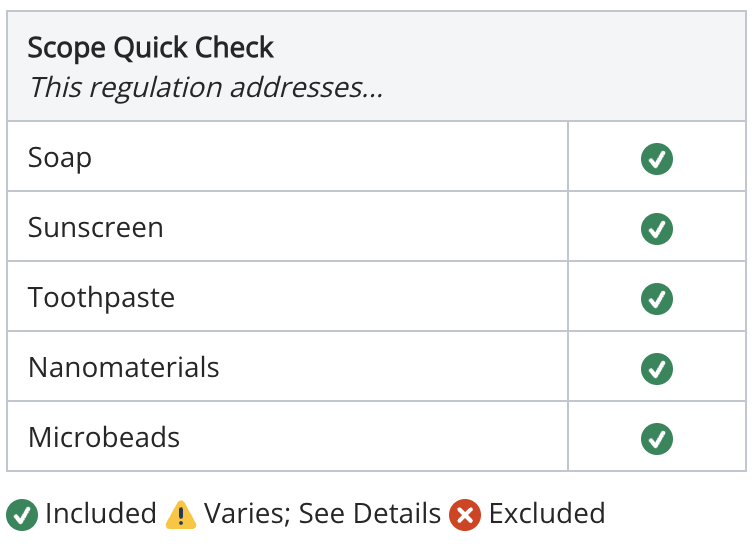
Examples of cosmetics include: soap, shampoo, toothpaste, shaving products, deodorant, perfume, hair dye, insect repellent, sunscreen, self-tanning products, lipstick, foundation and eye shadow.
Cosmetic products must not contain an ingredient listed in Schedule 4 of the Group Standard and must comply with any restrictions and conditions applicable to ingredients listed in Schedules 5 to 8.
Products with a therapeutic purpose are not considered cosmetic products under the Group Standard. Products making therapeutic claims are regulated separately under New Zealand's therapeutic products framework by Medicines and Medical Devices Safety Authority (Medsafe).
The amendment introduced the following changes to the Group Standards:
Expanded the scope of the Group Standard to include non-hazardous cosmetic products that contain a hazardous substance
Updated Schedule 4 to Schedule 8 to align with the EU Annexes
Removed the requirement for the 24-hour emergency phone number from the label
Phase out PFAS by adding them to the list of prohibited ingredients (Schedule 4, Table 2 of the group standard)
Added United Kingdom to the alternative labelling compliance list
Other changes including the requirements for fragrances and nanomaterials
For import and manufacture, the amendment takes effect on Dec 31, 2025 except for cosmetics containing PFAS, which has a longer transition period till December 31, 2026. For supply, the amendment becomes mandatory on Dec 31, 2026, but cosmetics containing PFAS may continue to be supplied till December 31, 2027.
Labelling of cosmetic products must comply with the Hazardous Substances (Labelling) Notice 2017. Required label elements can be found at Label Content.
For cosmetics, the label must also contain a list of the ingredients in the following order:
a list of the ingredients (≥1%) in descending order by volume or mass, excluding colour additives;
a list of the ingredients (<1%) in any order by volume or mass, excluding colour additives;
colour additives in any order;
words “flavour” or “flavours” or ”aroma” or “aromas”, or the ingredients in the flavour or flavours;
words “fragrance” or “fragrances” or “parfum” or “parfums”; or the ingredients in the fragrance or fragrances.
Schedules 5 to 8 of the Group Standard contain labelling requirements for components, colouring agents, preservatives and UV filters. Cosmetics that contain a component listed in these schedules must comply with the relevant labelling requirements.
If your cosmetic products comply with the current labeling requirements for cosmetics in Australia, USA, Canada and the United Kingdom or the European Union, the above requirements don't have to be met.
The ingredients may be listed with their common chemical names or their INCI names.
A label must provide the manufacturer's original source information or a batch code.
Manufacturers or importers of a cosmetic product containing nanomaterials, other than nanomaterials used as colourants, preservatives, or UV filters regulated under the Group Standard, must notify the EPA prior to the first import or manufacturer in writing with the following information:
the name of the substance;
the HSNO approval number and/or title of the group standard under which the product has a deemed approval;
the nature of the nanomaterials in the product.
The names of ingredients in the form of nanomaterials shall be listed on the label, followed by the word “nano” in brackets.
Some products containing plastic microbead, including plastic-based glitter, have been banned from manufacture and sale in New Zealand since June 7, 2018. Violations will carry a fine of up to NZD 100,000. The following cosmetic products containing plastic microbeads are banned:
"wash-off" face, hand and body cleansers, scrubs and exfoliators;
toothpastes;
glitter bubble bath.
Microbeads in wipe-off products, such as cosmetic makeup are not banned.
If a substance is imported into or manufactured in New Zealand after June 30, 2006, and contains a hazardous chemical that is not listed on the NZIoC, then the importer or manufacturer of the substance must notify the New Zealand EPA.
If a substance is a single component chemical, the importer or manufacturer must check whether it is listed on the NZIoC for use as a chemical in its own right. If a chemical is listed on the NZIoC for use as a chemical in its own right, the importer or manufacturer must assign a group standard that matches the use and hazard properties of the product. If a chemical is not listed on the NZIoC, or is listed but only for use as a component in a substance approved under a group standard, the EPA must be notified to obtain an HSNO approval.
For formulated products, cut-off levels for notification are based on the respective hazard cut-off concentrations. If a component contributes to the hazard of a product and is not on the Inventory, notification is required. The notification of non-hazardous substances is not mandatory.
To notify a new chemical component, an Application Form for Notification of New Chemical Components Approved under Group Standards must be submitted. The completed form should be emailed to: inventory@epa.govt.nz or mailed to the New Zealand EPA.
Applicants need to supply the EPA with the following information:
The name of the substance;
The HSNO approval number and/or title of the Group Standard under which the substance has a deemed approval;
The name and CAS number of the chemical not listed on the Inventory of Chemicals that is present in the substance;
The concentration of that chemical in the substance;
The hazardous properties of the chemical, including the provision of the relevant hazard data used to assign the substance to the Group Standard;
The proposed use of the substance.
Notifications will be acknowledged within 40 working days of receipt. There will generally be no fees associated with the notification of new chemicals to the Inventory.
¶ Hazardous Substances (Importers and Manufacturers) Notice
In October of 2015, the New Zealand EPA issued the "Hazardous Substances (Importers and Manufacturers Information) Notice 2015" that requires all importers and manufacturers to notify the EPA of the following information:
name of the importer or manufacturer
the importer or manufacturer's business or residential address in New Zealand
the contact details for an authorised contact person in New Zealand, including their name, email address, phone number, and relationship to the importer or manufacturer
business website address (if any).
The notice applies to New Zealand based importers that are bringing hazardous substances into New Zealand. It does not require information about the international exporters who are sending hazardous substances to New Zealand.
The rule came into force on November 19, 2015. Importers or manufacturers of hazardous chemicals for sale or commercial use must complete the Importer and Manufacturer Form on the EPA website within 30 days after the date of their first importation or manufacture. The EPA should also be updated if the contact information is changed.
On June 26, 2024, the EPA published Hazardous Substances (Importers and Manufacturers) Amendment Notice 2024. In additional to the information required on the existing Importer and Manufacturer Form, from January 1, 2026, all importers and manufacturers of hazardous substances must provide to the EPA their New Zealand Business Number, HSNO approval numbers and/or titles of the group standards for their hazardous substances.
The Amendment also introduces a new requirement that importers and manufacturers of certain hazardous substances report annually on the quantities imported and manufactured. The annual report requirement applies to the following substances, excluding fertiliser, Methyl bromide and Ethanedinitrite:
Agrichemical
Timber treatment chemical
Antisapstain chemical
Antifouling paint
Parasiticides used as veterinary medicines in large animals
Importers and manufacturers of these substances must report annually on the quantities imported or manufactured from January 1, 2026. Refer to the EPA website for more details on the changes to hazardous substances reporting requirements.
New Zealand ratified the Montreal Protocol in 1988 and published the Ozone Layer Protection Act 1996 and Ozone Layer Protection Regulations 1996 as means to implement their obligations under the Montreal Protocol to regulate and ultimately phase out chemicals known to deplete the ozone layer.
The regulations outline requirements for permits and the import and export of ozone depleting substances. They include the following three schedules:
Schedule 1: identifies controlled substances under the regulations;
Schedule 2: identifies plastic goods manufactured with chlorofluorocarbons;
Schedule 3: identifies prohibited import from non-complying countries.
New Zealand published Ozone Layer Protection Amendment Regulations 2018 to implement the Kigali Amendment, which came into force on February 18, 2019. On and from 1 January 2020, a person must not import or export a bulk HFC into or out of New Zealand without a permit. Information on how to apply for the permit can be found on the New Zealand EPA website.
New Zealand ratified the Stockholm Convention on Persistent Organic Pollutants (POPs) in September 2004 and has set out the National Implementation Plan to reduce the presence of POPs and meet the obligation under the convention.
Import, export, production and use of POPs in New Zealand are regulated by the Hazardous Substances and New Organisms (HSNO) Act 1996 and the Imports and Exports (Restrictions) Prohibition Order (No 2) 2004.
The Hazardous Substances and New Organisms (HSNO) Act 1996 was amended by the HSNO (Stockholm Convention) Amendment 2003 to implement the Stockholm Convention. The amendment took effect in December 2004. Schedule 2A of the HSNO Act includes POPs which are prohibited for production, importation and use other than the listed exemptions.
Imports and Exports (Restrictions) Prohibition Order (No 2) 2004 was issued under the Imports and Exports (Restrictions) Act 1988. Schedule 1 of the Order lists Stockholm chemicals that can't be exported from New Zealand without a permit issued by the Environmental Protection Authority.
The classifications of hazardous substances are regulated by the Hazardous Substances (Classification) Notice 2020, which replaced the Hazardous Substances (Classification) Notice 2017 to incorporate GHS 7 hazard classifications.
In October 2020, New Zealand adopted the seventh revised edition of the Globally Harmonised System (GHS 7) with an effective date of April 30, 2021. New Zealand EPA issued the Hazardous Substances (Hazard Classification) Notice 2020 to convert New Zealand's unique numbering classification system for hazardous chemicals to GHS hazard classes and categories. The updated EPA notices took effect on 30 April 2021 with a four-year transition period, which ended on April 30, 2025. All substances must now comply with the current EPA notices.
The following are adopted endpoints based on the GHS 7 with some hazard categories excluded.
List of adopted endpoints:
Hazardous Substances (Hazard Classification) Notice 2020 adopts GHS 7 hazard classifications with the following hazard classes or categories excluded:
acute toxicity Category 5;
skin irritation Category 3;
aspiration hazard Category 2;
hazardous to the aquatic environment acute Categories 2 and 3;
hazardous to the ozone layer.
The EPA also adopts the following non-GHS classifications for substances that are hazardous to the terrestrial environment:
hazardous to soil organisms;
hazardous to terrestrial vertebrates;
hazardous to terrestrial invertebrates;
designed for biocidal action.
Please note that these ecotoxicity classifications only apply to agrichemicals and some active constituents used for agrichemicals.
The EPA provides detailed hazard information for single chemicals in the Chemical Classification and Information Database (CCID). The CCID contains chemical identification information, chemical property data and hazard classifications. It is used by industry to classify formulated products and to prepare labels and Safety Data Sheets. To implement GHS 7, the HSNO hazard classifications in the CCID have been replaced with new GHS classifications.
On July 1, 2016, the New Zealand Environmental Protection Authority (EPA) started a new statutory process to help manufacturers and importers determine the HSNO hazard classification of a substance and whether the substance is covered by an existing approval.
Under the HSNO Act, all hazardous substances must be approved by the EPA before they can be manufactured in or imported to New Zealand. However, determination of whether a substance is hazardous or is covered by an existing approval could be a complicated process for some products. The new formal determination under Section 26 of the HSNO Act provides manufacturers and importers a legally-binding determination of whether a hazardous substance fits one of the existing approvals. This process replaced the SoS (Status of Substance) service, which offered informal advice on the status of a substance.
Section 26 Determination is optional. Applicants may submit the application form to the New Zealand EPA for this service. The fee for this application is $3300 NZ$ (GST excluded).
Where test data is not available for a mixture, for health and environmental endpoints, the GHS allows for classification based on the hazards of the substances in the mixture. The GHS usually defines the concentration at which a hazardous substance causes a mixture containing that substance to be classified, for most hazards. These are known as Concentration limits / Cut-off values. Countries must additionally set the thresholds for mixture classification for certain hazards:
Respiratory or Skin Sensitization
Carcinogenicity
Reproductive Toxicity
Specific Target Organ Toxicity - Single Exposure and Repeated Exposure
¶ Cut-off Values under GHS 7 Hazard Classifications
¶ Specific Target Organ Toxicity - Single Exposure and Repeated Exposure
*New Zealand adopts the lower cut-offs for classification and for SDS requirements, and the higher cut-off values for ingredient disclosure on labels, except for STOT (single and repeated) Category 1. For STOT category 1, EPA has adopted the higher concentration cut-off of 10% for classification, and the lower concentration cut-off of 1% for ingredient disclosure on SDS and labelling.
According to the Consolidated Hazardous Substances (Safety Data Sheets) Notice 2017, importers or manufacturers of a hazardous substance must prepare a Safety Data Sheet (SDS) that is in compliance with the Notice before supplying the substance to a workplace.
New Zealand has adopted the seventh revised edition of the Globally Harmonised System (GHS 7) with an effective date of April 30, 2021. New Zealand EPA has amended the Hazardous Substances (Safety Data Sheets) Notice 2017 and published the Consolidated Notice to adopt the new hazard classification system set out in the Hazardous Substances (Hazard Classification) Notice 2020.
The Consolidated Notice came into force on April 30, 2021 with a four-year transition period, which ended on April 30, 2025. The main change of the amended Notice is the replacement of HSNO hazard classes with the GHS 7 classification system. The SDS adopts the 16 header GHS format.
Overseas suppliers may use an SDS that is prepared in accordance with the GHS requirements of Australia, Canada, EU, or USA in New Zealand, as long as the following New Zealand-specific information is provided:
Contact details of the New Zealand manufacturer or importer
24-hour free emergency phone number for the following hazard classes: explosives (class 1), oxidising liquids, oxidising solids, oxidising gases, organic peroxides, acute toxicity, skin corrosion/irritation, serious eye damage/eye irritation, respiratory or skin sensitisation, and aspiration; free emergency phone number and hours of availability for other hazard classes
HSNO approval number and group standard title
Reference to New Zealand Tolerable Exposure Limit (TEL) or Environmental Exposure Limit (EEL)
In addition, the importer or manufacturer must keep a record of the import that shows the dates of each entry for at least 2 years after the substance is no longer available for supply.
Manufacturers and importers of hazardous substances must ensure that their products are labelled properly. Labels must be prepared in compliance with the requirements of the Consolidated Hazardous Substances (Labelling) Notice 2017.
New Zealand has adopted the seventh revised edition of the Globally Harmonised System (GHS 7) with an effective date of April 30, 2021. New Zealand EPA has amended the Hazardous Substances (Labelling) Notice 2017 and published the Consolidated Notice to adopt the new hazard classification system set out in the Hazardous Substances (Hazard Classification) Notice 2020.
The amended Notice became effective on April 30, 2021 with a four-year transition period, which ended on April 30, 2025. The main change of the amended Notice is the replacement of HSNO hazard classes with the GHS 7 classification system.
Product identifier, including common name, chemical name, or registered trade name 1
Contact details of New Zealand importer or manufacturer 2
Emergency phone number 3
Pictograms
Signal word
Hazard statements
Precautionary statements
Disposal method information
Note 1: For mixture containing toxic or corrosive ingredients, common or chemical name of the ingredient and its concentration at or above the concentration cut-off level must be included.
Note 2: For hazardous substances imported from overseas directly into a workplace for use, the contact details of the overseas supplier are acceptable.
Note 3: The label must include a 24-hour free emergency phone number for the following hazard classes: explosives, oxidising liquids, oxidising solids, organic peroxides, acute toxicity, skin corrosion/irritation, serious eye damage/eye irritation, respiratory or skin sensitisation.
The label must include the GHS label elements: pictograms, signal word, hazard statements and precautionary statements. The rules on precedence of hazard information and arrangements for presenting the label elements in the GHS apply to the New Zealand labels. Precautionary statements with minor differences are acceptable as long as the minor differences don't change the obvious meaning.
The importer or manufacturer may use a label that is prepared in accordance with the GHS requirements of Australia, Canada, the EU, or the USA in New Zealand, as long as the following New Zealand-specific information is provided:
Contact details of the New Zealand manufacturer or importer
24-hour free emergency phone number for hazard classes: explosives, oxidising liquids, oxidising solids, organic peroxides, acute toxicity, skin corrosion/irritation, serious eye damage/eye irritation, respiratory or skin sensitisation.
In addition, the importer must keep a record of the import that shows the dates of each entry for at least 2 years after the substance is no longer available for supply.
According to the Consolidated Hazardous Substance (Safety Data Sheets) Notice 2017, the identity of hazardous ingredients above the cut-off concentrations must be disclosed. However, for trade secrets, generic names or concentration ranges may be used.
A generic name may be used in the following circumstances:
Hazard classes: acute toxicity Category 4, skin/eye irritation Category 2, specific target organ toxicity – single exposure Category 3 and aspiration hazard Category 1; and
the ingredient identity is confidential; and
an exposure standard hasn't been established for the ingredient.
If the exact concentration of the ingredient is confidential, one of the following concentration ranges or a narrower range may be used (% of weight or volume):
New Zealand initially published occupational exposure limits in 1994. The Workplace Exposure Standards and Biological Exposure Indices serve as Guidance values for health risk management. The latest (16th) edition of the Standards was published by WorkSafe New Zealand (WorkSafe) in July 2026.
Workplace exposure standards (WES) are values that refer to the airborne concentration of substances at which it is believed that nearly all workers can be repeatedly exposed day after day without adverse health effects. The exposure standards include 8 hour TWAs, 15 minute Short Term Exposure Limits (STELs), Ceilings and Biological Exposure Indices. There are also designations for simple asphyxiants, known and suspected carcinogens, sensitisers and substances with exposure through skin contact.
Most WES in New Zealand have an eight-hour TWA, representing a work shift of 8 hours per work day. When shifts are longer than 8 hours/day or 40 hours/week, the TWA needs to be adjusted to account for the longer period of exposure and shorter recovery time.
Short-Term Exposure Limit (STEL) refers to the 15-minute exposure standard. This applies to any 15-minute period in the working day and is designed to protect the worker against adverse effects of irritation, chronic or irreversible tissue change, or narcosis that may increase the likelihood of accidents. The STEL is not an alternative to the TWA; both the short-term and time-weighted average exposures apply.
A ceiling refers to a concentration that should not be exceeded at any time during any part of the working day.
The Standards identify two categories of carcinogens:
6.7A Carcinogen–known or presumed human carcinogen
6.7B Carcinogen–suspected human carcinogen
The Health and Safety at Work (Hazardous Substances) Regulations require persons conducting a business or undertaking to ensure that no person is exposed to a substance exceeding its workplace exposure standard. If a hazardous or toxic substance has not been assigned a WES, it does not mean that the substance is safe under all conditions or that no restrictions should be placed on its uses. It is still important to take all practicable steps to eliminate, isolate or minimize the concentration of airborne substances to the lowest practicable level.
The NZ Transport Agency Waka Kotahi (NZTA) is responsible for the Transport of Dangerous Goods on Land (New Zealand Standard 5433:2020). This standard is based on the 21st Revision of the United Nations Recommendations on the Transport of Dangerous Goods.
Sources
Transport of Dangerous Goods on Land (New Zealand Standard 5433:2020) available for purchase from Standards New Zealand.