Nigeria is located in Western Africa by the gulf of Guinea. English is widely spoken in the country and their regulations can be found in English. The Federal Republic of Nigeria Official Gazette is printed in English, there is no single website for the Gazette but each ministry publishes the Gazette volumes related to them.
The National Agency for Food and Drug Administration and Control publishes many regulations regarding Food and Drug control as well as information and regulations regarding Pesticides and Chemical Control in Nigeria (http://www.nafdac.gov.ng/index.php)
The National Industrial Court of Nigeria publishes the Gazette volumes and regulations regarding their court systems and industry (www.nicn.gov.ng)
Nigeria does not require registration of any chemical substance. However, a license to trade hazardous materials within the country is required for import. This license is required when importing chemical substances or products.
In Nigeria, pesticides must be registered in accordance with the Pesticide Registration Regulations 2005. Each unique pesticide and pesticide formulation requires its own application. The National Agency for Food and Drug Administration and Control (NAFDAC) administers and enforces pesticide regulations. The application, safety data sheet, and labels for pesticides must be in English.
Companies and individuals in Nigeria can apply to register a pesticide if they are manufacturing the pesticide in a Nigeria-approved facility. If the company is not located within Nigeria, they must get representation within Nigeria by a registered company, and the company also must have registered in their country of origin. If the manufacturing facility is also outside of Nigeria, companies must formally invite the government of Nigeria to inspect the facility.
Manufacturers shall submit an application to the Director, Registration and Regulatory Affairs Directorate, NAFDAC. There is an online application, but the website is non-responsive. A paper application should be available upon request.
The application should be requested from the Director, Registration and Regulatory Affairs Directorate, NAFDAC.
Information Requirements
Administrative
Name of Manufacturer, including address, phone/fax number
Common Chemical name and Brand name of the pesticide
Certified analysis of the pesticide
Certified statement from the country of origin which states that the pesticide in question has been approved for use by the country of origin (for imports only)
A notarized contract agreement OR a Power of Attorney agreement
A statement that acknowledges that advertisements of the pesticide must be approved by Nigeria before they are published
Evidence of label claims that involve the properties, quality and safety of the pesticide
Formal invitation to inspect the manufacturer facility abroad with the full address, name of the contact person including phone and fax number and directions that illustrate the shortest route to the facility by land or air
Scientific
Classification
Samples of the pesticide and proper labels
Product composition, concentration, chemical characteristics and Standard Laboratory Analytical methods for each active ingredient, impurity or inert that has toxicological significant
Radioactivity test (if demanded by NAFDAC)
Environmental fate
Degradation
Metabolism in plants and animals
Mobility
Accumulation
Hazards to human or domestic animals
Toxicity (oral, dermal, inhalation)
Teratogenicity/ reproduction studies
Mutagenicity
Hazards to non-target organisms
Product performance, including efficacy trials in Nigeria
Once the Registration is received, it will take approximately 80 work days to receive a response from NAFDAC. The manufacturer will receive a Certificate of Registration that will expire after 5 years.
The National Agency for Food and Drug Administration and Control published a guideline for importing chemicals in Nigeria (NAFDAC/NCS/002/00). Import of chemicals is primarily controlled through a permitting process, detailed in the Guidelines document.
There are two permits described in the Guidelines:
"a permit to import industrial, consumable, laboratory, agricultural and restricted chemicals controlled under international conventions"
"a permit to clear chemicals restricted and controlled under international conventions into Nigeria"
Both permits are necessary when importing restricted chemicals and should be obtained prior to shipping.
Application Requirements for Permit to Import
Application letter on company’s letter head which should be addressed to The Director Narcotics and Controlled Substances Directorate, National Agency for Food & Drug Administration and Control, Oshodi, Lagos
The applicant should indicate the list of chemicals, the quantities required in standard/metric units and the intended uses of the chemicals in both hard and soft copies
The applicant shall purchase and duly fill the application form which should be signed by the Managing Director or Technical Officer
The following should be submitted:
Copy of certificate of incorporation (Original for sighting)
A certified true copy of memorandum of Article of Association (Original for sighting)
One certified true copy of particulars of Directors/Form CO7 (original for sighting)
Copy of Current Tax Clearance (Original for sighting)
Permit from Federal Ministry of Solid Minerals (applicable to importers of Ammonia Nitrate)
A letter of authority from Power Holding Corporation of Nigeria (PHCN) for importation of Transformer Oil
Proforma Invoice (for permit to import restricted chemicals)
Evidence of product registration with NAFDAC (where applicable)
Evidence of NAFDAC Listing Certificate for Marketers of Chemicals (where applicable)
Credentials, medical certificate of fitness, and letter of Appointment/acceptance of the technical officer
Certificate of manufacture issued by the relevant regulatory body in the country of source
Material Safety Data Sheet (MSDS) from the manufacturer
Request for Additional Chemical
Any request for additional chemicals to an existing permit in a current year should attract another application
The applicant should indicate the list of chemicals, quantities in standard/metric units and the intended uses of the chemicals
The Material Safety Data Sheet (MSDS) for the additional Chemical items must be submitted
Copy of the previous permit for which additional request is being made
The process should attract additional fee
Application Requirements Permit to Clear
Permit to clear must be obtained prior to the shipment of goods into Nigeria
Applicant shall apply to the Director, Narcotics & Controlled Substances Directorate, on company’s letter head attaching the following documents
Copy of permit to import issued by NAFDAC
Copies of shipping documents as follows:
Single goods declaration (SGD FORM)
Bill of lading/Airway bill
Form M
Risk Assessment Report (RAR)
Packing list
Certificate of analysis/quality Control Certification - Name, signature and designation of analyst must be clearly stated on the certificate
Certificate of value/commercial invoice
Permit should be issued upon satisfactory evaluation
Applicants should note that issuance of permit to import restricted chemicals does not authorize the importer to clear the consignment without first obtaining a permit to clear from the Chemical Import Control Division
Fees apply when obtaining or renewing these permits. Fees are found in Section G of the guidelines and are payable to the National Agency for Food and Drug Administration and Control.
Facilities storing the imported chemicals will be inspected by NAFDAC every three years. Inspection criteria is detailed in Section F of the Guidelines.
All cosmetic products must be registered in accordance with the Food, Drugs, and related Products (registration) ACT cap F.33 LFN 2004.
Definition of Cosmetic
Cosmetic includes any substance or mixture of substance intended to be rubbed, poured, sprinkled or sprayed, introduced into or otherwise applied to the human body or any part thereof for cleansing, beautifying, promoting attractiveness or altering the complexion, skin, hair or teeth and includes deodorants and detergent powder
All applications for registration for cosmetic products must be in writing to the National Agency for Food and Drug Administration and Control (NAFDAC) and shall include the following:
The particulars and description of the cosmetic product
The fee to the agency, if required
Upon receiving the application, the Agency may ask for more information on the product to make their decision if it is necessary in order to justify registration of the cosmetic product in Nigeria.
Each product needs its own application. Specific application requirements vary depending on whether the product is manufactured in or imported into Nigeria.
Application Requirements for Cosmetics Manufactured in Nigeria
According to Article 3 of the Guidelines for Registration of Cosmetics Made in Nigeria, the application must include the following:
The application letter and print-out of the registration form are to be accompanied with two (2) sets of the following documents and are to be submitted at the Liaison Office of the Director (LOD), R & R Directorate, Ground Floor, NAFDAC Office Complex, Oshodi-Apapa Express Way, Isolo, Lagos State or any NAFDAC Office (outside Lagos)
Evidence of Business Incorporation. In-case of Micro, Small and Medium Enterprises (MSMEs); evidence of Business name.
Evidence of Registration of Brand Name with Trademark Registry in the Ministry of Industry, Trade and Investment. This should be done in the name of the owner of the Trademark/Brand name as the case may be.
Evidence of satisfactory Inspection issued by the relevant Directorate or Good Manufacturing Practice (GMP) certificate for product line (companies with registered products).
Product Labels/artwork.
Comprehensive Certificate of Analysis. The certificate of analysis must be presented on a letter-headed paper of the Quality Control Laboratory where the sample was tested/evaluated and should contain the under listed information:
The brand name of the product
The batch number of the product
The manufacturing and expiry dates
The name, designation and signature of the analyst
Application Requirements for Imported Cosmetics
According to Article 3 of the Guidelines for Registration of Imported Cosmetics Nigeria, the application must include the following:
The application letter and print-out of the registration form are to be accompanied with two (2) sets of the following documents are to be submitted at the Liaison Office of the Director (LOD), R & R Directorate, Ground Floor, NAFDAC Office Complex, Oshodi-Apapa Express Way, Isolo, Lagos State or any NAFDAC Office (outside Lagos)
Notarized Declaration (Appendix 1). To be completed (typed), signed by Declarant and notarized by a Notary Public in Nigeria.
Power of Attorney or Contract Manufacturing Agreement. An applicant on behalf of a manufacturer outside Nigeria must file an evidence of Power of Attorney from the manufacturer which authorizes him to speak for his Principal, on all matters relating to the latter’s specialties. The Power of Attorney shall (be):
Issued by the manufacturer of the product.
Signed by the Managing Director, General Manager, Chairman or President of the company, stating the names of the products to be registered. The power of attorney shall also indicate ‘Authority to register product with NAFDAC
State ownership of Brand name(s)/Trademark
Notarized by a Notary Public in the country of manufacture
Valid for at least five (5) years
Contract Manufacturing Agreement: An applicant filing an application on behalf of his company, and being the owner of the product, shall provide a Contract Manufacturing Agreement, which shall be signed by himself (or his competent representative) and the manufacturer. The Agreement shall be
Notarized by a Notary Public in the country of manufacture
Signed by both parties stating names and designations of the signatories with the names of all the products to be registered and other relevant clauses clearly explained in an unambiguous language.
Certificate of Manufacture and Free Sale. The manufacturer must show evidence that the company is licensed to manufacture cosmetics products and that the sale of the product does not constitute a contravention of the laws of that country, i.e. Free Sale Certificate (Certificate of Manufacture and Free Sale). The Free Sale Certificate should:
Be issued by a relevant Health/Regulatory body in the country of manufacture
Indicate the name of manufacturer and products to be registered
Be authenticated by the Nigerian Embassy or High Commission in the country of origin. In countries where no Nigerian Embassy exists, any Commonwealth or ECOWAS country can authenticate the document
Comprehensive Certificate of Analysis. The certificate of analysis must be presented on a letter-headed paper of the Quality Control Laboratory where the sample was tested/evaluated and should contain the under listed information:
The brand name of the product
The batch number of the product
The manufacturing and expiry dates
The name, designation and signature of the analyst
Evidence of Business Incorporation of the importing company with the Corporate Affairs Commission in Nigeria
Evidence of Registration of Brand Name with Trademark Registry in the Ministry of Industry, Trade and Investment. This should be done in the name of the owner of the Trademark/Brand name as the case may be
Label or artwork of the product
Letter of Invitation for Good Manufacturing Practice (GMP) inspection: A letter of invitation to inspect the factory abroad shall be written by the manufacturer and shall state the following:
MANUFACTURER INFORMATION: Name of Company, full location address of factory (not administrative office address), e-mail, and current phone number. Details (name, phone number and email) of contact person overseas
LOCAL AGENT INFORMATION: Name of company, full location address, functional phone no., e-mail address. Details (name, phone number and email) of contact person. Names(s) of product(s) for registration
All cosmetic products labels shall state the following
Brand name
Product statement of identity
Lot or batch number
Net content
Expiration date
Manufacturers name and country of origin
Registration number assigned to it in a manner prescribed by the Agency
Storage conditions, and any other information as may be prescribed by the Agency
The letters of the name of the cosmetic product and the net content shall be of a size reasonably related to the predominant character on the label
Where a cosmetic container is covered by a wrapper, the label shall be readily legible through the outer wrapper and not be obscured by it
Where the wrapper carries the required information, it shall be affixed in a manner that is not removable from the cosmetic container
No label shall bear words, pictorial or other means which refers to any other product or falsely suggests either directly or indirectly, that the cosmetic product is connected with such other product
All information and statements as required by these Regulations shall appear on the part or panel of the label which is presented or displayed under customary conditions of purchase
Any claims on the cosmetic product shall be substantiated
For all labeling requirements please refer to the NAFDAC Cosmetic Products Labeling Regulations 2019.
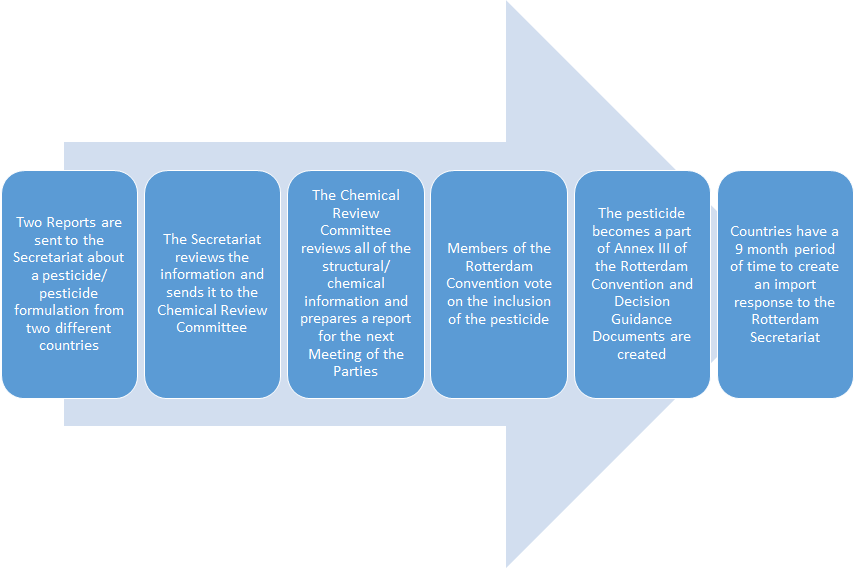
Nigeria ratified the Rotterdam Convention on June 28, 2001 by publishing Act 17 in 2005. For Nigeria, this treaty entered into force in 2004, even though the regulations were not published until 2005. The Rotterdam Convention Prior Informed Consent (PIC) Procedure for Certain Hazardous Chemicals and Pesticides in International Trade procedure applies to pesticides, industrial chemicals, and severely hazardous pesticide formulations, listed in Annex III to the Rotterdam Convention, that have been banned or severely restricted for health and environmental reasons.
Two reports, each arising from a different geographic region of the world, as defined by the Rotterdam Convention, must be received by the Rotterdam Secretariat. These reports are accepted by the Rotterdam Secretariat and then go to the Chemical Review Committee, where they evaluate the reports to see if they should be voted for inclusion at the Meeting of the Parties of the Rotterdam Convention.
Annex III contains 47 chemicals, but is expected to include many more in the future. The Conference of Members decides on the inclusion of more chemicals during their Meeting of the Parties for the Rotterdam Convention. Once a chemical is included in Annex III, a “decision guidance document” (DGD) containing information concerning the chemical and the regulatory decisions to ban or severely restrict the chemical for health or environmental reasons, is circulated to all Member countries. Annex III chemicals and their decision guidance documents can be found with the link provided to the Rotterdam Convention.
Countries have a nine-month period to prepare a response regarding future import of the chemical in question. The response can consist of either a final decision (to allow import of the chemical, not to allow import, or to allow import subject to specified conditions) or an interim response. Decisions by importing countries should dispense with any consideration of trade (that is applied equally to domestic production and imports).
The import decisions are circulated through bi-annual reports prepared by the Rotterdam Secretariat. These reports are available in June and December and exporting country members are obligated under the Convention to take appropriate measures to ensure that exporters within its jurisdiction follow the decisions that their countries have made.
The Montreal Protocol is a Multilateral Environmental Agreement that has Universal Ratification by all countries that are a part of the United Nations. Nigeria ratified the Montreal Protocol in 1988, and must follow specific rules and regulations as a party member. Any company or manufacturer that wishes to import or export an Ozone-Depleting Substance from Schedule 3 of Nigeria's National Environmental (Ozone Layer Protection) Regulation must obtain the appropriate permit from the National Environmental Standards and Regulations Enforcement Agency (NESREA). These regulations were last updated on September 30, 2009.
The requirements to apply for the permit to import and export ozone depleting substances can be found in Schedule 5 of the National Environmental (Ozone Layer Protection) Regulations. Companies and Manufactures should request the Ozone Depletion permit application from the National Environmental Standards and Regulations Enforcement Agency. There may be conditions that the permit holder must follow, either from the permit document or from a written notice.
Once the permit is obtained, a report must be sent biannually to NESREA. The details that are required in the report can be found in Schedule 4 of the National Environmental (Ozone Layer Protection) Regulations. All records must be kept for 5 years.
The report must be sent no later than:
July 31 for any import/ export activities that occurred from January to June
January 31 for any import/ export activities that occurred from July to December
There will be a fee set by NESREA, which may be waived in cases such as:
The import or export of the ozone depleting substance is less than half of a ton
Ozone depleting substance is used research purposes, or
Ozone depleting substance is disposed of in a safe manner
Nigeria signed the Stockholm Convention on May 23, 2001 and ratified the Convention on May 24, 2004. It went into force August 22, 2004. They do not have any legislation related to implementing the Stockholm Convention as of yet.
Nigeria has not specified any classification requirements or schemes, but does provide information regarding SDS and Label requirements in the Chemical Import Guidelines.
In 2016, Nigeria published a draft on Health and Safety in the workplace. The 2016 draft replaces an earlier 2012 draft and includes more safety precautions. The Bill aims to create the National Council for Occupational Safety and Health. This Council would create policies to advance Occupational Health and Safety, which may indicate more developed OHS regulations in the future.