¶ Background |
|
|
Norway is a constitutional monarchy located in Northern Europe. It is a member state of the European Economic Area (EEA), but not a member of the European Union (EU). Through its membership in the EEA, Norway has access to the internal market of the EU on the condition that Norway implements relevant pieces of EU legislation, such as the REACH, BPR and CLP. The rights and obligation are set in the EEA agreement. In Norway, the parliament has legislative power. Adopted statutes and regulations are published in the Official Gazette, Norsk Lovtidend, which is only available in Norwegian. Important authorities related to chemical regulation include the Norwegian Environment Agency (Miljødirektoratet), the Norwegian Food Safety Authority (Mattilsynet), and the Labour Inspection Authority (Arbeidstilsynet). In the Norwegian Environment Agency's website, Kjemikaliesøk, it is possible to search for substance by its name or CAS-number and to find out how the substance is regulated. |
Helpdesks CLP + REACH The Norwegian Environment Agency BPR The Norwegian Environment Agency |
¶ Inventories |
|
¶ C&L InventoryAs a member of the European Economic Area, Norway implements EU Legislation related to the internal market of the EU.
See European Union page: ¶ EC InventoryAs a member of the European Economic Area, Norway implements EU Legislation related to the internal market of the EU. The REACH Regulation, EC No 1907/2006, for which the following EU Inventories are relevant, is transposed in the Norwegian REACH Regulation, FOR-2008-05-30-516. See European Union page: |
|
¶ Substance Registration |
|
¶ REACHAs a member of the European Economic Area, Norway implements EU Legislation related to the internal market of the EU. The REACH Regulation, EC No 1907/2006, is transposed in the Norwegian REACH Regulation, FOR-2008-05-30-516. See European Union page: REACH |
|
¶ Product Registration |
|
¶ Norwegian Biocidal Product RegistrationAs a member state of the European Economic Area (EEA), Norway has fully implemented the European Union Biocidal Products Regulation (BPR) through the Norwegian Biocides Regulation. Therefore all the general rules and requirements established in the BPR also apply in Norway. Norway evaluates dossiers of products and active substances, including applications for Union authorisation. The Norwegian Environment Agency is responsible for authorising biocidal products in Norway. The authorisation can be granted for products where the active substance has been approved for use in European Union. If the active substance is under evaluation, the national transitional measures apply. ¶ ApplicationsAll applications for product authorisation are submitted through R4BP 3 on the ECHA website. In Norway, authorisation through mutual recognition is most common. This type of authorisation requires the following documentation to be sent to the Norwegian Environment Agency:
All biocidal products must be notified to the Norwegian Product Register regardless of the classification or the amount imported/used. ¶ Transitional measuresPrior to approval of the active substance for use in European Union, the following requirements must be followed when placing a biocidal product on the market in Norway:
During the interim period prior to the approval of the active substances in question, national regulations have to be followed for product-types (PT) 2, 3 and 5 in the following areas:
For more information related to regulation of PT 2 and 3, please contact the Norwegian Medicines Agency. For further information about the regulation of PT 5, please contact the Norwegian Food Safety Authority. ¶ National restrictionsIn accordance with article 37 in the Biocidal Products Regulation, Norway applies stricter national restrictions for use of authorised anticoagulant rodenticides and authorised insecticides against bed bugs, cockroaches and pharaoh ants. More information is available in the web pages of the Norwegian Environmental Agency. ¶ FeesThe fees for authorisation of products can be found in Appendix 1 to the Norwegian Biocides Regulation, an unofficial English translation of the fees is available. An invoice is sent upon receipt of the application. |
Sources Resources
*Not available in English Navigate to: EU Biocidal Products |
¶ Norwegian Plant Protection Product RegistrationOnly authorised plant protection products (PPPs) can be sold in Norway. The Norwegian Food Safety Authority is responsible for authorisation of the PPPs whose active substance is approved for use in European Union. In Norway, the PPPs are regulated by the Norwegian Plant Protection Regulation which implements the EU regulation (EC) No 1107/2009. According to the decision of the EFTA Joint Committee No 203/2014, the EFTA States, like Norway, can limit the access to their market of PPPs approved for use in EU. The Norwegian Food Safety Authority may apply this precautionary principle to ensure that substances placed on the market do not have any harmful effects on human or animal health or any unacceptable effects on the environment. More about the criteria can be found on the website of the Food Safety Authority. The evaluation of plant protection products in the EU is divided into three zones. Norway is part of the Northern zone along with Denmark, Estonia, Finland, Latvia, Lithuania, Sweden, and Iceland. These countries cooperate in sharing the work to evaluate applications for authorisation of PPPs. However, the application must be sent to each country where the plant protection product is intended to be registered. The Norwegian application should be sent to the Norwegian Food Safety Authority. The form and guidance for authorisation can be found on the Norwegian Food Safety Authority website. Mutual recognition is a simplified authorisation procedure. It can be used for the products for which authorisation is already granted under Regulation (EC) 1107/2009 in a Member State of the EU. The applicant needs to demonstrate that the performed and evaluated risk assessments (safety aspects, efficacy and crop safety) are also relevant to Norwegian conditions. These are explained in the Northern Zone Guidance Document. Information on associated fees can be found on the website of the Norwegian Food Safety Authority. |
Sources
Resources
*Not available in English
|
¶ Cosmetics |
|
|
As a member of the European Economic Area, Norway implements EU Legislation related to the internal market of the EU. The Cosmetics Regulation, EC No 1223/2009, is transposed in the Regulations on Cosmetics and Body Care Products, FOR-2013-04-08-391. See European Union page: Cosmetics ¶ Enforcement in NorwayAs a member of the European Economic Area, Norway implements EU Legislation related to the internal market of the EU. The Cosmetics Regulation, EC No 1223/2009, is transposed in the Norwegian Regulations on Cosmetics and Body Care Products, FOR-2013-04-08-391. The Regulation stipulates the following:
|
Sources Resources *Not available in English
|
¶ Notifications |
|
¶ C&L NotificationsAs a member of the European Economic Area, Norway implements EU Legislation related to the internal market of the EU. CLP Regulation, (EC) No 1272/2008, is transposed in the Norwegian CLP Regulation, FOR-2012-06-16-622. Therefore, the requirements to notify a substance to the C&L inventory, in accordance with Article 40 of the CLP Regulation, apply to Norway. See European Union page: C&L Notification |
|
¶ Poison CenterFor the purpose of providing a high level of consumer protection, the Norwegian Poison Center has to be provided with the relevant information on the chemical products. The legal requirement is directly related to Article 45 of the EU Regulation (EC) No 1272/2008 (CLP), which is fully implemented in the Norwegian CLP regulation (FOR-2012-06-16-622). This information is provided through Product Register. See European Union page: Poison Centres |
|
¶ Product Register¶ NotificationThe Norwegian Environment Agency maintains a register containing the information on products (pure substances or mixtures) placed on the market in Norway. Companies placing the products on the market are required to notify the Agency by using the online system. This can be done also by the foreign company, although the responsibility lies on the first party in Norway who places the product on the market. The notification must take place no later than when manufacture, placing on the market, or use begins in Norway. In order to get access to the Product Registry, companies must create a profile at “MinSide”. More information can be found on the Product Register website. Upon submission of the product notification the company will receive a PR number for the product that must be reported in Section 15 on the safety data sheet. ¶ Products to be NotifiedInformation must be submitted to the Product Register if a company produces, imports or places on the market substances and mixtures classified hazardous in accordance with Article 3 of the CLP Regulation in quantities of 100 kg or more per year. Regardless of the quantity and the classification, biocidal products must always be notified to the Product Register. If the product is classified as hazardous, and 100 kg or more of it is sold per year, the full declaration is needed. On January 25, 2024 the requirement to register Microbiological products was withdrawn. Certain explosive precursors must be declared regardless of their quantity. More information can be found in section 11 of the Regulation on the handling of explosives precursors. If the trade name of the product is changed, it requires a new notification. This is also the situation if the company that is responsible for the label is changed. ¶ Composition Notification or Full NotificationManufacturers who do not want to reveal the product composition to customers can submit the composition N=notification to the Product register. The product is assigned a PR number which is used in the subsequent full notification(s). The full notification additionally contains information on the Norwegian customer and a requirement to declare the annual quantities sold to the Norwegian customer in the previous year. A full declaration incurs a fee. ¶ Information RequirementsThe chemical composition of the product must be disclosed up to 100%. Each component need to be identified with a CAS or EC number or a Norwegian Product Register number (PR number). The information also includes the label information of the product and its components. Relevant physical properties to assess hazardous properties of the chemical are required, as well as the area of use and the product type. The area of use is selected from the Industry codes (available from the Statistics Norway website) and the product type is selected from a dedicated code system (UCN), which can be downloaded from the Product Register website. The Full Notification also includes the enterprise number of the Norwegian customer. ¶ Annual declaration on quantityThe annual declaration must be submitted by the March 15 for the previous year (full notification). The quantities are given in tons. ¶ FeesThere is an annual fee for holding information on the Product Registry. Submitters are charged 820 Krone per product on the register, up to the first 100 entries. Subsequent entries are charged at 135 Krone per product. The annual fee shall not exceed 110 000 Krone. |
Sources
Resources
*Not available in English |
¶ Restrictions and Bans |
|
¶ Restrictions under REACHAs a member of the European Economic Area, Norway implements EU Legislation related to the internal market of the EU. The REACH Regulation, EC No 1907/2006, is transposed in the Norwegian REACH Regulation, FOR-2008-05-30-516. See European Union page: Restrictions under REACH |
|
¶ Authorisation under REACHAs a member of the European Economic Area, Norway implements EU Legislation related to the internal market of the EU. The REACH Regulation, EC No 1907/2006, is transposed in the Norwegian REACH Regulation, FOR-2008-05-30-516. See European Union page: Authorisation under REACH |
|
¶ Restriction of Hazardous Substances (RoHS)As a member of the European Economic Area, Norway implements EU Legislation related to the internal market of the EU. The directive 2011/65/EU on the restriction of the use of certain hazardous substances in electrical and electronic equipment has been implemented in the Norwegian legislation. The Norwegian Environmental Agency is the competent authority ensuring compliance with the RoHS regulation in Norway. See European Union page: Restriction of Hazardous Substances (RoHS) |
Sources *Not available in English
|
¶ Persistent Organic Pollutants (POPs)As agreed in the EEA Agreement, Annex II, Chapter XV no. 12w, Norway implements the Regulation (EC) No. 850/2004 in the Norwegian legislation and has transposed it to the Product Regulation. The Norwegian Environmental Agency is the competent authority ensuring compliance with the Product Regulation in Norway. See European Union page: Persistent Organic Pollutants (POPs) |
Sources *Not available in English |
¶ Ozone Depleting SubstancesIn accordance with the EEA Agreement, Annex XX, Chapter III no. 21aa, Norway has agreed to "put into effect the measures necessary to comply with the corresponding provisions of the Montreal Protocol and with the corresponding measures in Regulation (EC) No 1005/2009 of the European Parliament and of the Council." The Ozone depleting substances have been regulated in the Norwegian Product Regulation which fully implements the Regulation (EC) No 1005/2009. The Norwegian Environmental Agency is the competent authority ensuring compliance with the Product Regulation in Norway. See European Union page: Ozone Depleting Substances |
Sources *Not available in English |
¶ SDS + Label |
|
¶ ClassificationAs a member of the European Economic Area, Norway implements EU Legislation related to the internal market of the EU. More information can be found at the Norwegian Environmental Agency website. CLP Regulation, (EC) No 1272/2008, is transposed in the Norwegian CLP Regulation, FOR-2012-06-16-622. See European Union page: Classification |
|
¶ SDSAs a member of the European Economic Area, Norway implements EU Legislation related to the internal market of the EU. The CLP Regulation, (EC) No 1272/2008, and REACH Regulation, (EC) No 1907/2006, are transposed into Norwegian legislation as FOR-2012-06-16-622 and FOR-2008-05-30-516, respectively. Therefore the requirements set out in Article 31 of the REACH Regulation are valid also for Norway. See European Union page: Safety Data Sheet In Norway, the Norwegian language is required for the SDS. |
|
¶ LabelAs a member of the European Economic Area, Norway implements EU Legislation related to the internal market of the EU. The CLP Regulation, EC No 1272/2008, is transposed into the Norwegian CLP Regulation, FOR-2012-06-16-622. Therefore the requirements set out in Article 17 of the CLP Regulation are valid also for Norway. See European Union page: Label In Norway, the Norwegian language is required for the label. |
|
¶ Trade SecretsAs a member of the European Economic Area, Norway implements EU Legislation related to the internal market of the EU. CLP Regulation, (EC) No 1272/2008, is transposed in the Norwegian CLP Regulation, FOR-2012-06-16-622. Therefore, the requirements set out in Article 24 of the CLP Regulation on the use of an alternative chemical name are valid also for Norway. See European Union page: Trade Secrets |
|
¶ Occupational Exposure LimitsSee European Union page: Occupational Exposure Limits ¶ Occupational Exposure Limits in NorwayOn June 6, 2011, the Ministry of Labour and Social Affairs adopted Statutory Order No. 1358 (FOR-2011-12-06-1358) on the action and limit values for physical and chemical agents and classified biological agents. The regulation was enacted under the Working Environment Act and it implements the EU Directive 1998/24/EC. Annex 1 of the Statutory Order defines the Occupational Exposure Limit values as
Converting a Limit Value to a Short Term Limit Value The first Norwegian OEL regulation from 1978 established a ''rule of thumb'' for calculation of the 15 minutes Short Term Exposure Limits (STELs). Although some substances in Annex 1 of the Statutory Order now have short-term values specified, the ''rule of thumb'' still applies for the substances where a STEL is not specified. Rule of thumb: 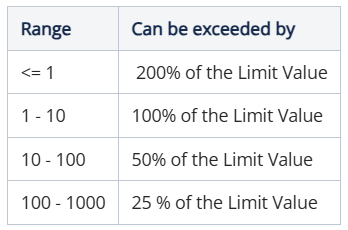 Example: The TWA values for Tetrachloromethane are 2 ppm and 13 mg/m3. Therefore, the STEL values are 4 ppm (100% higher) and 19.5 mg/m3 (50% higher) The substances are marked as below if they belong to any of the following categories:
|
Sources *Not available in English |
¶ Transport |
|
| See European Union page: Transport | |