¶ Recent Updates2026
|
|
¶ Background |
|
|
The Republic of the Philippines is a sovereign state and is an archipelago in Southeast Asia, with 7107 islands spanning more than 300,000 square kilometers of territory. English is one of the official languages in the Philippines and is widely used in government, print, broadcast media and business. The Philippines has been transitioning from an agricultural economy to an industrial economy. With the development of the economy, as in the other Southeast Asian countries, the Philippines has been facing various environmental issues in areas such as waste management as well as the pollution of air, water and soil. The Department of Environment and Natural Resources (DENR) is the main agency responsible for environmental issues in the Philippines. The core function of the DENR is to formulate and implement policies, guidelines, rules and regulations related to environmental management and pollution prevention and control. Under the DENR, the Environmental Management Bureau (EMB) was formed in 1987 to protect, restore and enhance environmental quality under its ambit of air, water and toxic and hazardous chemicals management. The Chemical Management Section of EMB is specifically tasked with oversight responsibility of chemical related activities. Republic Act 6969 (RA 6969) "Toxic Substances and Hazardous and Nuclear Wastes Control Act of 1990" is the primary legislation in relation to chemical control. It requires the implementation of a national inventory for chemicals that are imported to, manufactured or used in the Philippines as well as the monitoring and regulation of activities related to chemicals. Pursuant to provisions of Section 16 of RA 6969, the DENR Administrative Order (AO) No. 29 of 1992 was promulgated as the "Implementing Rules and Regulations of Republic Act 6969". It covers the importation, manufacture, processing, handling, storage, transportation, sale, distribution, use and disposal of all unregulated chemical substances and mixtures in the Philippines, as well as the keeping or storage and disposal of hazardous and nuclear wastes into the country for any purposes. It establishes the principles on requirements for chemical substances inventory, nomination of existing chemicals, notification of new chemicals, priority chemicals list, chemical control orders, hazardous and nuclear wastes, and so on. Based on the requirements of RA 6969 and this Administrative Order, the Philippine Inventory of Chemicals and Chemical Substances (PICCS) was first published by DENR-EMB in 2000. The Priority Chemical List (PCL) was promulgated in 1998 and it imposes specific compliance requirements on the listed chemicals. Chemical Control Orders (CCOs) are issued by DENR-EMB for certain chemicals on the PCL that pose serious risks to public health or environment. Other regulatory agencies that are stakeholders to chemicals control in the Philippines include:
The Official Gazette is the public journal of the Republic of the Philippines. Philippine laws, statutes, jurisprudence, presidential decrees, executive orders, administrative orders, and other legal materials can also be found at the Lawphil website. |
Official Gazette |
¶ Inventories |
|
|
As required by Republic Act 6969 Toxic Substances and Hazardous and Nuclear Wastes Control Act of 1990 and its Implementing Rules and Regulations DENR Administrative Order No. 29 of 1992, the Philippine Inventory of Chemicals and Chemical Substances (PICCS) was first published in 2000 by the DENR-EMB. This inventory is a list of all existing chemicals and chemical substances used, sold, distributed, imported, processed, manufactured, stored, exported, treated, or transported in the Philippines. As first published, it contained chemicals nominated in 1993 by manufacturers, importers, distributors and users. The latest update (2017 version) was released in 2018 and is available as a CD from DENR-EMB and the online database of PICCS at the authority's website. Additional lists of chemicals in PICCS were released as EMB Memorandum Circular (MC) 2020-007 (March 3, 2020), EMB MC 2021-08 (May 24, 2021), DAO 2025-09 (January 22, 2025) and DAO 2026-24 (May 11, 2026). The PICCS contains the following information:
Tip: The PICCS listing of a chemical can now be validated by a new tool (PICCS Tool) at the Online Permitting and Monitoring System website. Chemicals and chemical substances not included in PICCS cannot be manufactured or imported unless the proponent follows the Pre-Manufacturing and Pre-Importation Notification (PMPIN) testing and assessment process. 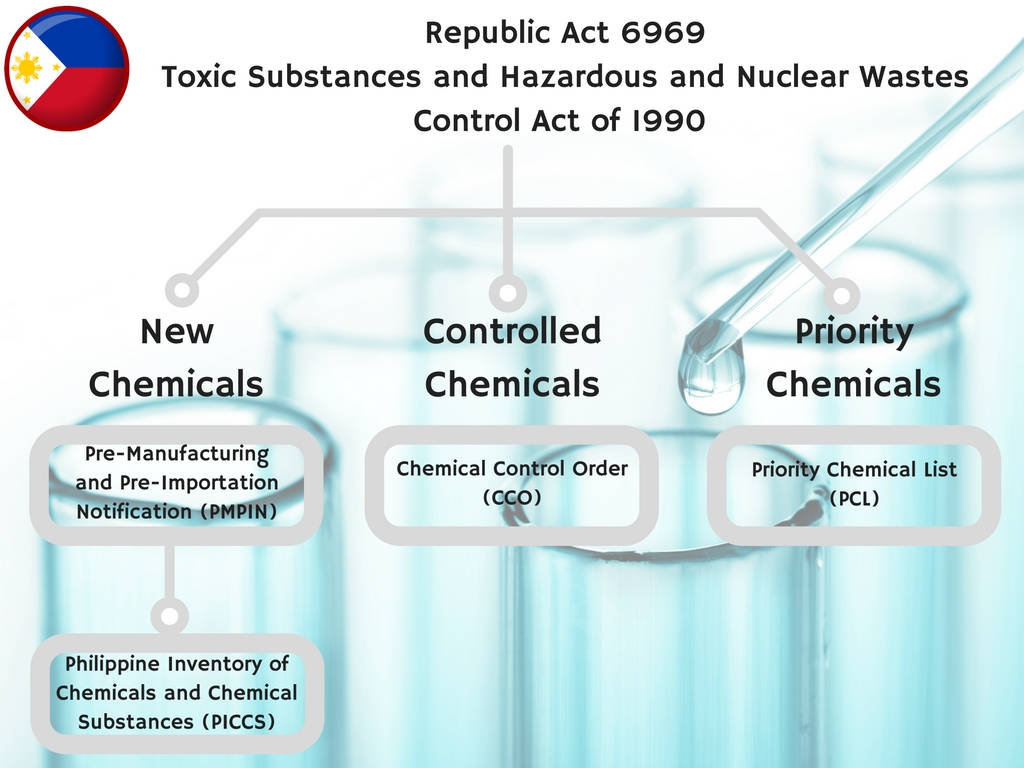 The PICCS is placed into a specially-designed computer database to facilitate compiling, storing, and organizing and managing the data. It is available in electronic form (CD) at Philippine Peso (PHP) 500 per copy at the DENR-EMB central office. Free searches in PICCS 2017 can be conducted online. To ascertain whether a chemical is included in the PICCS, one may search either by CAS No. or by the chemical name. According to the initial regulation, the PICCS was required to be updated every five years and the duration of updating is 120 days. However, according to the latest Memorandum Circular No. 2014-001 published by DENR-EMB, the updating of the PICCS shall be conducted annually to include industrial chemicals for which PMPIN Certificates have been issued. To update the PICCS, all non-exempt manufacturers, distributors, users, and importers are required to complete the PICCS Updating Form and submit it to EMB central or regional offices. In order to facilitate updating and monitoring, all premises subject to updating must maintain on file an Annual Chemical Inventory, which should also be made available to DENR-EMB inspectors, if requested. The premise should also keep a record of the following documents for at least five years:
The following substances are exempt from inclusion in the PICCS:
Besides the exemptions listed, the following are exempt from filing for updating of the PICCS:
|
Sources
Resources |
¶ Substance Registration |
|
¶ Chemicals Subject to Chemical Control Orders (CCO)Chemical Control Orders (CCO) are regulatory controls that restrict the use, manufacture, import, export, transport, processing, storage, possession and wholesale of chemicals deemed by the DENR-EMB to possess serious risks to public health, the workplace or the environment. The Priority Chemical List (PCL), which at present contains 48 chemicals, forms the candidate list from which substances are selected for further controls. Cognizant to the challenges faced by the industries in the Philippines to respond to regulatory requirements, DENR-EMB has thus far issued CCOs for the following chemicals:
In general, the following requirements apply to all chemicals subject to CCOs:
For detailed requirements for each specific substance, please refer to the CCOs available at the website of the Chemical Management Section of DENR-EMB. To get a registration certificate, the following documents are required:
The application fee is PHP 2,800 for each chemical and PHP 2,000 for renewal. The Registration Certificate can be issued within thirty working days. The following documents are required for the issuance of an importation clearance:
The application fee is PHP 1,700 for each chemical. The Importation Clearance can be issued within twenty working days. All manufacturers, importers, and industrial users must submit an Annual Report to DENR-EMB that includes the following information:
Memorandum Circular No. 2017-009 provides clarifications that manufacturers or importers shall apply under CCO:
Memorandum Circular No. 2019-006 proposes that CCO registration certificates can be obtained via the Online Permitting and Monitoring system. |
Sources Resources |
¶ Product Registration |
|
¶ FertilizersAs mandated by the Presidential Decree No. 1144 on Fertilizers and Pesticides Management, the Philippine Fertilizer and Pesticide Authority (FPA) was established in 1977. The agency is responsible for controls over fertilizers, pesticides, and other agricultural chemical inputs, and for promulgating rules and regulations for the registration and licensing of the above products. It is specified in the Presidential Decree No. 1144 that:
There are two types of registrations for fertilizers, provisional registration and full registration: Provisional Registration (valid for 1 year) – granted when the technical requirements are completed including one season of a significant efficacy test on a representative crop. Full Registration (valid for 3 years) - granted when all the technical requirements are satisfactorily complied with including two seasons of efficacy test on a representative crop. A provisionally-registered product shall be renewed only once. However, it can be upgraded to a full registration when all the technical requirements including the second season of significant efficacy test on the same representative target crop have been met satisfactorily. A full registration of a product shall expire on December 31 of the third year, and a provisional registration shall expire on December 31 of the same year of issuance. Renewal of either registration may be filed until March 31 of the subsequent year after expiration. No renewal applications will be accepted after June 30 of that year. The detailed requirements on registration and licensing can be found via the hyperlinks on the right. The application fee varies depending on the type of registration/license. |
Sources Resources |
¶ PesticidesAs mandated by the Presidential Decree No. 1144 on Fertilizers and Pesticides Management, the Philippine Fertilizer and Pesticide Authority (FPA) was established in 1977. The agency is responsible for controls over fertilizers, pesticides and other agricultural chemical inputs, and for promulgating rules and regulations for the registration and licensing of the above products as well. It is specified in the Presidential Decree No. 1144 that:
There are two types of pesticides: Chemical pesticides and Biorational pesticides. Chemical pesticides are usually for agriculture, home garden, turf and household use, or used in combination with other formulations. Biorational (low toxicity or low ecotoxicity) pesticides can be classified further into biochemical pest control agents (including semiochemical (signaling), hormone, natural plant regulator, and enzyme) and microbial pest control agents (including bacterium, fungus, protozoa, and virus). The registration requirements are different for chemical pesticides and biorational pesticides. Licensing requirements vary, depending on the activities related to pesticides (manufacturing, repacking, importing, trading, distributing, storing and so on). Only local companies registered with the Securities and Exchange Commission (SEC) to do business in the Philippines and duly licensed by FPA may apply for registration of a pesticide. Foreign suppliers or companies registered with the SEC as regional liaison offices are not allowed to register pesticides. For their products, the applicant registrant should be the distributor or the local subsidiary of a foreign-based pesticide company. The full registration is valid for 3 years and the renewal may be filed 3 months before expiration. The application fee varies depending on the type of registration/license. |
Sources Resources |
¶ Notifications |
|
¶ New Chemicals
|
Sources Resources |
¶ Application FeeAccording to the Administrative Order No. 2016-28, the application fee for PMPIN is set up as below: Abbreviated PMPIN: PHP 2,600; Detailed PMPIN: PHP 4,500. The successful outcome of the PMPIN process would be the PMPIN certificate. Conversely, the application will be rejected and a Denial Letter will be issued if the applicant fails to respond to DENR-EMB's requests for information within three months from the date of such requests being made. |
Sources |
¶ Procedure for Getting a New Chemical onto the PICCS
Only companies that are domiciled in the Philippines may notify and apply for a PMPIN Certificate as well as submit a Notice of Commencement. |
Resources |
¶ Exemptions from the PMPIN rules:
Industries are strongly advised to consult DENR-EMB before claiming exemptions. 
|
Sources |
¶ Clarifications on Confusing CircumstancesManufacturers or importers shall apply for a PMPIN Certificate first and then for a PCL Compliance Certificate or PCL Exemption (if concentration ≤ 1%) when the product is
Manufacturers or importers shall apply for a PMPIN Certificate first, then for a CCO Registration Certificate and/or CCO Importation Clearance (not allowed for SQI Clearance) when the product is
Manufacturers or importers shall apply for a PCL Compliance Certificate or PCL Exemption (if composition of PLC ≤ 1%) first and then for either SQI Clearance or a PMPIN Certificate when manufacturing or importing a mixture of new chemical(s) (cumulative weight ≤ 1000 kg/year) and chemical(s) under PCL. |
Sources |
¶ Certifications |
|
¶ Priority ChemicalsThe Philippine Priority Chemical List (PCL) contains chemicals that pose unreasonable risk to public health, workplace, and the environment. As stated in the section for CCO, among the chemicals in the PCL, the DENR-EMB determines which chemicals should be regulated further through CCOs. The DENR-EMB has special reporting requirements that apply only to the priority chemicals, which enables the DENR-EMB to obtain the necessary information concerning the such chemicals and their uses. Such information will assist the DENR-EMB in making informed decisions on which chemicals should be further regulated. Persistence, toxicity, and bioaccumulation are the basic criteria established by the DENR-EMB for the selection of chemicals to the PCL. In addition, other factors such as chemical use and management, production quantity, percentage of release, occupational exposure, disposal methods are also considered. The detailed requirements for compliance with the PCL rules can be found in the Chemical Management Section of the DENR-EMB website. A PCL Compliance Certificate can be issued in twenty working days and is valid for one year. The processing fee is PHP 1,000 for each chemical. In the case of a request for a change of the quantity granted in the previously issued PCL Compliance Certificate, the company is required to re-apply for a new certificate. Manufacturers or importers shall apply for one PCL Compliance Certificate (which will indicate all chemicals) for a mixture of two or more chemicals under PCL. Exemptions from securing a PCL Compliance Certificate shall be granted to:
|
Sources
*Fees shown in this document have not been updated to reflect the amount stated in Administrative Order No. 2016-28 Resources |
¶ PNP-Controlled ChemicalsIn the face of growing terrorist threats, and under the mandate of Presidential Decree No. 1866 as amended by Republic Act No. 9516, the Firearms and Explosives Office (FEO) of the Philippine National Police (PNP) initially identified 101 chemicals as explosive precursors to be subject to restrictive rules on their manufacture, import, export and transport. The original list contained several chemicals that are commonly used by various business sectors and translated into onerous and costly processes in getting the permits and licenses that became necessary in the trade of these chemicals. Implementing Rules and Regulations on Controlled Chemicals Pursuant to Section 4-C to 4-F of PD No. 1866 as Amended by RA No. 9516 ('IRR of RA 9516') was thus born of appeals from industry to the Philippines government and the consultative meetings that ensued. Published in the print edition of the Official Gazette on July 25, 2016 with an implementation date of August 9, 2016, one of the most important features of IRR of RA 9516 is the reduction of the list of PNP-controlled chemicals from 101 to 32. Of these chemicals, 15 had been identified as high-risk chemicals and 17 as low-risk chemicals. Additionally, the following substances may also be subject to testing on their explosive potentials by the PNP:
For reasons of public order and safety, the Chief of PNP may update the List of Controlled Chemicals or regulate unlisted chemicals to take effect immediately but with due regard to affected chemicals in transit or in circulation. The only differentiation between high-risk chemicals and low-risk chemicals lies in the security measures to be taken during their movement and transport. The IRR has introduced the concept of “PNP-accredited logistics services provider” to replace the police escorts that were previously required to accompany the sale, movement and transfer of controlled chemicals. However, prior to the operationalization of PNP-accredited service providers, one police escort will still be required for every movement and transport of high-risk chemicals. 
|
Sources
Resources |
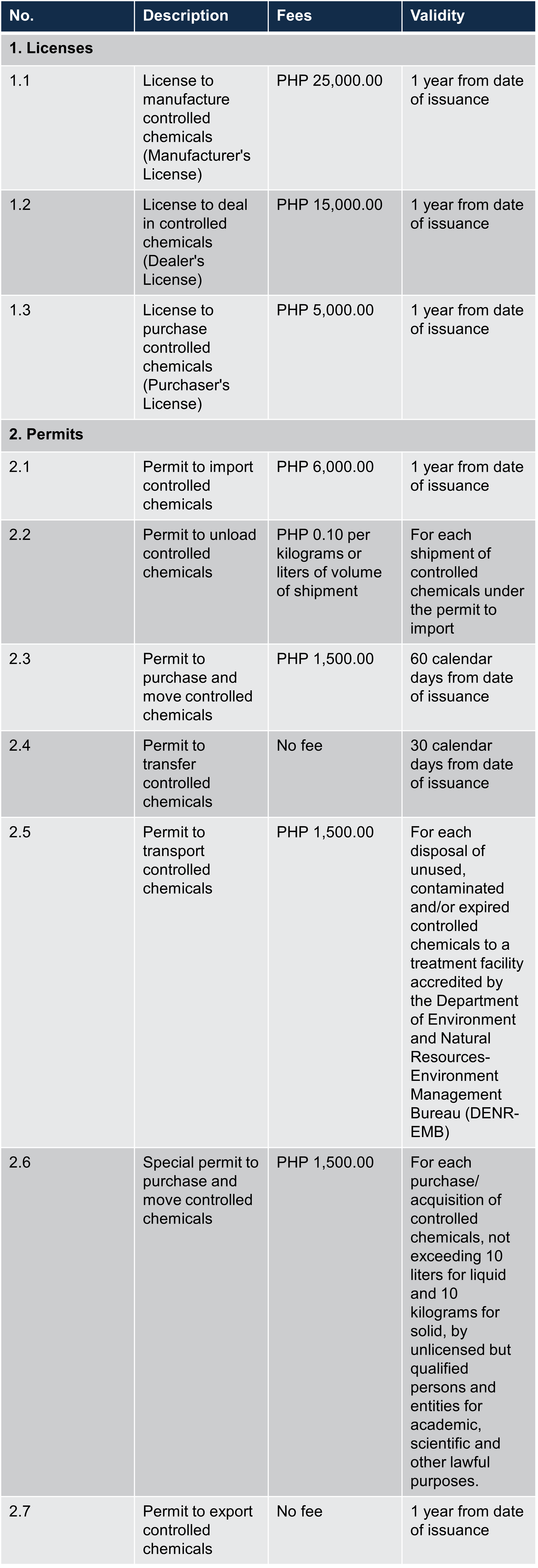
¶ Dangerous Drugs and Controlled Precursors and Essential ChemicalsDangerous drugs include those listed in the Schedules annexed to the 1961 United Nations Single Convention on Narcotic Drugs as amended by the 1972 Protocol, and in the Schedules annexed to the 1971 Single Convention on Psychotropic Substances. Controlled Precursors and Essential Chemicals are those listed in Tables I and II of the 1988 United Nation Convention against Illicit Traffic in Narcotic Drugs and Psychotropic Substances. Both of them are enumerated in the attached annex to Republic Act No. 9165 Instituting the Comprehensive Dangerous Drugs of 2002. Handlers of dangerous drugs or controlled precursors and essential chemicals are required to have licenses for their corresponding activities related to those drugs. The licensing system in the Philippines is complicated and can be divided into three overall categories:
The S-Licenses can be sub-divided into the following licenses:
The P-Licenses can be sub-divided into the following licenses:
Importers or exporters also need to have a permit to import or export dangerous drugs or controlled precursors and essential chemicals. There are four types of permits:
Such a permit is required for every specific importation/exportation of the substance. For specific requirements for the license/permit application, please refer to the website of the Philippine Drug Enforcement Agency. |
Sources Resources |
¶ Restrictions and Bans |
|
¶ Ozone Depleting SubstancesThe Philippines ratified the Montreal Protocol on Substances that Deplete the Ozone Layer on July 17, 1991. The national coordinating body responsible for implementing the Montreal Protocol in the country is the Department of Environment and Natural Resources (DENR), which has in turn set up a subsidiary unit under the Environmental Management Bureau (EMB) - the "Philippine Ozone Desk" (POD) as the National Ozone Unit (NOU) to facilitate and coordinate ozone depleting substances (ODS) phase-out projects and policies to fulfill the country’s obligations under the Montreal Protocol. Regulatory policies on ODS in the Philippines largely fall within the remit of DENR. The most notable of these include:
Methyl bromide, while controlled by the Montreal Protocol, is regulated by the Fertilizer and Pesticide Authority (FPA) since the substance is used as a pesticide. |
Sources Resources |
¶ Persistent Organic Pollutants (POPs)The Philippines ratified the Stockholm Convention on Persistent Organic Pollutants (POPs) on February 27, 2004. Since POPs covered by the Stockholm Convention span pesticide chemicals, industrial chemicals as well as unintentional by-products, the adoption of the Convention in most countries usually involves multiple agencies. The Philippines is no exception. Although the country has several laws, guidelines, and administrative orders that directly and indirectly address its POPs issues, these existing legal mechanisms do not fully respond to the requirements of the Stockholm Convention. The earliest of the Philippines' POPS-management initiatives can be traced back to as far as 1999 when it promulgated Republic Act No. 8749, otherwise better known as the "Philippine Clean Air Act of 1999". This Act mandates the Department of Environment and Natural Resources (DENR) to establish an inventory of all POPs sources and also to develop measures to reduce and eliminate POPs. At present, the Philippines had completed the inventorization of Polychlorinated dibenzo-p-dioxins (PCDD) and Polychlorinated dibenzofurans (PCDF); there is no complete inventory on the other POPs. In addition to attempts at creating a POPs inventory, DENR has also implemented control measures on POPs. The Priority Chemical List (PCL) established by DENR's Environmental Management Bureau (EMB) currently includes three POPs - Polychlorinated biphenyls (PCB), Mirex, and Hexachlorobenzene. Of these, a Chemical Control Order (CCO) had been issued for PCBs (DENR Administrative Order 2004-01), thereby providing guidelines to phase-out PCBs as well as materials containing PCBs. Wastes containing POPs listed in the Stockholm Convention are also deemed hazardous by DENR's policy on Hazardous Wastes (DENR Administrative Order No. 2013-22); and the generators, transporters, importers and exporters of such wastes are subject to registration and reporting requirements. Other than DENR, the Philippines' Fertilizer and Pesticide Authority had separately established a list of banned and restricted pesticides which correlates to the pesticide POPs of the Stockholm Convention. |
Sources Resources |
¶ Restriction of Hazardous Substances (RoHS)At present, the Philippines does not have any RoHS-like regulation prescribing allowable maximum concentration values of chemicals in electrical and electronic equipment; nor is the country known to have plans to promulgate such regulations in the near future. |
|
¶ SDS + Label |
|
¶ ClassificationThe Joint DTI-DENR-DA-DOF-DOH-DILG-DOLE-DOTC Administrative Order No. 2009-01 for the Adoption and Implementation of the Globally Harmonized System of Classification and Labelling of Chemicals (GHS) was issued by the eight governmental agencies involved in GHS implementation on May 25, 2009. This GHS Joint Administrative Order (JAO) requires the above agencies to draft or revise their respective implementing rules and regulations or department orders to incorporate the provisions of GHS. It also specifies the duties and responsibilities of these agencies in the adoption of the GHS classification, labelling, and SDS requirements. To date, only the Department of Labor and Employment (DOLE) and the Department of Environment and Natural Resources (DENR) had issued regulatory requirements on the implementation of GHS. |
Sources |
¶ DOLE Department Order No. 136-14The "Guidelines for the Implementation of Global Harmonised System (GHS) in Chemical Safety Program in the Workplace" (Department Order No. 136-14) was issued by DOLE on February 28, 2014. "Workplace" means all workplaces dealing with the manufacture, use, and storage of industrial chemicals, in the private sector, including their supply chain. The order emphasizes the roles and responsibilities of employers, employees and the Safety and Health Committee. Employers shall ensure that all chemicals are properly labelled and supplied with Safety Data Sheets which are prepared in accordance with GHS to guarantee the safe use of chemicals in workplaces. Employees shall protect themselves from the hazards resulting from the use of chemicals at work. The Safety and Health Committee shall develop accident prevention plans in order to assure the safety of people and establishments. While its text does not contain any specific criteria on hazard classifications, DOLE Department Order No. 136-14 nonetheless lists hazard classes that are actually in line with revision 3 of the GHS. The regulation also calls for adherence to "the latest edition of the GHS", which at present will be revision 6, thereby creating further confusion for the industry. The transition period for all establishments using industrial chemicals to comply with all the requirements in this Order is one year from the effective date (March 14, 2014), that is, by March 13, 2015. Please note that there are no separate deadlines for substances and mixtures. Both substances and mixtures used in workplaces shall be provided with GHS labelling and SDSs by March 13, 2015. |
Sources |
¶ DENR Administrative Order No. 2015-09On May 19, 2015, the DENR published an Administrative Order on "Rules and Procedures for the Implementation of the Globally Harmonized System of Classification and Labelling of Chemicals (GHS) in Preparation of Safety Data Sheet (SDS) and Labelling Requirements of Toxic Chemical Substances". It covers all toxic chemical substances and mixtures manufactured, imported, distributed, used, stored and transported in the Philippines. It also addresses the labelling and SDS requirements for these substances and mixtures where they meet criteria for GHS classification. The following chemicals shall be compliant with this Order in accordance with the following implementation timeline: 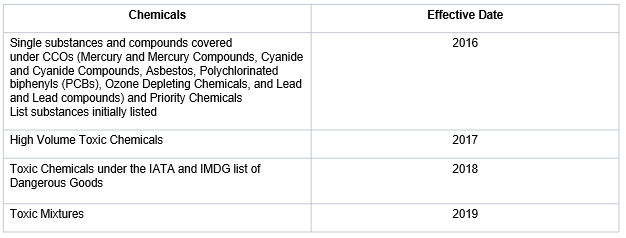 Toxic chemicals are defined by Administrative Order No. 2015-09 as “substances or mixtures that are harmful to the environment and/or to human health on short-term or long-term basis if inhaled, swallowed, or absorbed through the skin”. However, there is no definition on "High Volume" in the Order. All chemical importers, manufacturers, suppliers and distributors shall prepare SDS and labels for “all covered industrial toxic chemical and mixtures which meet the harmonized criteria for physical, health and environmental hazards under GHS”. 
|
Sources |
¶ SDSPhilippines' requirements on SDSs are covered under DOLE Department Order No. 136-14 and DENR Administrative Order No. 2015-09 for workplace chemicals and toxic chemicals respectively. In alignment with the GHS, the SDS shall be in the 16-sections format. The SDS must be in English and needs to be updated within 5 years or earlier if there are changes in product composition that may affect the classification of the product. |
Sources |
¶ Sections of the Safety Data Sheet |
|
¶ LabelAll toxic chemicals and mixtures covered by DENR Administrative Order No. 2015-09 shall be labelled and marked visibly, and shall include the following elements:
Transport pictograms prescribed by the UN Recommendations on the Transport of Dangerous Goods - Model Regulations shall be used for chemicals in transport. The minimum dimensions of 100mm by 100mm are required for transport pictograms. However, smaller pictograms can be used for very small packages and for gas cylinders. When a transport pictogram is used on a label, a GHS pictogram for the same hazard shall not appear. The minimum GHS label size should be based on the size of the container: 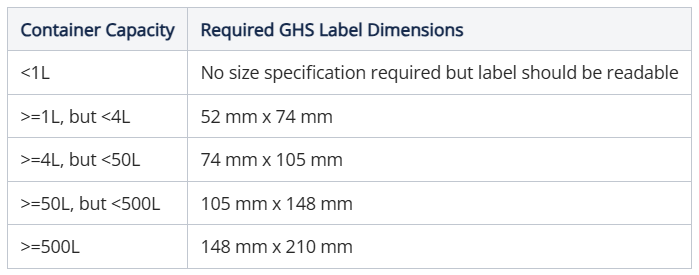 According to Memorandum Circular No. 2017-010, EMB requires that all HVCs shall be labelled and have SDS required in DAO No. 2015 - 09 through their entire life cycle. Importers shall require suppliers to provide proper SDSs and labels. Manufacturers are required to prepare SDSs of the HVCs and provide transporters, handlers and users with the updated SDSs and labels complying to GHS. |
Sources |
¶ Trade SecretsA Confidential Business Information (CBI) claim is acceptable in the Philippines but should be limited to the names of chemicals and their concentrations in mixtures. Request for protection of CBI is available for both PMPIN and SQI. The rules for CBI shall take priority over the rules for product identification. However, CBI must be disclosed in emergency situations, or when the provisions for CBI protection compromise the health and safety of workers. The most recent and completed CBI form can be found in Annex C of EMB MC No. 2020-005. |
Sources |
¶ Occupational Exposure LimitsThe Philippine Occupational Safety and Health Standards pursuant to Article 162 of the Labor Code of the Philippines Presidential Decree No. 442 identify the workplace Occupational Exposure Limits (OELs) that are required to be disclosed in Section 8 of the Philippine SDS. Workers cannot be exposed to airborne contaminants above the listed threshold limit value. Before personal protective equipment (PPE) is used, administrative or engineering controls must first be determined and implemented whenever feasible. |
Sources |
¶ Transport |
|
| The Philippines does not have a specific regulation for oversight of transport via ground. | |