According to the December 1, 2025 amendment of the Plant Protection Products Regulation, the Plant Protection Products section has been updated accordingly regarding the petition.
A new subsection, Poison Centers, was added under the Notifications section.
Since August 2005, new Chemical legislation has been in force in Switzerland. The Chemical legislation has essentially harmonized with current European Union legislation even though Switzerland is not a member country of the EU. Under this legislation, the following ordinances are mentioned:
Chemicals Ordinance (Chemo)
Ordinance on Biocide Products and Ordinance on Plant Protection Products
Ordinance on Risk Reduction related to Chemical Products (ORRChem)
PIC Ordinance
Ordinance on Good Laboratory Practice
Chemicals Fees Ordinance (ChemFeeO)
Federal Authorities of the Swiss Confederation are responsible for all regulations used in Switzerland. The "Bundesblatt" is the official gazette of Switzerland where all laws and regulations can be found and downloaded. It is published in the three official languages of the country (German, French, and Italian).
A revision to ChemO was released in January 2013. One of the revision's objectives was to align the Swiss legislation with that of Switzerland's main trading partners, so as to increase the level of health and environmental protection. It also involves adherence to the United Nations Globally Harmonized System of Classification and Labeling of Chemicals (GHS). The new revision was made mandatory in Switzerland as of December 1, 2012 for substances and June 1, 2015 for preparations.
A new revision of ChemO has been published in late 2020. The following are addressed in the new revision of the ChemO:
Registration obligation (“Anmeldepflicht”) for nanomaterials
Lessened registration requirement (“Meldepflicht”) for marketed intermediates
“Anmeldepflicht” is comparable to REACH registration obligation, and “Meldepflicht” is to let the authorities know the substance identity, classification and labeling, intended expected usage, if it is considered dangerous and the tonnage limit.
The Chemical Inventories in Switzerland were established once the Chemicals Act came into force in Switzerland on December 15, 2000. Substances and preparations are continually being added to the inventories by the notification authority.
The Inventory of New Notified Substances consists of European List of Notified Chemical Substances (ELINCS) and Newer Substances. The Federal Department of Home Affairs (FDHA) has released a new web page to access the inventories on their website. However, the Inventory of New Notified Substances is not currently available as a searchable database.
Based on article 4, paragraph 1, letter a of ChemA, new substances are described as those which are not considered as existing substances. Therefore, new substances are those (no longer) fully registered under REACH in the EU. New substances that are brough into circulation in Switzerland (including those imported for professional or commercial purposes) are condition to notification requirements under the Chemicals Ordinance (ChemO).
This inventory contains substances that were registered online by the manufacturers; pursuant to the self-regulation system under Article 5 of ChemO. Article 5 states that manufacturers are responsible for the classifying, packaging and labeling of their substances and preparations. Registration is mandatory for dangerous substances (thus, the inventory contains mainly dangerous existing substances), but some manufacturers may have chosen to register non-classified substances as well.
Substances and preparations as given in Article 19 of ChemO must be registered by manufacturers to the Swiss authorities within 3 months of being introduced to the market, without considering if a safety data sheet has been prepared for them.
The Federal Department of Home Affairs (FDHA) has released a new web page to access the inventories on their web site.
Under the Chemicals Ordinance (ChemO, SR 813.11), the responsibility for placing substances, preparations and articles on the market is completely that of the manufacturer/importer and/or their only representatives. According to Article 5 of ChemO, the manufacturer must determine whether substances or preparations may threaten human life, health or the environment and classify, label, package and prepare a safety data sheet and exposure scenario to this extent.
What about articles?
If articles contain hazardous substances, such as substances deemed to be persistent, bio-accumulative and toxic (PBT) or very persistent and very bio-accumulative (vPvB), or substances given by Annex 3 the manufacturer must determine by means of self-regulation according to Article 26 of Environmental Protection Act, whether the hazardous components may harm the environment or may indirectly endanger human health if articles are used as planned or as would typically be expected or if they are disposed of in accordance with the regulations. For articles containing substances as given in Annex 3, manufacturers must evaluate if these substances may pose any risk to human's health in case of using these articles for their proposed and future use purpose or when they are disposed.
According to Art. 48 of ChemO, the manufacturer must report the substances and preparations covered by Article 19, regardless of whether SDSs have to be created for those substances or not, within three months of first placing them on the market. This includes:
Preparations which are not considered dangerous within the scope of Article 3 (which refers to the EU CLP via Annex 2), containing at least one substance which is dangerous to health or to the environment in an individual concentration of ≥1.0 % (w/w)percent by weight (non-gaseous preparations) or ≥0.2 % (v/v)(gaseous preparations)
Carcinogenic category 2 substance, toxic for reproduction substance category 1A, 1B, 2, inhalation and skin allergen category 1, inhalation allergen Category 1, substance that cause lactation effect
Preparations containing at least one PBT or vPvB substance in an individual concentration of ≥ 0.1 percent by weight;
Preparations containing a substance listed in Annex 3 in an individual concentration of ≥ 0.1 percent by weight;
Preparations containing one substance for which a workplace exposure limit value has been established in EU Directives 2000/39/EC, 2006/15/EC or 2009/161/EU, (EU) 2017/164 or (EU) 2019/1831.
Nanomaterials, other than those specified in Article 19, that hold biopersistent fibres or tubes >5μm in length.
Materials having a water solubility <100mg/Lt or with a half-life in the lungs of 40 days or greater known to be biopersistent
The following data must be provided in the reporting application (Article 49):
The manufacturer's name and address;
Name of the person in charge of placing the substances or preparations on the market in the EEA according to Article 17 paragraph 1 letter a of the EU-CLP Regulation if the manufacturer's identity is not stated on the label;
In the case of substances:
The chemical name based on Article 18 paragraph 2, letters a-d of EU-CLP Regulation.
The CAS number,
The EC number,
The classification and labeling;
The predetermined use
For substances dangerous to the environment: the amount anticipated to be placed on the market annually, based on one of the following categories: <1 ton per annum, 1-10 metric tons per annum, 10-100 metric tons, >100 metric tons.
For nanomaterials: the composition, particle scheme, and the average particle size and, where obtainable, the number size distribution, the specific surface area/volume ratio, the crystal structure, the aggregation status, the surface coating and the surface functionalization.
The quantity to be anticipated to be placed on the market yearly based on one of the following categories: <1 kg, 1-10 kg, 10-100 kg, 100-1000 kg, 1-10 tonnes, 10-100 tonnes and >100 tonnes,
If applicable, the identification as a PBT or vPvB substance
The chemical safety report used in the EEA, as long as it is reasonably obtainable by the manufacturer.
In the case of dangerous preparations:
The trade name,
The UFI
Data on the components according to the requirements for the safety data sheet,
Classification and labeling,
Intended uses
Physical state
For preparations dangerous to the environment: the amount anticipated to be placed on the market annually, based on one of the following categories: <1 ton per annum, 1-10 metric tons per annum, 10-100 metric tons per annum, >100 metric tons per annum
For preparations containing nanomaterials which must be stated in SDS: the constituents, particle scheme, the average particle size and, where obtainable, the number size distribution, the specific surface area/volume ratio, the crystal structure, the aggregation status, the surface coating and the surface functionalization.
The report and extended report applications must be submitted:
Using an electronic form with a format requested by notification office;
In an official language of Switzerland or in English.
The notifier (manufacturer, importer or only representative) must reside and have registered office or a branch office in Switzerland. The notifier must open a user account on the Chemical Product Register website. After opening the user account, notifier should fill in the application form and send it to the Notification Authority.
By e-Mail to cheminfo@bag.admin.ch or by post to the Notification Authority for Chemicals, FOPH, 3003-Bern
Normally, user account is activated within 3 days after request. The creation and activation of the account is free of charge. The cost for registration of products depends on the type of product: for biocides and fertilizers there is the cost of the authorization. For all other preparations the registration is free of charge.
At the time of Corona virus out break, the disinfected products are treated with the highest priority and authorizations are issued in about 10 days, otherwise authorizations are issued in 60 days.
For information on how to open a user account to report, please refer to the link provided in the Resources section.
According to Article 54, the reporting requirements do not apply to:
Intermediates which: 1. are not handed to third parties, 2. do not leave the manufacturing site, or 3. placed on the market in amount<100 kg/year;
Substances and preparations introduced to the market only for the intention of analysis, research or development purposes;
Substances introduced to the market for training purposes
Substances and preparations used solely for foodstuffs, therapeutic products and animal feedstuffs;
Explosives and pyrotechnic devices that necessitate authorization according to Explosives Ordinance of November 27, 2000;
Substances obtained in Switzerland;
Preparations obtained in Switzerland and supplied in packaging other than that designed by the original manufacturer as long as:
The trade name, composition, the UFI and proposed usage are unchanged, and
The name of the initial manufacturer is also given
Gas mixtures comprising solely of declared gases.
Gases and gas mixtures which are classified in the «gases under pressure» hazard category;
Non-hazardous preparations given in Art.3 in packaging ≤ 200ml capacity, when they are manufactured in Switzerland and are directly delivered from manufacturers to professional or private end users.
Preparations placed on the market in the amount <100 kg/year and intended exclusively for professional users.
Substances notified by the manufacturer according to Article 24.
Paints formulated as requested in limited quantities for an individual or professional user at the point of sale by tinting or mixing colors, given that:
the conditions of Art. 25 paragraph 8 of the EU-CLP Regulation are fulfilled, or
the possibly dangerous colorants are specified in the notification of the base color in the maximum concentration in which they are added; in this case, the product must be labelled with the UFI of the base color
Concrete, plaster and cement, corresponding to the standard formulations in Annex VIII Part D of the EU-CLP Regulation and that carry the UFI required by the Notification Authority
The manufacturer of an existing dangerous substance, meeting the criteria according to Article 14 paragraph 4 of EU REACH Regulation and is provided as such to third parties in a total quantity of greater than or equal to 10 metric tons/year must prepare an exposure scenario for each recognized use of the substance, describing the conditions of use and the related risk management measures.
If one has received a substance for which an exposure scenario is prepared, and commercially provide it further to a third party, in an amount greater than 1 ton or more per year by itself or in a preparation, for a usage not specified in SDS, this usage must be covered by an exposure scenario.
The exposure scenario must be prepared according to the requirements of Annex I, section 5.1 of EU-REACH Regulation.
Sources
Ordinance on Protection Against Dangerous Substances and Preparations: German | English
The Swiss Federal Council published the Ordinance on the Placing on the Market and Handling of Biocidal Products on May 18, 2005. This ordinance is based on the Chemicals Act of December 15, 2000.
This Ordinance regulates:
The introducing to the market of biocidal products, treated articles and their active substances, the types of authorization and authorization procedures, the safe guarding and usage of owner's data from earlier applications for the benefit of subsequent applicants, as well as the classification, packaging, labeling and the safety data sheet
Certain handling of biocidal products and treated articles
The provisions of this Ordinance on the placing on the market of biocidal products and processed articles are also applicable to the import of biocidal products and processed articles which contain pathogenic microorganisms, for non-professional and non-commercial purposes.
It does not apply to:
Biocidal products or processed articles being introduced to the market only according to legislation with healthcare products, foodstuffs, animal feed or plant protection products for stated purposes;
Biocidal products or processed articles in transit under customs supervision, provided no treatment or processing takes place;
The transportation of biocidal products or processed articles by road, rail, water, air and through pipelines;
Animal feed or foodstuffs utilized as attractant or repellents
Biocidal products utilized as treating aids according to Article 3 of Feedstuffs Ordinance (FsO), and as declared in Article 2 of the Foodstuffs and Utility Articles Ordinance (FUO)
Biocidal products must be authorized according to the Ordinance on Biocidal Products (OBP - SR 813.12). The Federal Department of Home Affairs (FDHA) has released a new web page to access the inventories on their web site. Currently the inventory of Biocidal Products is available online.
The FDHA may add the following Inventories on Biocides in their next release.
Inventory of Biocides Active Substances
Inventory of Registered Biocides
The Notification Authority for Chemicals of Swiss confederation is considered the regulatory authority for biocidal products in Switzerland.
Biocidal products may be introduced to the market and used as professional and commercial purposes only if they have authorization through the registration office and are labeled according to Ordinance on Biocidal Products (OBP).
The authorization applies to a biocidal product:
With a precise composition;
With a precise trade name or two or more trade names;
For precise intended uses or two or more uses;
From a precise manufacturer or two or more manufacturers.
The authorization can also apply to a biocidal product family.
Only residents of Switzerland, or those with a registered office or branch in Switzerland, may apply for and carry an authorization. Authorization is given to one person only.
According to Article 11, a biocidal product shall be authorized pursuant to authorization AL or AnL if:
According to the common provisions given in Annex VI of EU Regulation 528/2012:
The biocidal product is adequately effective
It has no improper effects on target organisms. For example by causing improper resistance or cross-resistance or subjecting vertebrates to unnecessary suffering or pain, and
No acute or chronic negative health effects are anticipated to humans, in particular to vulnerable groups, or animals, directly or indirectly, by drinking water, food, feedstuff, air or other indirect effects.
No improper effects are accepted from biocide products or their residues on the environment in regards to descriptions given in the Art.11 item 4.
The amount, chemical identity and technical equivalence of the active substances in the biocidal product and where applicable, toxicologically or eco-toxicologically pertinent impurities and the residues of non-active substances with significant environment effects, resulting from authorized usage can be determined by using suitable analytical methods given in Annexes II and III of EU Regulation, 528/2012.
The physical and chemical properties are suitable for use, transport and storage.
For nanomaterials used in biocides, risk to people and environment has been assessed separately.
Existing or potential new applicable maximum concentration, maximum value for residue or specific migration value in or on food or feed materials are in agreement with the following provisions:
Article 49 paragraphs 3 and 4 letter c and 10 paragraph 4 letter e of Foodstuffs and Utility Articles Ordinance
Article 36 paragraph 1 of Regulation of Feedstuffs Ordinance
According to Article 13, a biocidal product shall be authorized with authorization AN if according to the latest scientific and technical knowledge and subject to being used as planned:
No improper effects on humans, animals or the environment are to be anticipated from it and its residues; and,
In the case of a wood preservative or a disinfectant, it has proper effect.
An application for authorization must be submitted to the Notification Authority. The application shall be prepared according to the following Annexes:
Applications, for AL or AnL authorizations: Annex 5
Applications for simplified authorizations: Annex 6
The application and documents must be surrendered to Swiss authorities:
In an electronic format as described by the authorities;
In an official language or in English;
If the application involves a biocidal product consisting of or containing genetically modified or pathogenic microorganisms, the summary of the application must be prepared in at least an official language.
The outline of replicas or drafts of packaging, labeling or leaflets must be submitted to authority upon request of assessment authority.
According to Article 58, the cantonal enforcement authorities shall audit biocidal products and treated articles which came into the market or used by the manufacturers themselves. They certify if:
The biocidal products which came into the market have an authorization,
The provisions under Articles 13e and 13f are satisfied with respect to biocidal products placed on the market for the purposes of research and development,
The orders pursuant to Article 20 are being adhered to, especially if the rules, concerning packaging and labeling and concerning the authoring of safety data sheets are being adhered,
The rules concerning the remittance and retention of safety data sheets are being adhered,
The special requirements regarding handling of biocidal products are being satisfied,
The provision for treated articles given under Articles 31 and 31a are satisfied,
The conditions for parallel trade according to Article 13a are satisfied.
Only biocidal products that are authorized and labeled in accordance with this Ordinance may be used for professional or commercial purposes.
If biocidal products or active substances which are being investigated are pathogenic microorganisms, or genetically modified, they are subject to the requirements of the Release Ordinance of 10 September 2008 (RO).
Biocidal products that are genetically modified microorganisms, or contain GMO microorganisms, must meet requirements of RO Ordinance for authorization and be identified accordingly on the label, in addition to requirements under Article 38. One of the following descriptions must be used for the labeling:
aus gentechnisch verändertem X/produit à partir de X modifié par génie génétique/da X modificato/a con tecnologia genetica
aus genetisch verändertem X/produit à partir de X génétiquement modifié/da X geneticamente modificato/al
The biocidal product must be used only for its intended purpose. Only equipment which allows the biocidal product to be applied correctly and in the intended manner may be used.
The type of biocidal product family authorization needed determines how long the application process takes. The application fees depends on the type of authorization. For a biocidal product family the fees increase by 8% for detail information on Fees refer to Chemical Fees Ordinance, of May 18, 2005.
The Regulation on plant protection products ensures that plant protection products are sufficiently suitable and have no unacceptable side effects by properly handling, on humans, animals, and the environment.
The Federal Office of Agriculture is responsible for the authorization of plant protection products and the authorized office in case an immediate action is required for plant protection products.
The regulation on plant protection products, according to Article 2, applies to products, that are supplied to the end user and contain or consist of active substances, safeners or synergists, which are intended for any of the following uses:
Protect plants and plant products from harmful organisms or prevent the effects of those organisms, unless the main purpose of these products is considered to be for hygiene reasons rather than to protect plants and plant products
Affect the vital process of plant in other way as nutrients, influencingthe life processes of plants, such as substances influencing their growth, especially in a way to control of plant growth;
Preserve plant products, as long these substances or products are not subject to the provisions on preservatives;
Destroy undesired plants or plant parts, with the exception of algae, unless the products are applied on soil or water to protect plants;
Prevent or delay the undesired growth of plants, with the exception of algae, unless the products are applied on soil or water to protect plants
The plant protection products can only be brought into circulation when they are permitted according to this regulation. According to the Art. 14, the permission is granted for plant protection products:
With a definite composition
With a definite trade name
For a definite application purpose
For a definite authorization holder
A grant petition must be obtained from the Admission Office. According to Article 14, the Admission Office can define in each individual case additional requirements on the petition's components. The petition must contain:
The license holder
The composition of the plant protection product in which it is brought into circulation
The purposes for which it is used in the market
The label and amount of each active substance, safener, and synergist, and its content in metric units
For microorganisms: the identity of each microorganism and its content, expressed in the respective units
The type of preparation (formulation type) of the plant protection product
Validity period of petition
The Swiss Federal license number
The hazard warnings that are required for the relevant classification according to Articles 6 or 7 of the Chemicals Ordinance of 5 June 2015 (ChemV)
If necessary, the permissible size of the packaging
The grant owners must keep a copy of all the documents during ten years after the last release of the plant protection product and should make documents available.
According to Article 106, experiments for research and development purposes that release un-permitted plant protection products to the environment or involve an unpermitted usage of a plant protection product, can only be performed, if the admission office has assessed available data, and has issued an authorization for experimental purposes.
According to Article 5, paragraph 1 of the revised Plant Protection Product Regulation, December 1, 2025, active substances, safeners, and synergists that are approved for use in plant protection products in the EU in accordance with Articles 13(4), 25, and 78(3) of Regulation (EC) No. 1107/2009 are also considered to be approved in Switzerland.
New Substances are subject to notifications by manufacturers/importers or their only representative to the Notification Authority before they are introduced to the Swiss market on its own, in a preparation or in an article.
If a new substance is enclosed in a polymer as a monomer or as another substance in the form of monomer units or chemically bound, the notification applies for the substance on its own.
Based on article 4, paragraph 1, letter a of ChemA, new substances are described as substances that are not considered as existing substances. Thus, new substances are those (no longer) fully registered under REACH in the EU.
New substances are hence substances:
that no longer are entirely registered under REACH in the EU
are only registered as intermediates (except monomers)
are placed on the market in a higher quantity category than they are registered in the EU
The notification should be in English or an official language, and should be provided electronically in a format requested by Swiss authority. The letter likewise must be in an official language.
For notification purpose the following information must be provided:
The quantity of the substance the applicant intends to introduce to the market
A technical dossier (see below for requirements) - a chemical safety report should be provided, according to Art.28, if the related substance quantity is greater or equal to 10 tons per year.
A recommended safety data sheet for dangerous substances, PBT o vPvB substances.
Entire existing data and information on exposure and the negative effects of the substance on humans and environment, as far as these are not already given in technical dossier.
Please refer to Article 26 of ChemO regarding exemptions from obligation to notify.
The data in the technical dossier may be presented in a form endorsed by the European Chemicals Agency, the technical dossier must be submitted as a IUCLID6 export file. In this situation, certain terminologies may disagree from those stated in this Annex. Whether the information in numbers 7–10 of Annex 4 is required or not depends on the quantity that has been brought to the market.
The following information should be provided in the Technical Dossier:
General Notifier Information
Identification of the Substance
Data on Manufacture and Use
Classification and Labeling
Instruction on Safe Usage
Information on Exposure (1-10 tons per year)
Information on Physicochemical Properties
Toxicological Data
Ecotoxicological Data
Details on each section is given in the text of the ChemO.
The technical dossier preparation and requirements are very similar to requirements under REACH Registration.
Sources
Ordinance on Protection Against Dangerous Substances and Preparations (Chemicals Ordinance, Chemo): English I German
The Swiss PCN, often referred to in Switzerland as the RPC (Register of Products for Chemicals) notification, is the obligatory requirement to notify authorities about hazardous mixtures placed on the Swiss market.
This requirement is explained in Article 48 of the Swiss Chemicals Ordinance (ChemO). These obligations are mainly aligned with the EU PCN framework under Article 45 of the CLP Regulation, while maintaining important national details.
Under the mandated notification procedure, manufacturers and importers of dangerous preparations classified for physical, human health, or environmental hazards are obligated to submit a notification dossier to the Swiss Register of Products for Chemicals (RPC).
This submitted information is made accessible to Tox Info Suisse, the officially authorized poison center, to support 24/7 medical advice and emergency response in cases of poisoning or suspected exposure.
Please refer to “How is this provided?” for submitting a notification dossier to the Swiss Register of Products for Chemicals (RPC) under ‘ChemO’ in the Substance Registration section of this page.
In case a manufacturer brings a preparation to the market that is classified as dangerous due to the physical or health hazards it presents, the manufacturer must label the preparation with a unique recipe identifier (UFI).
The manufacturer must generate the UFI via an electronic system accessed through the registration office. Generating the UFI with the electronic system can be avoided if the preparation already has a UFI generated according to the EU CLP Regulation.
The UFI must be clearly visible, legible, and permanent, together with the succeeding acronym 'UFI:' in capital letters, printed or affixed in the following place:
a. on the label in the section for additional information based on Article 25 of the EU CLP Regulation;
b. on the inner packaging together with the other labeling elements; if the inner packaging is so small that the UFI cannot be printed or affixed on it, it can be printed or affixed together with the other labeling elements on outer packaging.
What must be submitted?
The trade name
The UFI
Data on the components according to the requirements for the safety data sheet
Classification and labeling
Intended uses
Physical state
For preparations dangerous to the environment: the amount anticipated to be placed on the market annually, based on one of the following categories: <1 ton per annum 1-10 metric tons per annum 10-100 metric tons per annum >100 metric tons per annum
For preparations containing nanomaterials which must be stated in the SDS: the constituents, particle scheme, the average particle size, and where obtainable, the number size distribution, the specific surface area/volume ratio, the crystal structure, the aggregation status, the surface coating and the surface functionalization.
Sources
Ordinance on Protection Against Dangerous Substances and Preparations (Chemicals Ordinance, Chemo): English I German
Their storage is subject to ChemO Article 57, and they:
Must be kept away from unauthorized persons.
Must be stored in correctly labelled containers (including hazard pictograms and danger symbols).
Sale restrictions :
Group 1 substances and preparations cannot be sold commercially to private users.
Groups 1 and 2, substances and preparations, can only be sold to authorized persons.
Above stated sale restrictions do not apply to engine fuel.
Groups 1 and 2 may be supplied to minors "if they are capable of judgement and have to handle these substances or preparations in the course of their training or in a professional or commercial capacity"
Suppliers of such substances and preparations have the following obligations:
Selling of substances and preparations of Group 1 to professional user, must inform them of the necessary precautions and disposal methods.
Selling of substances and preparations of Group 2 to private users, must inform them of the necessary precautions and disposal methods
Sale of substances and preparations of Group 2 to the individuals, which have the perception to adhere to duty of care according to Article 8 of Chemicals Act, and the requirements of Article 28 of EPA.
The above duties do not apply to the sale of engine fuel.
Substances and preparations in Group 1 may be given to anyone in commercial capacity only to use it professionally and not to place them in the market for a different purpose
Special knowledge is needed by anyone who provide substances and preparations in Group 2 to private users
Substances or preparations supplied for self-defense, should not be provided on a self-service basis. (Article 69)
Sources
Ordinance on Protection Against Dangerous Substances and Preparations: German | English
Switzerland ratified the Montreal Protocol of ozone depleting substances on December 28, 1988. Ozone depleting substances are restricted and defined by the Chemical Risk Reduction Ordinance (ChemO, SR 814.81).
Switzerland ratified the Stockholm convention on July 30, 2003. A list of banned POPs is given in the Chemical Risk Reduction Ordinance, (ChemO, SR 814.81).
The Swiss Chemical Risk Reduction Ordinance has a list of banned substances used in electronics if they pass a certain maximum concentration limit. This list is the same as that of the EU RoHS Directive.
The Chemicals Ordinance is mostly harmonized with the EU CLP Regulation as a result of several direct references throughout ChemO.
Manufacturers+ must evaluate whether their substances or preparations+ cause danger to human life, health or the environment and correspondingly classify, package and label those substances and preparations in addition to preparing SDSs and exposure scenarios. ChemO refers to this system as 'self-regulation'.
The technical provisions for classification, labelling and packaging of dangerous substances and preparations in Annex 2 of ChemO refer to Annex I-VII of the EU CLP Regulation.
Manufacturers must classify substances according to Articles 5, 7–13 and 15 of the EU-CLP Regulation
If harmonized classifications is given for a substance, in Annex VI of the EU CLP Regulation , the manufacturer must additionally use Article 4 paragraph 3 of EU CLP to further classification.
Classification should be based on: In the case of existing substances, data collected according to Article 5 paragraph 4; in the case of new substances, data collected as specified in Article 5 paragraph 4 and on data in the technical dossier as specified in Article 27 paragraph 2 letter b.
The Federal Department of Home Affairs (FDHA) has the authority to establish a harmonized classification and related labeling for certain hazard classes of a substance, if a harmonized classification is not established for the substance in regards to relevant hazard class in Annex VI to the CLP Regulation with the agreement of the Federal Department of the Environment, Transport, Energy and Communications (DETEC) and the Federal Department of Economic Affairs, Education and Research (EAER), in cases where there is not an EU CLP harmonized classification.
¶ Implications of classification within Switzerland
Group 1 substances and preparations are those labelled with the following elements by EU CLP (as listed in Annex 5 1.1 of ChemO):
Skull and Crossbones symbol in combination with H300, H310, H330 (Acute Toxicity - Category 1 or 2)
Exploding Bomb symbol
Health Hazard symbol in combination with H340, H350 (by inhalation can cause cancer), H360 (Mutagenic, Toxic to Reproduction - Category 1)
Group 2 substances and preparations are those labelled with the following elements by EU CLP (as listed in Annex 5 1.2 of ChemO):
Skull and Crossbones symbol in combination with H301, H311, H331 (Acute Toxicity - Category 3)
Health Hazard symbol in combination with H370 or H372 (Specific Target Organ Toxicity - Single or Repeated Exposure - Category 1)
Corrosive symbol in combination with H314 (Skin Corrosion/Irritation - Category 1 and Eye damage); Preparations that must be classified as "Skin Corrosion category 1 and labelled H314 only because they contain lactic acid [CAS 79-33-4] are not considered to be Group 2 preparations)
Environment symbol in combination with H410 (Hazardous to the aquatic environment - Aquatic Chronic - Category 1)
Flame symbol with H250, H260, H261 (Pyrophoric solids, liquids, substances and mixtures which in contact with water emit flammable gases)
H230, H231, EUH019, EUH029, EUH031. EUH032
Group 1 and Group 2 substances and preparations are subject to certain restrictions by ChemO.
Sources
Ordinance on Protection Against Dangerous Substances and Preparations (Chemicals Ordinance, ChemO): English I German
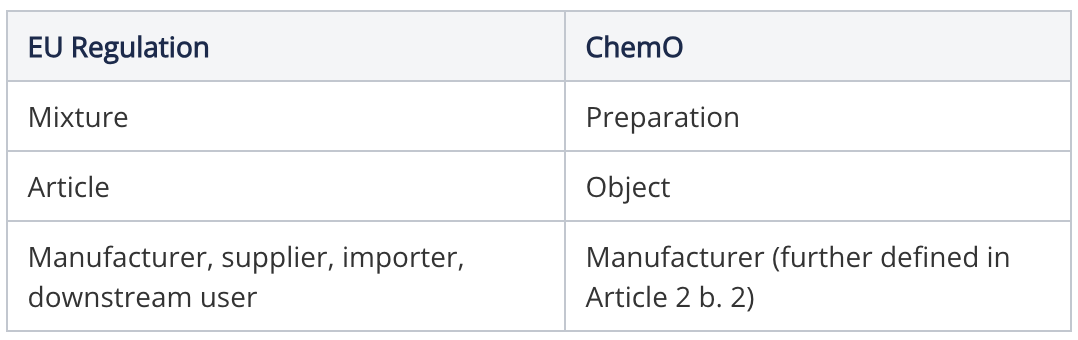
+Chapter 3 of ChemO contains notable correspondances between terms used in the EU REACH and CLP regulations, and those in ChemO. These include:
Effectively the use of the term dangerous in the ChemO is equivalent to hazardous in the GHS sense, as the technical provisions for classification, labelling and packaging in Annex 2 of ChemO refer to Annex I-VII of the EU CLP Regulation.
Preparations which are not considered dangerous within the scope of Article 3 (which refers to the EU CLP via Annex 2), containing at least one of the following:
substance which is dangerous to health or to the environment in an individual concentration of ≥1.0 % (w/w)percent by weight (non-gaseous preparations) or ≥0.2 % (v/v)(gaseous preparations)
A category 2 carcinogenic substance, a category 1A, 1B or 2 toxic for reproduction substance, a category 1 skin allergen, a category 1 inhalation allergen, a substance imposing effects on or through lactation, or a PBT or vPvB substance in an individual concentration of ≥ 0.1% (w/w) percent by weight;
Preparations containing a substance listed in Annex 3 in an individual concentration of ≥ 0.1 percent by weight;
Preparations containing one substance for which a workplace exposure limit value has been established in EU Directives 2000/39/EC, 2006/15/EC or 2009/161/EU, (EU) 2017/164 or (EU) 2019/1831.
The safety data sheet must be prepared according to technical provisions of Annex 2, section 3, which refers to Annex II of the REACH Regulation. There are some additional format requirements such as suggestions and requirements on the emergency telephone number.
SDSs must be supplied at no cost, in one of the official languages (German, French, and Italian) demanded by the recipient, or, per mutual agreement, in another language. In any case, an annex to SDS (exposure scenario) may be prepared in English. An SDS may be provided electronically or on paper.
When new and important information becomes known to the supplier of the Safety Data Sheet, supplier of the SDS, must update the SDS without delay and make the update available to everyone who recieved the product within the previous 12 months (apart from SDSs provided through retail outlets).
Sources
Ordinance on Protection Against Dangerous Substances and Preparations (Chemicals Ordinance, ChemO): English I German
Manufacturers providing hazardous substances and preparations to third parties must label them according to Art.17 (1), Art. 18 (except last sentence of paragraph 2), Art. 19-23, 25 (Paragraphs 1, 3 and 4), Art. 26-28, 29 (1-4), Art. 31, 32 (1-5) and 33 of EU CLP regulation.
Preparations with specific hazards, as given in Article 4 section 7 of EU CLP Regulation, must be labeled additionally, according to Article 25, section 6 of EU-CLP Regulation.
In addition, the label must:
Include the name, address and telephone number of the manufacturer.
Be in an official language of the location, where the substances or preparations is provided to private or professional users.
In the case of an agreement with an individual professional end-user, a substance or preparation can, for supply only to this end user, be labeled in another official language or in English. In this case the same information should be given in all the languages used.
Where the substances or preparations are imported from a member state of the EEA (European Economic Area) and not expected for private use, the name of the manufacturer can be replaced by that of the person who is responsible for placing the product in the EEA, in case substances and mixtures;
are not intended for supply to a private user or;
are supplied to private users, within an inner packaging in portions <=125ml or g and on the outer packaging are marked with the name, address and telephone number of the manufacturer.
Manufacturers providing dangerous substances and/or preparations to a third party must package them according to Article 35 of the EU CLP Regulation.
For packaging aerosols that are not subject to the Foodstuffs Act, (FSA), provisions of Chemo applies as well as, Article 1 and 2 and sections, 2.1, 2.3, 3, 4, 5, and 6 of Annexes of Directive 75/324/EEC.
Sources
Ordinance on Protection Against Dangerous Substances and Preparations: German | English
Manufacturer of preparations may use a replacement chemical name for a substance if:
They can demonstrate that revealing the name of the substance on the label or SDS would jeopardize the secrecy of their intellectual property rights.
The substance meets the conditions given according to Annex I section 1.4 of EU-CLP Regulation according to Annex 2 section 1.
The alternate chemical name must identify the most important functional groups or act as a replacement naming.
Manufacturers who wish to use a replacement chemical name must request this in writing from the Notification Authority, who will make a decision together with the assessment authorities.
The process is stipulated by Articles 14 and 15 of ChemO.
Authorization to use a replacement chemical name is given to the manufacturer and is not transferable. The request to use a replacement chemical name for a substance in a preparation should be prepared in an official language or in English and should be provided electronically in the requested format by the Notification Authority, along with an additional letter in an official language.
The request must contain:
The manufacturer’s name, address and telephone number
The following data for those substances whose identification will be kept secret on the label:
The chemical name,
The Chemical Abstracts Service (CAS) registry number,
The EC number,
The replacement name of the substance,
The reasons for the request,
The trade name or naming of the preparation,
The information on the compositions according to the requirements regarding to the safety data sheet,
The classification of the preparation,
The labeling of the preparation,
The expected usage of the preparation,
The physical state
The safety data sheet, if applicable
Sources
Ordinance on Protection Against Dangerous Substances and Preparations: German | English
The Swiss list of exposure limits, with its MAK and BAT values, is modeled after the German AGW list (and somewhat after the ACGIH - American Conference of Governmental Industrial Hygienists – the TLV list).
Maximale Arbeitsplatzkonzentrationen (MAKs), or maximum workplace concentrations, give the maximum concentration of a chemical substance in the workplace. They are the maximum allowable average concentrations of a working substance in the air in form of gas, steam or dust, whereby it can be assumed that the health of the vast majority of healthy employees being exposed to these substances during an 8-hour work shift up to 42 hours a week or even over longer periods will not be harmed.
Biologische Arbeitsplatztoleranzwerte (BATs), Biological Tolerance Values, give limits for the concentration of some substances in the human body resulting from workplace exposure.
The list contains substances that are considered harmful to humans, together with their applicable limit values. It also contains information and safety precautions for particular problem areas, such as carcinogens, dust, noise, heat, pressure, vibration, radioactive substances, and skin absorption, as well as remarks on testing methodology.
The limit values are documented in "Grenzwerte am Arbeitsplatz" (limit values at the workplace) and are published by the Swiss National Insurance Fund (SUVA), in line with a decree of the Bundesrat and in conjunction with the limit value commission of the Swiss Association for Occupational Medicine, Hygiene and Safety.