¶ Recent Updates2026
2025
|
|
¶ Background |
|
|
Taiwan, officially known as the Republic of China, is located in east Asia. As a Chinese-speaking country, Taiwan's official gazettes are published in Traditional Chinese language; some of them are translated into English. There are several government agencies involved in chemical control in Taiwan. Different regulations are implemented by their respective agencies. Readers may obtain the official gazettes through the Executive Yuan Gazette Online. The Executive Yuan is the highest administrative agency in Taiwan. A number of ministries and agencies are governed through a president and vice president under Executive Yuan. "Yuan" is a direct pronunciation through Pinyin in Chinese. It means "institution". The Ministry of Environment, formerly known as the Environmental Protection Administration (EPA), administers the following regulations:
On February 17, 2014, the Taiwan Council of Labor (CLA) was renamed the Ministry of Labor (MOL). The MOL is responsible for the following regulations:
The Department of Health (DOH) was renamed the Ministry of Health and Welfare (MOHW). The MOHW is responsible for the following regulations:
On August 1, 2023, Taiwan's Council of Agriculture (COA) was transformed into the Ministry of Agriculture (MOA). These regulations are controlled by MOA:
GHS was implemented since 2008. The competent authorities involved in GHS implementation include: Transport: Emergency Response:
Consumers:
Environmental Agents/Pesticides:
Fees disclosed in this report are in New Taiwan dollar (NT$). 1 NT$ is approximately equal to USD 0.032. |
Official Gazette |
¶ Inventories |
|
¶ TCSIFollowing the conclusion of the Existing Chemical Substance Nomination (ECN) on December 31, 2010, the Supplementary Existing Chemical Substance Nomination (SECN) on August 31, 2012, and the Second Supplementary Existing Chemical Substance Nomination (SSECN) on July 31, 2014, the Ministry of Labor published the Taiwan Chemical Substance Inventory (TCSI) on December 31, 2014 through MOL Document No. 10302023691. The inventory contained approximately 93000 substances and enforcement started on January 1, 2015. On September 8, 2015, OSHA Order No. 10402028451 amended TCSI to add more substances, bringing the total to over 100000 chemical substances. The amendment on September 8, 2015 includes substances registered via both the Taiwan Ministry of Labor (MOL) and the Environmental Protection Administration (EPA), under the Occupational Safety and Health Act and Toxic Chemical Substances Control Act, respectively. The substances listed on the September 8, 2015 amendment does not compile substances announced on December 31, 2014. Therefore, both lists shall be reviewed for completeness. Chemicals are listed with either CAS numbers or serial numbers. N and E serial numbers are given to substances without CAS numbers, while P and C serial numbers are assigned to substances with protected data. As shown in the chart, the majority of the entries are listed with CAS numbers. This inventory serves as an important reference for the development of chemical management in Taiwan. There are related registration requirements for New and Existing Chemicals under EPA and New Chemicals under the MOL. The inventory is searchable by CAS number, serial number, and Chinese or English Chemical names. There is also a multiple search function available through the website of Chemical Registration Management (CSNN), Occupational Safety and Health Administration, Ministry of Labor. |
Sources
Resources
*Not available in English 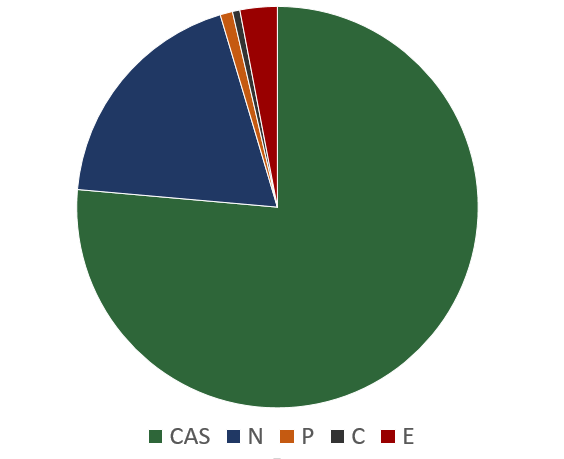 |
¶ Substance Registration |
|
¶ Toxic and Concerned Chemical Substances Control ActThe Taiwan Toxic Chemical Substances Control Act (毒性化學物質管理法, TCSCA) was originally promulgated on November 26, 1986 and was last amended on January 16, 2019 through Presidential Order No. 10800005221. In the latest amendment, the Act's name was changed to the Toxic and Concerned Chemical Substances Control Act (毒性及關注化學物質管理法). The amendment expands the provisions of the Act from 44 articles to 75 articles; therefore, the Act has been revised extensively. There are seven key aspects to this amendment:
|
Sources
Resources
*Not available in English
|
¶ Toxic Chemical Substances“Toxic chemical substances” refers to those chemical substances that are intentionally produced by human activity or unintentionally derived from production processes and that have been officially announced by the central competent authority; they are divided into 4 classes as follows:
Toxic chemical substances with their classes and management of handling were announced by "Guidelines on Regulated Toxic Chemical Substances and the Management of Their Handling." Only the announced substances with a concentration equal to or higher than the cut-off concentration are considered toxic chemical substances. The management of handling is based on the graded handling quantity announced in the Appendix 1 of the Guidelines. The Toxic and Concerned Chemical Substances Control Act requires a permit, registration or approval to be obtained for the following activities:
The validity period of a permit, registration document or approval document is 5 years. If handling activities will continue after this period, an application for extension must be submitted within 3 to 6 months prior to expiration. The extension may not exceed 5 years for each time. When permits, registration documents or approval documents are damaged or lost within the validity period, an application for replacement or renewal shall be submitted within 30 days. Modification of permits, registration documents or approval documents shall be applied for with regard to the following cases:
The competent authority may modify or cancel the permit, registration document or approval document when necessary to prevent Class 1, 2, 3 or 4 toxic chemical substances from polluting the environment and endangering human health. The application for permits, registration documents or approval documents shall be done online, through the Toxic and Concerned Chemical Substances Registration and Notification system. On April 7, 2021, EPA amended the Toxic Chemical Substances Handling Application and Chemical Substances Registration Fee Standards and renamed it the Fee-charging Standards for Toxic and Concerned Chemical Substances Control Act, via EPA Document No. 1108200208. The fees applied for issuance, approval, extension, or change of all types of toxic chemical substances handling permits, registration documents, approval documents, and applications for removal of restrictions or prohibitions on Class 1, Class 2, and Class 3 toxic chemical substances are summarized in Appendix 1 of the Standards. To facilitate the management of toxic chemicals, Taiwan EPA established the Toxic and Chemical Substances Bureau on December 28, 2016 via Order No. 10500630241. The bureau is expected to improve the audit and registration of toxic chemicals and ensure industrial chemicals are distinguished from chemicals used in foods. The bureau is responsible in enforcement and inspection of toxic chemical substances. |
Sources
Resources
*Not available in English |
¶ Concerned Chemical Substances"Concerned Chemical Substances" refer to "chemical substances aside from toxic chemical substances, that have been officially announced by the central competent authority to pollute the environment or are a suspected threat to human health based on substance characteristics or public consumer issues of domestic or foreign concern and are controlled by the central competent authority." The central competent authority is requested to announce the concerned chemical substances with the corresponding management requirements for different levels of handling. On October 30, 2020, Taiwan's Environmental Protection Administration (EPA) promulgated "Categories and Management of Handling for Concerned Chemical Substances," a subsidiary regulation under Toxic and Concerned Chemical Substances Control Act. The regulation was amended on January 12, 2023, which divided concerned chemical substances into 3 categories based on the nature of the chemical substances and their management needs:
A permit is required for the handling of concerned chemical substances. Handling includes the following activities: manufacturing, importing, selling, transporting, using and storing of chemical substances. Additionally, "Categories and Management of Handling for Concerned Chemical Substances" also specifies recordkeeping and reporting requirements, labeling and SDS requirements, and personnel requirements. The Taiwan EPA enforces these regulations by observation and unannounced facility inspections. A professional technician is required for handling emergency response or preventing hazards and pollutions of hazardous concerned chemicals. Transporting vehicles shall be equipped with real-time monitoring systems for quicker response during an accident. If handling activities will continue after the validity period of an approval document, an application for extension must be submitted within 3 to 6 months prior to expiration. When an approval document is damaged or lost within the validity period, an application for replacement or renewal shall be submitted within 30 days. Modification of an approval document shall be applied for with regard to the following cases:
The application for approval documents shall be done online, through the Toxic and Concerned Chemical Substances Registration and Notification system. The fees associated with issuance, approval, extension, or change of concerned chemical substances handling approval documents are summarized in Appendix 1 of the Fee-charging Standards for Toxic and Concerned Chemical Substances Control Act. |
Sources
Resources
*Not available in English |
¶ New and Existing Chemicals under EPAWith the amendment of the Toxic Chemical Substances Control Act (TCSCA) on December 11, 2013, Taiwan Environmental Protection Administration (EPA) (updated to Ministry of Environment (MOE) in 2023) was granted the authority to make the enforcement rules regarding the procedures for the registration of new and existing chemical substances. Taiwan's Regulation of New and Existing Chemical Substances Registration was issued on December 4, 2014 according to the requirements under the Toxic Chemical Substances Control Act (the Act was amended and renamed the Toxic and Concerned Chemical Substances Control Act on January 16, 2019). The Regulation was last amended on November 23, 2021. The Regulation specifies detailed registration requirements for new and existing chemical substances. Exemptions The following substances are exempt from existing and new chemical registration:
Additionally, the following substances or products which are regulated under other laws are also exempted from the registration requirements under the Regulation of New and Existing Chemical Substances Registration:
However, the raw materials which are used to produce the above substances or products are still subject to registration requirements. New and Existing Chemical Substances Registration is explained in the following details:

|
Definitions "Existing chemicals" refers to chemical substances which have been published in the Taiwan chemical substance inventory (TCSI). "New chemicals" refers to any substances not included in the Existing Chemical Substances inventory. Sources
Resources
*Not available in English Assistance from the EPA To introduce the existing and new chemical substances registration, Taiwan hosted over 50 seminars in the past three years. To further facilitate the enforcement of the chemical registration, the MOE opened telephone and email services to handle inquiries from industry. The MOE welcomes phone calls to +886-(02)2314-2000 or emails to chemist@eri.com.tw. |
¶ New Chemicals under the MOLOn July 3, 2013, the Labor Safety and Health Act was amended and renamed the Occupational Safety and Health (OSH) Act to incorporate stipulations for New Chemical Substance registration. With the amendment, Taiwan MOL granted the authority to make the enforcement rules regarding the procedures for the registration of new chemical substances and published Regulations on New Chemical Substances Registration (新化學物質登記管理辦法) on December 31, 2014 (last amended on August 19, 2015). Taiwan's Ministry of Environment (MOE, formerly known as Environmental Protection Agency (EPA)) and Ministry of Labor (MOL) administer new chemical substances based on different legal sources. MOL is mainly focused on the principle of safety protection of laborers and their work, and tries to manage and reduce workers' exposure risk when handling chemical substance. MOE is focused on the protection of the domestic environment and people's health, and it tries to gather the sources of all imported or manufactured chemical substances and carry out subsequent related control operations. Therefore, manufacturers or importers still need to carry out the registration of related chemical substances in accordance with the two legislatives. However, in order to reduce cumbersome work and repetitive data, MOE and MOL have now completed the coordination of related operating procedures, and the chemical substance registration can be carried out at a single window: CHEMical Information System and Tool (CHEMIST). On August 18, 2017 and January 31, 2020 MOL announced via Notice No. 10602033931 and No. 1090200024, respectively, that for new chemical substances in level I and in level II - IV of Standard Registration, manufacturers or importers are exempted from the application for registration approval if they have previously obtained approval from the central authority in accordance with the Toxic and Concerned Chemical Substances Control Act (TCCSCA). The notices were effective immediately, but the Regulations have not yet been updated. Exemptions The following substances are exempted for existing and new chemical registration:
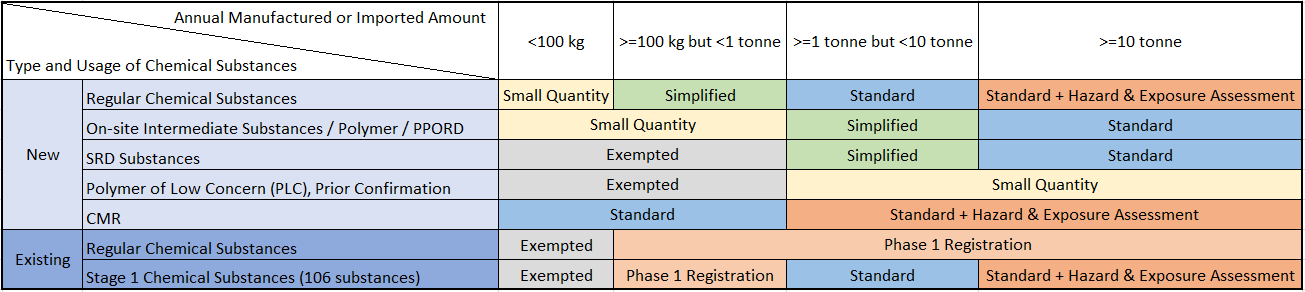
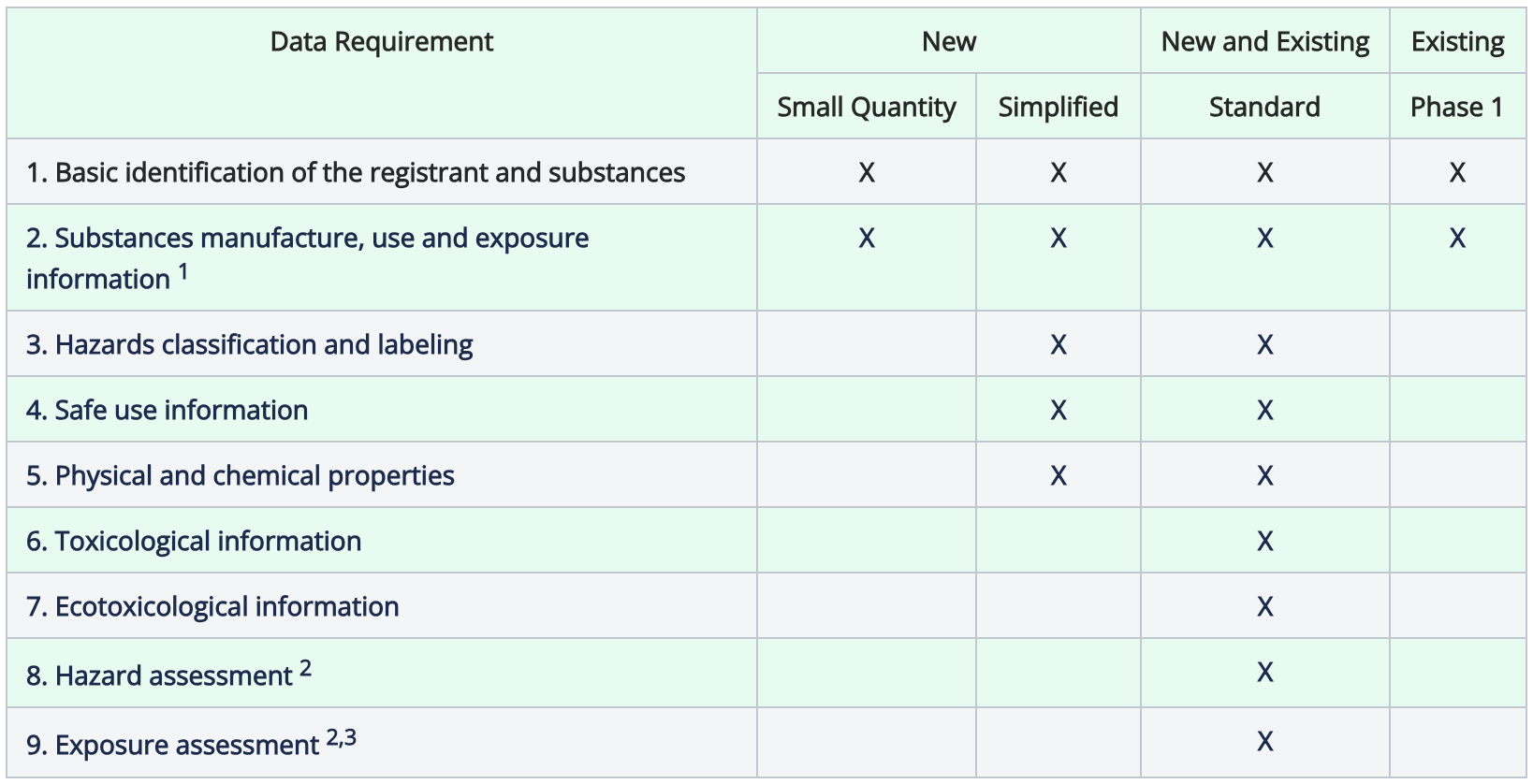
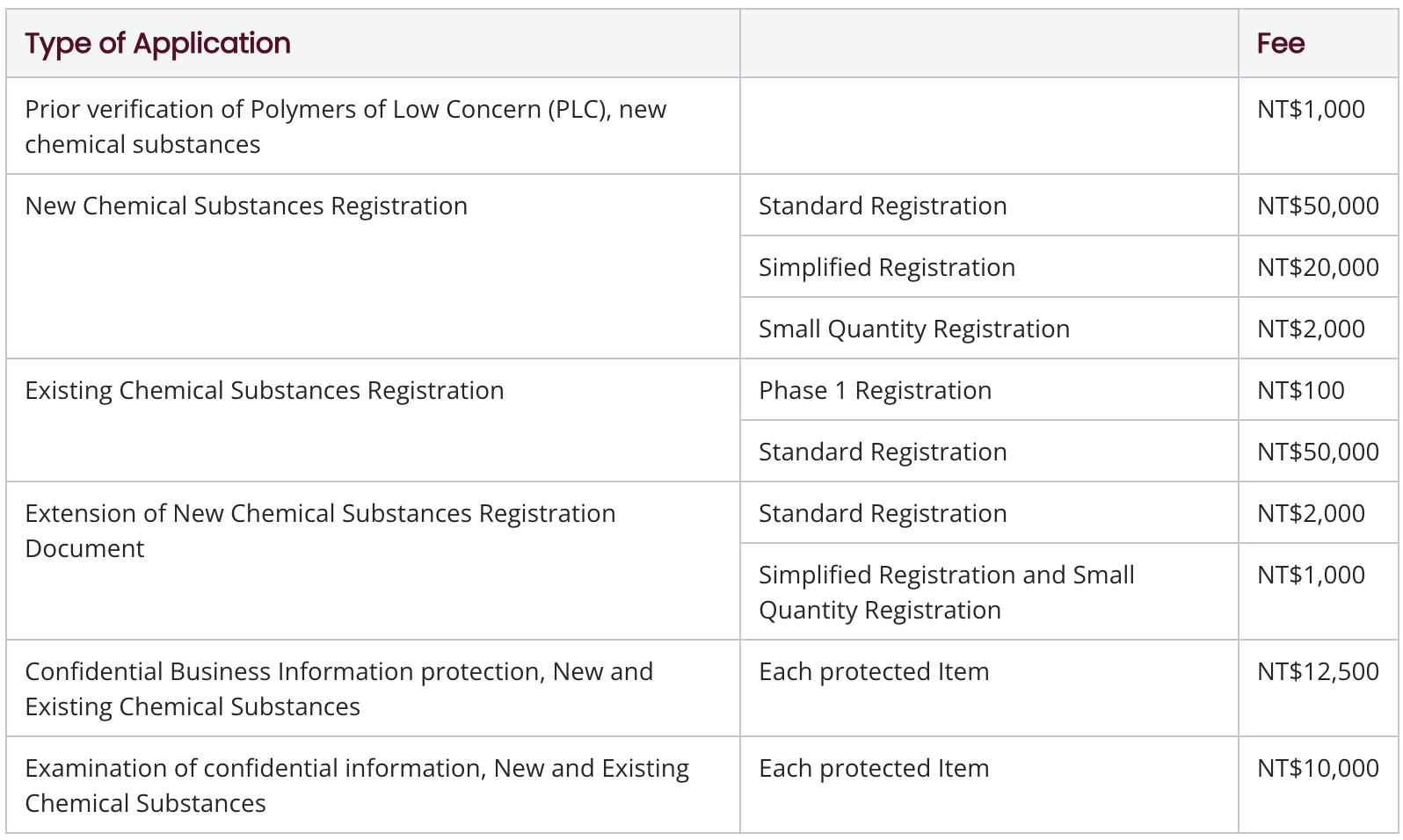
No manufacturers or importers shall manufacture or import new chemicals, which are not listed on the inventory, before submitting a chemical substance safety assessment report to the central competent authority and receiving approval of registration of the new chemical substances. Only Taiwan's local entities (i.e. domestic manufactures or importers, Third Party Representatives (TPR)) may register substances. Different from the EU REACH, the Only Representative (OR) rule is not adopted in Taiwan chemical registration. ¶ Registration TypesThe registration of new chemical substances under MOL are categorized into three types based on the annual manufactured/imported tonnage, as summarized below. 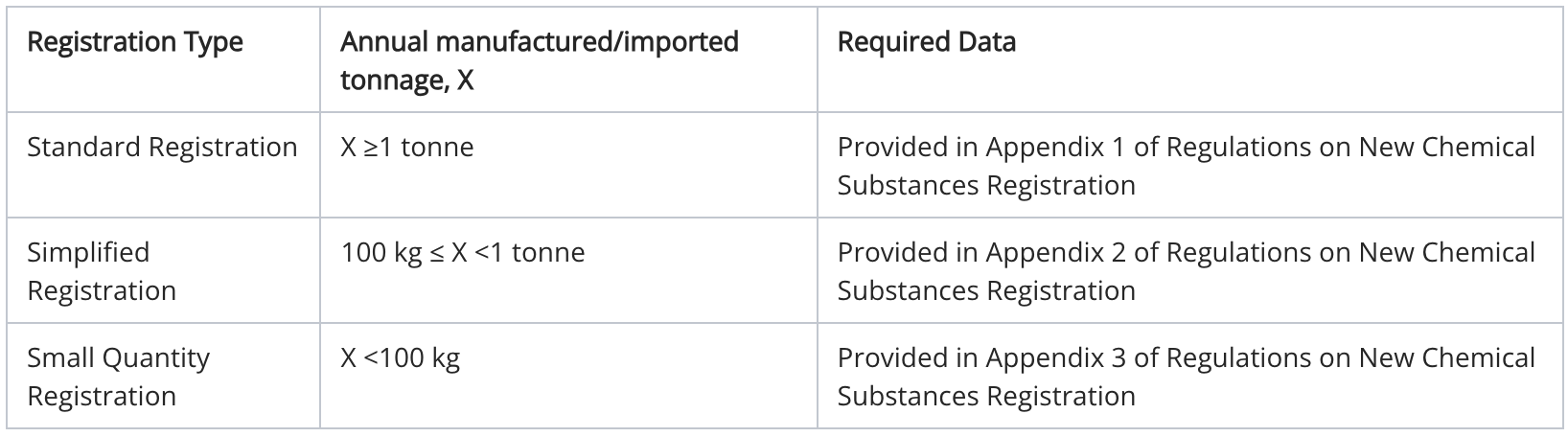 ¶ Special CasesThe following tonnage bands are applied to new chemical substances under the noted special cases: 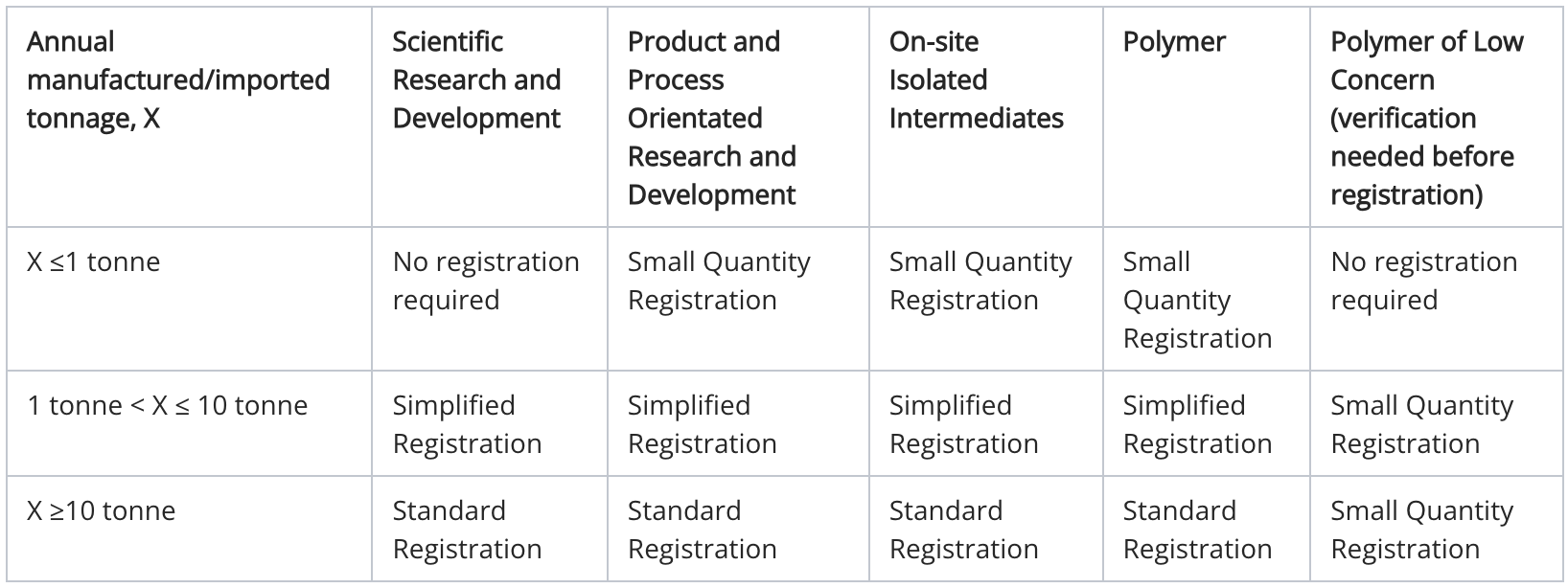 If a substance is categorized as a Category 1 Carcinogenic, Mutagenic and Reprotoxic (CMR) substance, the central competent authority may request the applicant register according to standard registration. ¶ DeadlinesNew chemical substances shall be registered 90 days before manufacturing or import activities. MOL may request further supporting documents to amend registration content if necessary. In this case, the registrant shall revise and submit the required information within 30 working days. The revision shall not exceed two times, or the registration will be revoked. The registration and the supporting documents shall be kept for at least 5 years. ¶ Confidential Business InformationConfidential business information, i.e. the chemical identity, may be protected. The application for Confidential Business Information (CBI) shall be completed 3-6 months before the substance is listed on the TCSI. Once approved, the protected period is 5 years and may be extended 3 months before expiration. The extension can only be done once. ¶ FeesOn January 30, 2015, MOL published the New Chemical Substances Registration and Controlled Chemicals Permit Application Fee (新化學物質登記及管制性化學品許可申請收費標準), via MOL Document No. 10302023092. This regulation was amended and renamed Controlled Chemicals Permit Application Fee (管制性化學品許可申請收費標準) on November 10, 2020. Even though the purposes and objectives of the new chemical substance registration specification are different under the OSH Act and TCCSCA, the information that the applicant should submit has been integrated and consistent. In order to avoid duplication and to unify the standards for the application fee, the regulation was amended and renamed. Now, the application fee on new chemical substances registration is the same as that required by MOE. |
Definitions "Existing chemicals" refers to chemical substances which have been published on the Taiwan chemical substance inventory (TCSI). "New chemicals" refers to substances not included in the Existing Chemical Substances inventory. **Stipulations for chemical substances controlled under the Toxic and Concerned Chemical Substance Control Act (TCCSCA) by the MOE shall take precedence over the Regulations on New Chemical Substances Registration. Articles 6, 7 and 31 of the Regulations on New Chemical Substances Registration provides further clarification on this. Sources
Resources
*Not available in English |
¶ Controlled and Priority Management Chemicals¶ Regulatory StructureTaiwan published the following regulations in accordance with Article 14 Paragraph 3 of the Occupational Safety and Health Act:
¶ DefinitionsControlled Chemicals, regulated by Article 19 of the Enforcement Rules of the Occupational Safety and Health Act, are Priority Management Chemicals stipulated in Article 20 of the Rules that are evaluated by the central competent authority to be of high exposure risks. The list of Controlled Chemicals is provided in Appendix 1 of the Measures on the Designation and Operational License of Controlled Chemicals. Priority Management Chemicals are:
Substances in items (2) and (3) have been announced gradually. ¶ Controlled ChemicalsA permit shall be applied for before beginning the operations of Controlled Chemicals. For chemicals operated before the enforcement of the Regulation, a permit shall be applied for within one year of the effective date of the regulation. A combined application is permissible for mixtures of Controlled Chemicals with different concentrations, but with the same usage, hazard classification and exposure control measures. The processing time for the permit application is 30 working days, but this may be extended for an additional 30 days if necessary. An on-site inspection may be conducted if required by the Ministry of Labor (MOL). After being approved, for regular cases, a permit shall be effective for 5 years. However, depending on how harmful the operational activity is, the duration of the permit may be reduced to 3 years. Applications for permit renewal may be submitted three to five months before the expiration. If the following information changes, the permit shall be revised and updated within 30 days, according to Appendix 4 of the Measures on the Designation and Operational License of Controlled Chemicals:
A permit shall be re-applied for if the following conditions occur:
To replace lost permits, one may re-apply according to Appendix 5 of the Regulations. On January 30, 2015, the MOL published the New Chemical Substances Registration and Controlled Chemicals Permit Application Fee (新化學物質登記及管制性化學品許可申請收費標準) via MOL Document No. 10302023092. The application fee for the permit of controlled chemicals is NT$3600. An application for permit changes is free of charge. This regulation was amended and renamed Controlled Chemicals Permit Application Fee (管制性化學品許可申請收費標準) on November 10, 2020. ¶ Priority Management ChemicalsOn November 5, 2015, Taiwan published a list of "First Phase Designated Priority Management Chemical Substances" through MOL Document NO. 10402033851. It is enacted in accordance to Article 2, Paragraph 2 of Regulations Governing Designating and Handling of Priority Management Chemicals. The list consists of 2 parts - Part 1 includes 83 Category 1 CMR Substances and Part 2 includes 420 substances with physical hazards or health hazards. The "Second Phase Designated Priority Management Chemical Substances", including 90 Category 1 CMR substances and 482 substances with physical or health hazards, were announced by OSHA Order No.10702056381 on December 27, 2018. The Order became effective on April 1, 2019. The First Phase and Second Phase Designated Priority Management Chemicals were combined and reclassified according to their physical and health hazards. The new lists were published on February 14, 2022 and became effective on April 1, 2022. Activities regulated for Priority Management Chemicals are their manufacture, import, and supply, as well as any handling (including processing, placing or storing) and usage by workers. The operator of the Priority Management Chemicals shall report the following information to the MOL for the first time of recordation:
The operator of the Priority Management Chemicals shall submit the above information every year for periodic recordation. The registration shall be revised and updated within 30 days, according to Appendix 7 of Regulations Governing Designating and Handling of Priority Management Chemicals, if:
When two or more Priority Management Chemicals are handled, and the maximum handling quantity for each chemical is smaller than the quantity limit specified in Appendix 2 of the Regulations, the following formula shall be used to determine the necessity of registration. Total handling quantity = (Maximum handling quantity of Priority Management Chemicals A) / (Quantity limit of Priority Management Chemicals A) + ((Maximum handling quantity of Priority Management Chemicals B) / (Quantity limit of Priority Management Chemicals B) +... Registration is required if the total handling quantity is larger than 1. ¶ How to ApplyThe permit application for controlled chemicals and the reporting of priority management chemicals shall be done through the Permit and Report of CHEMicals (PRoCHEM) portal. Guidance and tools for reporting priority management chemicals and application for permit of controlled chemicals can be downloaded through the resource links. The tools shall be used to prepare the required information. Applicants shall open an account on the PRoCHEM portal before the submission of report or application. Account approval may take 2 to 3 working days. The report or application shall be done by logging into the approved account. |
Sources
Resources
*Not available in English Exemptions The following substances are exempted from both of the regulations:
|
¶ Product Registration |
|
¶ Controlled DrugsThe Controlled Drugs Act was promulgated by the Government of the Republic of China on November 11, 1929, and last amended on June 14, 2017. The Schedules and Items of Controlled Drugs are regulated under the Act and have been amended from time to time. Controlled drugs are administered by the National Bureau of Controlled Drugs, established within the Department of Health Executive Yuan at the Central Government level. The term controlled drugs as used in this Act refers to the following types of drugs:
The controlled drugs of this act exclude those drugs without potential for misuse or used as test reagents for humans, when the following conditions apply:
The controlled drugs mentioned above shall be classified into four schedules by their potential for habitual use, dependence, abuse, and danger to society. Controlled drugs may only be used for medical and scientific purposes. The schedules and items of the controlled drugs shall be reviewed and announced to the public by the Executive Yuan after consideration by the Controlled Drugs Review Committee established by The Central Health Administration. The Food and Drug Administration and the Department of Health shall establish pharmaceutical plants to handle the import, export, manufacture and selling of Schedule 1 and 2 controlled drugs. Without the approval of the Central Health Administration, medical institutions may not use Schedule 1 and 2 controlled drugs for the treatment of addiction to controlled drugs. The import, export, manufacture, sale or purchase of controlled drugs shall adhere to the following procedures and guidelines:
These companies/institutions must apply to the FDA for registration and should hold a controlled drugs registration license. |
Sources
*Not available in English |
¶ Agro-pesticidesThe Agro-pesticide Management Act was originally promulgated on January 6, 1972 and last amended on May 23, 2018. According to Article 9 of the Agro-pesticide Management Act, the manufacture, processing, and import of agro-pesticides shall pass examination and get an approval and permit through registration to the central competent authority. According to Article 15 of the Act, the following information will be provided in a permit:
Information provided in the registration shall not be changed unless approved by the competent authority. To make changes, the permit applicant shall, within 6 months of the publication under Article 15, file for alteration of the registration. The permit issued shall be valid for 5 years. A permit extension can be filed within 6 months before the expiration. Each extension shall not exceed 5 years. |
Sources
Resources *Not available in English Navigate to: Agro-pesticide Label |
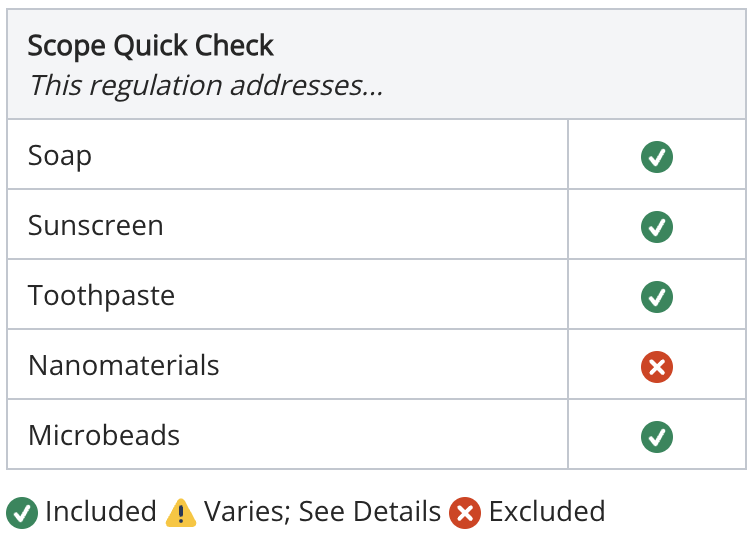
¶ CosmeticsThe Statute for the Control of Cosmetic Hygiene was first enacted on December 28, 1972 and renamed to Cosmetic Hygiene and Safety Act on May 2, 2018. Cosmetic(s) is defined as "products applied externally to the human body, teeth, or oral cavity mucous membranes, and used to moisturize hair and skin, stimulate the sense of smell, improve body odors, change appearance, or cleanse the body." However, this is not applicable to those that are regarded as drugs in accordance with other laws or regulations. Under Article 4 of the Act, product notification shall be completed for those cosmetics which are announced by the central competent authority and manufactured or imported of a certain scale, before the cosmetics are supplied, sold, presented, publicly displayed or provided for a consumer trial. In order to implement the requirements prescribed under the Cosmetic Hygiene and Safety Act, the following regulations were issued: |
Sources
 |
¶ Regulations Governing Notification of Cosmetic ProductsThis Regulation is enacted pursuant to Article 4 (2) of the Cosmetics Hygiene and Safety Act. Manufacturers or importers of cosmetics shall complete product notification via the Cosmetic Product Log-in Platform. Product notification shall include:
The product notification shall be made in Chinese, English, numbers or international symbols. If the data provided in notification is different, a separate notification should be submitted, except for the following cases:
Re-notification shall be submitted for any change in composition; other changes in the submitted data can be amended in the notification. The valid period for data notification is three years. Extension of the the data notification shall be submitted within three months prior to its expiration. According to the notice "Types of cosmetics for which product notification should be completed", all cosmetics, other than handmade soap for which the entities are exempt from industry registration, are subject to product notification. |
Sources
Resources
|
¶ Regulations for Cosmetic Product Information File ManagementThis Regulation is enacted pursuant to Article 4 (3) of the Cosmetics Hygiene and Safety Act. Cosmetic manufacturers or importers of a certain scale shall establish product information file prior to the supply, sale, giveaway, public display, or consumer trial. According to Article 2 of the Regulation, the cosmetic manufacturers or importers of a certain scale shall mean the following entities which engage in cosmetic manufacturing or importing:
On March 11, 2019, Taiwan Food and Drug Administration (FDA) published Notice No. 1091601089 which contains the manual and guideline on establishing product information file. The manual and guideline were most recently amended on April 1, 2024. Details of establishing product information file can be found in the regulation via the hyperlinks. The FDA published the notice "Cosmetics for Which Cosmetic Product Information File Management Shall Be Established and the Implementation Dates" on May 30, 2019 which specifies the implementation dates for various types of cosmetics. The notice was most recently amended on June 26, 2024 with the following implementation dates:
|
Sources
*Source is only available in traditional Chinese. |
¶ Regulations Governing the Application of Animal Testing for the Safety Assessment of Cosmetics or Cosmetic IngredientsThis Regulation is enacted pursuant to Article 6 (6) of the Cosmetics Hygiene and Safety Act. Animal testing is prohibited for safety evaluation of cosmetics or cosmetic ingredients unless one of the following conditions applies and has been approved by the central competent authority:
Cosmetics in violation of the above provisions shall not be provided for sale. Details of the application procedure can be found in the regulation via the hyperlink. |
Sources |
¶ Regulations Governing the Source and the Flow Data of Cosmetic ProductsThis Regulation is enacted pursuant to Article 11 (2) of the Cosmetics Hygiene and Safety Act. Cosmetics businesses shall establish and maintain data on direct supply sources and destinations of products, but the direct sale to consumers is not included. Details on the scope, methods for establishment and maintenance, retention period of data, and other information can be found in the regulation via the hyperlink. |
Sources
|
¶ Regulations for Cosmetics RecallThis Regulation is enacted pursuant to Article 17 (4) of the Cosmetics Hygiene and Safety Act. Cosmetic manufacturers or importers shall immediately notify sellers and recall violating products from the market within a time period. Sellers shall cooperate with manufacturers and importers in the recall of cosmetics. Details about violating products and recall method can be found in the regulation via the hyperlink. |
Sources
|
¶ List of Cosmetic Ingredients with RestrictionsArticle 6 of the Act allows Ministry of Health and Welfare to restrict the use of cosmetics ingredients to prevent and avoid causing allergies, irritations, depigmentation, and conditions that pose a hazard to human health. The List of Cosmetic Ingredients with Restrictions was published by the Taiwan Food and Drug Administration (FDA) to restrict the use of ingredients or other conditions that pose an impact to the hygiene and safety, their composition, content, applied body part, usage method, and so on. |
Sources
*Source is only available in traditional Chinese. |
¶ List of Prohibited Ingredients in CosmeticsArticle 6 of the Act requires Ministry of Health and Welfare to announce a list of prohibited ingredients in cosmetics. Details of the Prohibited Ingredients in Cosmetics are available through the hyperlink. |
Sources
*Source is only available in traditional Chinese. |
¶ List of Preservatives in Cosmetics with RestrictionsArticle 6 of the Act allows Ministry of Health and Welfare to restrict the use of preservatives in cosmetics. The preservatives not on the Taiwan's list but allowed for use with prescribed restrictions from any of the following countries: United States, European Union and Japan, can be used in Taiwan by following the standards stipulated in those countries; when there is a difference for the allowable limit in those three countries/areas, the safest one should be adopted. Details of List of Preservatives in Cosmetics with Restriction are available through the hyperlink. |
Sources
*Source is only available in traditional Chinese. |
¶ Restrictions on the Manufacture, Import, and Sale of Personal Care and Cosmetics Products Containing Plastic MicrobeadsPlastic microbeads is defined as "solid plastic particles used for exfoliation or cleaning of the body wherein the scope of particles diameter is smaller than 5 mm, and the material of which they are made includes biodegradable plastic" in this regulation. The following cosmetics and personal care products containing plastic microbeads, other than those manufactured or imported before August 23, 2016, are not allowed to be manufactured, imported, or sold:
Details of the regulation are available through the hyperlink. |
Sources |
¶ Other Subsidiary RegulationsThere are some other subsidiary regulations under the Cosmetic Hygiene and Safety Act. The names of the regulations are listed below and the details can be found in the regulations via the hyperlinks.
|
|
¶ Labeling for CosmeticsArticle 7 of the Cosmetic Hygiene and Safety Act requires that the following information shall be included on outer packaging or containers of cosmetics:
The information should be provided in traditional Chinese other than item 5 which can be provided in English. If the surface area of the outer packaging or container is too small to include the information, it should be printed on the leaflet, package insert or by other means. The FDA published the notice "Labeling requirements for cosmetic packaging, containers, labels or leaflets." Additional labeling requirements are specified in the notice, including:
|
Sources
*Source is only available in traditional Chinese. |
¶ Notifications |
|
| Currently, there are no substance notification requirements in Taiwan. | |
¶ Restrictions and Bans |
|
¶ Ozone Depleting SubstancesTaiwan is not a party to the Montreal Protocol. Nevertheless, since the protocol agreement was ratified, Taiwan has worked to control and phase out Ozone Depleting Substances (ODS) proactively and voluntarily. To date, it has phased out consumption of various regulated ODS, including Halon, Chlorofluorocarbons (CFCs), and Methyl Bromide, as well as reduced consumption level of Hydrochlorofluorocarbons (HCFCs). Phasing out of HCFCs is expected on January 1, 2030. The National Council for Sustainable Development (formerly known as the Working Committee on Global Environmental Change Policy) was formed to establish policies for sustainable development and design strategies in response to the Montreal Protocol. The Working Group for International Environmental Protection led by the Ministry of Environment (MOE, formerly known as Environmental Protection Administration (EPA)) is the responsible agency that conducts activities in response to the mandates of the Montreal Protocol, including overseeing production, import, and export of controlled ODS and reporting data to the Ozone Secretariat of United Nations Environment Programme (UNEP) every year. 
|
Sources
Resources
|
¶ Persistent Organic Pollutants (POPs)Although Taiwan is not a party to the Stockholm Convention, the control of persistent organic pollutants (POPs) are strictly regulated in Taiwan. The National Implementation Plan for POPs was implemented and promoted through several pieces of legislation, including the Toxic and Concerned Chemical Substances Control Act (TCCSCA), Environmental Agents Control Act, and Agro-pesticides Management Act, which prohibit and restrict the use of POPs listed under Stockholm Convention. At the same time, Taiwan is dedicated to source control and contamination emergency response for POPs. The environmental POPs distribution is controlled in order to improve management on the pollution source and production. The Dioxin emission level dropped 78% by 2008 since the control was implemented in 1997. ¶ Regulatory Status of POPs Listed under Stockholm ConventionIn Taiwan, POPs are regulated by several Acts. There are several pollution control regulations that prohibit/restrict the use of Furans and Dioxin produced as byproducts of industrial processes or incineration process. The emissions and concentration control standards of Dioxins and Furans are enforced in these regulations. Most of the remaining POPs are regulated as toxic chemicals under TCCSCA. Their uses as environmental agents and pesticides are also regulated by the Environmental Agents Control Act and Agro-pesticides Management Act. All relevant regulations are listed as below:
|
Sources
Resources
*Not available in English |
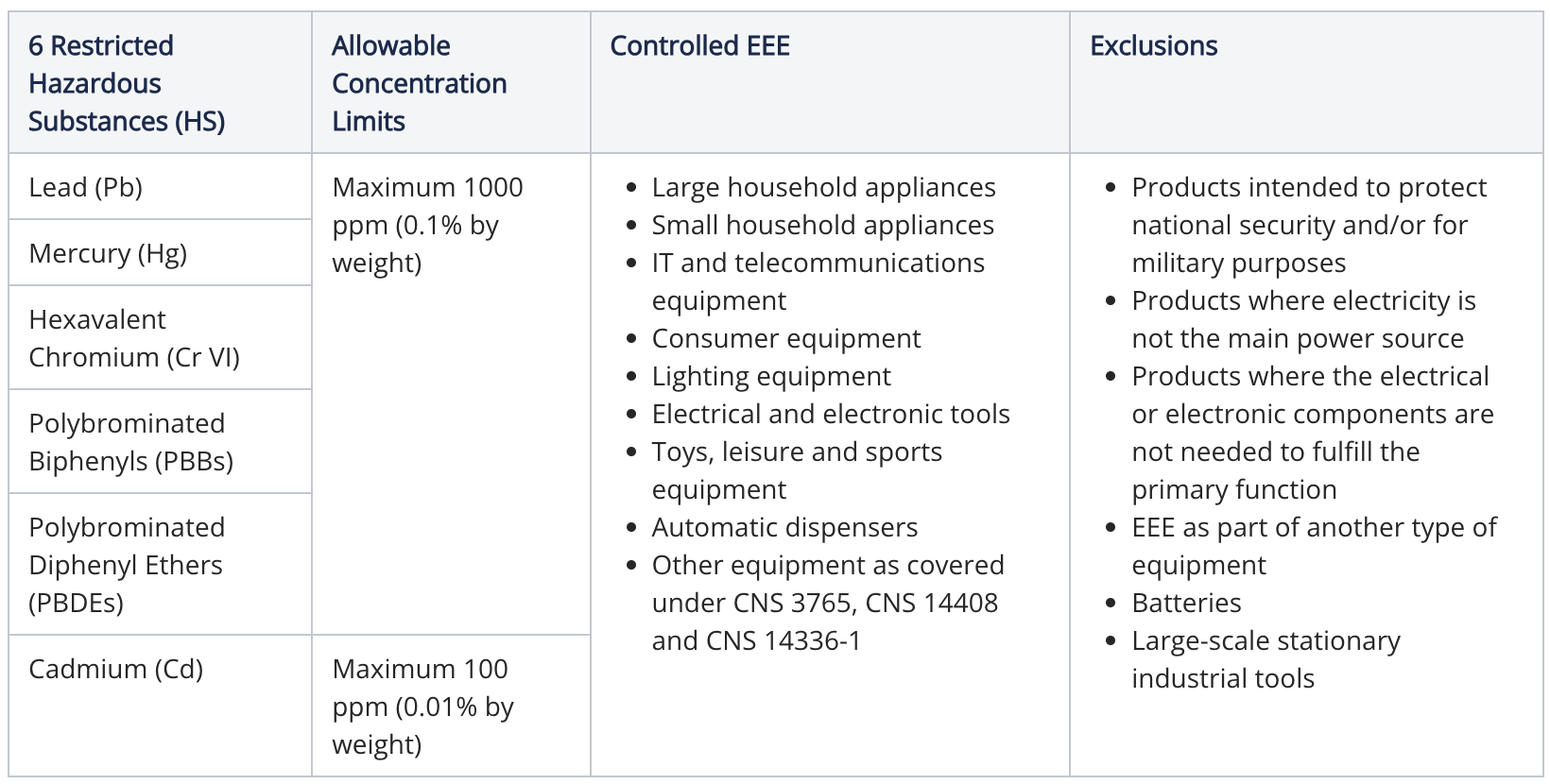
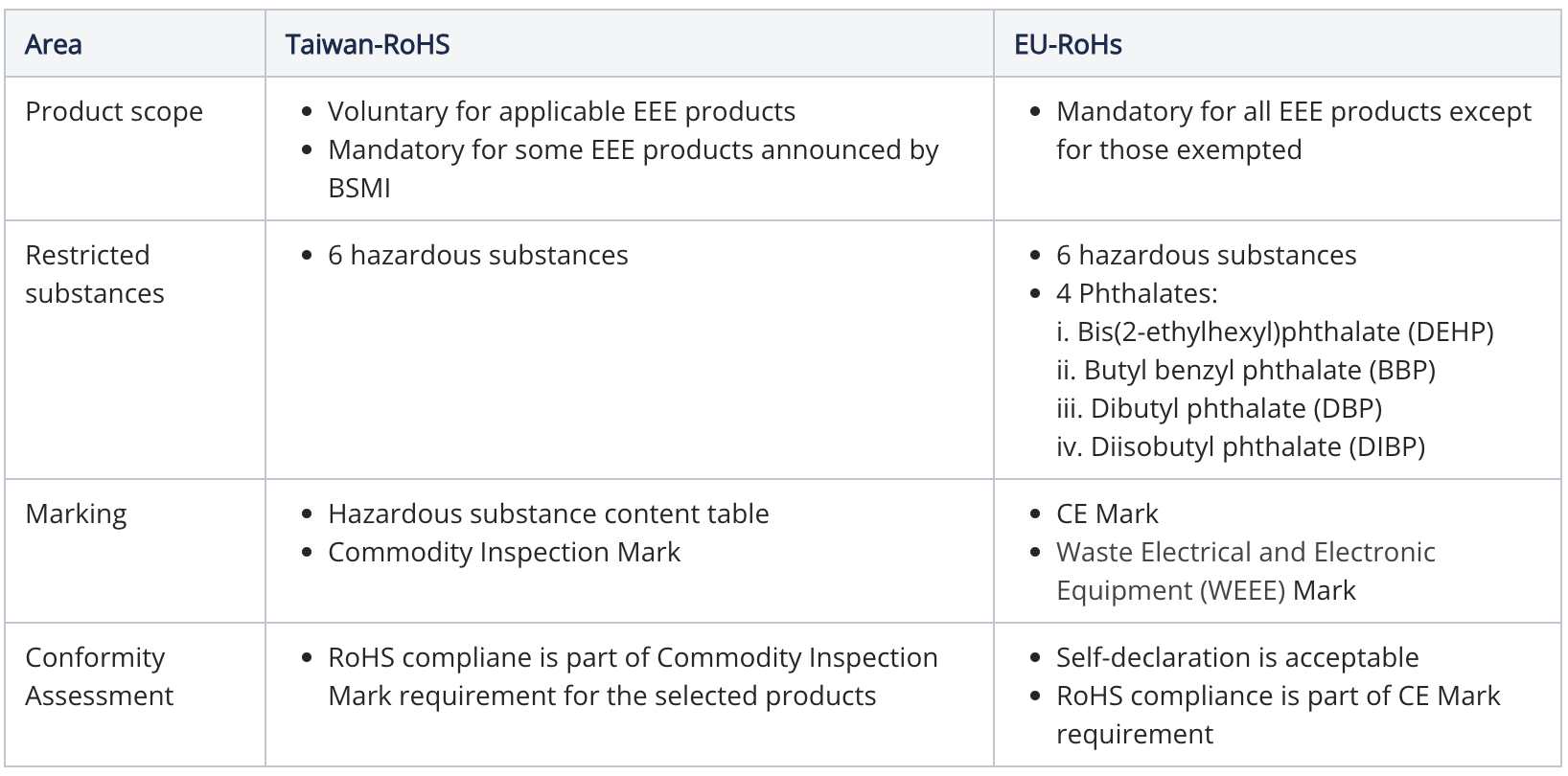
¶ Restriction of Hazardous Substances (RoHS)On July 1, 2017, Restriction of Hazardous Substances (RoHS) was enforced by Bureau of Standards, Metrology and Inspection (BSMI) based on the standard, CNS 15663: Guidance to Reduction of the Restricted Chemical Substances in Electrical and Electronic Equipments (EEE) Section 5. CNS 15663 was published as a voluntary standard, which sets the scope of EEE products affected, the concentration limits of 6 hazardous substances and the way of marking the presence of hazardous substances in the EEE products. Due to its similarity with the EU-RoHS, it is also known as Taiwan RoHS. The evaluation of CNS 15663 compliance is only compulsory for certain EEE products subjected to mandatory inspection under the Commodity Inspection Act, and announced by BSMI. 
|
Sources The following sources are available for online preview and purchase:
Resources
*Not available in English |
¶ SDS + Label |
|
|
All Taiwanese standards are available from https://www.cnsonline.com.tw/ For non-local companies, the standards can be purchased with a credit card. Buyers shall first purchase card points through the Hi Net website. The transactions shall be done through the card points. A brief guidance to purchase the standards is given:
For further enquiries regarding Hi Net purchase, please contact the customer service: +886-0800-080-412. For questions regarding the National Standards, please contact the CNS online: +886-2-23414772 or +886-2-23431994. |
|
¶ ClassificationThe Rules on Labeling and Hazard Communication of Dangerous and Harmful Materials was enacted on October 19, 2007. On June 27, 2014, the Taiwan Ministry of Labor (MOL) amended the rule through MOL Document No. 10302007861, and renamed it the Regulations for the Labeling and Hazard Communication of Hazardous Chemicals. The regulation was enacted in accordance with Article 10, Paragraph 3 of the Occupational Safety and Health (OSH) Act and has been in effect since July 3, 2014. It is consistent with the GHS and is administered by the Ministry of Labor. For mixtures of hazardous materials, hazard labels and Safety Data Sheets must be based on the hazardous properties after mixing. The hazard assessment must be based on the test results of the mixture. Where there has not been testing, the health hazard category must follow the mixture classification standards as specified in the Taiwan National Standards 15030. Information on Classification and labeling of hazardous chemicals can be found in Attachment 1. The regulation was most recently revised on August 26, 2026 through MOL Document No. 1150253048A to align with GHS Rev. 8 and CNS 15030 revisions. The major changes can be summarized as follows: 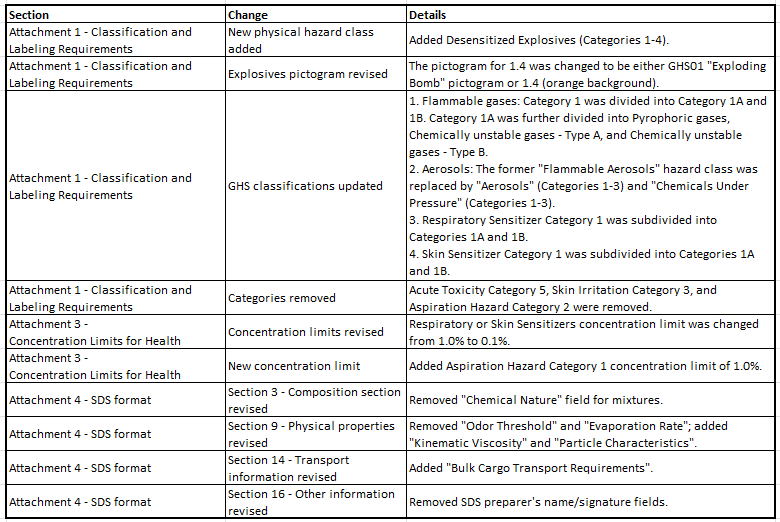
The provisions of these rules do not apply to:
¶ |
Sources
|
¶ ClassificationIn order to adopt the Globally Harmonized System of Classification and Labelling of Chemicals (GHS), Taiwan's Bureau of Standards, Metrology and Inspection (BSMI), the Ministry of Economic Affairs established the Taiwan National Standards, CNS 15030 Z1051 Chemical Classification and Labelling. The standards were originally published on October 12, 2006 and have been revised several times to align them with different revisions of the United Nations GHS Purple Book:
Taiwan has adopted all 29 GHS hazard classes under GHS Revision 8 in CNS 15030. Z1051-Classification and labelling of chemicals − General rules Where test data is not available for a mixture, for health and environmental endpoints, the GHS allows for classification based on the hazards of the substances in the mixture. The GHS usually defines the concentration at which a hazardous substance causes a mixture containing that substance to be classified, for most hazards. These are known as Concentration limits / Cut-off values. Countries must additionally set the thresholds for mixture classification for certain hazards:
Taiwan published concentration limits / cut-off values in CNS 15030 Z1051; however, they did not specify which of the values provided for the above hazards as options by the GHS should be used. List of substance classifications In conformance with CNS 15030, to lower industries burden in GHS implementation, particularly for small or medium enterprises, the Occupational Safety and Health Administration administered by Ministry of Labor has issued sample Labels and Safety Data Sheets (SDS) for public reference. Due to the limitation of manpower and costs, information for a significant amount of hazardous substances cannot be completely compiled in a very short period of time. Therefore, instead of SDSs, Taiwan's Ministry of Labor (MOL) published a list of 6,000 hazardous substances with recommended GHS classifications on January 5, 2016, followed by a list of 3000 hazardous substances on March 7, 2017. |
Sources
Note: Registration may be required to read the SDS documents. Substances are searchable by Chinese Chemical Names, English Chemical Names, CAS Numbers or UN Numbers. Resources
*Not available in English |
¶ Toxic and Concerned Chemical SubstancesThe Measures on the Management of Toxic Chemical Substances Labelling and Safety Data Sheets were enacted on December 17, 2007, in accordance with the Toxic Chemical Substances Control Act (TCSCA). The TCSCA and its corresponding regulation, required SDSs and Labels for toxic substances before the GHS implementation was in fully place. The format of the SDS required by TCSCA has been harmonized with that described in the Regulations for the Labeling and Hazard Communication of Hazardous Chemicals on December 8, 2014. The amendment was enacted in accordance to the Article 12 of the Measures on the Management of Toxic Chemical Substances Labelling and Safety Data Sheets, and it has been effective since December 11, 2014. For the purpose of the GHS, the technical terms in the regulations were modified to be consistent with those used in the Purple Book, as below: 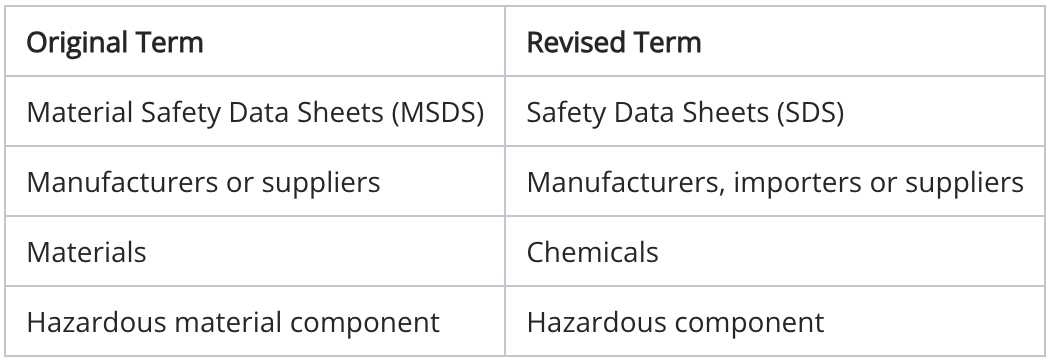 Since the Toxic Chemical Substances Control Act (TCSCA) was amended and renamed Toxic and Concerned Chemical Substances Control Act (TCCSCA) on January 16, 2019, the Measures on the Management of Toxic Chemical Substances Labelling and Safety Data Sheets was amended and renamed Regulations for the Labeling and Safety Data Sheets for Toxic and Concerned Chemical Substances on January 13, 2020 to incorporate the requirements for concerned chemical substances. Taiwan’s Environmental Protection Administration (EPA) published an amendment to the Regulations for Labeling and Safety Data Sheets for Toxic and Concerned Chemical Substances on November 4, 2022. The amendment refers to the EU Regulation on Classification, Labelling and Packaging of Substances and Mixtures (CLP Regulation), and adopts the minimum dimensions for the label. The label should contain the hazard information clearly, but its size should not be smaller than the minimum dimensions shown below. 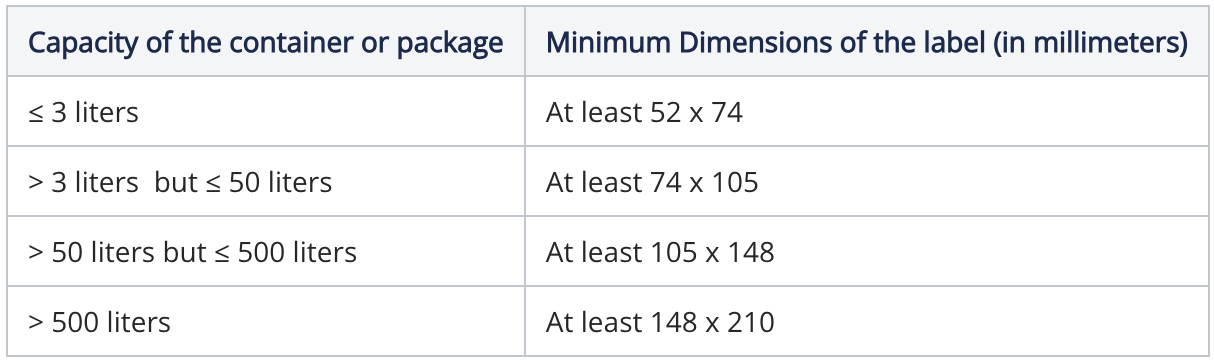 Due to the size, shape, or material used of the container or package, folding labels or hanging labels can be used. In this case, the size of the label is not restricted by the above minimum dimension requirements. When the concentration of the toxic or concerned chemical substance is at or above the cut-off concentration determined by the National Standard CNS15030, the following information should be disclosed on the label: However, if the concentration of the toxic or concerned chemical substance is less than the cut-off concentration, the pictograms, signal word, hazard and precautionary statements can be omitted from labelling. When the toxic or concerned chemical substances are a mixture, the hazardous ingredients should be listed on the SDS and label. In addition, Guidelines on Regulated Toxic Chemical Substances and the Management of Their Handling and Categories and Management of Handling for Concerned Chemical Substances have special requirements on warnings or other supplementary information for the toxic and concerned chemical substances. For example, Nitrous oxide is regulated as a concerned chemical substance and it has a special warning as "restricted to industrial use, no smoking". The label for Nitrous oxide should contain this special warning.
|
Sources
|
¶ SDSThe Safety Data Sheet (SDS) is prescribed by a combination of the EPA's Regulations for the Labeling and Safety Data Sheets for Toxic and Concerned Chemical Substances and the MOL's Regulations for the Labeling and Hazard Communication of Hazardous Chemicals, which have been harmonized. The requirements for sections and subsections are translated and summarized here. The Rules on Labeling and Hazard Communication of Dangerous and Harmful Materials was enacted on October 19, 2007. On June 27, 2014, the Taiwan Ministry of Labor (MOL) amended the rule through MOL Document No. 10302007861 and renamed it the Regulations for the Labeling and Hazard Communication of Hazardous Chemicals. This amended regulation is consistent with the GHS and is administered by the Ministry of Labor. The Regulations for the Labeling and Hazard Communication of Hazardous Chemicals was most recently revised on August 26, 2026, through MOL Document No. 1150253048A. In this revision, Attachment 4, which specifies the SDS content and format, was amended. Traditional Chinese language is mandatory for these documents. Foreign languages can be used to supplement if necessary. Safety Data Sheets must be issued when any hazardous material is present at a concentration greater than the value specified in the concentration table of Attachment 3 of the Regulations for the Labeling and Hazard Communication of Hazardous Chemicals. The format and required items for an SDS are provided by Attachment 4 of the Regulations for the Labeling and Hazard Communication of Hazardous Chemicals. Following the amendment of the Measures on the Management of Toxic Chemical Substances Labelling and Safety Data Sheets, Taiwan harmonized the format of the SDS with that described in the Regulations for the Labeling and Hazard Communication of Hazardous Chemicals on December 8, 2014. The amendment was enacted in accordance to the Article 12 of the Measures on the Management of Toxic Chemical Substances Labelling and Safety Data Sheets, and it has been effective since December 11, 2014. Since the Toxic Chemical Substances Control Act (TCSCA) was amended and renamed Toxic and Concerned Chemical Substances Control Act (TCCSCA) on January 16, 2019, the Measures on the Management of Toxic Chemical Substances Labelling and Safety Data Sheets was amended and renamed Regulations for the Labeling and Safety Data Sheets for Toxic and Concerned Chemical Substances on January 13, 2020 to incorporate the requirements for concerned chemical substances. More details can be found in the Classification section. Manufacturers, importers, suppliers, or employers shall check the accuracy of an SDS based on the actual circumstances and update it as needed. An SDS shall be reviewed at least once every three years. Records of revision, such as content, date, and version of the SDS shall be kept for 3 years. The provisions of these rules do not apply to:
|
Sources
*Not available in English |
¶ Sections of the Safety Data Sheet |
|
¶ LabelIn Taiwan, dangerous and harmful chemical substances are governed by the Ministry of Labor (MOL), while toxic and concerned chemical substances are governed by the Environmental Protection Administration (EPA). Both Regulations for the Labeling and Hazard Communication of Hazardous Chemicals and Regulations for the Labeling and Safety Data Sheets for Toxic and Concerned Chemical Substances require that the following information must be included on labelling:
Toxic and concerned chemical substances have more specific labeling requirements. Regulations for the Labeling and Safety Data Sheets for Toxic and Concerned Chemical Substances requires that all toxic or concerned chemical substances exceeding the control concentration shall be labeled with the Chinese and English names announced by EPA with their CAS numbers. In addition, the phrase "toxic or concerned chemical substances" and the weight percentages of the toxic or concerned chemical substances contained in the product shall be stated on the label. More details can be found on the Classification page. Information on classification and labeling of dangerous and hazardous chemicals, and a reference format for labeling can be found in Attachments 1 and 2 of Regulations for the Labeling and Hazard Communication of Hazardous Chemicals, respectively. The requirement of label size is not specified in either regulation. There is a small packaging exemption: containers or packaging of dangerous or harmful chemical substances, or toxic or concerned chemical substances with quantities <=100 mL may identify the name, hazard symbol and signal word only on the label. Traditional Chinese language is mandatory for these documents. Foreign languages can be used to supplement if necessary. The provisions of these rules do not apply to:
|
Labelling requirements specific to cosmetics may be found on the cosmetics page. Sources |
¶ Agro-pesticide LabelThe Agro-pesticides Labeling Management Regulation was promulgated by the Council of Agriculture (COA) on December 15, 2003, as required by Article 14-2 of the Agro-pesticides Management Act. On August 5, 2019, Taiwan's Executive Yuan Gazette Online published the amendment of the Agro-pesticides Labeling Management Regulation, which was made by the COA Order No. 1081489093. With the full implementation of the Globally Harmonized System of Classification and Labeling of Chemicals (GHS) in Taiwan since January 1, 2017, the regulation has been amended to strengthen the pesticide labeling management and comply with the international norms, and to provide users with clearer operating guidelines and precautions for hazard prevention. Definitions According to the Agro-pesticides Management Act, Agro-pesticide denotes formulated agro-pesticides and technical grade agro-pesticides. Formulated agro-pesticides are defined as the chemicals or biologically-based formulations listed below: Technical grade pesticides are defined as raw materials of active ingredients for manufacturing of formulated agro-pesticides. However, if the technical grade pesticide is directly used for the purpose(s) listed above, it is deemed a formulated agro-pesticide.
¶ Application for the Use or Change of LabelingThe manufacturer or importer of a pesticide needs to submit an application for the use of pesticide labeling or the change of labeling. Two samples of the pesticide label should be submitted together with the application form. The samples should be generated by the operation system producing labels, which is established by the COA. The regulation requires manufacturers or importers to replace the label with its alteration. Correcting information by using stickers or by affixing both new and original labels on the package is not allowed. 
|
Sources
Resources
*Not available in English |
¶ Trade SecretsThe Rules on Labeling and Hazard Communication of Dangerous and Harmful Materials was enacted on October 19, 2007. On June 27, 2014, the Taiwan Ministry of Labor (MOL) amended the rule through MOL Document No. 10302007861 and renamed it Regulations for the Labeling and Hazard Communication of Hazardous Chemicals. The regulation was enacted in accordance with Article 10, Paragraph 3 of the Occupational Safety and Health (OSH) Act and has been in effect since July 3, 2014. The regulation was most recently revised on August 26, 2026, through MOL Document No. 1150253048A. Currently, Articles 18 and 18-1 are related to data protection in an SDS. The information required to file for data protection in SDS includes:
The substances with the following classifications according to CNS 15030 are not eligible for data protection:
Additionally, a chemical substance with a published occupational exposure limit is not eligible for data protection either. Starting from September 1, 2016, Taiwan MOL accepts application for data protection in SDSs and labels through an online platform. Once approved by MOL, the following data are protected in SDSs and Labels:
|
Sources
Resources
|
¶ Occupational Exposure LimitsThe Standards of Permissible Exposure Concentrations of Airborne Hazardous Substances in Workplaces were issued by the Ministry of the Interior on August 7, 1974, and were renamed the Standards of Permissible Exposure Limits at Job Sites in 2014. The standards have been amended periodically to reflect the latest requirements for managing and controlling occupational exposure to hazardous substances. Employers shall ensure that the concentration of hazardous substances in workplace air does not exceed the limits specified in Appendix 1 or Appendix 2 of the regulation. Workplace exposure to hazardous air contaminants should comply with the following requirements:
This regulation shall apply to Section 8 of SDSs, Exposure Prevention Measures. To align with the implementation of Chemical Control Banding (CCB), Taiwan published the Technical Guidance on Exposure Assessment and Control Banding of Hazardous Chemicals on December 2, 2015 through Order No. 10402003261. The guidance is enacted in accordance with Article 7 of the Regulation on Exposure Assessment and Control Banding of Hazardous Chemicals, under the Occupational Safety and Health (OSH) Act. Provisions stipulated by the following regulations shall take precedence over the Technical Guidance document to manage risk and reduce exposure to hazardous chemicals. If the risks are not mitigated according to the stipulations provided by the following regulations, then the Regulation on Exposure Assessment and Control Banding of Hazardous Chemicals shall be applied.
Employers who manufacture, handle or use chemicals which possess health hazards according to the criteria found in the Taiwan National Standards, CNS 15030 Classification and Labelling of Chemicals, are obligated to perform exposure assessment, categorize the risk levels and take corresponding control banding approaches. This shall be done at least once every three years. For circumstances occurring as a result of changes of chemicals, the handling procedures or the conditions in manufacturing processes, exposure assessment shall be done within three months after the changes. Enterprises who are engaged in special health hazard activities with more than 100 workers, or have a total of more than 500 workers and handling chemical substances with Permissible Exposure Limits (PELs), shall perform exposure assessment in accordance to the methods designated by the MOL, i.e., Sampling analysis method, Direct-reading instruments, Quantitative predictive models such as the Zero ventilation model, Saturation vapor pressure model, Box model, Well-mixed room model, Two-zone model, Turbulent eddy diffusion model and Statistical model etc. can be used. The results of assessment are categorized into three levels:
Exposure assessment shall be done once every three years for level 1, once every year for level 2 and once every three months for level 3. Controls and risk management shall be done based on risk levels.
Employers shall document all assessment and control measures taken and keep the record for at least three years. Premises using two or more chemicals or mixtures with health hazards shall perform risk assessments for each chemical or mixtures. The risk management shall be based on the results from the assessment with the highest risk level. The Regulation and its Guidance do not apply to manufacturing, handling or usage of the following:
|
Sources
Resources
*Not available in English |
¶ Transport |
|
| The Ministry of Transport is responsible for the Road Traffic Safety Rules. Appendix 8 of the Rules regulates the signs and nameplate content for dangerous goods. The Environmental Protection Administration governs the Toxic and Concerned Chemical Substances Transportation Management Regulations, which specify the special requirements for the transportation of toxic or concerned chemical substances within Taiwan. |
Sources
Resources *Not available in English |