¶ Recent Updates2025
¶ Background |
|
|
Thailand is located in Southeast Asia, bordered by Cambodia, Malaysia, Myanmar (Burma) and Laos. It is a constitutional monarchy. The control of chemicals in Thailand is mainly through the Hazardous Substance Act, Buddhist Era (B.E.) 2535 (1992). This act has been amended thrice (2001, 2008 and 2019). Based on this Act, Thailand adopted the UN GHS Revision 3, on February 1, 2012, through the Notification of the Ministry of Industry Concerning Hazard Classification and Communication System of Hazardous Substances B.E. 2555 (2012). The following authorities are responsible for the control of hazardous substances to be in compliance with the Hazardous Substance Act in Thailand :
Each of the above government agencies has the right to publish regulations regarding the control of hazardous substances in Thailand. Thailand publishes the official gazette through the website: http://www.ratchakitcha.soc.go.th/RKJ/index/index.htm
|
|
¶ Inventories |
|
|
Currently, there exists two versions of the Thailand Existing Chemicals Inventories: one which was issued by the Department of Industrial Works (DIW) and another by the Food and Drug Administration (FDA). The DIW has released a preliminary existing chemicals inventory which is now available on the Hazardous Substances Management Division (HSMD)’s official website. Chemicals present in the preliminary inventory can be searched by their CAS numbers or trade names. The DIW has combined the following sources to make its version of the Existing Chemicals Inventory:
The FDA, as a secretariat of the National Committee on Strategy Development for Chemical Management, published its version of the inventory known as, "Thailand Existing Chemical Inventory (TECI)". This version contains approximately 7200 single substances manufactured or imported into Thailand in B.E. 2555 (2012), as reported by various government agencies such as the Customs Department, the Department of Agriculture, the Department of Fishery, and the Industrial Estate Authority of Thailand. Each substance is assigned an identification number (TECI number). In addition, TECI contains information such as common and IUPAC names in English, substance name in Thai, Harmonized System (HS) code, regulatory control for certain chemicals, and production and/ or import quantity in 2012. The difference between the inventories is their source of data. Furthermore, as neither the FDA nor the DIW has set requirements or procedures pertinent to non-inventory listed substances, both versions serve as informative database; both have no associated legal obligations, and neither takes precedence over the other. Consequently, substances not found in both inventories can continue to be imported into Thailand. Readers should consult Registration sections for more information. |
Sources
Resources
*Not available in English |
¶ Substance Registration |
|
|
Thailand's Hazardous Substance Act was first enacted in 1992 and last amended on April 30, 2019. The Hazardous Substance Act (4th Issue), B.E. 2562 (2019) amended:
The List of Hazardous Substances identifies the types of hazardous substances and their respective responsible agencies. Each responsible government agency publishes its ministerial regulation to provide restrictions on the hazardous substances. The List of Hazardous Substances was last amended on July 7, 2025 by Notification of the Ministry of Industry (MOI) Regarding the List of Hazardous Substances (No. 8) B.E. 2568 (2025). A consolidated list of hazardous substance was published to replace the following:
The manufacture, import, export, or possession for professional use of certain hazardous substances, or mixtures which contain certain hazardous substances may require a permit, contingent upon its hazard type, from the government agency that is responsible for that particular hazardous substance. The Notification of the MOI Regarding the List of Hazardous Substances, B.E. 2556 (2013) and its amendments, the Notification of the MOI Regarding the List of Hazardous Substances (No. 2) B.E. 2558 (2015), the List of Hazardous Substances (No. 3) B.E. 2559 (2016) and the List of Hazardous Substances (No. 4) B.E. 2561 (2018), set out these substances. The Act establishes prohibitions and regulations for four types of hazardous substances, classified according to their control requirements as follows:
In addition to these broad regulations, the MOI may impose Ministerial Orders on Hazardous Substances. The MOI has also authorized other Departments with the enforcement of portions of the Hazardous Substances Act. For example, the Department of Agriculture (DOA) enforces the Hazardous Substances Act for certain pesticides. The registration requirements are established by different Ministers through their notifications.
¶ Draft Chemical ActReaders should note that the Thai government has issued a draft of new chemical control and management scheme called "Chemical Act" which will repeal and replace the aforementioned Hazardous Substance Act. If promulgated, a notable change is the revision of the chemical classification system. Under Chemical Act, chemicals present in the country's inventory will be assigned 3 distinct lists:
Another significant change is what must be registered. Currently, only Type 2 and 3 Hazardous Substances must be registered with competent authorities. However, under Chemical Act, all substances must be registered. Moreover, enterprises that wish to manufacture, import or transit new substances (those not present in the chemical inventory) must submit a request to evaluate to competent authorities prior to commencing the activities. |
Sources
*Not available in English |
¶ Ministry of Industry (MOI)Substances Registration The Notification of the MOI regarding Registration, Issuance and Renewal of Documents Pertaining to Registration of Hazardous Substances under the Responsibility of the Department of Industrial Works (DIW) B.E. 2552, issued pursuant to the Hazardous Substance Act B.E. 2535, requires manufacturers and importers of Type 2 and Type 3 hazardous substances to submit: 1) A copy of the application form, วอ./อก. 1 (Wor Or./ Or Gor. 1) 2) A safety data sheet 3) Specifications of hazardous substances 4) A document or photograph of containers of hazardous substances 5) A document or photograph of packaging of hazardous substances (if applicable) 6) A letter of authorization (if applicable) 7) A copy of identification card 8) A copy of certification of registration as a legal entity 9) A copy of VAT registration (ภ.พ. 20) (Por.Por. 20) If approved, competent authority will issue form วอ./อก. 2 (Wor Or./ Or Gor. 2) to the applicant, which is valid for 6 calendar years. In addition, importers and those having in possession of Type 2 and Type 3 hazardous substances under one kilogram and intend to use the substances for research and development are exempted from such requirements. Quantity Report The Notification of The MOI regarding Providing Facts of the producer, importer, exporter, or person possessing Hazardous Substances under the Responsibility of the Department of Industrial Works (DIW) (No.2) B.E. 2563, issued pursuant to the Hazardous Substance Act B.E. 2535, requires producers, importers, exporters, or possessors of hazardous substances in the quantity of one hundred kilograms or more, between January and June or between July and December to submit a report on the actual quantity of hazardous substances that are produced, imported, exported, or possessed to the authorities. A copy of the report forms;
Details of the facts about the hazardous substance to be reported include: Formula and ratio, trade name, common name or abbreviation (if any), type 2 hazardous substance processing receipt number or license number. and registration certificate number (if any), quantity produced, imported, exported or possessed, quantity sold, used or distributed, name, purchaser's identification number, use and purpose of use of these hazardous substances. Annex 5.6 report Notification of the MOI regarding Providing Facts of the Production or Import of hazardous substances according to list 5.6 Hazardous Substances under the Responsibility of the Department of Industrial Works (DIW) 2565 (2022) by virtue of the third paragraph of Section 5 of the Hazardous Substance Act B.E. 2535, amended by the Hazardous Substance Act (No. 4) B.E. 2562. A copy of the report forms;
|
Sources
*Not available in English |
¶ Ministry of Agriculture and Cooperatives (MOAC)The MOAC oversees three government agencies, namely the Department of Agriculture (DOA), the Department of Fisheries (DOF), and the Department of Livestock Development (DOLD). Each department is responsible for a set of hazardous substances:
These lists are annexed to the Notification of the MOI Concerning the List of Hazardous Substances and its amendments. Furthermore, each department sets its own criteria and necessary documents with regards to business activities, such as production or importation. |
|
¶ DOAThe Notification of the MOAC regarding Registration, Issuance and Renewal of Documents Pertaining to Registration of Hazardous Substances under the DOA B.E. 2551 sets out the registration requirements of hazardous substances under the DOA. Importers and manufacturers of Type 2 and Type 3 hazardous substances overseen by the DOA must submit form วอ./ กษ./ กวก. 1 (Wor Or./ Gor Sor./ Gor Wor Gor. 1) and supporting dossier which includes: 1) A copy of identification card 2) A copy of certification of registration as a legal entity 3) A letter of authorisation (if applicable) 4) 6 copies of experimental design on efficacy and toxic residuals 5) A document or photograph of packaging or containers of hazardous substances 6) An example of label and leaflet 7) Analysis results of hazardous substances Upon approval, form วอ./ กษ./ กวก. 2 (Wor Or./ Gor Sor./ Gor Wor Gor. 2) will be issued to the applicants. It is valid for 6 years from the date of its issuance. |
Sources
*Not available in English |
¶ DOFThe Notification of the MOAC regarding Registration, Issuance and Renewal of Documents Pertaining to Registration of Hazardous Substances under the DOF B.E. 2551 sets out necessary documents for registering Type 2 and Type 3 hazardous substances. Manufacturers and importers of these types of hazardous substances must submit form วอ./ กษ./ กปม. 1 (Wor Or./ Gor Sor./ Gor Por Mor. 1) and supporting documents below: 1) A copy of identification card 2) A copy of certification of registration as a legal entity 3) A letter of authorisation (if applicable) 4) Experimental design on efficiency and toxic residuals 5) Documents or photographs of packaging or containers of hazardous substances 6) An example of label and leaflet 7) Analysis results of hazardous substances If approved, applicants will receive form วอ./ กษ./ กปม. 2 (Wor Or./ Gor Sor./ Gor Por Mor. 2) which is valid for 6 years from the date of it is issued. |
Sources *Not available in English |
¶ DOLDThe Notification of the MOAC regarding Registration, Issuance and Renewal of Documents Pertaining to Registration of Hazardous Substances under the DOLD B.E. 2551 includes application form วอ./ กษ./ กปศ. 1 (Wor Or./ Gor Sor./ Gor Por Sor. 1) which importers and manufacturers of Type 2 and Type 3 hazardous substances must submit. Furthermore, applicants must also submit the following supporting documents: 1) 2 copies of hazardous substances label and leaflets (if applicable) 2) 2 copies of certification of registration as a legal entity/ identification card/ commercial registration in the case of individuals (if applicable) 3) 2 copies of letter of authorisation (if applicable) Competent autoriseer will issue form วอ./ กษ./ กปศ. 2 (Wor Or./ Gor Sor./ Gor Por Sor. 2) upon approval. This form is valid for 6 years after its issuance. Possessors of Type 2 and Type 3 Hazardous Substances used for livestock-related purposes under the authority of the DOLD are exempted from notifying or obtaining a permit from the agency, respectively, if possession of such hazardous substances do not exceed 10 metric tons per annum in animal farms and animal feed manufacturing facilities or 50 metric tons per annum in abattoirs and animal processing plants. Possessors of hazardous substances in finished-product form intended for sale are not exempted from the requirements. |
Sources
*Not available in English |
¶ Ministry of Public Health (MOPH)Registration of Type 2 and Type 3 hazardous substances with the MOPH is regulated through the Notification of the MOPH regarding Registration, Issuance and Renewal of Documents Pertaining to Registration of Hazardous Substances under the Responsibility the Food and Drug Administration (FDA) B.E. 2552. Manufacturers and importers of such hazard substances must submit: 1) A copy of the application form วอ./สธ. 1 (Wor Or./ Sor Tor. 1) 2) 2 copies of safety data sheet (4 copies for new substances) 3) 2 copies of hazardous substances labels and leaflets (if applicable) 4) 2 copies of certification of registration as a legal entity/ or identification cards and copies of commercial registration in the case of individuals (if applicable) 5) 2 copies of letter of authorisation If approved, form วอ./สธ. 2 (Wor Or./ Sor Tor. 2) will be issued to the applicant. This form is valid for 6 calendar years. |
Sources
Resources *Not available in English |
¶ Product Registration |
|
¶ Pesticides¶ Non-Household and Non-Public Health UseThe Office of Agricultural Protection, Department of Agriculture (DOA), is responsible for regulating the hazardous substance(s)-containing pesticides for non-household and non-public health use to meet quality and safety standards by the empowerment of the Hazardous Substance Act B.E. 2535 (1992). The primary steps to determine if a pesticide must be registered are to check whether the product's active ingredients match any of the hazardous substances, or hazardous chemical groups, under the responsibility of the DOA, or whether its use corresponds to the conditions specified in List 1 annexed to Notification of Ministry of Industry (MOI) Concerning List of Hazardous Substances B.E. 2556 (2013), and its amendments. Manufacturers and importers of pesticides containing Type 2 or Type 3 hazardous substances must submit form วอ./กษ./กวก. ๑ (Wor Or /Gor Sor/ Gor Wor Gor 1), annexed to the Notification of the Ministry of Agriculture and Cooperatives (MOAC), and required documents to obtain a product registration certificate prior to proceeding with any business activity. The registration process consists of 3 registration phases:
Each registration phase has a different set of required documents and supporting data, which are detailed in the Notification of the DOA regarding the Determination on Details, Criteria and Methods for Registration of Hazardous Substances under the DOA and its amendments. Data requirements for Trials Clearance Phase
Data requirements Provisional Clearance Phase
Data requirements Full Registration Phase
Moreover, the DOA requires additional information submission for microbial and botanical pesticides registrations. Data requirements Microbial and Botanical Pesticides Registration
Should applications be denied, applicants have 180 days from the date of being notified by the DOA to amend or submit additional documents. Should applications be rejected again, applicants have 180 days to fulfill their requirements from the date of being notified. Corrections and resubmission of applications are allowed no more than 2 times. The validity of certificate of registration is 6 years after the date of issuance. Applicants who wish to renew their registration certificate must submit form วอ./กษ./กวก. 3 (Wor Or./Gor Sor./Gor Wor Sor. 3), annexed to the Notification of the MOAC, 180 days before the expiration of their certificates. The Notification of the DOA (No. 11), published in the National Gazette on June 12, 2018, amends Article 20 in which business enterprises that wish to renew registration certificates of hazardous substances/ mixtures under Trade Name 2 and 3 are exempt from submitting certain required documents such as efficacy test report and residual toxicity report. The exemption only applies if such hazardous substances/ mixtures are manufactured from the same source as that of hazardous substances/ mixtures under Trade name 1 and whose expiration dates are within 1 year of that of Trade Name 1. The new certification is valid 6 years from its date of issuance. |
Sources
*Not available in English |
¶ Household and Public Health UseThe Hazardous Substances Control Group, Bureau of Cosmetics and Hazardous Substances Control, Food and Drug Administration (FDA), is responsible for regulating the hazardous substance(s)-containing pesticides for household and public health use to meet quality and safety standards by the empowerment of the Hazardous Substance Act B.E. 2535 (1992). The primary steps to determine if a pesticide must be registered are to check whether the product's active ingredients match any of the hazardous substances, or hazardous chemical groups, under the responsibility of the FDA or whether its use corresponds to the conditions specified in List 4 annexed to Notification of Ministry of Industry (MOI) Concerning List of Hazardous Substances B.E. 2556 (2013) and its amendments. Manufacturers or importers of pesticides containing Type 1 hazardous substances must notify the authority of the product information by submitting an application and the required documents stated in the form, namely
In the case of manufacturing, the information must be notified to the authority within 15 days from the first production date. Only the first import must be notified to the authority before clearing shipment at customs. Furthermore, if the manufacturing or storage sites of Type 1 pesticides are located in Bangkok, the manufacturers and the importers must notify the FDA office. If the sites are located in other provinces, the manufacturers or the importers must notify the provincial public health offices where the sites are located. Export and possession for professional use of Type 1 pesticides are not required to notify the authority. In the case of a change of hazardous substance(s), the importer or producer must notify the difference within 30 days of the change to Food and Drug Administration (FDA) In case the operator has a place of production or storage in Bangkok or the Provincial Public Health Office In the event that the entrepreneur has a place of production or storage in that province by submitting an application and the required documents stated in the form, namely
Manufacturers or importers of pesticides containing Type 2 or Type 3 hazardous substances must obtain a registration certificate prior to proceeding with further actions, such as notifying the authority for manufacturing or import of Type 2 pesticides or obtaining a license of manufacturing or import of Type 3 pesticides. Applicants must submit form วอ./สธ 1 (Wor Or /Sor Tor 1) and required documents in order to obtain the registration certificate. Please refer to Substance Registration under MOPH for details. In addition to the aforementioned requirements, certain products, such as insecticides and disinfectants, that contain hazardous substances under the authority of the FDA must undergo quantitative analysis of the important substances annexed to to the Notification of the FDA regarding Documents and Evidence for Registration of Hazardous Substances B.E. 2560. Should submitted documents be rejected, applicants have 30 days and 20 days to correct or resubmit additional documents for the 1st and 2nd corrections or resubmissions, respectively. Failures to meet these deadlines will result in recommencing of the registration procedure. The application fee is 2,000 Baht and a registration certificate is valid for 6 years after its issuance. Pesticides that contain Type 4 hazardous substance(s) are banned from all activities in Thailand. Fees The application fees for different types of licenses are summarized in the table below: 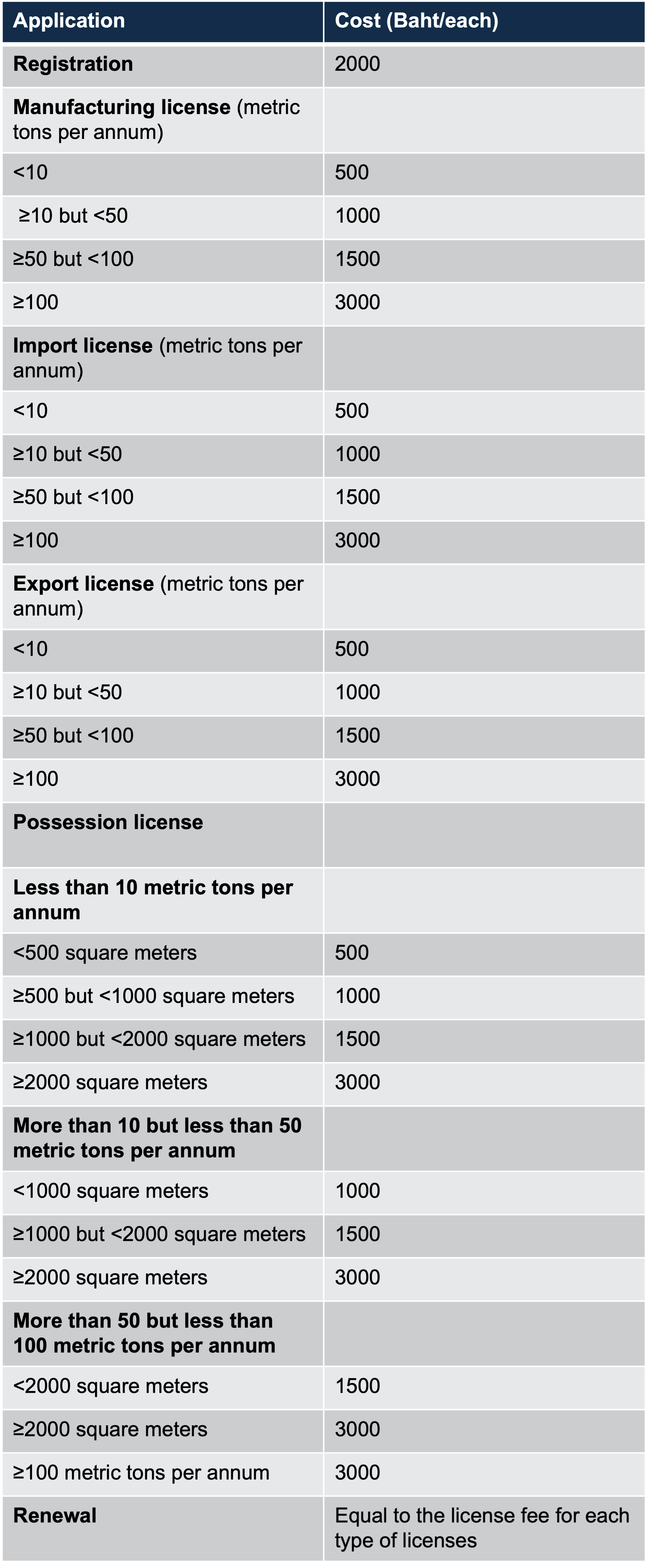 |
Sources
*Not available in English |
¶ Notifications |
|
| Information related to pesticides notification may be found with the related product registration details. | |
¶ Restrictions and Bans |
|
¶ Ozone Depleting SubstancesThailand ratified the Montreal Protocol on ozone-depleting substances on July 7, 1989. Currently, there is no specific legislation on ozone-depleting substances in Thailand. However, the country employs Hazardous Substance Act B.E. 2535 (1992) and its amendments as legal means in controlling and managing these substances. Under this act, Thailand establishes a list of hazardous substances and regulates them according to their hazard severity from Type 1 to Type 4: Type 1 hazardous substances are subjected to least control, and Type 4 hazardous substances are subjected to the most stringent control and are prohibited from production, import, export or possession. More information can be found in Hazardous Substance Act. Ozone-depleting substances, namely certain Chlorofluorocarbons (CFCs) and Hydrofluorocarbons (HCFCs), are found in Annex 5.1 of the List of Hazardous Substances which is overseen by the Department of Industrial Works. The substances are categorized as Type 3 hazardous substances. Consequently, they require registration and permits for business-related activities. |
Sources
*Not available in English |
¶ Persistent Organic Pollutants (POPs)Thailand became a signatory to the Stockholm Convention on Persistent Organic Pollutants (POPs) on May 22, 2002. The convention entered into force on May 17, 2004. The country has designated the Thai Pollution Control Department as the national focal point - liaising agency - to coordinate local and international organizations in compliance with the convention. Although there exists no specific legislation on POPs, the country employs Hazardous Substance Act B.E. 2535 (1992) and its amendments as legal instruments in controlling and managing these pollutants. Under this act, Thailand establishes a list of hazardous substances and regulates them according to their hazard severity from Type 1 to Type 4: Type 1 hazardous substances are subjected to least control, and Type 4 hazardous substances are subject to the most stringent control and are prohibited from production, import, export or possession. More information can be found in Hazardous Substance Act. Most Persistent Organic Pollutants are categorized as Type 4 hazardous substances and consequently business activities associated with them are prohibited. However, certain pollutants, such as Perfluorooactane sulfonate and Pentachlorobenzene, have not yet been included in the List of Hazardous Substances and its amendments. |
Resources |
¶ Restriction of Hazardous Substances (RoHS)Thailand established a RoHS-like regulation via the Notification of the Ministry of Industry No. 3865 (B.E. 2551) under the authority of the National Standardization Act B.E. 2551 titled, “Electrical and Electronic Equipment that May Contain Hazardous Substances: Restriction of the Use of Certain Hazardous Substances”, also known as MorOrKor. 2368-2551 (มอก. 2368-2551). This notification sets maximum concentrations of 6 restrictive substances, namely Lead, Mercury, Cadmium, Hexavalent chromium, Polybrominated biphenyls (PBB) and Polybrominated diphenyl ether (PBDE) in electrical and electronic products listed in Annex B (ภาคผนวก ข.), including light bulbs and lamps for residential use. The allowable maximum concentrations are 0.1% by weight of a homogenous material for Lead, Mercury, Hexavalent chromium, Polybrominated biphenyls (PBB) and Polybrominated diphenyl ether and 0.01% by weight of a homogenous material for Cadmium. Materials containing any of the 6 restrictive substances in lower concentrations than the aforementioned values are taken to be free of such substances. These standards do not apply to repaired or reused electronic and electrical parts prior to the publication of the notification. Moreover, Annex A (ภาคผนวก ก.) of the notification lists certain products which may contain the 6 substances in higher concentrations than the permissible maximum values. It should be noted, however, that the imposed standards are voluntary and Thailand has yet to promulgate enforceable legislative measures to monitor or regulate restrictive substances in electrical and electronic equipment. Business enterprises that wish to obtain a license to display Standard Mark on the product(s) may do so by submitting application form MorOr. 1 (มอ. 1), a report of quality control system assessment and a report of product testing to the Thai Industrial Standards Institute (TISI). The process takes approximately 15 working days to complete. |
Sources
Resources *Not available in English |
¶ SDS + Label |
|
¶ ClassificationThe Notification of the Ministry of Industry (MOI) Concerning Hazard Classification and Communication System of Hazardous Substances B.E. 2555 (2012) was announced on February 1, 2012 and published in the Government Gazette, Volume 129, Special Part 48 Ngor, dated March 12, 2012. The Regulation is administered by the Hazardous Substances Control Bureau, Department of Industrial Work (DIW) to align with Revision 3 of the United Nations GHS. Hazardous substances are substances regulated under the Hazardous Substance Act, B.E. 2535 (1992) and its amendments. Currently, hazardous substances under the responsibility of the Thai Department of Industrial Works (DIW), Food and Drug Administration (FDA) and Department of Livestock Development (DOLD) are classified to conform to GHS classification, in addition to categorizing them into four types of hazardous substances. Three other authorities (Department of Agriculture (DOA), Department of Fisheries (DOF), and Department of Energy Business (DOEB)), which are responsible for their respective hazardous substances, are following suit to classify hazardous substances to comply with the third revision of the UN GHS purple book. All of the building blocks in the 3rd GHS revision are adopted by Thailand. The following summarize the hazard classes and categories in the Thai language:
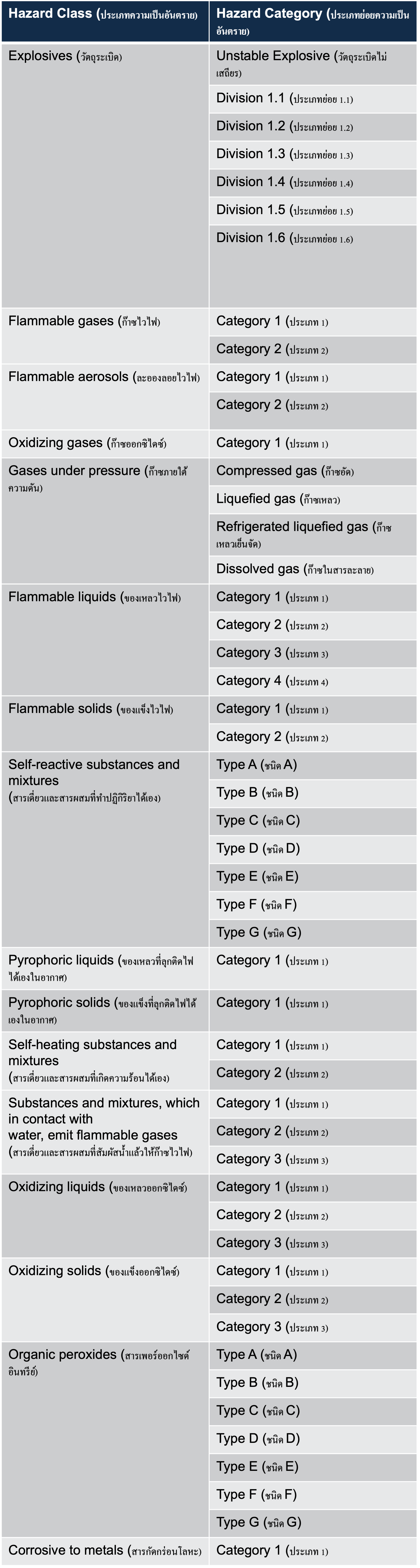 Health hazards (ความเป็นอันตรายต่อสุขภาพ) 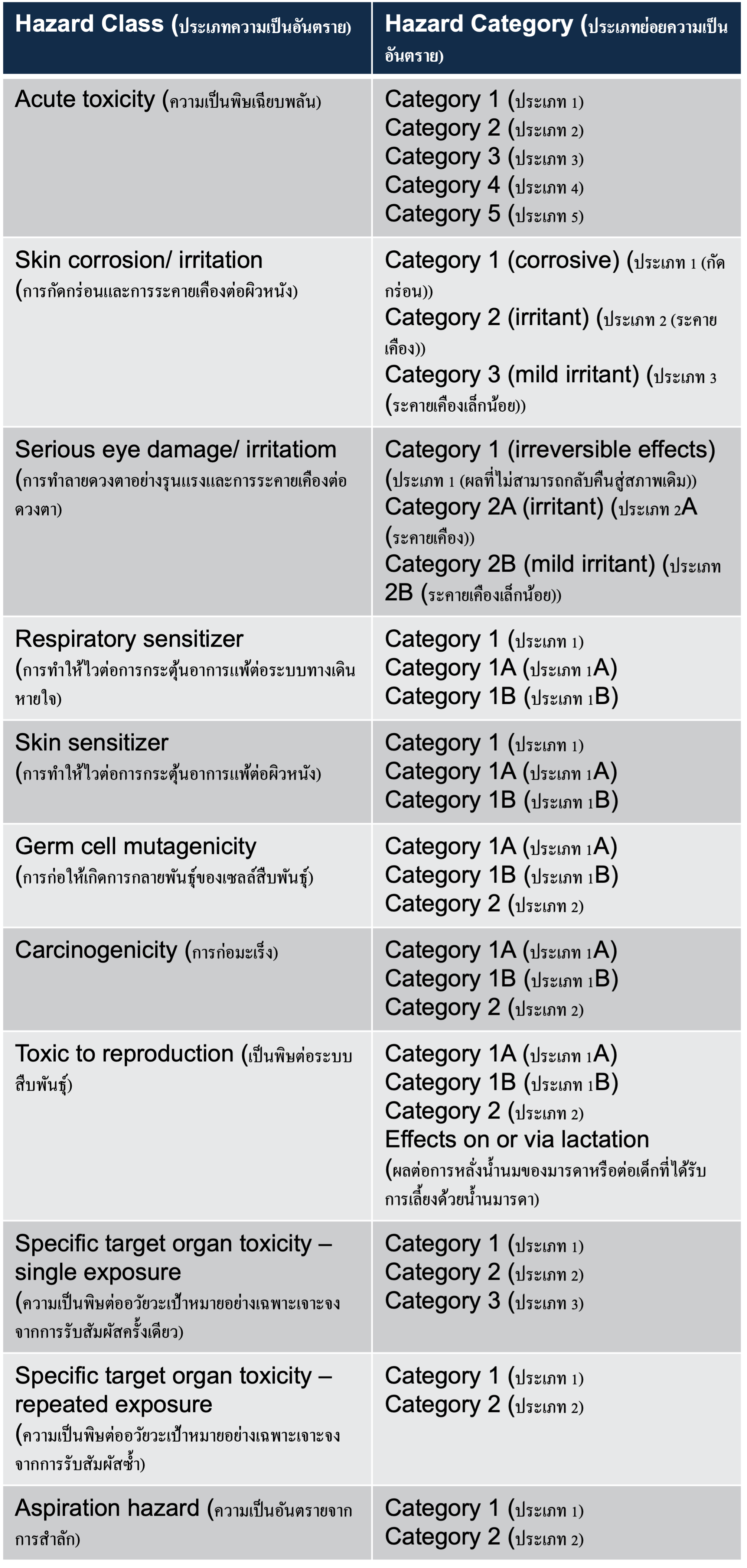 Environmental hazards (ความเป็นอันตรายต่อสิ่งแวดล้อม) 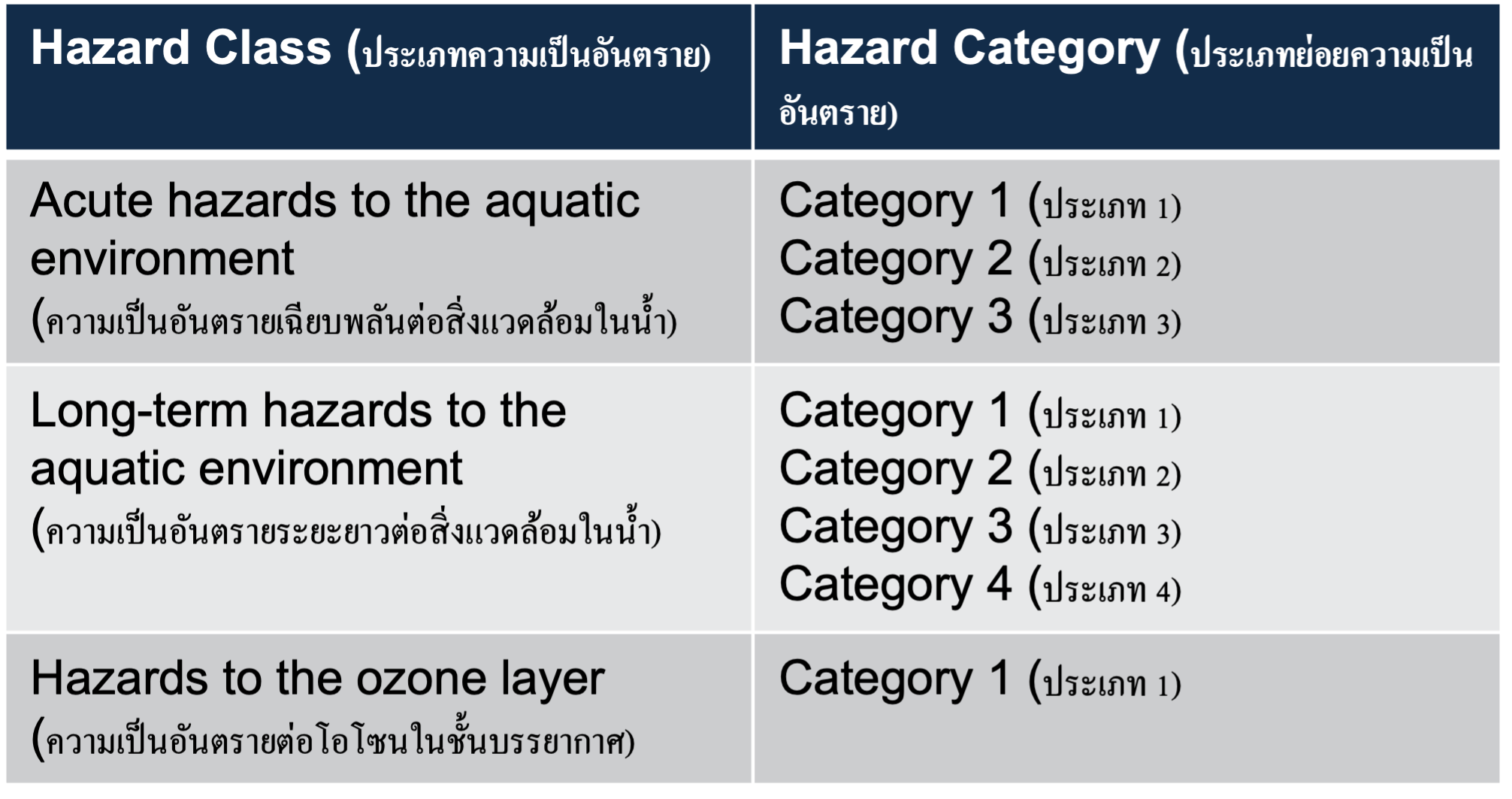 The DIW published GHS Classifications through a database on their website, searchable by CAS number or chemical name. The database contains over 500 single substances and mixtures that are classified according to their physical, health and environmental hazards. The database was published for informative purposes and it is not enforceable by laws. To achieve legal compliance, classifications must be in accordance with the criteria outlined in the Notification of the MOI Concerning Hazard Classification and Communication System of Hazardous Substances B.E. 2555 (2012). |
Sources
Resources *Not available in English |
¶ Cut-off Values/Concentration LimitsWhere test data is not available for a mixture, for health and environmental endpoints, the GHS allows for classification based on the hazards of the substances in the mixture. The GHS usually defines the concentration at which a hazardous substance causes a mixture containing that substance to be classified, for most hazards. These are known as Concentration limits / Cut-off values. Countries must additionally set the thresholds for mixture classification for certain hazards:
Thailand is implementing specific classification cut-off values and concentration limits for mixtures for certain hazard classes, prescribed in Notification of the Ministry of Industry Re: Hazard Communication (http://www.ratchakitcha.soc.go.th/DATA/PDF/2555/E/048/15.PDF). ¶ Sensitization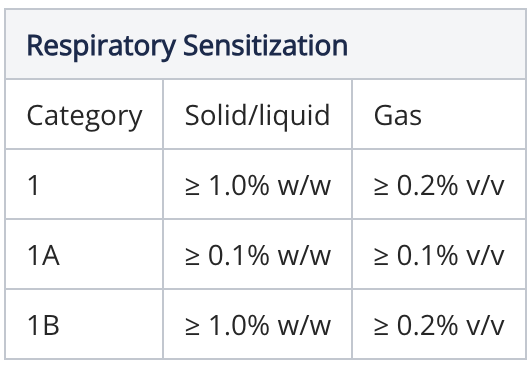 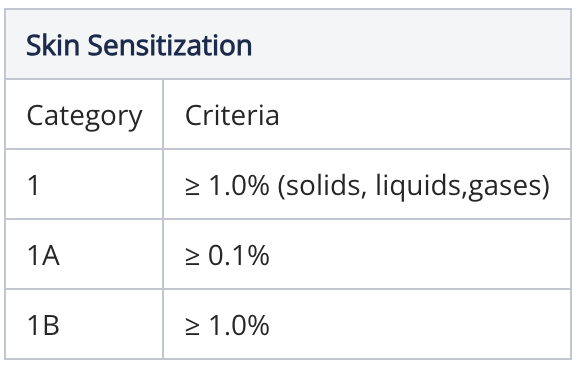 ¶ Carcinogenicity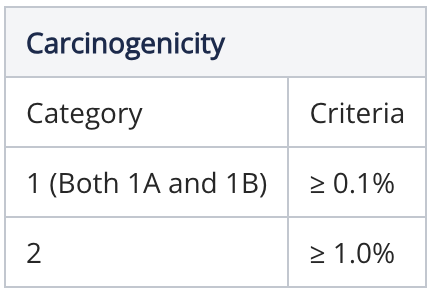 ¶ Reproductive Toxicity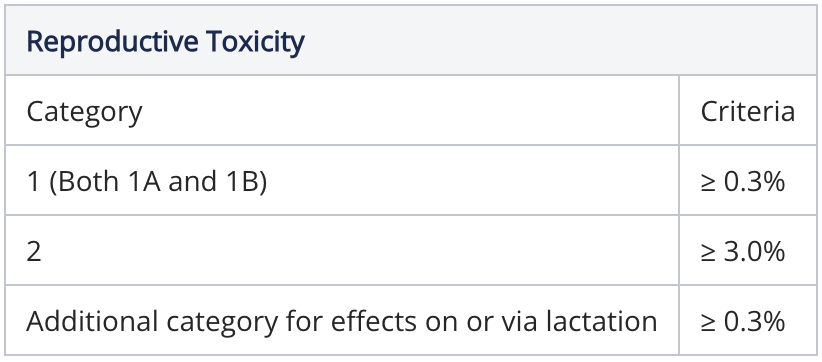 ¶ Specific Target Organ Toxicity - Single Exposure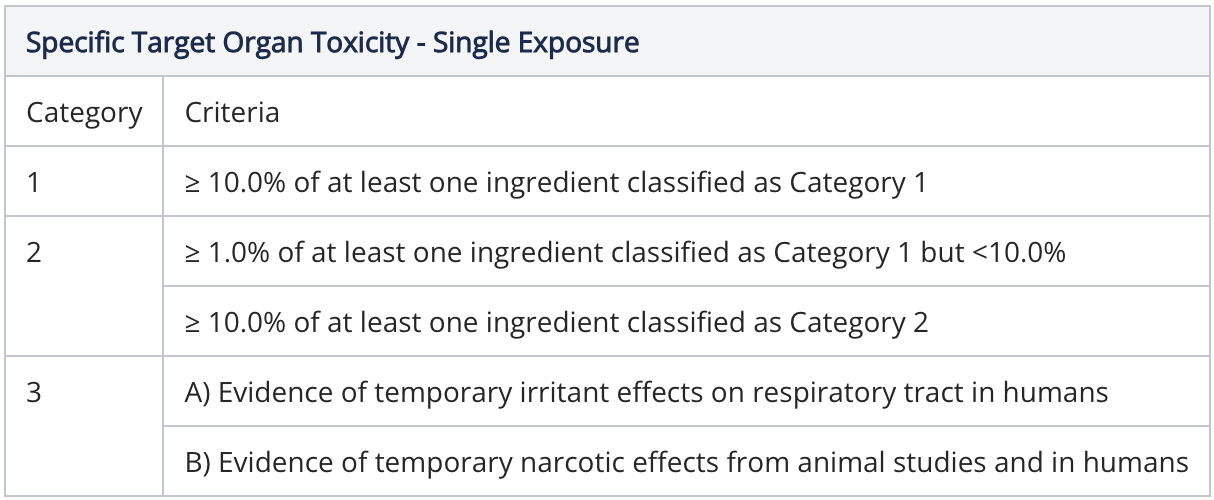 ¶ Specific Target Organ Toxicity - Repeated Exposure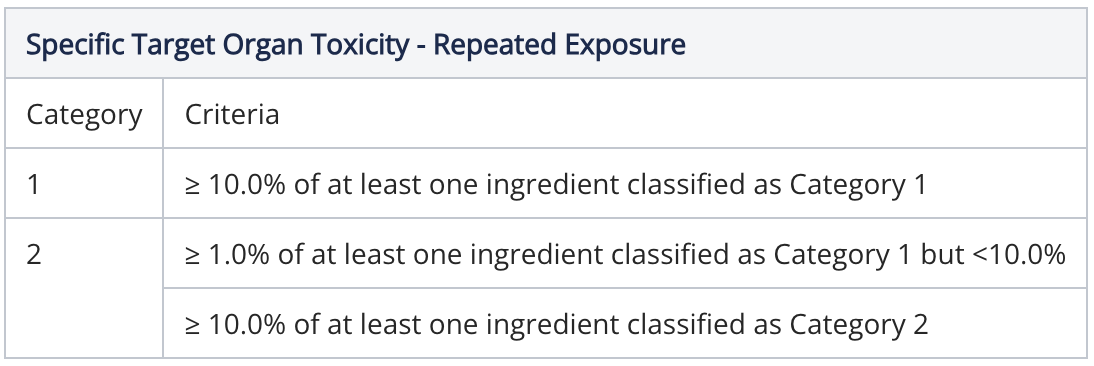
|
|
¶ SDSManufacturers or importers of hazardous substances shall prepare Safety Data Sheets (SDSs) and labels according to the format specified in the attachment to the Notification of the MOI Concerning Hazard Classification and Communication System of Hazardous Substances B.E. 2555 (2012). The deadline for compliance with the SDS and labeling requirements for hazardous substances under the responsibility of DIW for single substances has already passed (March 12, 2013). Compliance for mixtures under the responsibility of the DIW must occur by March 12, 2017. The requirements for hazardous substances under the responsibility of FDA and DOLD shall be complied with within one year following the publication of the agencies' notifications in the Thai Government Gazette for substances, and within 5 years for mixtures. Thus, for single substances under the responsibility of the FDA the deadline was March 20, 2016. For mixtures under the FDA, the deadline is March 20, 2020. For single substances under responsibility of the DOLD, the deadline was July 11, 2016. For mixtures under the DOLD, the deadline is July 11, 2020. |
|
¶ LabelA label affixed to a container of a hazardous substance must have an appropriate size to such a container and must be clearly visible. A label must minimally comprise the following label elements:
For instance, the MOAC and MOPH published notifications which stipulate additional information and formats that must appear on the labels on all containers of hazardous substances under the responsibility of the DOLD and FDA, respectively. These notifications require a label to contain:
Moreover, the notifications require the font size to be larger than 1 millimeter, whereas the Notification of the MOI does not set the minimum font size and only states that the content of a label must be clearly visible. |
Sources
*Not available in English |
¶ Trade SecretsApplicants who wish to apply for confidential business information status for information that otherwise must be disclosed in the SDS (Section 3) may do by emailing the Department of Industrial Works (DIW). Applicants must attach safety data sheets, as well as other applicable documents, with the emails. It should be noted that the DIW requires the disclosure of 100% composition by the applicants. Readers can consult a procedural diagram published on the official website of the DIW. |
Resources |
¶ Occupational Exposure LimitsThe Thai government published Occupational Safety, Health and Environmental Act, B.E. 2554 (2011) in the Royal Thai Government Gazette Vol. 128, Part 4 Gor (ก) on January 17, 2011. Under this act, the government issued Ministerial Regulation titled, "Prescribing of Standard for Administration and Management of Occupational Safety, Health and Environment in Relation to Hazardous Chemicals, B.E. 2556 (2013)". This regulation was published in the Government Gazette Vol. 130 Part 113 Gor (ก) on November 29, B.E. 2556 (2013). These two pieces of legislation allow the Department of Labour Protection and Welfare (DLPW) to ensure workers' well being and safety in Thailand. Notably they allow the Director-General of the DLPW to establish limit values of hazardous chemicals exposed in workplace. On June 28, B.E. 2560 (2017), the DLPW published the notification "Concentration Limits of Hazardous Chemicals'' which established chemical exposure standards in workplaces and storages of hazardous chemicals in Thailand. It was subsequently published in the Royal Thai Government Gazette, Volume 134, Special Part 198 Ngor (ง) on August 3, B.E. 2560 (2017) and became effective the following day. |
Sources
*Not available in English |
¶ Transport |
|
|
In Thailand, the land transport of dangerous goods was first enacted specifically for the transport of dangerous goods by road in 2002 by the Hazardous Substances Committee. To provide a standard for operators of dangerous goods to comply with. Subsequently, the laws and regulations for the transportation of dangerous goods have been amended and there are relevant government agencies have taken part in the responsibility. Currently, there are two main agencies that regulate the transportation of dangerous goods by land. Ministry of Industry and Department of Land Transport, Ministry of Transport. Currently, the regulations or requirements for the transport of dangerous goods in Thailand are applied by the 2011 edition of ADR. To ensure that the transportation of dangerous goods in Thailand has a comprehensive standard, emphasizing safety and compliance with international standards. Therefore, the following regulations have been announced. Ministry of Industry (MOI) For the responsibility of transporting dangerous goods by land, The Ministry of Industry is primarily responsible for issuing standards related to dangerous goods, including classification of dangerous goods according to the transportation of dangerous goods, packaging and other aspects related to the transport of dangerous goods. The regulations issued by the Ministry of Industry applicable for the transport of dangerous goods by land are as follows:
Department of Land Transport, Ministry of Industrial (DOLT) To provide safe and standardized transportation of dangerous goods on land Department of Land Transport, which is in charge of establishing specific regulations for the transport of dangerous goods. The relevant regulations are as follows.
|
Sources
*Not available in English |