The United Arab Emirates (UAE) adopts regulations from different parts of the world and modifies them to fit its own needs. The UAE is also part of the Gulf Cooperation Council (GCC), which consists of six different Arab member states: the United Arab Emirates, Saudi Arabia, Bahrain, Oman, Qatar, and Kuwait (more information available at www.gcc-sg.org). The GCC member states have also adopted some of the EU Regulations and formats. Most regulations adopted after the year 2000 are available in both English and Arabic. The official Gazette (al-jarida al-rasmiya) is available at http://gsec.abudhabi.ae/Sites/GSEC/Navigation/EN/official-gazette.html. New regulations and decrees are published in the Gazette. Responsible ministries also reproduce the legislation on their websites. Law Decree 20G 9/2008 launched the integrated system used for the management and control of hazardous chemicals in the UAE, which includes E-permits, banned and restricted materials, material safety data sheets, and laws and regulations. The website is available in both English and Arabic at www.hazmat.ae Standard Operating Procedures (SOPs) were established by the Environment Agency of Abu Dhabi to improve management practices of hazardous materials, and to to minimize the health and environmental risks involving the use and handling of chemicals. The SOPs follow Federal Law No. 24 of 1999 and its by-laws; the SOPs are available upon request from the Environment Agency of Abu Dhabi at www.ead.ae.
The United Arab Emirates does not require registration of any chemical substance. However, a permit is required to trade hazardous materials within the country. This permit is called is the Permit for Trading in Hazardous Materials and is required for both substances and mixtures. It can be completed in either English or Arabic. The permit is used for distribution, transportation, import/export, and storage.
The following documents must be included with the application form:
Certificate from the Abu Dhabi Chamber of Commerce and Industry (membership or trade name reservation)
Copy of the License issued by the Municipality or forwarding letter from them
Copy of the License issued by the Department of Planning and Economy
Copy of the License issued by the Ministry of Environment and Water (for Pesticides Handlers only)
Signature authorization for owner and authorized manager
Copies of the passports of the owner, technical/administration manager, and applicant
Letter of delegation from the owner/authorized manager for agent submitting the application and receiving permit
Company profile for previous experience (if present)
Civil Defense approved emergency plan
Copy of Civil Defense certificate for chemicals and hazardous materials transporting vehicle and certificate for driver in this field
Map of company location and storage sites authorized by a government agency
Copy of the facility and stores layout with the technical specifications approved by the Civil Defense
List of chemicals and hazardous materials being dealt with, showing the following for each:
Chemical name
Customs harmonized system code (HS)
CAS No.
UN No.
Annual consumption rates
Copies of SDS forms, if not submitted before
The permit application form and instructions are available in the SOP and must be requested from the EAD.
The United Arab Emirates has published a list indicating pesticides restricted for use in the UAE and pesticides requiring a permit from the Local Competent Authority.
Permits can be refused or revoked for the following reasons:
If it is proved that the pesticide has a detrimental side effect on humans or the environment under the conditions of use locally.
If the company did not ensure that the pesticide has been included in the list of the Food and Agriculture Organization and the United Nations Programme for Environment
If the pesticide is included in the list of pesticides of Prior Informed Consent (PIC) which means that the pesticide has been suspended or banned for use because of human health concerns or concerns regarding the environment.
If studies have demonstrated the sensitivity level of the lesion to become resistant against this pesticide and ineffective under conditions used locally.
If during storage of the pesticide unstable conditions can occur that lead to decomposition of the pesticide itself or the storage container.
The update to the pesticide list, Law Decree 30 of year 2016, is available on the Ministry of Climate Change and Environment (MOCCAE) website. All pesticides found in these lists require a permit from the MOCCAE. The permits can either be acquired from the ministry itself or from the hazmat website at www.hazmat.ae. Each case is different in regard to time needed to acquire the permits.
All pesticides sold in the United Arab Emirates are subject to specific label requirements. According to the regulation, pesticide labels must include the following information:
Expiration and manufacture dates;
A license number granted by the FEA;
Information written in Arabic and English;
Clear and indelible print;
Pictographs and warning signs following WHO guidelines; and
Storage and disposal instructions.
A copy of this label should be sent to the FEA with the application for licensing.
Packaging requirements given by the regulation include provisions requiring importers or manufacturers to ensure that liquid pesticides are securely closed with two caps and packaging sufficient to withstand contact with corrosive materials, and solid pesticides are packaged in containers not consisting of paper and not exceeding five kilograms. For both solid and liquid pesticides, containers should close securely and protect the product from reacting with other materials during transport.
The UAE has a 2 step compliance process for Cosmetic registration, it follows the GCC regulation listed below as well as a requirement for getting a Conformity Certificate for Cosmetic Product (information included below the GCC regulation) as required by Cabinet Decree 48 of year 2016.
Similar to other regions in the Middle East, the GCC uses the EU Regulation 1223/2009 as a basis for their cosmetics regulatory framework - GSO 1943/2016 Safety Requirements Of Cosmetics And Personal Care Products.
GSO 1943/2016 has its own distinctions when it comes to safety requirements and parameters for product claims, as well as labeling and packaging requirements that should be fulfilled by all cosmetics and personal care products.
Cosmetic: Any substance or mixture intended to be placed in contact with the external parts of the human body (epidermis, hair system, nails, lips and external genital organs) or with the teeth and the mucous membranes of the oral cavity with a view exclusively or mainly to cleaning them, perfuming them, changing their appearance, protecting them, keeping them in good condition or correcting body odors.
Halal Cosmetic: Cosmetic product that does not violate the provisions of the Islamic Sharia and which meet the technical requirements referred to in the standards GSO1943 and 2055.
The product shall be completely free from pork and all its derivatives.
Safe for human health when used under normal or reasonably foreseeable conditions of use
Homogenous, stable and the properties shall not change during its shelf life when stored and used as per the instructions.
Free from filthy or decomposed substances
No graphics or images or phrases that are inconsistent with Islamic traditions and social values in the GCC
No substances listed in Annex 2 of the standard
Sunscreen products comply with articles 5.11 and 9.9 in GSO 2237:2012 Cosmetics Sunscreen Products
Comply with microbiological limits in GSO ISO 17516 “Microbiology-Microbiological limits.”
The pH of cosmetic products should be in the range (4-8) excluding the ranges in Annex 3
The manufacture of cosmetic products shall comply with good manufacturing practices compliance with good manufacturing practices shall be presumed where the manufacture is in accordance with the relevant harmonized standards such as GSO ISO 22716.
Impurities in cosmetic and personal care products should not exceed the following limits:
New regulations set by the Gulf Cooperation Council Standardization Organization (GSO) have made it mandatory to place the product information, the name of cosmetic and personal care products in Arabic on the packaging of products sold in the GCC
Conditions of use and warnings for a range of ingredients listed in the Annexes 3 to 6 column 1 must be printed on the label of both the container and the packaging. Additionally, any other information deemed necessary for the safe use or disposal of the product must also be provided at GSO 1943:2016
Safety Requirements of the halal cosmetics not only in the final product but also the raw materials, the ingredients, equipment, apparatus, utensils, labels, packaging material, technology, process employed in the production halal cosmetics
Compliance with UAE Conformity Assessment Scheme (ECAS), in accordance with cabinet resolution No 18 for year 2014, is required for all cosmetic products in the UAE. Compliant products will receive the "Mark of Conformity," which indicates compliance to the general requirements by the UAE.
Registration certificate for Industrial Measurement System
Test Report from accredited and recognized laboratory according to Gulf standard UAE.S GSO 1943
Formula Declaration with ingredients and percentage issued by the manufacturer
For Imported Products: Free sale certificate on the manufacturer letterhead (Legalization is not mandatory and Third party certificate is accepted as well)
Representative artwork, Label of the product. according to Annex No. 1 of the cabinet resolution No. 18 of 2014 (which is to follow the requirements of the GSO 1943)
Product safety report according to Annex No. 3 of the cabinet resolution No. 18 of 2014
Part A: Cosmetic Product Safety Information
Quantitative and qualitative composition of the cosmetic product including chemical identities, names and CAS and their intended functions
Physical/chemical characteristics and stability of the cosmetic product
Microbiological quality
Impurities, traces, information about the packaging material
Normal and reasonably foreseeable use
Exposure to the cosmetic product
Exposure to the substances within the product
Toxicological profile of the substance
Undesirable effects and serious undesirable effects
Information on the cosmetic product (existing studies from human volunteers or findings of risk assessments carried out in other relevant areas
Part B: Cosmetic Product Safety Assessment (made available upon request from MOIAT)
Assessment conclusion (statement on the safety of the product)
Labeled warning and instruction of use
Reasoning (for more information it is listed within the decree)
The United Arab Emirates signed the Stockholm Convention on May 23, 2001 and ratified the Convention on July 11, 2002. It went into force on May 17, 2004. They do not have any legislation related to implementing the Stockholm Convention as of yet.
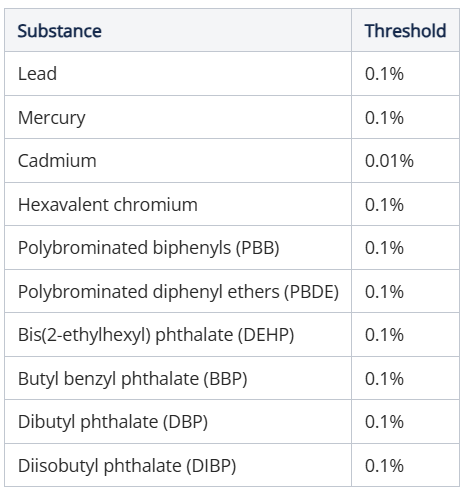
Law Decree (10) of 2017 was published in the Official Gazette on April 10, 2017 and deals with the restriction of certain hazardous substances in electrical and electronic equipment (EEE). The electrical and electronic equipment affected are defined under categories listed in Annex I of the Decree.
Definition
'electrical and electronic equipment’ or ‘EEE’ means equipment which is dependent on electric currents or electromagnetic fields in order to work properly and equipment for the generation, transfer and measurement of such currents and fields and designed for use with a voltage rating not exceeding 1000 volts for alternating current and 1500 volts for direct current
Categories
Large household appliances
Small household appliances
IT and telecommunications equipment
Consumer equipment
Lighting equipment
Electrical and electronic tools
Toys, leisure and sports equipment
Medical devices
Monitoring and control instruments including industrial monitoring and control instruments
Automatic dispensers
Other EEE not covered by any of the categories above
The restricted substances and their related thresholds are listed in Annex II. The following substances are restricted in all homogeneous materials in the EEE:
Cadmium, Lead, Mercury, Hexavalent chromium, PBB, and PBDE in electrical and electronic equipment, excluding equipment belonging to Category 11 (Other EEE) found in Annex I
January 1, 2020
Cadmium, Lead, Mercury, Hexavalent chromium, PBB, and PBDE in medical devices, in vitro diagnostic medical devices, monitoring and control instruments, and industrial monitoring and control instruments, as well as in equipment belonging to Category 11
DBP, DEHP, BBP, and DIBP in medical devices and their spare parts and cables
January 1, 2022
Cadmium, Lead, Mercury, Hexavalent chromium, PBB, and PBDE in cables and spare parts in medical devices, in vitro diagnostic medical devices, monitoring and control instruments, and industrial monitoring and control instruments
DBP, DEHP, BBP, and DIBP in electrical and electronic equipment, in vitro diagnostic medical devices, monitoring and control instruments, and industrial monitoring and control instruments
The United Arab Emirates acceded to the Montreal Protocol on December 22, 1989. They also acceded to the Protocol's amendments that are currently in force.
The United Arab Emirates has implemented restrictions on ozone depleting substances requiring importers/exporters to acquire a permit to obtain these substances. All permits are received from the Ministry of Environment or through their Integrated Hazardous Materials Management System. You will need to register through the site to access the registration forms.
In October 2019, the GSO (GCC Standardization Organization) published its first draft (GSO/TC01) for implementing the Globally Harmonized System (GHS) in the GCC countries based on the 5th revision of GHS. The new implementation of the Globally Harmonized System is expected to happen by mid-2020 with a 2-3 year grace period. Full details available in the Classification section.
There is no regulation implementing a classification scheme. The UN GHS is to be used for the SDS and label but the UAE has not specified terms of implementation just that use of the EU CLP is best practice. However, a draft has recently been published to specifically address GHS implementation in the GCC countries
In October 2019, the GSO (GCC Standardization Organization) published its first draft (GSO/TC01) for implementing the Globally Harmonized System (GHS) in the GCC countries based on the 5th revision of GHS. The draft is available on the GSO website at https://www.gso.org.sa/en/. The Gulf countries that are members of GCC include Saudi Arabia, United Arab Emirates (UAE), Kuwait, Qatar, Bahrain, and Oman. The implementation will help the competent authorities align more closely with other countries who have fully implemented GHS.
The new implementation of the Globally Harmonized System is expected to happen by mid-2020. After the implementation of GHS, there will be a grace period of 2-3 years for the six countries in the GCC to place the new law in their legislation, giving all companies who do business in that region enough time to adjust to the new regulation.
The draft liberally refers to the EU CLP as its model thus referencing concepts such as SVHCs and makes the same distinction as CLP between cut-off values and concentration limits.
Some key points from the draft:
Classification will be based off the Annex VI of the EU CLP regulation and is considered a mandatory classification. However, this is considered a minimum classification and the responsible party must additionally self-classify for those hazard classes not covered in the Annex VI entry. It is unclear in this draft as to which CLP adaptation will be mandatory as chapter 8 of the draft refers to the 9th ATP while the Appendix (Resources) refers to the 11th
The excluded building blocks match those excluded by the EU CLP regulation: Flammable liquid category 4; Acute toxicity category 5; Skin corrosion/irritation category 3; Serious eye damage/eye irritation category 2B; Aspiration hazard category 2; Hazardous to the aquatic environment - acute categories 2 and 3
The Safety Data Sheets (SDS) will include the standard 16 sections, and will be written in both Arabic and English. The SDS information should be updated regularly and if no new information becomes available they will need to be reviewed once every 3 years at minimum. If it becomes necessary to update the SDS, it should be revised without delay with the revised version of the SDS provided to all who have purchased the product within the preceding 12 months.
Labels will be also be in Arabic and English, with a maximum of 6 precautionary statements on the label, unless it is necessary to include more due to the severity of the hazards of the product.
Confidential Business Information (CBI) will be allowed to protect trade secret materials without compromising any risks to human health or the environment. Any CBI information shall be given to the competent authorities if requested.
The draft does state that the legislation will not apply to radioactive substances, non-isolated intermediates, mixtures for scientific research and development, or veterinary products, cosmetic products, food or feeding products. It will not apply for articles either but can be provided for articles on a voluntary basis.
The UAE follows the international format for Safety Data Sheets. The SDS can be completed in English or Arabic (depending on the SDS destination). The UN GHS is to be used for the SDS and label but the UAE has not specified terms of implementation just that use of the EU CLP is best practice. A draft has been published by the GSO that would specify GHS implementation in GCC countries.
Currently there is no mandatory requirement for an emergency 24 hour phone number other than the company contact phone number.
In October 2019, the GSO (GCC Standardization Organization) published its first draft (GSO/TC01) for implementing the Globally Harmonized System (GHS) in the GCC countries based on the 5th revision of GHS. According to the draft, Safety Data Sheets will include the standard 16 sections, and will be written in both Arabic and English. The SDS information should be updated regularly and if no new information becomes available they will need to be reviewed once every 3 years at minimum. If it becomes necessary to update the SDS, it should be revised without delay with the revised version of the SDS provided to all who have purchased the product within the preceding 12 months.
Read full details about the draft implementation in the Classification section.
In October 2019, the GSO (GCC Standardization Organization) published its first draft (GSO/TC01) for implementing the Globally Harmonized System (GHS) in the GCC countries based on the 5th revision of GHS. According to the draft, labels will be in Arabic and English, with a maximum of 6 precautionary statements on the label, unless it is necessary to include more due to the severity of the hazards of the product.
Read full details about the draft implementation in the Classification section.
The UAE makes no provisions for or restrictions on trade secrets. However, a draft GHS implementation has been published for GCC countries that addresses Confidential Business Information.
In October 2019, the GSO (GCC Standardization Organization) published its first draft (GSO/TC01) for implementing the Globally Harmonized System (GHS) in the GCC countries based on the 5th revision of GHS. According to the draft, Confidential Business Information (CBI) will be allowed to protect trade secret materials without compromising any risks to human health or the environment. Any CBI information shall be given to the competent authorities if requested.
Read full details about the draft implementation in the Classification section.
The United Arab Emirates has established various restrictions for the safety at workplace. The Competent Local Authority established and published maximum allowable limits for air pollutants in the working areas (occupational exposure limits) under Cabinet Decree 12 of 2006.
All facilities are required to not exceed the maximum allowable levels set out in Annex I of this regulation for any emission or leakage of solid or gaseous pollutants or vapors into the environment. All facilities are subjected to monitoring work and measurements by the Competent Local Authority.
All institutions must be aware when burning any type of hydrocarbon fuel for research and exploitation, drilling, and extraction of crude oil or for the purpose of industry, power generation, construction, or any commercial purpose. Also, smoke, gas, vapor need to be within the permissible limits as set out in Annex II of this regulation. These facilities are subject to monitoring and measurements in co-ordinance with the Competent Local Authority. Closed up public places and semi-closed places need to be compliant with the means for adequate ventilation, commensurate with the size of the place and its capacity and type of activity carried out inside of it to ensure the renewal of the air and purity and to maintain a suitable temperature. Determining the requirements for this coordination is dealt between the Competent Local Authority (CLA) and facilities involved for setting up the buildings. Additionally, emissions of vehicles and auto exhaust must not exceed the maximum allowable levels set forth in Annex II or any amendments thereto.
Agencies and facilities are obligated to ensure adequate ventilation in the workplace, and to take precautions and necessary measures to not leak or emit air pollutants, except to the extent permissible by supplement 7A and 7B of this regulation. Occupational Exposure Limits (OELs) are addressed in supplement 7B of the publication, outlining TWA limits, STELs, Ceiling limits, substances that absorb through the skin, and carcinogens. The limits included in the Supplement are intended as a minimum regulatory value to be upheld by industry in the United Arab Emirates.
The Federal Environmental Agency oversees the Regulation for Handling Hazardous Materials, Hazardous Wastes and Medical Wastes. Although not a signatory, the United Arab Emirates follows the European Agreement Concerning the International Carriage of Dangerous Goods by Road (ADR).