¶ Recent Updates2026
|
|
¶ Background |
|
¶ Legislative SystemThe legal system of the United Kingdom of Great Britain and Northern Ireland (UK) is made up of common law and legislative statutes, which include as the primary form of legislation, Acts of Parliament, which are enacted by the House of Commons following the approval of Bills (draft law) and Royal Assent. Secondary legislation are adopted in the form of Statutory Instruments (SIs) which enable the provisions of an Act to be subsequently brought into force in a variety of forms, including most commonly, regulations, rules and orders. The original and revised versions of all enacted legislation are available online and published by His Majesty's Stationery office (HMSO): http://www.legislation.gov.uk/ |
|
¶ Inventories |
|
|
See European Union pages: |
|
¶ Substance Registration |
|
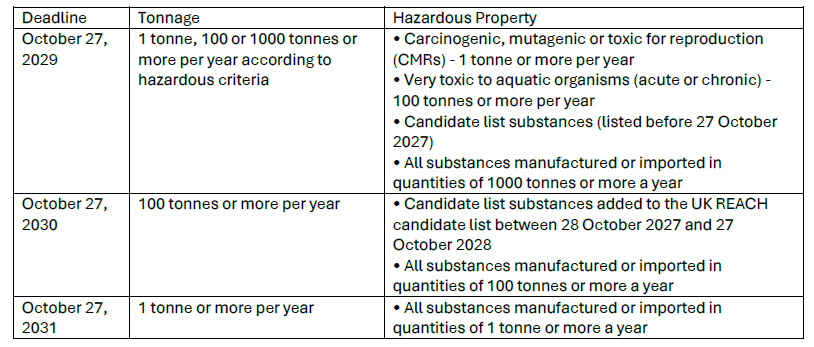
¶ UK REACHSince January 1, 2021, UK REACH regulates the manufacture, supply and use of substances in Great Britain. The UK REACH Regulation originates from EU Regulation EC/1907/2006 on the registration, evaluation, authorisation, and restriction of chemicals in Great Britain which ceased to apply within Great Britain since the UK's exit from the EU, at 11pm (GMT) on December 31, 2020. REACH etc. (Amendment etc.) (EU Exit) Regulations 2019, S.I. No. 758, were made and adopted by the UK Government in exercise of the powers conferred by the European Union (Withdrawal) Act 2018 (c. 16). They address failures of retained EU law to operate effectively and other deficiencies, following the withdrawal of the United Kingdom from the European Union. The UK REACH transitional provisions reduced potential business disruptions to industry during the phase-in period of the UK Regime, superseding the EU REACH regime obligations. These provisions allowed companies to submit an "initial notification" to continue placing chemical substances on the market in Great Britain, and subsequently submit full registration dossiers with the relevant risk management information. The transitional provisions applied to those who were registrants, including downstream users or distributors under EU REACH before UK REACH came into effect. 
|
Sources
Resources |
¶ Product Registration |
|
¶ Plant Protection ProductsEU Regulation (EC) No 1107/2009 lays down harmonised rules for the approval of active substances and the authorisation/registration required for placing plant protection products on the market. Hereinafter referred to as EU PPP Regulation. The Plant Protection Products Regulations 2011 (SI No. 2131) and the Plant Protection Products Regulations (Northern Ireland) 2011 (SI No. 295) were adopted for the purpose providing for the enforcement of EU Regulation (EC) No 1107/2009 concerning the placing of plant protection products on the market. The EU PPP Regulation (EC) No 1107/2009 is directly applicable within the UK since its entry into force on June 14, 2011. During the transition period and until 31 December 2020, the EU and UK will be negotiating new arrangements as to the implementation of national rules regarding PPPs. Until further notitce, the PPP Regulations remain applicable in the UK. All active substance approvals, Plant Protection Products (PPP) authorisations and Maximum Residue Levels (MRLs) in place before exit day continue to be valid in the UK. However, as the UK is no longer a "leading authority" under the EU Regime, in order to obtain approvals for active substances, MRL applications or product authorisations, businesses are required to submit applications to another EU member state's regulatory authority. HSE no longer acts as the lead for zonal Rapporteur Member State (zRMS), therefore product authorisation applications submitted to HSE that were still under consideration on exit day, January 31, 2020, were transferred to an EU member state to lead. The existing UK statutory requirements for authorisations of products remains unchanged. The Chemicals (Health and Safety) and Genetically Modified Organisms (Contained Use) (Amendment etc.) (EU Exit) Regulations 2019, SI No. 720 amend:
The Plant Protection Products Regulations 2011 (SI No. 2131) identify the following competent authorities within the United Kingdom of Great Britain for implementing the necessary measures relating to the registration requirements established under the EU Regulation (EC) No 1107/2009 on Plant Protection Products (PPPs), including:
While the Plant Protection Products Regulations (Northern Ireland) 2011 (SI No. 295) identify the designated authority for carrying out the obligations established under the EU PPP Regulation as:
The Secretary of State acts as the national authority for coordinating all the necessary contacts with applicants, other Member States, the Commission and the European Food Safety Authority are made in due course. There are multiple application forms that can be submitted for the purpose of obtaining an authorisation, including:
The HSE is continuing to provide services for regulating chemicals during the coronavirus outbreak for products falling under the scope of the Control of Pesticides Regulations (COPR). The HSE can be contacted by emailing: CRD.information.management@hse.gov.uk Non-agricultural product application forms regulated under the Control of Pesticides Regulations (COPR) will continue as usual until the end of the transition period. Some products covered under the EU Biocidal Products Regulation will also fall under the scope of the COPR, as they may contain active substances that are not yet fully regulated under the EU BPR. 
|
Sources
Resources
|
¶ Biocidal ProductsThe Great Britain Biocidal Products Regulation (GB BPR) replaced EU Biocidal Products Regulation (EU BPR) with some amendments to enable it to be implemented effectively in GB since December 31, 2020, end of the transition period following the UK’s exit from the EU. In effect, it mirrors the EU BP Regulations but tailored to the regulatory framework in Great Britain. On March 11, 2024, the Biocidal Products (Health and Safety) (Amendment and Transitional Provision etc.) Regulations 2024, S.I. No. 352, were made and were effective on April 6, 2024. The amendments made by these Regulations are addressed under Schedule 1 and 2 concerning Annexes 2 and 3 of the EU BRP and apply only to applications made on or after October 2, 2025. For applications made between April 6, 2024, and October 5, 2025, applications may either comply with the requirements in Annex 2 and 3 of the EU BPR as amended by S.I. No. 352; or, alternatively, comply with the requirements in Annex 2 and Annex 3 of the EU BPR as they were immediately before the coming into force of S.I. No. 352. They do not affect any application made to the competent authority before the coming into force of these Regulations. A biocide is a chemical substance, mixture, or microorganism intended to control any harmful organism in a way that is not purely physical or mechanical. A biocidal product is most commonly a mixture of chemicals, that contain an active substance to control the effect of a harmful organism. There are however, biocidal products that are made up of one active substance only, or that are articles that have been impregnated with the active substance, such as disinfecting wipes, referred to as “treated articles” or are classified as bacteria, viruses or other micro-organisms. The GB BRP address the following main requirements include:
The HSE released a Chemicals Legislative Reform Proposal which was the subject of a public consultation until August 18, 2025. This Proposal addresses key reforms to modernize the current regulatory framework concerning biocides, by recognizing approvals from international jurisdictions, including the EU, thus eliminating the need for duplication of dossiers and evaluations, as well as removing the fixed expiry dates for substance approvals and reviewing instead used substances based on emerging risk. This would mean that they could continue indefinitely on the market, unless specifically recalled for review based on emerging risks criteria or application guidance changes. It also aims to reduce applicable fees and avoid unnecessary renewals of substance approvals. The Biocidal Products (Data Protection Periods) (Amendment) Regulations 2025, SI. No. 1221, were adopted on November 24, 2025. They apply in Great Britain from December 30, 2025, and amend Article 95.5 of the GB BPR concerning the fixed data protection period for active substances/product type combinations listed in Annex II to Regulation (EU) 1062/2014, but for which no decision has been made by the Secretary of State as to their approval status. Pursuant to SI. No. 1221, the data protection period, which was to expire on December 31, 2025, has been extended for another five years until December 31, 3030, for those active substance/product-type combinations for which the Health and Safety Executive has not yet decided on a renewal date for their approval to be placed on the market. Withdrawal of support under the GB Biocidal Products Regulation (GB BPR) On February 2, 2024, a decision was adopted by the HSE to not approve 63 active substances/product type combination(s) in Great Britain (GB). Biocidal products containing these active substances in the relevant product types can no longer be:
New treated articles containing these active substances in the relevant product types cannot enter the supply chain or be imported into GB after July 31, 2024. Treated articles that have entered GB supply chains before this date can continue to be supplied and used. The 63 active substance/product type combinations impacted can be downloaded from: HSE Biocides ebulletin: GB active substance non-approval decisions (govdelivery.com) The list of BPR active substances for GB and NI, include substances that are approved, are or have been evaluated, are no longer approved or are identified under the simplified active substance status. The full list can be downloaded from: BPR active substance lists for GB and NI - HSE Great Britain (UK, except Northern Ireland) GB Biocidal Products Regulation (GB BPR) came into force on December 31, 2020 at 11pm. The GB BPR incorporates the requirements of the existing EU Biocidal Products Regulation (EU BPR) with some amendments to enable it to be implemented effectively in GB. At the end of the transition period on December 31, 2020, EU rules and regulations in the field of biocidal products, including EU Biocidal Products Regulation ceased to apply in the United Kingdom. The Health and Safety Executive (HSE) is the competent authority for Great Britain. HSE is the designated authority responsible for introducing its own processes and systems for receiving and processing biocide related applications, such as active substance approval, biocide authorisations and other permissions under the GB Biocidal Product Regulations. This has a direct implication as regards authorisation holders under the BPR, as they must be established within the EU according to Article 3(1)(p) and Article 95(1) concerning active substance or product suppliers. Therefore post-transition period, UK suppliers and representatives of non-EU suppliers based in the UK will no longer be listed as authorised suppliers under Article 95, and any substances or biocidal products they were supplying will no longer be allowed to be made available on the EU market. COM/20200 324 final addresses the impacts on registration that leaving the EU will have on chemical sector companies operating in the UK and any relevant information for the downstream user in the EU according to Regulation EC/1907/2006 (REACH). Further to this, a Notice to Stakeholder on the Withdrawal of the United Kingdom and EU rules in the field of Biocidal Products was issued by the European Commission, Directorate General for Health and Food Safety, on June 17, 2020. The label of biocidal products will need to reflect the new address of the authorisation holder for the product placed on the EU market. Any authorisations based on mutual recognition of a United Kingdom authorisation granted by Member States before the withdrawal date remain valid from January 1, 2021 until its expiry date, as long as the authorisation holder is established in the UK. If applying for the renewal of an authorisation, under the EU BPR, the authorisation holder will have to be established in the EU, including Northern Ireland, the EEA or Switzerland. Any data submitted for the renewal will not need to be submitted to the UK HSE, unless otherwise requested by the Executive. However, new applications will not be able to be submitted to the UK as reference Member State. The Withdrawal Agreement, Article 44, obliges the UK to transfer all relevant files to the new reference Member State. It is important to fulfil the following in order to maintain or get access to the GB market: If need to apply for an active substance to be approved, or for a biocidal product to be authorised in:
Authorisations are no longer issued by post, they are all processed online by signing-up to e-approvals service. To sign-up to this service email: applications@hse.gov.uk HSE is the UK's designated authority for coordinating the active substance evaluation process for Great Britain. Northern Ireland (NI) The IE/NI Protocol is subject to periodic consent every 4 years by the Northern Ireland Legislative Assembly. EU rules apply to and in the United Kingdom in respect of Northern Ireland, Northern Ireland is treated as if it were an EU Member State. Therefore, post transition period, EU rules and regulations will continue to apply in Northern Ireland, including the EU BPR. Note that a biocidal product produced in NI and shipped to the EU will be regarded as an EU product, not imported. And furthermore, a product shipped from Great Britain to Northern Ireland will be regarded as an imported product. However, NI will not be able to act as leading authority for assessments, examinations, approval and authorisations as regards to active substances and biocidal products within the EU.
Up until 31 December 2020, the so called "transition period" the EU and UK negotiated new arrangements as to the implementation of national rules regarding biocide products. Until further notice, the EU Regulation (EU) 528/2012, the Biocidal Products Regulation (BPR), remains applicable in the UK. The Health and Safety Executive (HSE) is the UK´s competent authority for the evaluation of national authorisations of biocides intended to be placed on the market, although it is not able to act as the "leading authority" to conduct certain assessments. Authorisations applications made under the EU Biocidal Products Regulation to place biocidal products on the market within the United Kingdom had to continue to be submitted via the European Chemicals Agency’s (ECHA) R4BP3 system. During the transition period, the United Kingdom had to still accept and review new applications for authorisations in its territory, i.e. assume its role as the Member State, as provided under Articles 33 and 34 of Regulation (EU) No 528/2012. The UK's HSE continued to process product applications under the Biocidal Products Regulation for the UK market under the national authorisation route. New applications were being considered against current EU rules and standards. All new registrations, approvals, authorisations and classifications granted by the EU will be recognized by the UK. Registrations, substance approvals, authorisations and classifications in place before the UK left the EU remained valid.
HSE may introduce administrative measures in order to meet significant challenges faced by stakeholders placing biocidal products on the market, such as during the Covid-19 outbreak. During this time, the high-level demand for raw ingredients in order to manufacture biocidal hand sanitisers represented significant challenges for industry, particularly in the supply chain. In response to this unprecedented health pandemic, the HSE took steps to derogate the requirements for authorisation of biocidal products for the manufacture of hand sanitisers containing Propan-2-ol (CAS 67-63-0). On this occasion, the HSE was able to introduce an authorisation product requirement derogation under the provisions of Article 55(1) of the Biocidal Products Regulation (BPR), in case of danger to public health, animal health or the environment which could not be contained by other means. Biocidal hand sanitisers containing Propan-2-ol, also known as Isopropanol or Isopropyl alcohol/IPS, were not required to obtain authorisation if they complied with the WHO-specified formulation II. Prior to placing products that meet the WHO-specified formulation on the UK market, the industry representative of such products must contact the HSE via email and indicate in the subject title "Propan-2-ol Article 55": Products cannot be placed on the market until HSE has confirmed that the derogation applies to the product and issued a certificate of exemption from the authorisation. Article 95 of the Biocidal Products Regulation requires suppliers of active substances for use in biocidal products to have obtained a letter of access to an active substance dossier, to have submitted their own dossier to the European Chemicals Agency, or to be a participant in the European Commission’s on-going review programme of active substances. The sources are listed on the European Chemical’s Agency’s (ECHA) searchable database[3]. Any correspondence, including data packages on CD/DVD must be communicated by email to discuss alternative methods if data is too large for sending by email: Authorisations are no longer issued by post, they are all processed online by signing-up to e-approvals service. To sign-up to this service emails:
|
Sources
Resources Navigate to: EU Biocidal Products |
¶ Notifications |
|
¶ C&L NotificationOn exit day, the UK effectively adopted the United Nations Globally Harmonised System (UN GHS). The UK chemicals classification and labelling regime will continue to be based on existing EU regulatory regime implemented under the CLP Regulation to provide continuity for businesses. Now that exit day has passed, manufacturers and importers have the duty to notify the required classification and labelling of substances they placed on the UK market to the HSE, instead of the European Chemicals Agency (ECHA). Existing notification that had been submitted to ECHA by UK based companies will remain as they are, although their notification status are legally "void" as the UK is no longer a Member State of the EU. Administrative changes resulting from exit day include that the function performed by ECHA will be carried out in the UK by HSE. This would mean companies operating in the UK will need to notify the HSE in place of ECHA. Chemicals Legislative Reform, which will last for eight weeks until August 18, 2025, was released by the HSE. It addresses key reforms to modernize the current regulatory framework according to the Regulatory Action Plan (RAP) published by the Government in March 2025. Currently, Article 40 of the GB CLP, requires GB duty holders to submit notifications to HSE as the GB CLP Agency, on the classification and labelling on new chemicals placed on the GB market. The consultation seeks comments on the proposed revocation of Article 40, thus no longer requiring a GB CLP notification database which would save duty holders time and associated costs of notification. Stakeholders interested in submitting any comments may consult the Chemicals Legislative Reform consultation document and submit any comments by the closing date, by responding in three different ways:
The main requirements of CLP continue to be applied in the UK. Therefore UK manufacturers, importers, suppliers and downstream users must continue to classify, label and package the substances and mixtures they place on the UK market in accordance with CLP Regulation. This includes all labelling requirements, such as the principles of precedence for the different labelling elements, the location of the label on packaging, and exemptions where available 
|
|
¶ Restrictions and Bans |
|
¶ Restriction under UK REACHUK REACH incorporates Annex 17 on restrictions on the manufacture, placing on the market and use of certain dangerous substances, mixtures and articles is amended, under the REACH etc. (Amendment etc.) (EU Exit) Regulations 2019, Schedule 7. It incorporates the restrictions established under Regulation (EC) No 1907/2006 of the European Parliament and of the Council concerning the Registration, Evaluation, Authorisation and Restriction of Chemicals (REACH), establishing a European Chemicals Agency, with the relevant changes in order to allow its implementation in the UK. Under REACH, the term "Restriction" refers to specified restrictions delineated in Annex XVII to the Regulation. The REACH Restrictions came into force June 1, 2009, repealing the Market and Use Directive (76/769/EEC). Restrictions are given for individual substances or a group of substances and their specific uses. The compounds that appear in Part 3 of Annex VI to the Regulation (EC) No 1272/2008 (CLP), classified as Category 1A and 1B carcinogenic, mutagenic and toxic to reproduction (CMR) and listed in appendices 1 - 6 of REACH Annex XVII, are generally restricted as a substance and in mixtures for consumer use (see entry 28, 29 and 30 of Annex XVII). List of restrictions are applicable under UK REACH, are established under Schedule 3 of the amending Statutory Instruments 758 (2109), 1144 (2019) and 1577 (2020) and should be read alongside Regulation (EC) No. 1907/2006 as it was on 31 December 2020. Annex XVII is amended on a regular basis, according to the following Statutory Instruments, implementing the amendments in the UK:
The full list of restrictions under UK REACH was published on March 31, 2021, and has been updated to include corrections or amendments as per legislation progress. The main list includes entries incorporated under Annex 17 of UK REACH, as well as 12 separate appendices that provide further detail on regulated list of substances under the specific data entries. The last amendment to the list of restriction was made in November 30, 2021, taking into account amendments made to entry 51, entry 68, entry 72, entry 74 of Annex 17, as introduced by The REACH etc (Amendment) Regulations 2021 (S.I. 2021/904) which entered into force on September 30, 2021. A last correction was introduced to entry 23 relating to Cadmium restrictions, in April 29, 2022. The full list of restrictions is available in an Excel spreadsheet published by the HSE at: https://www.hse.gov.uk/reach/assets/docs/list-of-restrictions.xlsx |
Sources |
¶ Authorisation under REACHUK REACH provides for the authorisation requirements to be implemented in order to phase out the use of hazardous substances of very high concern (SVHCs). Once an authorisation has been granted, substances on the authorisation list can continue to be used temporarily when the relevant criteria are met. The end is to phase them out and use safe alternative substances. Applications for authorisation shall be submitted to the Health and Safety Executive (HSE). The HSE provides an online database with the list of:
UK REACH transitional measures provided that authorisation applications that were submitted by GB-based companies under EU REACH, if the application was at the final decision stage before the end of the transition period, and the European Chemicals Agency (ECHA) had adopted final opinions but the European Commission had not made a final decision before 31 December 2020, applications can be submitted directly to the Secretary of State for Environment, Food and Rural Affairs to make a decision. The Secretary of State’s decisions are published on the authorisation decisions page. |
Sources |
¶ Restriction of Hazardous Substances (RoHS)
|
Sources
Resources |
¶ Persistent Organic Pollutants (POPs)The Stockholm Convention came into effect in 2004 and aims to prohibit, eliminate or restrict the production and use of POPs in conjuntion with the UNECE POPs Protocol. The Convention's goal is to eliminate and restrict the production and use of these substances. It requires Parties to the Convention to adopt the necessary measures to reduce releases of POPs. It regulates the production, placing on the market, and use of POPs which are banned or restricted under the Convention with exemptions and limits for the quantity of the substance allowed in new articles. The UK is a Party to the Stockholm Convention. The Persistent Organic Pollutants Regulations 2007, SI No. 3106 of 2007, (UK POPs Regulation) were published on October 30, 2007 and came into force on December 3, 2007. They established the competent authorities for the purpose of Regulation (EC) 850/2004, now revoked by Regulation (EU) 2019/2021, as:
The Persistent Organic Pollutants (Amendment) (EU Exit) Regulations 2020, SI No. 1358 of 2020 make further amendments to the POPs 2007 Regulations. They introduce the necessary corrections for the implementation of the existing Regulation (EU) 2019/1021 of the European Parliament and of the Council on Persistent Organic Pollutants in Great Britain following the withdrawal of the UK from the EU. The POPs Regulation covers all POP substances, as well as products and mixtures containing POPs. This Regulation includes provisions for:
Under this Regulation certain substances are banned or their production and use in the UK is severely restricted. Several substances listed in the Annexes to this Regulation correlate directly with substances listed in the Stockholm Convention, while others may be found in the Protocol to the 1979 Convention on Long-Range Transboundary Air Pollution. The 2020 Regulation also makes amendments to ensure that the legislation continues to be operable, such as making the necessary changes so as to include amending references to the EU, EU institutions and EU administrative processes to domestic equivalents, updating legal references to refer to relevant domestic legislation and placing an obligation on the Secretary of State to publish reports previously sent to the Commission. It also transfers legislative and administrative functions that were previously to Brexit assigned to the European Commission and the European Chemicals Agency (“ECHA”), and allows these function to be exercised instead by public authorities in Great Britain. It also makes changes for purposes relating to the implementation of the Protocol on Ireland / Northern Ireland (“the Protocol”). Great Britain is able independently implement the Stockholm Convention by regulating the production, placing on the market, and use of POPs. The amendments also enable GB authorities to regulate stockpiles of POPs and manage waste where POPs are present. They also set out monitoring and reporting requirements. Furthermore, the necessary measures implemented within GB will ensure the control and traceability of waste contaminated by relevant pollutants. The Persistent Organic Pollutants (Amendment) (EU Exit) Regulations 2022, SI No. 1293 of 2022 were made on December 6, 2022 in order to address the deficiencies of the EU Exit POPs regulations 2020. When the EU Exit POPs regulations 2020 were drafted in preparation for the end of the Implementation Period, some errors were made. This resulted in three issues which need to be remedied. First, there were deficiencies for two POPs in the retained POPs regulation, perfluorooctane sulfonic acid and its derivatives (PFOS), and Perfluorooctanoic acid (PFOA), its salts and PFOA-related compounds. Second, a set of exemptions from the prohibition of use of the POP decaBromodiphenyl ether (decaBDE) was accidentally deleted in the retained regulations. Finally, two provisions in the EU Exit POPs regulations 2020 have no legal effect in relation to the retained regulations for PFOS. The changes made under the 2022 instrument are:

|
Sources
|
¶ Ozone Depleting SubstancesThe United Kingdom ratified the United Nations Montreal Protocol on Substances that Deplete the Ozone layer on December 16, 1988. Since the implementation of the EC Ozone Depleting Regulations (ODRs), which were directly applicable in UK law until January 1, 2021, the UK has committed to the reduction of Ozone Depleting Substances (ODS). The list of regulated Ozone-depleting substances (ODS) - GOV.UK (www.gov.uk), currently regulated under Regulation (EC) No 1005/2009 on ODS, following Brexit, remain within the scope of the retained UK ODS Regulation. The UK retained the provisions of Regulation (EC) No 1005/2009 on substances that deplete the Ozone layer, in order to continue to restrict the use of ODS and also apply the same schedule as the European Union to phase down Hydrofluorocarbons (HCFs), which represent the most common type of Ozone depleting fluorinated gas by 79% by 2030 relative to a 2009 to 2012 baseline. On November 14, 2017, the UK ratified the Kigali amendment to the Montreal Protocol. The Kigali amendment to the UN Montreal Protocol commits nations to reducing hydrofluorocarbon greenhouse gases (HFCs) by 85% between 2019 and 2036. Registration of ODS used for laboratory and analytical purposes and their annual declaration must be reported to the UK Government via this link: F gas - Register & declare (laboratory-ozone-depleting-substances.service.gov.uk ODS are permitted to be used for the following essential laboratory or analytical uses, as long as there is no non-ODS alternative:
ODS may also be uses as a controlled substances as a reference or standard to:
Licences for the import or export of ODS or their use in aviation purposes must be obtained after registering for an ODS account at: Licence Application (ozone-depleting-substances.service.gov.uk) ODS import or production quotas may be applied for at: |
|
¶ SDS + Label |
|
¶ ClassificationFollowing the withdrawal of the UK from the European Union on January 31, 2020, the EU CLP Regulation (EC) No 1272/2008 on the classification, labeling and packaging of substances and mixtures, amending and repealing Directives 67/548/EEC and 1995/45/EC, and amending Regulation (EC) No 1907/2006, referred to as ''the CLP Regulation'' was retained for domestic application, and referred to as the “GB CLP Regulation”. It has since become assimilated law under Section 3 of the European Union (Withdrawal) Act 2018. Amendments were made to the retained EU CLP Regulation to address deficiencies that would arise from the UK's withdrawal from the EU. For example, the responsibilities previously held by the European Chemicals Agency (ECHA) were transferred to Health and Safety Executive (HSE), such as evaluation of legally binding classifications and labelling. The modifications made were limited as the powers provided did not permit changes to policy. The HSE, referred to as the "Agency", is the designated official authority in Great Britain for the enforcement of the GB CLP Regulation, the update of the Mandatory Classification and Labelling (GB MCL), and for performing administrative duties relating to chemical classification notifications. It is referred to as the Agency, taking over duties previously attributed to the European Chemicals Agency (ECHA) as regards placing chemicals on the market in the UK. The EU CLP Regulation was retained into the legislative system of Great Britain as the GB CLP system under the transitional provisions of the Chemicals (Health and Safety) and Genetically Modified Organisms (Contained Use) (Amendment etc.) (EU Exit) Regulations 2019 No. 720, as amended by The Chemicals (Health and Safety) and Modified Organisms (Contained Use) (Amendment etc.) (EU Exit) Regulations 2020. These Regulations came into force on exit day. This means that GB continues to adopt GHS, independently of the European Union. Currently implementing the 6th Revised Edition of GHS. However, not all EU harmonised classification and labelling of substances that applied in the EU on December 31, 2020, were incorporated into Great Britain's MCL List, First Edition. As per Article 37 and Article 37A procedures of the GB CLP Regulation, the HSE updates the legal status and implementation of the GB MCL Entries. The HSE also takes into account any changes required to be implemented following any updates adopted under the Adaptation to Technical Progress of the Regulation (EC) 1272/2008. The most recent update of the MCL is now the Seventh Edition, released on September 16, 2025. Previously, changes were introduced under the Second Edition, of October 20, 2023, whereby 98 substances were added as per the Agency's recommendation to Ministers of September 2023. The Third Edition of the MCL list incorporated information on the status of the 14th and 15th Adaptations to Technical Progress (ATPs), which addressed 90 substances, for which the classification and labelling requirements were not formally implemented into the MCL, not until later, following Ministerial Decision of June 2024. The Fourth Edition of the MCL list was published on March 2, 2024. This included new/revised GB mandatory classifications and labelling for the 25 substances included in the second GB CLP Agency recommendation to ministers and agreed by ministers in February 2024. The Fifth Edition of the MCL of June 26, 2024, added 88 substance classification and labelling provisions, as per Ministerial Decision of June 2024. This update incorporated the 14th and 15th ATPS, except for two substances that were removed from the GB MCL list:
The Sixth Edition of the MCL list was released on February 15, 2025. It added new and revised mandatory classifications and labelling for 46 substances, as per the Agency's recommendation to ministers, which was agreed on January 15, 2025. Before new or revised entries are enforced in the MCL, the HSE conducts public consultations on specific substances. The full list of technical reports and supporting minister's decisions are published on the HSE website: https://www.hse.gov.uk/chemical-classification/classification/publication-template.htm The HSE has proposed a Chemicals Legislative Reform to address key reforms to modernize the current regulatory framework according to the Regulatory Action Plan (RAP) published by the Government in March 2025. The current UK CLP regime includes supplier requirements that are unnecessary and burdensome. According to the Chemicals Legislative Reform document, it has also created disproportionate and inefficient processes to deliver scientific and technical updates. The reform of GB CLP is required to address these problems to remove burdensome and non-essential requirements on business and to keep pace with the EU legislative developments, where appropriate. The changes would need to be delivered through a mix of primary and secondary legislation. As regards the proposed reforms to the GB CLP regulation, the Government intends to introduce the following regulatory changes:
This reform also seeks to protect the UK internal market in line with the Government's commitment to apply a consistent CLP regime across the UK. At present, the Government recognizes discrepancies in CLP regimes between Northern Ireland and Great Britain have the potential to impact the smooth operation of the UK internal market. Therefore, to avoid the development of disincentives for traders to move goods from Great Britain to Northern Ireland, the Government is considering under this consultation document to incorporate recent EU CLP Regulation amendments, such as Commission Delegated Regulation (EU) 2023/707 and Regulation (EU) 2024/2865 into the domestic CLP regime on a UK-wide basis. Commission Delegated Regulation (EU) 2023/707 introduced six new hazard classes into the EU CLP:
Regulation (EU) 2024/2865 further amended the EU CLP Regulation to improve how chemical hazards are classified, provide clearer safety warnings and improve compliance and user safety. These new measures are aimed at optimizing labelling provisions concerning hazard communication, introducing labelling rules such as voluntary use of digital labelling for non-obligatory information, minimum font size, line spacing and colouring, whilst also permitting for broader use of fold-out labels. It also requires suppliers to update product labels within six months of a classification and labelling mandatory change which may result in additional hazard class or category classification or new supplemental information to be provided on the label elements. Derogations to the labelling requirements of the EU CLP are introduced for chemicals supplied without packaging, such as fuel at filling stations, chemicals contained in very small packaging with contents below 10mL, and ammunition. It should be noted that the EU CLP Regulation, as recently amended, already applies in Northern Ireland under the Windsor Framework. Further guidance on GB CLP Regulation is regularly made available at: https://www.hse.gov.uk/chemical-classification/legal/clp-regulation.htm |
Resources
Resources
|
¶ Regulation (EC) No 1272/2008 (CLP)Regulation (EC) No 1272/2008 on the Classification, Labelling and Packaging of substances and mixtures (CLP) establishes a classification and labelling system in the EU in line with the Globally Harmonised System (GHS). As an EU Regulation it directly applies in all EU Member States. Due to subsequent Adaptations to Technical Progress (ATPs) the CLP will be in line with Revision 7 of the GHS as of October 17, 2020. The CLP replaced the Dangerous Substances Directive (DSD, 67/548/EEC) and Dangerous Preparations Directive (DPD, 1999/45/EC) and republished (in CLP Annex VI Table 3.2) all of the DSD harmonised classifications. Under the CLP, there continue to be harmonised classification and labelling elements which are mandatory to use. These are published in Table 3.1 of Annex VI to the CLP and contain the DSD list, translated into GHS, and subsequently determined harmonized classifications. ¶ Transitional PeriodThe transitional period between the DSD classification system and the GHS-based CLP classification ended on June 1, 2015. From June 1, 2015 substances and mixtures must have classification and labelling in accordance with the CLP. For mixtures placed on the market before the June 1, 2015 deadline, the deadline for re-labelling and repackaging was extended to June 1, 2017. Direct conversions of the classification and labelling in accordance with the DSD and DPD into the GHS-style classifications using the conversion table in Annex VII of the CLP is permitted. The following types of substance are exempt from the CLP:
|
Sources
Resources
|
¶ ClassificationThe CLP requires the classification and labelling of substances and mixtures before placing them on the market in the EU. The import of a substance or mixture automatically constitutes "placing on the market." Substances not placed on the market or subject to Regulation 1907/2006 (REACH) should be classified by manufacturer/producer. The CLP requires the use of the harmonised classifications for substances listed in Part 3 of Annex VI. Substances are listed under their EC, CAS and Index number. The regulation cites several notes for substances in Annex VI that may have a significant impact on classification and labelling. These notes precede Table 3.1 in Annex VI. A harmonised classification can be suggested by Member states or Industry by submitting a Dossier. Substances with a harmonised classification still require a self classification for the hazard classes that are not covered by the entry in Annex VI. Substances that do not have a harmonised classification require self-classification by the manufacturer, importer or downstream user for all hazard classes. Mixtures must always be self classified by the downstream user. The CLP is in line with Revision 7 of the GHS but it did not adopt all of the hazard classes suggested by the GHS. A full listing of hazard classes and categories is given in Table 1.1 in Part 1 of Annex VI to the regulation. The hazard classes and categories suggested by the GHS that the CLP does not cover are:
Certain other hazards are captured by additional hazard statements mandated by the EU. ¶ Notification of ClassificationArticle 40 of the CLP requires notification of the Classification and Labelling information to the European Chemicals Agency (ECHA) for substances placed on the market in the EU. |
|
¶ SDSSee European Union page: Safety Data Sheet In the United Kingdom, English is the required language to be used for the purpose of SDS. ¶ Sections of the Safety Data Sheet |
|
¶ LabelSee European Union page: Label In the United Kingdom, the official language for labeling products and substances is English. |
|
¶ Trade SecretsSee European Union page: Trade Secrets |
|
¶ Occupational Exposure LimitsSee European Union page: Occupational Exposure Limits
The COSHH Regulations require employers to protect employees from occupational exposure to hazardous substances by ensuring protection and control measures are implemented according to the risk of exposure to hazardous substances at the workplace. Examples of such measures include the provision of systems of work and supervision and the cleaning of workplaces. Pursuant to Regulation 6 of the COSHH Regulations, the employer must ensure that a suitable risk assessment has been carried out at the workplace. For this purpose, compliance with the workplace exposure limits (WELs) adopted by the Health and Safety Executive (HSE) is necessary. Regulation 7(7) of COSHH Regulations 2002, as amended, requires that exposure must be reduced as low as reasonably practicable. It is a legal requirement not to exceed the occupational exposure to workplace exposure limits (WELs) established under EH40/2005 for use with the Control of Substances Hazardous to Health Regulations (COSHH). The 4th Edition was published and came into effect on January 17, 2020. The 4th Edition implements Directive 2017/2398 (Appendix 1), which amends the Carcinogens and Mutagens Directive (CMD) 2004/37/EC and establishes the adoption of 13 binding OELVs in Table 1 of EH40, as well as amends two existing carcinogenic substance OELVs. The results of the public consultation CD287 - Carcinogens and Mutagens - Revisions of limit values were incorporated into this Edition. WELs for lead, lead alkyls and asbestos are regulated separately, as provided under the Control of Lead at Work Regulations 2002, SI No. 2676 and the Control of Asbestos Regulations 2012, SI. No. 632. It should be noted that the IOELVs for hazardous substances are merely reference values, becoming mandatory when enforced by the HSE. WELs are set in order to protect the health of workers and are British occupational exposure limits (OELs) and are required to be disclosed in Section 8 of the Safety Data Sheet (SDS). The workplace risk assessment results, required pursuant to regulation 6 of COSHH, must be kept and communicated to employees, together with any relevant health and safety protection and prevention measures required to be implemented at the workplace. These measures are also required to be provided in section 8 of the SDS of the relevant chemical substances or mixtures used or handled at the workplace. |
Sources
|
¶ Transport |
|
| See European Union page: Transport | |