Vietnam recently issued a new Chemical Law, three Decrees and two Circulars. The new Law introduces tighter requirements on chemical safety and guidance for sustainable industry development, with an emphasis on applying digital advancement onto centralized data management of chemical activities and safety requirements. The subordinate Decrees and Circulars provide four regulated chemical lists, new requirements covering licensing, and reporting and information disclosure of hazardous chemicals and goods. The new regulations came into effect on January 1, 2026.
In this update, the following sections were removed as they are no longer applicable under the new framework: Industrial Precursors, Toxic Chemicals Control Card. A new section was added: Hazardous Chemicals in Products and Goods. The Restricted Chemicals Section was changed into Chemicals Subject to Special Control. Other sections have updated content to reflect new requirements.
There are several types of legal instruments in Vietnam including Laws, Ordinances, Decrees, Circulars, Decisions, and Orders. A Law is a legislative set of rules, discussed, approved and promulgated by the National Assembly on the basis of compliance with the Constitution. An Ordinance is tentatively considered as "a temporary law", promulgated by the Standing Committee of the National Assembly in order to quickly settle and regulate the issues that have not been regulated by any law. An Ordinance is likely to be superseded by a law. A Decree is promulgated by the government, usually for elaborating and guiding the implementation of laws and ordinances. A Circular is promulgated by one or multiple Ministries in order to elaborate and guide the implementation of the law in certain sectors or in a specific industry. Decisions are issued by the Director or Deputy Director of any agency. Orders are issued by the State President.
The key agency responsible for chemical management, Vietnam Chemicals Agency (Vinachemia), was established under Decision No. 01/QD-TTg, dated January 2, 2009, by the Prime Minister. It functions under the authority of the Ministry of Industry and Trade (MOIT). Vinachemia assists the Ministry of State management and implements the state-level task of chemical activities in accordance with legislation. Decision No. 1008/QD-BCT, dated February 25, 2009 of MOIT, defined the functions, tasks, powers and organizational structure of Vinachemia. This Decision was replaced by Decision No. 851/QD-BCT dated February 5, 2013 promulgated by MOIT. The other main agencies involved in chemical control in Vietnam are:
The Ministry of Industry and Trade (MOIT), which maintains lists of harmful or banned chemicals, in accordance with international conventions, and carries out the functions of government management on chemicals including industrial explosives, import, export and circulation of goods.
The Ministry of Agriculture and Environment (MAE) (previously Ministry of Agriculture and Rural Development and Ministry of Natural Resource and Environment), which manages pesticide restrictions and plays an important role in the control and reduction of pollution sources originated from agricultural activities and the use of fertilizer chemicals. The MAE also regulates chemicals' emissions to air, soil, and water, and is responsible for the management of POPs, including production, transportation, treatment and disposal.
The Ministry of Health (MOH), which regulates chemicals for household use, drugs, and precursors for medical use, and is responsible for the management and protection of public health regarding drugs and medicines, cosmetics, food safety and hygiene. It plays a direct role in raising awareness related to environmental health including persistent organic pollutants (POPs) from hospital waste incineration.The MOH also regulates chemicals with respect to occupational health and occupational diseases (previously regulated by the Ministry of Labour - Invalids and Social Affairs).
The Ministry of Science and Technology (MOST), which has jurisdiction over radioactive chemicals.
The Ministry of Defense (MOD), with regard to chemicals used in the production, research, and logistical support of military technology.
The Provincial People Committee (PPC) is also a stakeholder and has authority over state management of local chemical and environment protection.
One of the main chemical legislations in Vietnam is the Chemical Law (No. 06/2007/QH12), which was adopted on July 1, 2008. On June 14, 2025, the new Chemical Law No. 69/2025/QH15 was issued, and it came into effect on January 1, 2026. It addresses a broad scope of chemical management including regulations on chemical production and trading, chemical use, accident prevention and mitigation, declaration, registration and provision of chemical information, environmental protection and safety for community, state management responsibility and chemical handling, and implementation provisions.
The Vietnamese government and MOIT also have published the following regulations that modify or update the Chemical Law (2025):
Decree No. 24/2026/ND-CP on January 17, 2026: incorporating the lists of chemicals under the Chemical Law;
Decree No. 25/2026/ND-CP on January 17, 2026: providing management details and measures towards the development of the green chemical industry and chemical safety and security;
Decree No. 25/2026/ND-CP on January 17, 2026: providing management requirements for chemical-related activities and hazardous substances in products and goods;
Circular No. 01/2026/TT-BCT on January 17, 2026: guiding Decree No. 26/2026/ND-CP requirements for chemical-related activities and hazardous substances in products and goods;
Circular No. 02/2026/TT-BCT on January 17, 2026: providing guidance for Decree No. 25/2026/ND-CP.
In addition to the listed regulations, the chemical control legislation in Vietnam includes the Environmental Protection Law; the Health Care Law; the Safety Code for Production, Use, Storage and Transportation of Dangerous Chemicals; the Narcotics Prevention Law; the Radiation Safety Law; the Ordinance on Plant Protection, and the Food Safety Law. The Vietnam Official Gazette at http://congbao.chinhphu.vn/ and the Legal Normative Documents website http://vbpl.vn/pages/portal.aspx contain more regulatory information.
Vietnam does not currently have a chemical inventory.
However, development of an inventory is ongoing. Under the Chemical Law, its sub-legislation and their amendments, it is stated that “the Ministry of Industry and Trade shall assume the prime responsibility for, and coordinate with line ministries and localities in elaborating a scheme on building the national chemical database and making a national list of chemicals." Decree No. 26/2026/ND-CP states that the national chemical inventory is expected before 2028 with a roadmap to adopt new chemical assessment.
On April 6, 2020, VINACHEMIA issued Notice No. 288/HC-ATHC, allowing chemical enterprises to provide comments as well as to submit additional substances to the National Chemicals Inventory (NCI). As of March 1, 2020, VINACHEMIA had complied a total of 36,777 chemicals in the NCI draft. VINACHEMIA has been processing the information submitted for the NCI.
The chemical substances nominated for the NCI are accessible and searchable via the National Chemical Database System (NCDS) website.
According to MOIT, after the final National Chemical Inventory is issued, chemicals not on it will be considered new, and enterprises will have to perform assessments as well as register the new substance(s) prior to any public usage.
On June 22, 2012, the Prime Minister published Decision No. 768/QD-TTg to approve the plan for "Compilation of National Chemical Inventory and National Chemical Database," which aims to compile and develop a National Chemical Inventory (NCI), National Chemical Database System (NCDS) and related services. The implementation duration of the plan was approved from 2012 to 2015.
On January 13, 2016, regarding the Ministry of Trade's suggestion, the Prime Minister published an Official Letter No. 291/VPCP-KTN to prolong the duration of "Compilation of National Chemical Inventory and National Chemical Database" plan to the end of 2018.
On September 15, 2016, Vietnam’s Ministry of Industry and Trade (MOIT) published a draft of "National Chemical Inventory" for public feedback. This "National Chemical Inventory (NCI)" is still a work in progress and according to the Law of Chemicals, it is defined as a “list of chemicals currently used in Vietnam under government regulations.” The draft was generated from existing evaluations of regulated chemicals and newly collected data from public consultation.
With the assistance of the Japanese Ministry of Economy, Trade and Industry (METI), the MOIT collected data from Vietnam-based industrial companies who have been either manufacturing or importing chemicals. From this survey, over 3000 chemicals (with CAS numbers) were identified for inclusion on the draft inventory.
A first public consultation period, which ended on October 30, 2016, was held in order to gather additional information from enterprises. For chemicals that were not in the draft inventory, enterprises had an opportunity to file a form with the government. For mixtures, a list of single substances with their relative percentage concentrations (to ensure confidentiality) could be reported.
On March 13, 2017, Vietnam’s Ministry of Industry and Trade (MOIT) published a modified draft of NCI for a second public feedback. The March version consisted of more than 5,000 chemicals (with CAS numbers) with about 2,000 chemicals added compared to the 2016 version. The additions were from public comments and individual surveys conducted by the Vietnam Chemicals Agency (VINACHEMIA), and were more industrial based and more specific to enterprises.
On August 2, 2018, MOIT issued Notice No 211/TB-BCT to announce the official operation of Vietnam National Chemical Database System (NCDS) stating from July 31, 2018. With the purpose of sharing useful chemical information among governmental departments, businesses and the public, the system currently contains over 170,000 chemicals searchable with CAS numbers and English names. Chemicals regulated under Decree No. 113/2017/ND-CP and on the draft NCI can be searched within the system. Enterprises are welcome to use any chemical information on the database for reference, however, VINACHEMIA does not hold any liability for referencing the information. The responsibility for the correct classification of chemicals remains with the supplier of the safety data sheet. The NCDS is continuously being developed for additional functions.
On September 14, 2018, the Vietnam Chemical Agency (VINACHEMIA) issued Notice No 902/HC-CNHC to announce the third draft of NCI. This version includes around 31,750 chemicals compiled from different foreign inventories and legislation, supplier portals and public databases. VINACHEMIA also announced that they developed a software to report and check for chemicals on the NCI.
On April 6, 2020, VINACHEMIA issued Notice No. 288/HC-ATHC, allowing chemical enterprises to provide comments on the NCI as well as to submit additional substances to the National Chemicals Inventory (NCI). As of March 1, 2020, VINACHEMIA had complied a total of 36,777 chemicals in the NCI draft, which is accessible via the National Chemical Database System website.
VINACHEMIA continued to receive feedback and contributions from enterprises and related organizations for the draft until May 30, 2020.
On October 16, 2020, the Vietnamese Department of Chemicals (VINACHEMIA), under the Ministry of Industry and Trade (MOIT), issued Notice No. 897/HC-ATHC which reopens the window for additional submissions to the draft National Chemicals Inventory (NCI). The chemical application had to be submitted by April 15, 2021 via the National Chemical Database System and required the following information: chemical name, CAS registry number, SDS and proof of the chemical being in commerce in Vietnam. Proof can be made via purchase contracts, invoices, or custom forms.
A new chemical means "a chemical not yet listed in the national chemical inventory or foreign chemical inventories recognized by the Vietnamese competent state agencies." Recognized foreign inventories include the following:
Inventory of substances from the European Chemicals Agency (ECHA);
TSCA chemicals from the US Environmental Protection Agency (EPA);
Inventory of Existing and New Chemical Substances from the Japan Ministry of Economy, Trade, and Industry (METI).
In accordance with the Chemical Law and its sub-legislation, a new chemical shall only be put into use or circulation in the market after it has been registered with the competent agency. However, since Vietnam is in the process of developing an inventory, the implementation of new chemical registration is not clear yet. Decree No. 26/2026/ND-CP states that the National Chemical Inventory is expected before 2028 with a roadmap to adopt new chemical assessment.
Chemical Law (No. 69/2025/QH15) Article 20 and Decree No. 26/2026/ND-CP regulate the registration documents for a new chemical:
Registration documents for a new chemical contain the following information:
An application for registration of a new chemical;
Information about the chemical and physical properties and hazardous properties of the chemical confirmed by the new chemical assessment organizations, which are capable of assessing new chemicals and designated by competent state agencies or foreign standard conformity testing organizations accredited by the Organization for Economic Cooperation and Development (OECD) regarding chemical assessment.
Registration documents for a new chemical listed under recognized foreign inventories contain the following information:
An application for registration of a new chemical;
Summary of the chemical assessment including CAS or UN number of the substance listed in two foreign inventories;
Proof that the chemicals have been introduced to market circulation (reports on production and trading quantities).
Please note that this registration list, or inventory, has not yet been formally established.
Circular No. 21/2015/TT-BNNPTNT Pesticide product administration requires that all pesticide products having the following usages must be registered on the List of Pesticides Permitted in Vietnam:
Prevent, eliminate pests or regulate plant growth;
Disinfect warehouses and yards;
Preserve agricultural and forest products not used for food and pharmaceuticals;
Exterminate termites in construction works, dikes;
Treat seeds.
Domestic organizations or individuals can directly register a trade name for an active ingredient or technical pesticide product produced by them. Foreign organizations and individuals can register directly only if they have representative offices, companies, or branches of companies trading plant protection drugs with permission to operate in Vietnam. Otherwise, they need to authorize domestic or foreign organizations and individuals that have representative offices, companies, or branches of companies trading plant protection drugs with permission to operate in Vietnam for the registration.
Pesticide products banned from registration in Vietnam include those:
Pesticide products specified in the List of pesticide products banned for use in Vietnam (Annex II of Circular No. 75/2025/TT-BNNMT dated December 26, 2025).
Formulated pesticide products or pesticide active ingredients with the GHS classification as Acute toxicity Category 1 or Category 2, except for biological pesticide products, pest steam cleaners, rodenticides, pest control products used for preserving food or herbal forestry products, or termiticides used for killing termites to protect buildings, dykes, or embankments.
Pesticide products which pose high risks to human health, domestic animals, ecosystem or environment.
Pesticide products whose commercial names are identical to the names of active ingredients or the commercial names of other pesticides as defined by the List of Pesticides Permitted in Vietnam.
Methyl bromide pesticides.
Pesticide products registered to exert such effects as controlling organisms other than the ones harmful to plants in Vietnam.
Pesticide products invented but not yet licensed in overseas countries.
The plant protection drugs registered for use in Vietnam must first get the permit for testing of plant protection drugs. After obtaining the permit, the registrant can start the application for registration on the List of Pesticides Permitted in Vietnam. However, restrictions for use in Vietnam may still apply even after approval.
There are two types of registrations: official registration and additional registration.
The additional registration applies to pesticide products that have a different trade name for articles than pesticide products with the same active ingredients on the List; and changes in range of use, dosage, use method, form of drug, or content of active ingredients.
The different types of registration require different dossiers to obtain a testing permit.
Testing permit application for official registration:
Application form (Annex I of Circular No. 21/2015/TT-BNNPTNT);
Documents confirming that applicants are eligible for the registration of their pesticide products in Vietnam;
Technical documents as required by Annex III of Circular No. 21/2015/TT-BNNPTNT.
Testing permit application for additional registration:
Application form (Annex I of Circular No. 21/2015/TT-BNNPTNT);
The copy of the preexisting certificate of pesticide product (for the change of formulation type, active ingredient content, dosage and application method);
Technical documents as required by Annex III of Circular No. 21/2015/TT-BNNPTNT (applicable to the change to formulation type and active ingredient content).
However, the dossier for official registration and additional registration is the same, requiring:
An application form for registration (Annex II of Circular No. 21/2015/TT-BNNPTNT);
A copy of the testing permit for the pesticide product issued by the Department of Plant Protection;
A sample of the product label;
The original test results regarding biological effects (in the form in Annex XVI), the test results regarding determination of isolation duration (in the form of Annex XVII), and the general report on the testing (in the form of Annex XI).
Both the certificate of registration and the testing permit for plant protection drugs are valid for 5 years. The recordkeeping duration is 5 years for hard copies and 10 years for soft copies. Applicants may refer to Circular No. 21/2015/TT-BNNPTNT for details.
Organizations or individuals that are planning to import any chemical substances listed in Chapters 28 and 29 of Vietnam’s nomenclature of exports and imports are required to notify the government of their intent.
For organizations or individuals engaged in importation of chemicals, declaration shall be made before customs clearance through the National Single-Window website by creating an account and uploading necessary information.
Necessary information for declaration includes:
Information declared on the national single-window website about the declarant and imported chemicals (Form 13a of Annex XII in Circular No. 01/2026/TT-BCT);
Original copy of the commercial sale and purchase invoices and the Vietnamese version (authenticated by the declarant) of the invoices in case of issued in foreign languages. For non-commercial goods without purchase or sale invoices, the declarant may use papers of port arrival instead of commercial invoices;
Safety data sheets in Vietnamese.
Information will be automatically transferred to the system of the Ministry of Industry and Trade. The Feedback form (as specified in Form 13b of Annex XII in Circular No. 01/2026/TT-BCT) will be automatically provided through the National Single-Window website to the declarant and Customs as valid legal proof of completion of chemical declaration to conduct customs clearance procedures.
Exempted cases are as follows:
Import of chemicals subject to special control with an already issued import license;
Import of prohibited chemicals with an already issued import license;
Import of less than 10 kg of chemicals under Chapters 28 and 29;
Import of less than 1 kg of new chemicals for experiment and evaluation of physical and chemical properties;
Import of mixtures that are not listed in Chapters 28 and Chapter 29 but contain component chemicals under Chapters 28 and 29.
The declarant shall take responsibility for the accuracy of declared information (forms, documents and electronic data) on declaration of chemicals through the National Single-Window website. If incorrect, the declarant shall be sanctioned according to Decree No. 71/2019/ND-CP and its amendment with penalties ranging from 2,000,000 up to 12,000,000 VND. If the declarant doesn't declare online, they shall be fined from 20,000,000 to 25,000,000 VND. In the case of repeating to give insufficient or incorrect declared information or no declaration, the declarant shall be suspended from importing chemicals for 1 to 3 months along with the penalty fee.
The declarant shall retain the set of documents on declaration of chemicals for at least 5 years to present it to competent authorities if required. If the declarant fails to retain the documents or retains the documents for less than regulated time, the penalty fee is ranging from 12,000,000 to 20,000,000 VND.
Organizations who wish to produce, trade, import and export conditional chemicals shall obtain appropriate certificates before such activities. Conditional chemicals are listed in Annex II of Decree No. 24/2026/ND-CP, including:
Chemicals on the list of conditional industrial chemicals enclosed in Part 1 of the Annex;
A mixture is subject to conditional production and trading if it contains at least one component classified as conditional chemical with a concentration exceeding 5% by mass.
The requirements and conditions on production and trading in order for the applicant to apply for an appropriate certificate are regulated under Articles 7 and 8 of Decree No. 26/2026/ND-CP.
Animal feeds (husbandry and aquaculture), veterinary drugs, agrochemicals, organic fertilizers, biofertilizers, mixed chemical fertilizers, organic mineral fertilizers, bio-mineral fertilizers;
Products used for preservation and processing of agricultural products, forestry products, fishery products and foods;
Radioactive substances, building materials, paints, printing inks;
Household products including adhesives, cleaning products and cosmetics;
Gasoline, oil; condensate and naphtha used for gasoline and oil processing;
Batteries, rechargeable batteries, medical equipment, and testing equipment.
¶New Issuance of Certificate for Conditional Industrial Chemicals
Enterprises are requested to prepare a set of application documents and send it, by post, in person or through the online public service system, to the provincial-level People's Committee where their headquarters or their production and trading facilities are located.
If the application is invalid, the issuing authority shall inform the applicant of additional document(s) within 3 days from the day on which the application is received. Within 12 working days after they receive the valid application dossier, the issuing authority should review the application, conduct on-site inspection and issue the certificate. If the headquarters and the production and trading facilities are located in different jurisdictions, the process will take 15 working days. If the application is rejected, the issuing authority shall provide the applicant with a written explanation.
The certificate will be valid for 5 years. The format of the granted license can be found in Template 10c of Annex X in Circular No. 01/2026/TT-BCT.
¶Dossier for Certificate of eligibility for production of conditional chemicals:
An application form (Template 10a of Annex X in Circular No. 01/2026/TT-BCT);
A master plan of the facilities and storage units including the location of the factory workshops, storage units, chemical storage areas, the area and entrance to the factory workshops, production sites and chemical storage areas;
Documents proving land use right of the factory workshops and storage units locations or rent agreements for storage units that possess an issued Certificate of eligibility to operate chemical storage services;
Inspection notice of construction commissioning for work items and structures (according to construction laws);
Presentation of technology sequences and safety measures in production of conditional chemicals;
A copy of the official approval decision of Incident Prevention and Response Plan or decision of Incident Prevention and Response Measures issued by production facilities;
A copy of the undergraduate degree or higher in chemistry major of chemical safety supervisors in the production facilities;
A copy of the Recognition decision of the chemical safety training results of organizations and individuals in accordance with Article 32 of Decree No. 25/2026/ND-CP;
Safety Data Sheets of all conditional chemicals.
¶ Dossier for Certificate of eligibility for trading of conditional chemicals
An application form (Template 10a of Annex X in Circular No. 01/2026/TT-BCT);
A master plan of the storage units including the location of the storage units and chemical storage areas, the area and entrance to the chemical storage areas;
Documents proving land use right of the storage unit locations or rent agreements for storage units that possess an issued Certificate of eligibility to operate chemical storage services;
Inspection notice of construction commissioning for work items and structures (according to construction laws);
A copy of the official approval decision of Incident Prevention and Response Plan or decision of Incident Prevention and Response Measures ;
A copy of the community college's degree or higher of chemical safety supervisors in the trading facilities;
A copy of the Recognition decision of the chemical safety training results of organizations and individuals in accordance with Article 32 of Decree No. 25/2026/ND-CP;
Safety Data Sheets of all conditional chemicals.
¶Dossier for Certificate of eligibility for production and trading of conditional chemicals
An application form (Template 10a of Annex X in Circular No. 01/2026/TT-BCT);
A master plan of all facilities and storage units including the location of the factory workshops, storage units, chemical storage areas, the area and entrance to the factory workshops, production sites and storage areas;
Documents proving land use right of the factory workshops and storage units locations or rent agreements for storage units that possess an issued Certificate of eligibility to operate chemical storage services;
Inspection notice of construction commissioning for work items and structures (according to construction laws);
Presentation of technology sequences and safety measures in production of conditional chemicals;
A copy of the official approval decision of Incident Prevention and Response Plan or decision of Incident Prevention and Response Measures issued by production and trading facilities;
A copy of the undergraduate degree or higher in chemistry major of chemical safety supervisors in the production and trading facilities;
A copy of the Recognition decision of the chemical safety training results of organizations and individuals in accordance with Article 32 of Decree No. 25/2026/ND-CP;
Safety Data Sheets of all conditional chemicals.
¶ Re-issuance of Certificate for Conditional Industrial Chemicals
If the granted Certificate was lost or damaged or contains any wrong information or any information changed in the producer/trader's business registration, organizations/individuals can prepare a re-issuance dossier and send it, by post, in person or through the online public service system, to the issuing authority that granted the original Certificate.
The application shall include:
A completed application form for reissuance of the license (Template 10b of Annex X in Circular No. 01/2026/TT-BCT);
Documents and proofs of the changed information about the applicant.
Within 5 working days after they receives the valid application dossier, the issuing authority shall consider granting the certificate and send a copy of the certificate to any involved authorities. If the application is rejected, the authority shall provide the applicant with a written explanation.
¶ Revision of Certificate for Conditional Industrial Chemicals
In case of any change to the location of the factory or store, type, scale or classification of chemicals to be produced or sold, organizations/individuals can prepare and send a set of application including:
A completed application form for issuance of the revised license (Template 10b of Annex X in Circular No. 01/2026/TT-BCT);
Relevant documents proving the fulfillment of production or trading requirements for the revised contents.
Within 12 working days after they receive the valid application dossier, the issuing authority shall consider granting the certificate in the same manner as new issuance. If the application is rejected, the authority shall provide the applicant with a written explanation.
Organizations shall only export the conditional chemicals that are permitted in their issued Certificate of eligibility for production of conditional chemicals or Certificate of eligibility for trading of conditional chemicals.
Organizations shall only import the conditional chemicals for trading purposes that are permitted in their issued Certificate of eligibility for trading of conditional chemicals.
Organizations and individuals importing conditional chemicals for their own use must publicly disclose these purposes on the National chemical database and are not required to obtain Certificate of eligibility for production and trading of conditional chemicals.
Importers and exporters of conditional chemicals for trading purposes must obtain Certificate of eligibility for production of conditional chemicals or Certificate of eligibility for trading of conditional chemicals, in addition to any customs documents when doing import/export.
Organizations/individuals who applied for the certificate must be responsible for:
Fulfilling the requirements specified in Article 9 when engaging in chemical-related activities;
Retaining the certificate at the factory/store as the basic for supervising safety at the chemical factory/store and presenting it to competent authorities if required;
Making reports in accordance with the provisions of Clause 1 and Clause 2 Article 36 of Decree No. 113/2017/ND-CP.
The fees for assessing and issuing the Certificate for producing and/or trading of industrial precursor chemicals are regulated by Circular No. 08/2018/TT-BTC: 1,200,000 VND/certificate for initial issuance, and 600,000 VND/certificate for re-issuance and revision. These fees are collected by Department of Industry and Trade of province or city level where the applicant registered its headquarters.
If the license holder has any inappropriate actions such as altering or illegally renting, selling the certificate, they shall be sanctioned according to Decree No. 71/2019/ND-CP and its amendment with penalties ranging from 1,000,000 up to 5,000,000 VND. With other more serious offences, they shall be fined from 5,000,000 to 20,000,000 VND. Additionally, the certificate shall be forfeited for 1 to 6 months along with the penalty fee.
A license is required to produce, trade, import and export industrial chemicals subject to special control. These chemicals are listed in Annex III of Decree No. 24/2026/ND-CP, including:
Chemicals on the list enclosed in Part I of the Annex, including:
Group 1 is comprised of Group IVB precursors (essential precursors in the structure of drugs with legal applications in medicine and social life), Schedule 2 chemicals of the Chemical Weapons Convention (CWC) and other hazardous chemicals.
Group 2 is comprised of Group IVC industrial precursors that are chemicals, solvents, and catalysts used in the production process of narcotic substances, Schedule 3 chemicals of the CWC, and chemicals in the Rotterdam Convention and the Stockholm Convention.
A mixture is subject to special control if it contains at least one of the following:
Group 1 chemicals exceeding 1% by mass.
A chemical under CWC and international chemical conventions classified as a Group 2 chemical with a concentration exceeding 1% by mass.
An industrial precursor classified as a Group 2 chemical with a concentration exceeding 5% by mass.
The requirements and conditions on production and trading in order for the applicant to apply for an appropriate certificate are regulated under Articles 11 and 12 of Decree No. 26/2026/ND-CP.
Production and trading of chemicals subject to special control which concentration is less than 0.1% of total mass of the mixture.
Import or export of Group 1 chemicals subject to special control which concentration is less than 1% of total mass of the mixture and Group 2 which concentration is less than 5% of total mass of the mixture.
Transferring or mixing chemicals for internal production activities of organizations and individuals.
If the chemicals are components of the following products:
Animal feeds (husbandry and aquaculture), veterinary drugs, agrochemicals, organic fertilizers, biofertilizers, mixed chemical fertilizers, organic mineral fertilizers, bio-mineral fertilizers;
Products used for preservation and processing of agricultural products, forestry products, fishery products and foods;
Radioactive substances, building materials, paints, printing inks;
Household products including adhesives, cleaning products and cosmetics;
Gasoline, oil; condensate and naphtha used for gasoline and oil processing;
Batteries, rechargeable batteries, medical equipment, and testing equipment.
¶ New Issuance of Licenses for Chemicals Subject to Special Control
There were four types of licenses for activities involving chemicals subject to special control: License to produce, License to trade, License to produce and trade, and License to import/export. Organizations/individuals are requested to prepare a set of application documents and send it, by post, in person or through the online public service system, to the issuing authority. The issuing authority of each group is delegated as follows:
The provincial People's Committee where the applicant's headquarters is located is responsible for:
Receiving applications, organizing appraisals, issuing, reissuing or amending License to manufacture, License to trade, License to manufacture and trade for applicant who manufacture and trade Group 2 chemicals and do not manufacture or trade Group 1 chemicals;
Receiving applications, issuing, reissuing, amending or renewing License to export or import for organizations or individuals exporting or importing Group 2 chemicals.
2. Vietnam Chemicals Agency (VINACHEMIA) is responsible for:
Receiving applications, organizing appraisals, issuing, reissuing or amending License to manufacture, License to trade, License to manufacture and trade for applicants who engaged in the manufacturing and trading of Group 1 chemicals and organizations engaged in the manufacturing and trading of both Group 1 and Group 2 chemicals;
Receiving applications, issuing, reissuing, amending or renewing License to export or import Group 1 chemicals.
For License to produce, License to trade and License to produce and trade:
If the application is invalid, the issuing authority shall inform the applicant of additional document(s) within 3 days from the day on which the application is received. Within 16 working days after they receive the valid application dossier, the issuing authority should inspect the application, conduct on-site inspection and consider issuing the license to the applicant. If the application is rejected, the issuing authority shall provide the applicant with a written explanation.
If the organizations already obtained a valid License to produce and trade Group 2 chemicals and want to expand to involve with Group 1 chemicals, they shall send another new application to VINACHEMIA.
The license will be valid for 5 years. The format of the granted license can be found in Template 06c of Annex VI to Circular No. 01/2026/TT-BCT.
For License to import/export:
If the application is invalid, the issuing authority shall inform the applicant of additional document(s) within 3 days from the day on which the application is received. Within 7 working days after they receive the valid application dossier, the issuing authority should consider issuing the license. If the application is rejected, the issuing authority shall provide the applicant with a written explanation.
If organizations export any industrial precursors under Annex III of Decree No. 24/2026/ND-CP, an approval document issued by the Ministry of Public Security shall be required. Within 7 working days after receiving the valid application dossier, the issuing authority will inspect the application and send the following information to the Ministry of Public Security for export approval: name and address of the exporter; name, content and quantities of precursors; name and address of the importer; name of border checkpoints in order to issue pre-export notification of the consignment to authority of importing countries. If the request is rejected, the Ministry of Public Security shall provide a written explanation.
The license will be valid for 6 months and can be extended once in case the import/export has not been done by the license expiration date. The format of the granted license can be found in Template 07c of Annex VII to Circular No. 01/2026/TT-BCT.
A completed application form (Template 06a of Annex VI to Circular No. 01/2026/TT-BCT);
A master plan of the facilities and storage units including the location of the factory workshops, storage units, chemical storage areas, the area and entrance to the factory workshops, production sites and chemical storage areas;
Documents proving land use right of the factory workshops and storage units locations or rent agreements for storage units that possess an issued Certificate of eligibility to operate chemical storage services;
Inspection notice of construction commissioning for work items and structures (according to construction laws);
A copy of the official approval decision of Incident Prevention and Response Plan or decision of Incident Prevention and Response Measures issued by production facilities;
A copy of the undergraduate degree or higher in chemistry major of chemical safety supervisors in the production facilities;
A copy of the Recognition decision of the chemical safety training results of organizations and individuals in accordance with Article 32 of Decree No. 25/2026/ND-CP;
Presentation of technology sequences and safety measures in production of chemicals subject to special control;
Measures for preventing loss of chemicals subject to special control;
Document to show commitment to produce chemicals subject to special control for non-prohibited purposes;
Safety Data Sheets of all chemicals subject to special control.
A completed application form (Template 06a of Annex VI to Circular No. 01/2026/TT-BCT);
A master plan of the storage units including the location of the storage units and chemical storage areas, the area and entrance to the chemical storage areas;
Documents proving land use right of the storage unit locations or rent agreements for storage units that possess an issued Certificate of eligibility to operate chemical storage services;
Inspection notice of construction commissioning for work items and structures (according to construction laws);
A copy of the official approval decision of Incident Prevention and Response Plan or decision of Incident Prevention and Response Measures;
A copy of the community college's degree or higher of chemical safety supervisors in the trading facilities;
A copy of the Recognition decision of the chemical safety training results of organizations and individuals in accordance with Article 32 of Decree No. 25/2026/ND-CP;
Measures for preventing loss of chemicals subject to special control (Annex VIII to Circular No. 01/2026/TT-BCT);
Document to show commitment to produce chemicals subject to special control for non-prohibited purposes;
Safety Data Sheets of all chemicals subject to special control.
A completed application form (Template 06a of Annex VI to Circular No. 01/2026/TT-BCT);
A master plan of all facilities and storage units including the location of the factory workshops, storage units, chemical storage areas, the area and entrance to the factory workshops, production sites and storage areas;
Documents proving land use right of the factory workshops and storage units locations or rent agreements for storage units that possess an issued Certificate of eligibility to operate chemical storage services;
Inspection notice of construction commissioning for work items and structures (according to construction laws);
A copy of the official approval decision of Incident Prevention and Response Plan or decision of Incident Prevention and Response Measures issued by production facilities;
A copy of the undergraduate degree or higher in chemistry major of chemical safety supervisors in the production facilities;
A copy of the Recognition decision of the chemical safety training results of organizations and individuals in accordance with Article 32 of Decree No. 25/2026/ND-CP;
Presentation of technology sequences and safety measures in production of chemicals subject to special control;
Measures for preventing loss of chemicals subject to special control (Annex VIII to Circular No. 01/2026/TT-BCT);
Document to show commitment to produce chemicals subject to special control for non-prohibited purposes;
Safety Data Sheets of all chemicals subject to special control.
A completed application form (Template 07a of Annex VII to Circular No. 01/2026/TT-BCT);
Original copy and Vietnamese translation of commercial invoice certified by importers if the commercial invoice is in foreign languages;
Safety Data Sheets of all chemicals subject to special control.
Report on export, import, purchase, use, and storage of Group 1 chemicals pursuant to issued license;
License to produce chemicals subject to special control in case of the applicants export the chemicals that they produce;
License to trade chemicals subject to special control in case the applicants export or import the chemicals for trading purposes;
If the exported chemicals are Schedule 3 substances, the applicant must provide a copy of the End-user Certificate issued by competent authority of importing countries that are not signatories of the Chemical Weapons Convention.
If the granted License was lost or damaged or contains any wrong information or any information changed in the producer/trader's business registration, organizations/individuals can prepare a re-issuance dossier and send it, by post, in person or through the online public service system, to the issuing authority.
The application shall include:
A completed application form for reissuance of the license (Template 06b of Annex VI to Circular No. 01/2026/TT-BCT);
Documents and proof of the changed information about the applicant.
Within 5 working days after they receive the valid application dossier, the Ministry of Industry and Trade shall consider granting the certificate and reissue the license to the applicant. If the application is rejected, the authority shall provide the applicant with a written explanation.
In case of any change to the location of the factory or store, type, scale or classification of chemicals to be produced or sold, organizations/individuals can prepare and send a set of application documents including:
A completed application form for issuance of the revised license (Template 06b of Annex VI to Circular No. 01/2026/TT-BCT);
Relevant documents proving the fulfillment of production or trading requirements for the revised contents.
Within 16 working days after they receive the valid application dossier, the issuing authority should inspect the application, conduct on-site inspection and consider issuing the license to the applicant in the same manner as new issuance. If the application is rejected, the authority shall provide the applicant with a written explanation.
Entities using chemicals subject to special control for production must publicly disclose the type of chemicals and their use purposes on the national chemical database 30 days before the chemicals are used for the first time or upon changes of the initially declared use purposes. The Disclosure form can be found in Annex XIV to Circular No. 01/2026/TT-BCT.
Organizations/individuals who applied for the certificate must be responsible for:
Fulfilling the requirements specified in Article 15 of Decree No. 113/2017/ND-CP when engaging in chemical-related activities;
Retaining the license at the factory/store as the basic for supervising safety at the chemical factory/store and presenting it to competent authorities if required;
Making reports in accordance with the provision of Clause 2 Article 36 of Decree No. 113/2017/ND-CP.
All VAT invoices and sale invoices related to sale and purchase of the restricted industrial chemicals shall have full chemical names in accordance with the list stated in Annex 2.
The producer and trader shall only sell restricted industrial chemicals to the following buyers:
The buyer purchasing chemicals for trade and fulfilling all requirements for trading restricted industrial chemicals stated in Article 15 of Decree No. 113/2017/ND-CP;
The buyer purchasing chemicals for use and fulfilling all the requirements stated in Chapter V of the Law on Chemicals.
If the license holder has any inappropriate actions such as altering or illegally renting/selling the certificate, they shall be sanctioned according to Decree No. 71/2019/ND-CP and its amendment with penalties ranging from 3,000,000 up to 10,000,000 VND. With other more serious offences, they shall be fined from 10,000,000 to 25,000,000 VND. Additionally, the certificate shall be forfeited for 3 to 12 months along with the penalty fee.
Chemical Law 2025 regulates prohibited chemicals as dangerous chemicals under the list of prohibited chemicals and minerals in the Investment Law.
Decree No. 26/2026/ND-CP only allows certain organizations involved in special cases for the purposes of scientific research, defense and security assurance or epidemic prevention and control or missions approved by the Government or the Prime Minister to use prohibited chemicals. Organizations with granted permission must strictly monitor the quantity and ensure no loss or accidents occur.
The production of Schedule 1 chemicals under Annex III of Decree No. 24/2026/ND-CP for purposes of research, healthcare, pharmaceutical, or national defense and security in small scale must adhere to the following:
The production takes place in reactors that do not constitute continuous production sequences;
Volume of such reaction vessels shall not exceed 100 liters. The total volume of all reaction vessels with volume exceeding 5 liters shall not be more than 500 liters.
The production of Schedule 1 chemicals at facilities other than small scale facilities must adhere to the requirements of production facilities and production scale specific to use purposes below:
For national defense and security: a production facility with total throughput of at most 10 kg/year;
For research, healthcare, or pharmaceutical: a production facility with throughput not exceeding 10 gram/year per chemical and total throughput not exceeding 10 kg/year;
For laboratory: a production facility with total throughput not exceeding 100 gram/year.
The requirements, conditions and procedures to apply for licenses to produce or import/export prohibited chemicals are regulated under Section 4 of Decree No. 26/2026/ND-CP.
Investors of chemical projects involving production, trade, storage or use of at least 1 chemical listed in Annex IV of Decree No. 24/2026/ND-CP with the largest storage volume at a period of time over or equal to the listed threshold shall have an approved Incident Prevention and Response Plan for every hazardous chemical prior to commencing operation.
According to Annex IV of Decree No. 24/2026/ND-CP, hazardous chemicals that are subject to developing an Incident Prevention and Response Plan include:
Chemicals listed in Table A of Annex IV; and
Mixtures of any Table A chemical that when classified in accordance with GHS belong to any categories listed in Table B of Annex IV.
Article 23 of Decree No. 25/2026/ND-CP requires project developers, organizations and individuals involved with all hazardous substances to request official inspection and approval in one of the following cases:
At least one substance or mixture exceed their corresponding threshold in Annex IV of Decree No. 24/2026/ND-CP;
Total ratio in mass of stored hazardous chemicals (with quantities above the threshold) is ≥1 if the previous point does not apply.
Total ratio in mass of hazardous chemicals in storage is calculated as follows:
qx1/QUX1 + qx2/QUX2 + ……..qxi/QUXi ≥ 1
Where:
qxi = maximum storage quantities at any time of a hazardous chemical in Table A or Table B of Annex IV of Decree No. 24/2026/ND-CP.
QUXi = threshold quantities of a hazardous chemical in Table A or Table B of Annex IV of Decree No. 24/2026/ND-CP.
¶ Required Content of the Incident Prevention and Response Plan
Information on properties, quantities, scale, storage, chemical manufacturing and use technologies, geography, population, and environment conditions of project locations.
Human resources and equipment for chemical incident prevention and response.
Evaluation of impact of the locations and human/equipment resources on prevention and response to chemical incidents.
Forecast of risks, scenario involving chemical incidents, affected radius, estimated consequences and classification of chemical incidents.
Measures for preventing chemical incidents at chemical storage locations and high-risk locations.
Measures for preserving and preventing chemical losses.
Solutions for responding to chemical incidents at high-risk locations, including: classification of dangerous zones, measures for deploying forces and vehicles depending on geography and meteorology; techniques and materials for responding to identified incident scenario; methods for using personal protective equipment appropriate to hazards of each chemical involved in incidents; plans for cooperating with external forces; plans for evacuating people and property.
Plans for rehearsing chemical incident response drills.
Measures to remediate chemical incident consequences in accordance with relevant laws.
Organizations/individuals are requested to prepare a set of application documents and send it, by post, in person, or through the online public service system, to the Vietnam Chemicals Agency (VINACHEMIA). The dossiers consist of the following:
A complete application prepared in accordance with the guidance manual in Annex III of Circular No. 02/2026/TT-BCT;
9 copies of the plan.
If the application is invalid, the issuing authority shall inform the applicant of additional document(s) within 3 days from the day on which the application is received. Within 15 working days after they receive the valid application dossier, the issuing authority should organize an Inspection Board of 7-9 people to inspect the application, conduct on-site inspection and approve the application by voting. The Plan is considered "approved without the requirement of revision" when at least 2/3 of the Board (who participate in the meeting) vote "approve" and the remaining participants vote "approve with the requirement of revision." The Plan is considered "rejected" when more than 1/3 of the Board vote "rejected." Any other cases will be considered "approve with the requirement of revision."
If the application is approved with requirement of revision, the applicant shall execute the requirement and send an official explanation text along with 1 soft-copy and 7 hard copies of the revised plan to the issuing authority. On the basis of the approved plan, VINACHEMIA shall certify onto the title page and send the approved plan and the official approval note to the applicant and the relevant local authorities where the project is based. The format of the granted plan can be found in Form 3e of Annex III of Circular No. 02/2026/TT-BCT.
If the application is rejected, the issuing authority shall provide the applicant with a written explanation, and the applicant shall reconstruct and reapply with a new plan.
Organizations/individuals who have an approved Incident Prevention and Response Plan are required to:
Fulfill the requirements specified in the Plan when carrying out chemical-related activities;
Retain the approved Plan at the facility as the basis to supervise safety measures and present it to competent authorities if required;
Update the Plan in the National database within 30 days from the issue date except for national defense and security purposes.
The fee for assessing an Incident Prevention and Response Plan is 36,000,000 VND per application.
If the organizations/individuals fail to adhere to the approved Incident Prevention and Response Plan, they shall be sanctioned according to Decree No. 71/2019/ND-CP and its amendment with penalties ranging from 2,000,000 up to 25,000,000 VND. The organizations/individuals must also implement measures of pollution control if any violations create an environmental threat to the surrounding area.
If the storage quantity of hazardous chemicals is not accounted in the approved Plan (except approved prior to December 28, 2017) or exceeds the regulated threshold, the penalty is ranging from 5,000,000 to 25,000,000 VND. The organizations/individuals shall be forced to suspend any hazardous chemical activities from 1 to 3 months if any chemical incidents occurred to threaten human, animal, plantation health or the surrounding environment.
If the organizations/individuals fail to retain the approved Incident Prevention and Response Plan, the penalty is ranging from 10,000,000 to 15,000,000 VND. If the organizations/individuals attempt to put projects into effect without an approved Incident Prevention and Response Plan, they will be sanctioned with penalties ranging from 15,000,000 to 25,000,000 VND and are forced to suspend any hazardous chemical activities from 1 to 3 months if any chemical incidents occurred to threaten human, animal, plantation health or the surrounding environment.
Chapter V of Chemical Law 2025 promulgates new requirements for hazardous chemicals in finished products and goods. Chemicals that have existing technical regulations must follow this Law, the Law on Product and Goods Quality, and any other pertaining regulations. If the hazardous chemicals do not have existing technical regulations, organizations and individuals must follow the requirements of the Ministry that has purview on the products and goods.
The hazardous substances in products managed by the Ministry of Defense are promulgated in Circular No. 13/2026/TT-BQP.
For the purpose of public security and safety, Circular No. 138/2025/TT-BCA from the Ministry of Public Security defines the hazardous substances in products and goods that require public information disclosure as substances in Annexes II, III and IV of Decree No. 24/2026/ND-CP.
Under the purview of Ministry of Industry and Trade (MOIT), the list of hazardous chemicals in products and goods that require public information disclosure is issued in Annex XIX of Circular No. 01/2026/TT-BCT.
Manufacturers and importers of products and goods containing hazardous chemicals must disclose required information in the national chemical database before introducing the products and goods into market circulation. For each production or import consignment, the following information is required:
Name of the products and goods containing hazardous chemicals;
On July 11, 2005, pursuant to the 1985 Vienna Convention for the Protection of the Ozone Layer, the 1987 Montreal Protocol on Substances that Deplete the Ozone Layer, and amendments to the Montreal Protocol (acceded since January 1994), the Ministry of Trade* and the Ministry of Natural Resources and Environment (MONRE) published Joint Circular No. 14/2005/TTLT-BTM-BTNMT guiding the management of the import, export and temporary import for re-export of ozone depleting substances. *The Ministry of Trade merged with the Ministry of Industry in 2007 to form the Ministry of Industry and Trade (MOIT).
This Circular was replaced by Joint Circular No. 47/2011/TTLT-BCT-BTNMT on January 1, 2012. This joint circular was deemed abolished on December 31, 2024.
To comply with the Law on Environment Protection 2020, the Government issued Decree No. 06/2022/ND-CP on mitigation of GHG emissions and ozone protection. This Decree was amended by Decree No. 119/2025/ND-CP and Decree No. 83/2026/ND-CP.
The Decrees apply to all traders and related organizations/individuals involved in the production, import, export and temporary import for re-export of ozone depleting substances. Such activities are only allowed within countries that ratified the Protocol and within the import quotas listed in the Circular.
Organizations or individuals should mail a dossier to the Ministry of Agriculture and Environment (MAE) including the following:
An application form (Form 1 in Annex VI of Decree No. 83/2026/ND-CP);
An exact copy (certified and sealed by the trader) of business registration certificate or investment certificate or business license.
Within 5 business days after receiving a complete and valid dossier, MOIT will assess and publish information about organizations that have completed the registration for the use of controlled substances on the Administrative Procedure Resolution Information System and the Ministry of Agriculture and Environment's electronic portal.
Vietnam signed the Stockholm Convention on May 23, 2001 and ratified the Convention on July 22, 2002.
During more than 10 years following ratification, the Vietnamese government published many regulations on management of plant protection products containing POPs. On June 8, 2015, the Ministry of Agriculture and Rural Development published Circular No. 21/2015/TT-BNNPTNT on pesticide product administration (see Pesticides).
On August 10, 2008, the Prime Minister of the Vietnamese Government published Decision No. 184/2006/QD-TTg to approve the national plan for implementing the Stockholm Convention with specific objectives to manage, minimize and eliminate Persistent Organic Pollutants (POPs).
On October 17, 2017, the Prime Minister issued Decision No. 1598/QD-TTg to promulgate the national plan to implement the Stockholm Convention until 2025 with a vision to 2030 and replaced Decision No. 184/2006/QD-TTg. The Decision aimed to provided details on life-cycle safety management, pollution control, and waste reduction and treatment towards the removal of POPs in Vietnam.
With the purpose to strengthen the legal basis for waste treatment, the Vietnamese government issued the 2020 version of the Law on Environment Protection with Chapter VI dedicated to waste control and management, effective from January 1, 2022. Decree No. 08/2022/ND-CP and Circular No. 02/2022/TT-BTNMT were later issued to provide further requirements and guidelines to the Law.
According to Article 38 of Decree No. 08/2022/ND-CP, POPs must be registered for specific exemptions required by the Stockholm Convention regulation. The list of POPs is specified in Annex XVII of the Decree. In case any requirements in the Stockholm Convention change, the newest changes shall be applied.
To use any POPs under the prescribed restriction, individuals and/or organizations shall submit an application to the Ministry of Natural Resources and Environment, including:
An application form for registration of specific exemptions for POPs (Annex XVIII);
A report on registration of specific exemptions for POPs (Annex XIX);
Most recent result of environmental monitoring and surveillance prescribed by law.
Upon granted approval, the authorized parties are only permitted to import POPs in accordance with the type and weight specified in the issued notification of approval and transfer the chemicals to the appropriate organization or individual under the authorization contract. When the notification/registration expires, the POPs must be managed as hazardous wastes.
On August 10, 2011, the Ministry of Industry and Trade (MOIT) published Circular No. 30/2011/TT-BCT on temporarily regulating the permissible limitation of certain toxic chemicals in electronic and electrical products. On September 16, 2011, MOIT published Decision No. 4693/QD-BCT to modify some content of the Circular. On April 25, 2014, MOIT published Consolidated Circular No. 16/VBHN-BCT to combine both texts above.
The following products are exempted from the Circular:
electronic and electrical parts, batteries;
replacement parts for repair, reuse, or upgrading of electrical and electronic products;
electrical and electronic products which are gifts, souvenirs, exhibited items;
baggage and movable assets of organizations or individuals;
goods temporarily imported for re-export or in transit;
electrical and electronic products circulated on the market prior to the effective date of this Circular.
The Circular applies to all organizations/individuals that produce, trade and import electric and electrical products. According to Article 4 of the Consolidated Circular, the following product groups are regulated:
Large household appliances
Small household appliances
IT and telecommunications equipment
Consumer equipment
Lighting equipment
Electrical and electronic tools
Toys, leisure and sports equipment
Automatic measurement devices.
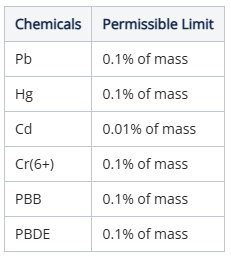
Annex 2 provides a specific list containing products subject to the above items, in which the concentration of the toxic chemicals shall be controlled within the limit. Annex 3 provides a list of products that are exempted from applying the limitation.
According to Annex 1, the permissible content limitation is as follows:
Organizations and individuals that produce or import electronic and electrical products are responsible for disclosing general information that the electrical, electronic products comply with the provisions of this Circular within the permissible limit of toxic chemicals. The disclosure can be made in one of the following forms:
Post on the website of the organizations/individuals;
Print information in the instruction manual (manual books or papers along with the product);
Provide information in an electronic form (CD, etc.);
A penalty ranging from VND 3,000,000 to VND 20,000,000 shall be applied for any one of the following violations:
Failure to retain documents complying with the permissible limit of toxic chemicals;
Failure to disclose information on permissible limit of toxic chemicals;
Failure to compile documents complying with the permissible limit of toxic chemicals;
Manufacture and/or import of electrical, electronic products that exceed the permissible limit of toxic chemicals. The violator is also forced to recycle and export or dispose (if can't recycle or export) any violated products.
Circular No. 01/2026/TT-BCT, which establishes classification, labeling and SDS requirements for substances and mixtures in line with the United Nations Globally Harmonized System (GHS), are fully implemented in Vietnam for both substances and mixtures.
Classification of chemicals is mentioned in Article 7 of Circular No. 01/2026/TT-BCT, in accordance with the rules and technical guidance of GHS from Revision 2 (2007) onwards.
The following GHS classes or categories are not adopted by Vietnam:
Desensitized explosives
Hazardous to the Ozone Layer
Due to the very specific and complex nature of requirements related to classification, please refer to Annex XV of Circular No. 01/2026/TT-BCT for details.
Failure to classify chemicals in correspondence to GHS Revision 2, 2007 and onwards results in a penalty from 3,000,000 to 5,000,000 VND.
Failure to classify manufactured or imported chemicals before putting them into circulation results in a penalty from 10,000,000 to 15,000,000 VND. The violator is forced to recall any not-yet-classified chemicals from market circulation.
Where test data is not available for a mixture, for health and environmental endpoints, the GHS allows for classification based on the hazards of the substances in the mixture. The GHS usually defines the concentration at which a hazardous substance causes a mixture containing that substance to be classified, for most hazards. These are known as Concentration limits/Cut-off values. Countries must additionally set the thresholds for mixture classification for certain hazards:
Vietnam is implementing specific classification cut-off values and concentration limits for mixtures for certain hazard classes, prescribed in Annex XV of Circular No. 01/2026/TT-BCT which provides GHS Implementation Guidelines for Classification and Labeling of Chemicals.
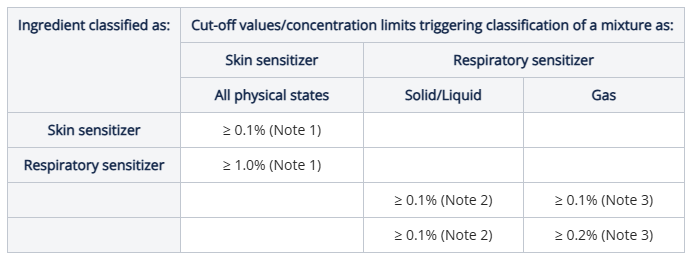
Cut-off values/concentration limits of a substance which is a skin/respiratory sensitizer that would trigger classification of a mixture:
Note:
If a skin sensitizer is present in a mixture with a concentration of ≥ 0.1%, it must be reported in the Safety Data Sheet (SDS) and the label;
If a solid/liquid is a respiratory sensitizer and present in a mixture with a concentration of ≥ 0.1%, it must be reported in the Safety Data Sheet (SDS) and the label;
If a gaseous respiratory sensitizer is present in a mixture with a concentration of ≥ 0.1%, it must be reported in the Safety Data Sheet (SDS) and the label.
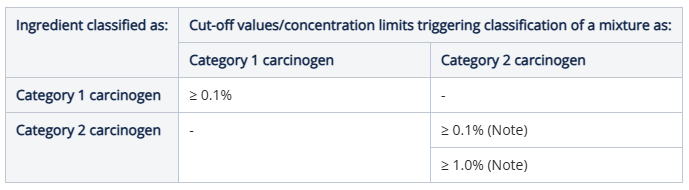
Cut-off values/concentration limits of a substance which is a carcinogen that would trigger classification of a mixture:
Note: If an ingredient is a Category 2 carcinogen present in a mixture with a concentration of ≥ 0.1%, it must be reported in the Safety Data Sheet (SDS) and the label.
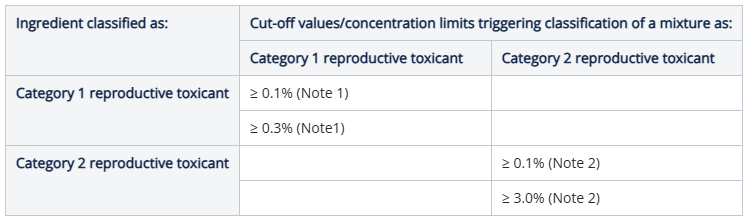
Cut-off values/concentration limits of a substance which is a reproductive toxicant that would trigger classification of a mixture:
Note:
If a Category 1 reproductive toxicant is in a mixture at the concentration of ≥ 0.1%, it must be reported in the Safety Data Sheet (SDS) and the label.
If a Category 2 reproductive toxicant is in a mixture at the concentration of ≥ 0.1%, it must be reported in the Safety Data Sheet (SDS) and the label.
¶ Specific Target Organ Toxicity - Single Exposure
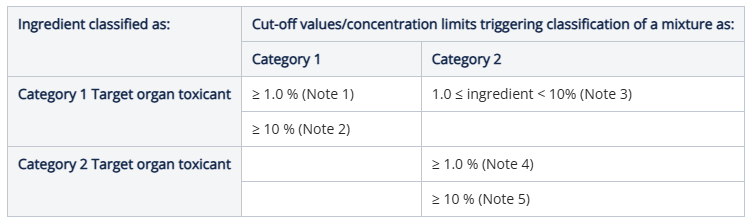
Cut-off values/concentration limits of a substance which is a specific target organ toxicant - single exposure that would trigger classification of a mixture:
Note:
If a Category 1 Target organ toxicant - single exposure is present in a mixture with a concentration of between 1.0% and 10%, it must be reported in the Safety Data Sheet (SDS).
If a Category 1 Target organ toxicant - single exposure is present in a mixture with a concentration of ≥ 10%, it must be reported in the Safety Data Sheet (SDS) and the label.
If a Category 1 Target organ toxicant - single exposure is present in a mixture with a concentration of between 1.0% and 10%, the classification of this mixture is a Category 2 Target organ toxicant - single exposure.
If a Category 2 Target organ toxicant - single exposure is present in a mixture with a concentration of between 1.0% and 10%, it must be reported in the Safety Data Sheet (SDS).
If a Category 2 Target organ toxicant - single exposure is present in a mixture with a concentration of ≥ 10%, it must be reported in the Safety Data Sheet (SDS) and the label.
¶ Specific Target Organ Toxicity - Repeated Exposure
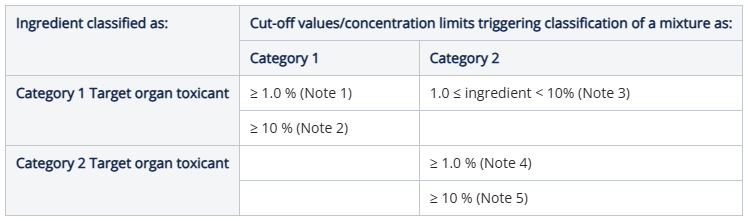
Cut-off values/concentration limits of a substance which is a specific target organ toxicant - repeated exposure that would trigger classification of a mixture:
Note:
If a Category 1 Target organ toxicant - repeated exposure is present in a mixture with a concentration of between 1.0% and 10%, it must be reported in the Safety Data Sheet (SDS).
If a Category 1 Target organ toxicant - repeated exposure is present in a mixture with a concentration of ≥ 10%, it must be reported in the Safety Data Sheet (SDS) and the label.
If a Category 1 Target organ toxicant - repeated exposure is present in a mixture with a concentration of between 1.0% and 10%, the classification of this mixture is a Category 2 Target organ toxicant - repeated exposure.
If a Category 2 Target organ toxicant - repeated exposure is present in a mixture with a concentration of between 1.0% and 10%, it must be reported in the Safety Data Sheet (SDS).
If a Category 2 Target organ toxicant - repeated exposure is present in a mixture with a concentration of ≥ 10%, it must be reported in the Safety Data Sheet (SDS) and the label.
Organizations and individuals producing or importing hazardous chemicals must prepare Safety Data Sheets (SDSs) prior to using and delivering these chemicals to the market and be legally responsible for the SDS's content. Vietnam has adopted the Globally Harmonized System (GHS). According to the Chemical Law (Article 25) and Circular No. 01/2026/TT-BCT (Annex I), an SDS is required to be in 16 section format.
The SDS shall be in Vietnamese. Organizations and individuals must keep the SDSs for all hazardous chemicals in the facility and ensure that all parties involved in activities related to hazardous chemicals are provided with SDSs of those chemicals.
A penalty shall be applied for any one of the following violations:
Failure to specify any required sections of the SDS (penalty from 500,000 to 1,000,000 VND);
Specification of false information about chemical hazards in the SDS (penalty from 3,000,000 to 5,000,000 VND; the violator is forced to correct the false information);
Failure to provide SDS to any individuals/organization using hazardous chemicals to manufacture other products (penalty from 10,000,000 to 15,000,000 VND);
Failure to provide SDS in Vietnamese for hazardous chemicals before putting them into circulation (penalty from 15,000,000 to 20,000,000 VND; the violator is forced to recall and recycle or dispose (if can't be recycled) any circulated hazardous chemicals that threaten the human, animal and plantation health and environment).
Decree No. 37/2026/ND-CP, a regulation on labeling of goods, came into effect on January 23, 2026, and replaced Decree No. 43/2017/ND-CP. The Decree regulates labels of circulated and imported goods in Vietnam except temporarily imported goods for re-export or transit; fuels and materials of agriculture, fishing and minerals to be directly sold; petroleum and gas without commercial packaging; used goods and radioactive substances.
Chapter IV of Decree No. 37/2026/ND-CP regulates the mandatory contents on a label. A label must include name(s) of good(s), name(s) and address(es) of organization(s)/individual(s) responsible for the good(s), origin(s) of good(s). In addition, a label for a chemical product must contain the following items:
Quantity;
Date of manufacture;
Expiry date (if any);
Ingredients or ingredient quantities;
Chemical identification code (if any);
Pictogram, signal words, risk warning;
Precautions;
Manuals, maintenance instructions.
Other than the requirements of Decree No. 37/2026/ND-CP, Clause 4 Article 23 of the Chemical Law requires the labeling of hazardous chemicals to follows GHS guidelines.
Information on hazardous chemical contents and compositions and use restrictions of the products and goods containing hazardous chemicals must be disclosed and displayed on information portal or website of manufacturers and importers or in physical sale locations, and on labels of the products and goods.
The compulsory content of goods labels must be in Vietnamese, except:
International names or scientific names of ingredients or ingredient quantities of goods, in case they cannot be translated into Vietnamese or their Vietnamese translations are meaningless;
Names and addresses of foreign manufacturing or franchising enterprises.
For goods domestically manufactured and circulated, their labels may contain information in another language. The content in another language must be similar to that content in Vietnamese and the size of letters in another language must not be bigger than those in Vietnamese.
According to Article 5 Chapter I of Decree No. 43/2017/ND-CP, organizations and individuals responsible for labeling goods shall determine the size of labels, however, must ensure that such labels with all compulsory contents (specified in Content) are easily readable by naked eyes.
Goods or packaging with small dimensions are those that cannot display all compulsory information using a minimum font size of 0.9 mm. For these goods or packaging, this information (name(s) of good(s), name(s) and address(es) of organization(s)/individual(s) responsible for the good(s), origin(s) of good(s)) must be displayed on a physical label on the goods or packaging. The remaining information may be provided in supplemental documents or electronic labels.
For imported goods or packaging with small dimensions, the contents must be displayed on a physical label on the goods or packaging, including name(s) of good(s), origin(s) of good(s), name(s) and address(es) of organization(s)/individual(s) responsible for the good(s) in foreign countries.
The position of label is regulated in Article 36 of Decree No. 37/2026/ND-CP as following:
Goods labels must be attached to goods or commercial packing at a position where the compulsory contents of goods labels can be easily and fully noticeable without detaching any components.
In case it is disallowed or impossible to open exterior packing, labels containing all compulsory contents must be attached to exterior packing.
In case the goods have interior and exterior packaging, the requirements are as follows:
For goods with an exterior packaging and individual units with interior packaging not to be sold separately, the label must be placed on the exterior packaging.
For goods with an exterior packaging and individual units with interior packaging to be sold separately, the label must be placed on both packaging.
If the exterior packaging cannot be opened, the exterior packaging must have a label that has the compulsory information.
If the label content of the product can be observed through transparent packaging, label in the transparent packaging is not required.
According to Clause 3 Article 40 of Decree No. 37/2026/ND-CP, a supplementary label containing compulsory contents in Vietnamese is required for imported goods whose labels are unable to contain or do not contain full contents in Vietnamese (original labels shall remain unchanged). The content in Vietnamese and in the original language must be consistent.
A supplementary label shall be attached to a container without obscuring the original label. Supplementary labels can be e-labels.
Vietnamese Decision No. 3733/2002/QD-BYT of the Ministry of Health on the Labor Hygiene Standard establishes the workplace Occupational Exposure Limits (OELs) that are required to be disclosed in Section 8 of the Vietnamese SDS.
OELs for chemicals present in working air are regulated in Chapter XXI of the said decision. It applies to all facilities that are considered ''working environments'' (manufacturing, business, service facilities etc.) and not to residential environments.
On June 10, 2019, the Ministry of Health issued Circular No. 10/2019/TT-BYT to promulgate the national technical regulations for OELs of 50 chemicals present in working air including calculation formula and quantitative methodology. This regulation replaced the corresponding requirement of corresponding 50 chemicals in Decision No. 3733/2002/QD-BYT when it came into effect on December 9, 2019. On April 28, 2025, Circular No. 09/2025/TT-BYT was issued to revise an additional 70 chemicals in workplace, effective from October 1, 2025.
All working establishments are required to periodically monitor the chemical concentrations at least once a year and immediately perform necessary measures to improve working conditions and protect employees' health when the concentrations exceed the threshold.
Decision No. 3733/2002/QD-BYT contains 4 standards regarding dust at workplaces for silica dust, non-silica dust, cotton dust and asbestos dust. These standards were replaced, as of September 22, 2019, by Circular No. 02/2019/TT-BYT which promulgates the national technical regulation on OELs for 5 types of dust: asbestos dust, silica dust, non-silica dust, cotton dust and coal dust. This regulation applies to governmental agencies of environmental management, organizations monitoring the working environment and organizations and individuals having dust generating activities at workplaces.
Clause 1 Article 26 Chapter IV of Chemical Law 2025 states that certain confidential information of declarants, registrants and reporters can be claimed as long as relevant information and supporting documents are provided to the authorities to evaluate for the necessity of the confidentiality request. Article 26 of Decree No. 26/2026/ND-CP specifies that the requesters can submit encrypted information registered with the authorities. If the organizations or individuals requesting Confidential Business Information (CBI) cannot directly provide the information, the foreign manufacturers or suppliers must provide said information via their representatives or their designated entities in Vietnam. The evaluation results will be sent to the requesters and to MOIT to publish in the National database.
According to Clause 2 Article 26, Chapter IV of Chemical Law 2025 the following information shall not be considered as confidential:
Trade names of chemicals;
Names of organizations and individuals producing or importing chemicals or organizations and individuals reporting on chemical activities into the National database;
Safety data sheets;
Information serving the prevention of and response to chemical incidents, prevention and mitigation of adverse impacts of chemical toxicity, warning information for the person using or exposed to chemicals, and methods to preliminarily remedy incidents;
Analysis methods to determine the possibility of human or environmental exposure to chemicals, and summarized results of chemical toxicity testing;
Purity of mixtures or substances and hazards of additives and impurities.
The transportation of dangerous goods is regulated under several different regulations, applying to all Vietnamese and foreign organizations and individuals engaged in the transport of dangerous goods in Vietnamese territory. There are three main means of transportation regulated under different regulations: roadway by Decree No. 161/2024/ND-CP, inland waterway by Decree No. 34/2024/ND-CP and railway by Decree No. 16/2026/ND-CP.
Hazardous goods are classified into nine classes. In addition to complying with the requirement under each Decree for the specific means of transportation, involved parties also have to comply with regulations related to the classifications of their goods (if any).
Classification of dangerous goods
Class 1. Explosive substances and articles
Division 1.1: Substances and articles which have a mass explosion hazard
Division 1.2: Substances and articles which have a projection hazard but not a mass explosion hazard
Division 1.3: Substances and articles having a fire hazard and either a minor blast hazard or a minor projection hazard or both, but not a mass explosion hazard
Division 1.4: Substances and articles which present no significant hazard
Division 1.5: Very insensitive substances which have a mass explosion hazard
Division 1.6: Extremely insensitive articles which do not have a mass explosion hazard
Class 2. Gases
Division 2.1: Flammable gases
Division 2.2: Non-flammable, non-toxic gases
Division 2.3: Toxic gases
Class 3. Flammable liquids and desensitized liquid explosives
Class 4.
Division 4.1: Flammable solids, self-reactive substances and solid explosives which are submerged in liquid or desensitized
Division 4.2: Substances liable to spontaneous combustion
Division 4.3. Substances which, in contact with water, emit flammable gases
Class 5.
Division 5.1: Oxidizing substances
Division 5.2: Organic peroxides
Class 6.
Division 6.1: Toxic substances
Division 6.2. Infectious substances
Class 7: Radioactive materials (also complied to Circular No. 59/2025/TT-BKHCN)
Class 8: Corrosive substances
Class 9: Miscellaneous dangerous substances and articles
Packages and containers of hazardous chemicals that are not cleaned internally and externally after unpacking shall also be considered hazardous goods and classified in corresponding to their content.
Vietnam's Ministry of Industry and Trade (MOIT) issued Circular No. 37/2020/TT-BCT (previously Circular No. 44/2012/TT-BCT) to promulgate regulations on the list of dangerous industrial goods with packaging required during transportation and transportation of dangerous industrial goods by roadway, railway and inland waterway motor vehicle. For the transport of dangerous industrial goods in bulk in a quantity greater than that specified in column 7 of the list in Appendix I, there must be an emergency response plan. The contents of the emergency response plan are specified in Appendix IV of this Circular. For the dangerous industrial goods not subject to provide an emergency response plan, there must be a chemical safety form including the troubleshooting instructions for the spill, leakage or explosion of goods being transported. An emergency response plan or troubleshooting instructions must be carried during transportation of dangerous industrial goods and kept in a conspicuous position in the vehicle by the driver of the vehicle.
A penalty from 2,000,000 to 3,000,000 VND shall be imposed to the transporter for not having an escort when transporting chemicals exceeding the regulated threshold.
A penalty shall also be applied for any one of the following violations:
Failure to provide the transporter with applicable personal protective equipment (penalty from 3,000,000 to 4,000,000 VND);
Employing transporter without a Certificate of training in safe transport of hazardous industrial goods (penalty from 3,000,000 to 5,000,000 VND;
Transportation of chemicals in a newly produced or reusable container which has not been tested or inspected before packaging (penalty from 5,000,000 to 10,000,000 VND; the violator is required to provide measures to control any environmental pollution occurred);
Failure to fulfill regulated packaging requirements before transportation or develop an emergency response plan when transporting chemicals exceeding the regulated threshold (penalty from 10,000,000 to 15,000,000 VND; the violator is required to provide measures to control any environmental pollution occurred).