¶ Recent Updates2026
2025
|
|
¶ Background |
|
|
Australia has a three-tiered government system: Federal or Commonwealth, State or Territory, and Local. Australia has 6 States including New South Wales, Queensland, South Australia, Tasmania, Victoria, and Western Australia, and two major mainland territories, the Australian Capital Territory and the Northern Territory. Assessment and registration of chemicals is covered by national schemes to minimize unnecessary regulatory burden on industry. These schemes operate as follows:
Industrial chemicals are assessed and notified at the national level. However, State and Territory governments are responsible for the control of storage, supply, use, and transport of industrial chemicals. |
Chemical related government gazettes may be found at the following links:
|
¶ Inventories |
|
¶ The Australian Inventory of Industrial ChemicalsUnder the Australian Government's Industrial Chemicals Act 2019 (IC Act), the Australian Industrial Chemicals Introduction Scheme (AICIS) must keep a list of industrial chemicals that can be introduced or manufactured in Australia. The list, which is called the Australian Inventory of Industrial Chemicals (the Inventory), replaced the Australian Inventory of Chemical Substances (AICS) on July 1, 2020. This new inventory contains about 40000 industrial chemicals, and approximately 1600 chemicals in the AICS have been removed from the inventory as they were not industrial chemicals. The inventory is used to determine if an introduction is a listed introduction, or other type of introduction which requires further categorisation. The following chemicals don't need to be listed on the inventory for import or manufacture:
Information provided by the Inventory includes:
¶ Unlisted IntroductionAn unlisted introduction applies when the industrial chemical is not listed on the Inventory, or is outside the terms of the inventory listing. Under the IC Act, introducers are responsible for categorizing the unlisted introduction into one of the four categories: exempted introduction, reported introduction, assessed introduction, commercial evaluation authorisation, based on exposure and hazard information. ¶ Listed IntroductionA listed introduction applies when the industrial chemical is listed on the inventory and complies with all terms and conditions included on the inventory listing. Due to the large number of listed substances, AICIS performs the existing chemical assessments on a priority basis in response to concerns about their health and/or environmental effect. Where applicable, the inventory will also include a defined scope of assessment, any conditions of introduction or use, and specific information requirements. For a listed introduction, it will be important for manufacturers and importers to ensure that they meet all the conditions associated with it on the AICIS Inventory. This can include the volume permitted to be introduced or used, and where or how the chemical is allowed to be used. ¶ CBIUnlike AICS which has two sections: a public section and a confidential section, there is no confidential section of the publicly searchable inventory. Confidential Business Information (CBI) is protected in the inventory by substituting chemical name and end use with AICIS Approved Chemical Name (AACN) and Generalised End Use (GEU). Once the CBI application is approved, the protection will be in place for a maximium of five years, before being reviewed by AICIS. If you can't find your chemical on the Inventory and you are genuinely intending to import or manufacture it in Australia, you can submit confidential inventory search requests through AICIS Business Services. AICIS will review requests and inform users once the applications have been completed. All results will be kept in the service history in the account for future reference. The search service is free of charge. ¶ Adding to the InventoryAll chemicals that receive an assessment certificate are automatically added to the the Inventory five years after the certificate date. However, the certificate holder can apply for an early listing to add the assessed chemicals to the inventory before the five-year certificate period expires. For a chemical with CBI protection, the CBI approval lasts for five years. When the chemical is due for Inventory listing, the certificate holder may apply to continue the protection. If approved, the chemical will be listed with the CBI protected. |
Sources
|
¶ Substance Registration |
|
| There are currently no obligations to register substances in Australia. However, the notification scheme applies to new chemicals that are not on the inventory. | |
¶ Product Registration |
|
¶ PesticidesIn Australia, agricultural chemicals are regulated along with veterinary chemicals under the Agricultural and Veterinary Chemicals Act 1992 and the Agricultural and Veterinary Chemicals Code Act 1994. All new agricultural and veterinary chemical products must be registered with the Australian Pesticides and Veterinary Medicines Authority (APVMA) before they can be supplied, sold or used in Australia. APVMA maintains the Public Chemical Registration Information System (PUBCRIS), which contains details of agricultural and veterinary chemical products registered in Australia and the approved active constituents contained in them. An application for registration of an agricultural or veterinary chemical product is required to be made through the APVMA portal, an online system where applicants can submit and check the status of their applications. Applicants can request pre-application assistance regarding how to prepare and submit a complete application. Each chemical product submitted to the APVMA for registration will undergo an assessment that takes between 3 and 18 months before it can be approved. All active constituents for agricultural and veterinary chemical products are to be approved by APVMA. Active constituents may be approved either before, or at the same time the product is registered. ¶ Who can applyAn applicant may be an individual or a corporate body, irrespective of whether or not they are in Australia. However, an oversea holder of a registration will be required to appoint an Australian nominated agent once approval and/or registration is completed. A nominated agent has the same rights and obligations as a holder. This ensures that there is a person in Australia with the same liabilities as the holder for the active constituent or chemical product. Australian applicants may appoint an authorised agent to act on their behalf on an ongoing basis. Overseas entities can only use authorised agents to assist with the application process for approval or registration. ¶ Timeframe and feesThe assessment period and the application fee depend on the application type and the complexity of the application. Please refer to Table 1: Approvals and registrations made under section 10 of the Agvet Code from the APVMA website for assessment periods and fees. ¶ Renewals of registrationThe holder of a registration shall apply to renew their registration each financial year or for a period of five years. The renewal application must be made no later than one month before the registration ends. An application to renew a registration must be made online through the APVMA portal. The renewal fee is $700 for 1 year, $3850 for 5 years. |
Sources
Resources |
¶ CosmeticsIn Australia, cosmetics are regulated as industrial chemicals under Industrial Chemicals Act 2019 (IC Act 2019) by the Australian Industrial Chemicals Introduction Scheme (AICIS). In Australia, cosmetics are regulated under the Industrial Chemicals Act 2019 (IC Act 2019), with the chemical ingredients in cosmetics regulated as industrial chemicals by the Australian Industrial Chemicals Introduction Scheme (AICIS). Products that are therapeutic goods are regulated separately by the Therapeutic Goods Administration (TGA).
¶ Definition of CosmeticsCosmetic product is defined as a substance or preparation intended for placement in contact with any external part of the human body or inside the mouth for the purpose of altering the odours of the body, changing its appearance, cleansing it, maintaining it in good condition, perfuming it or protecting it. The product must not be for preventing, diagnosing, curing or alleviating a disease, ailment, defect or injury in persons. AICIS doesn't regulate therapeutic goods that claim to have a ‘therapeutic’ effect, such as desensitising toothpastes, skin-whitening lotions, primary sunscreens, and disinfectants, etc. ¶ Sunscreen ProductsThe following sunscreen products are regulated as cosmetics by AICIS:
The following sunscreen products are regulated as therapeutic goods by the Therapeutic Goods Administration (TGA):
¶ RegistrationAustralian manufacturers and importers of industrial chemicals, including cosmetics, for commercial purposes must register with AICIS. It is not the registration of chemicals or products, but is the registration of the business to enable the manufacturer or importer to lawfully manufacture or import relevant industrial chemicals into Australia. A registration year runs from September 1 to August 31 of the following year. There are eight levels of registration. Your registration level and hence registration cost is based on the total value (in Australian dollars) of relevant industrial chemicals imported and/or manufactured each year. Manufacturers and importers of cosmetics may register their business via the AICIS Business Services by providing the value of the relevant industrial chemicals imported and/or manufactured during the previous financial year. Your registration level and hence registration cost is based on the total value (in Australian dollars) of relevant industrial chemicals imported and/or manufactured in the previous financial year. The following table provides a summary of AICIS registration fees and charges for the 2026-2027 registration year. 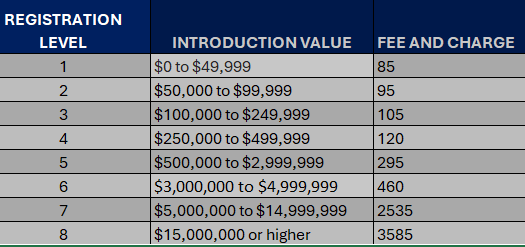 ¶ Obligations for Introduction of CosmeticsIntroducers of industrial chemicals, including ingredients in cosmetic products, must categorise their introduction into one of five main categories below, based on risk of introduction of a chemical:
Certain regulatory obligations such as pre-introduction report, premarket risk assessment, annual declaration, must be met for the category of introduction. Please refer to New Chemical Notification for the requirements for each category of introduction. ¶ Animal TestingAustralia bans the use of new animal test data obtained from tests conducted on or after July 1, 2020, with the following exceptions:
¶ LabellingUnder the Work Health and Safety Regulations, cosmetics for consumer use are exempt from workplace labelling requirements when used in a manner and quantity consistent with household use. Cosmetic products must have full ingredient disclosure in accordance with the Consumer Goods (Cosmetics) Information Standard 2020 which is administered by the Australian Competition and Consumer Commission (ACCC). The ingredients in a cosmetic product must be listed on the container or on the product if the product is not packed in a container. The names of the ingredients in the list must be either their English names or their International Nomenclature Cosmetic Ingredient names. When listing ingredients, ingredients in concentrations of 1 percent or more need to appear in descending order by volume or mass, while ingredients in concentrations of less than 1 percent may appear in any order. The quantity or percentage of each ingredient is not required to be listed. A fragrance or fragrances in a cosmetic product must be shown in the list of the product’s ingredients by including the word ‘fragrance’, ‘fragrances’, ‘parfum’ or ‘parfums' or the ingredients in the fragrance or fragrances. ¶ MicrobeadsAustralia started a voluntary industry phase-out of plastic microbeads in November 2016. The voluntary phase out was led by the national industry association (Accord) and overseen by the Commonwealth Department of Environment and Energy and the NSW Environment Protection Authority. The scope of the phase-out includes rinse-off personal care, cosmetics and cleaning products for skin, hair or mouth. It doesn't include cosmetic products that are wiped off, such as make up and lipsticks. The microbeads were replaced with natural biological materials such as cellulose, jojoba wax, bamboo beads, polenta and fruit/nut kernels. In 2018, the Department of the Environment and Energy conducted an assessment of progress toward the voluntary phase-out of microbeads and was satisfied with the voluntary result and will keep monitoring and promoting the phase-out of microbeads. |
Sources
Resources
Scope Quick Check
|
¶ Notifications |
|
¶ New Chemical NotificationThe Australian Government's Industrial Chemicals Act 2019 (IC Act) and Industrial Chemicals (General) Rules 2019 regulate the introduction of industrial chemicals and provide a national scheme for the notification and assessment of industrial chemicals. The scheme is known as the Australian Industrial Chemicals Introduction Scheme (AICIS), which replaced the National Industrial Chemicals Notification and Assessment Scheme (NICNAS) on July 1, 2020. Chemical introducers must follow AICIS requirements to categorise their introductions and meet the obligations associated with the applicable introduction category. AICIS regulates industrial chemicals only. Chemicals used solely as agricultural chemicals, medicines, or food additives are outside of the scope of the IC Act. The IC Act requires introducers of industrial chemicals to categorise their introduction into one of five main categories below, based on risk of introduction of a chemical. ¶ Introduction CategoriesThere are five introduction categories: listed introduction, exempted introduction, reported introduction, assessed introduction, and introduction for commercial evaluation. ¶ 1. Listed IntroductionListed introduction applies to chemicals that are listed on the inventory, and the chemicals are introduced within the conditions and terms of the inventory listing. ¶ ObligationsAnnual declaration Introducers of listed chemicals must submit an annual declaration after the end of the registration year via AICIS Business Services. The annual declaration is due by November 30 each year and covers introductions during the previous registration year, September 1 to August 31. Record keeping Introducers of listed chemicals must keep records about their chemical introductions. Information on the record shall include chemical identity information, such as CAS number, IUPAC or eligible INCI name, and terms of the inventory listing, if a defined scope of assessment, conditions, or specific requirements to provide information to AICIS are included. The record must be kept for 5 years. Introducers have 20 business days to provide the record to AICIS once they are requested for the record. ¶ 2. Exempt introductionExempt introduction applies to chemicals that are not listed on the inventory and have a very low risk to human health and the environment. Special cases Introductions that cannot be exempted:
Introductions that may be categorised as exempted if they meet the applicable criteria:
¶ ObligationsPost-introduction report A one time post-introduction declaration is required for the following chemicals for the first time introduction:
All post-introduction declarations must be submitted via AICIS Business Services Portal by November 30 for the previous registration year. Information to be provided for introductions categorised as very low risk generally includes: chemical identity information, the total introduction volume, the end use, and the maximum concentration of the industrial chemical. Annual declaration Introducers of exempted chemicals must submit an annual declaration after the end of the registration year via AICIS Business Services. The annual declaration is due by November 30 each year and covers introductions during the previous registration year, September 1 to August 31. Record keeping Introducers of exempted chemicals must keep records about their chemical introductions. Information on the record for introductions where the highest indicative risk is very low shall include: chemical identity, information to prove the introduction isn't medium to high risk or low risk, description of the introduction, use and exposure, hazard characteristics, and additional information for specified classes of introduction. Please prepare your records in accordance with the EXEMPTED Checklist - Highest indicative risk for your introduction is very low risk.pdf The record must be kept for 5 years. Introducers have 20 business days to provide the record to AICIS once they are requested for the record. ¶ 3. Reported introductionReport introduction applies to chemicals that are not listed on the inventory and have chemicals with a low risk. A one time declaration is required before the product is introduced. Record keeping is required. Special cases Introductions that may be categorised as reported if they meet the applicable criteria:
Introduction that cannot be reported:
¶ ObligationsPre-introduction report Introducers of chemicals under the reported category must submit a one-time pre-introduction report via the AICIS Business Services before importing or manufacturing. Information to be provided in the report for low risk introductions generally include: chemical identity information and information on how you categorised your introduction as reported, such as the introduction volume, end use, human health and environment hazard characteristics and exposure bands that apply to your introduction. Annual declaration Introducers of chemicals under the reported category must submit an annual declaration after the end of the registration year via the AICIS Business Services. The annual declaration is due by 30 November following the end of the registration year. The registration year runs from September 1 to August 31. There is no fee to submit the declaration. Record keeping Introducers of chemicals under the reported category must keep records about their chemical introductions. Information on the record shall include: chemical identity, information to prove the introduction isn't medium to high risk, description of the introduction, use and exposure, hazard characteristics, and additional information for specified classes of introduction. Please prepare your records for low risk introductions in accordance with the Checklist - Highest indicative risk for your introduction is low risk.pdf The record must be kept for 5 years. Introducers have 20 business days to provide the record to AICIS once they are requested for the record. ¶ 4. Assessed introductionAssessed introduction applies to chemicals that are not listed on the inventory and have a medium to high risk. An assessment certificate is required before you introduce the product. Only assessed introductions will be added to the Inventory. Special cases Introductions that are always medium to high risk for human health:
Introductions that are always medium to high risk to the Environment:
¶ ObligationsPremarket risk assessment Who can apply? Applicant of an assessment certificate can be an Australian business with an Australian Business Number, or an overseas business with an Australia Registered Body Number. How to apply? The premarket risk assessment application shall be submitted through the Business Services Portal. The required information for the risk assessment depends on whether the assessment is applied with a health focus or an environment focus, but generally the following information is required:
The assessment timeframe is 70 business days after the application is received. Once the process is completed, an assessment certificate will be issued through the AICIS Business Services Portal. The certificate includes:
Assessment certificate holders can apply to vary the terms of their certificate if they wish to vary the defined scope of assessment, a condition or a specific information obligation. Annual declaration Manufacturers and importers of assessed introductions must submit an annual declaration after the end of the registration year via AICIS Business Services. The registration year runs from September 1 to August 31 each year, and the annual declaration is due by November 30 following the end of the registration year. Record keeping Manufacturers and importers must keep records about their chemical introductions. Information on the record shall include: chemical name or AICIS Approved Chemical Name (AACN), and records to prove the introduction complies with the terms of the assessment certificate, including defined scope of assessment, conditions, or specific requirements to provide information to AICIS are included. The record must be kept for 5 years. Introducers have 20 business days to provide the record to AICIS once they are requested for the record. ¶ 5. Commercial EvaluationCommercial evaluation authorization applies to the introduction of a chemical into Australia for evaluation of its commercial potential. The authorization is valid for a maximum of 4 years and for up to 10 tonnes over 4 years. You are not allowed to renew the authorization after the 4 year period. ¶ ObligationsCommercial Evaluation Authorisation (CEA) Manufacturers and importers of chemicals can apply for an authorization for activities under commercial evaluation, such as trialing and optimising formulation processes, and market testing. The application Form must be submitted through AICIS Business Services Portal with the following required information: business information, chemical details, introduction and end use details. AICIS will make a decision within 20 working days on whether to issue a CEA. The chemical will not be added to the Inventory and the following information will be published on the AICIS website:
¶ Notification FeesThe fees for applications of assessment certificate and commercial evaluation authorization are available here. |
Sources Resources |
¶ Specific Information Requirement (Secondary Notification)All chemicals that have been assessed by AICIS, including both new and listed chemicals may be subject to a specific information requirement, previously known as a secondary notification requirement under the NICNAS. The AICIS inventory will indicate whether a chemical is subject to the requirement. Specific information may be required, for example, when the introducer can't find the assessment report for the chemical, or becomes aware of any new hazards that haven't identified by AICIS in their assessment or evaluation statement, or becomes aware of an increase in the severity of a hazard that AICIS has already identified in their most recent assessment or evaluation statement. The importer or manufacturer must notify the Director of Chemicals Notification and Assessment within the timeframe specified in the applicable Specific Information Requirement. A notification shall be submitted through the online form on the AICIS website. AICIS will decide if an evaluation is needed after receiving the information. There is no fee for an evaluation. |
Resources |
¶ Restrictions and Bans |
|
¶ Ozone Depleting SubstancesAustralia ratified the Montreal Protocol in 1989 and has set forth the Ozone Protection and Synthetic Greenhouse Gas Management Act 1989 and Ozone Protection and Synthetic Greenhouse Gas Management Regulations 1995 for the reduction and eventual elimination of ozone depleting substances (ODS). The Act and Regulations impose licensing requirements for manufacturing, importing, and exporting the controlled substances in Australia. Schedule I of the Act contains the scheduled substances covered under the Ozone Protection Act. Each substance is separated into one of twelve parts. The parts are:
The National Environmental Protection Agency (National EPA), established on July 1, 2026, is responsible for administering the licensing and reporting framework for ozone depleting substances and synthetic greenhouse gases. Businesses engaging in the manufacture, import, or export of regulated substances, or certain equipment containing these substances, must obtain the applicable licence or qualify for an exemption. Depending on the substance or activity, licences include Equipment Licences (EQPLs), Controlled Substances Licences, Essential Uses Licences, and Used Substances Licences. |
Sources |
¶ Restriction of Hazardous Substances (RoHS)Currently Australia does not have a RoHS-like regulation. |
|
¶ Persistent Organic Pollutants (POPs)Australia ratified Stockholm Convention on Persistent Organic Pollutants (POPs) in May 2004 and has set out the National Implementation Plan to reduce the presence of POPs and meet the obligation under the convention. The Department of Climate Change, Energy, the Environment and Water (DCCEEW) is the lead agency for implementation of the convention in consultation with other agencies, including the Department of Agriculture, Fisheries and Forestry, National Industrial Chemicals Notification and Assessment Scheme, and Australian Customs Service. Import, manufacture, use and export of POPs are regulated by the following regulations:
|
Sources |
¶ SDS + Label |
|
¶ ClassificationUnder the Work Health and Safety (WHS) Regulations, manufacturers and importers have the responsibility to determine whether a substance, mixture or article is a hazardous chemical, and to ensure that the hazardous chemical is correctly classified. Australia implemented the 3rd Revised edition on January 1, 2012. The 5-year transitional period, during which manufacturers could use the GHS classification in accordance with the WHS Regulations (based on GHS), or the Approved Criteria for Classifying Hazardous Substances [NOHSC (1008:2004)], ended on December 31, 2016. Australia started to move from the 3rd revised edition of the GHS (GHS 3) to the 7th revised edition of the GHS (GHS 7) on January 1, 2021, with a 2 year transition period. Starting from January 1, 2023, the GHS 7 must be used for classification and labelling of hazardous chemicals in Australia. ¶ Work Health and Safety Regulations (GHS)The manufacturer or importer of a hazardous chemical product must ensure that the hazardous chemical is correctly classified in accordance with GHS 7 before supplying it to a workplace. Refer to the Classifying Hazardous Chemicals National Guide for more information on how to classify mixtures of hazardous chemicals. The following are adopted endpoints by Australia based on the 7th revised edition of the UN GHS system with some hazard categories excluded. List of Adopted Endpoints
GHS Revision 7 Building Blocks Excluded
Under the WHS Regulations, a hazardous chemical is defined as a substance, mixture, or article that can pose a significant risk to health and safety if not managed correctly. Hazardous chemicals may have health hazards, physical hazards or both. For hazard communications, environment hazard classifications are not compulsory, but the best practice is to include environment hazards where known. For some hazard classes and categories in the UN GHS system, competent authorities are given an option of choosing concentration cut-off values to use. Australia is implementing specific classification cut-off values and concentration limits for mixture classification for certain hazard classes, prescribed in Schedule 6 of the WHS Regulations. To assist with the correct classification of hazardous chemicals using the GHS, Safe Work Australia developed the Hazardous Chemical Information System (HCIS). HCIS provides GHS classification and labelling information for chemicals evaluated by authoritative sources, including the European Chemicals Agency (ECHA) and the Australian Industrial Chemicals Introduction Scheme (AICIS), formerly NICNAS. The information in HCIS is advisory and does not cover every hazardous chemical. Manufacturers and importers remain responsible for determining whether their products are hazardous chemicals and for assigning the appropriate classifications. The original HCIS was released in June 2016. In August 2026, Safe Work Australia introduced a redesigned HCIS to replace the original system. The updated system offers a simplified way to search chemical information and incorporates more recent GHS classification information from ECHA and AICIS. |
Sources Resources |
¶ Cut-off Values/Concentration LimitsAustralia is implementing specific classification cut-off values and concentration limits for mixtures for certain hazard classes, prescribed in Schedule 6 of the Model Work Health and Safety Regulations. ¶ Sensitization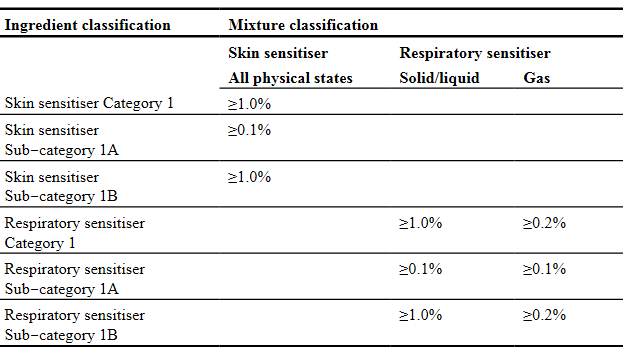 ¶ Carcinogenicity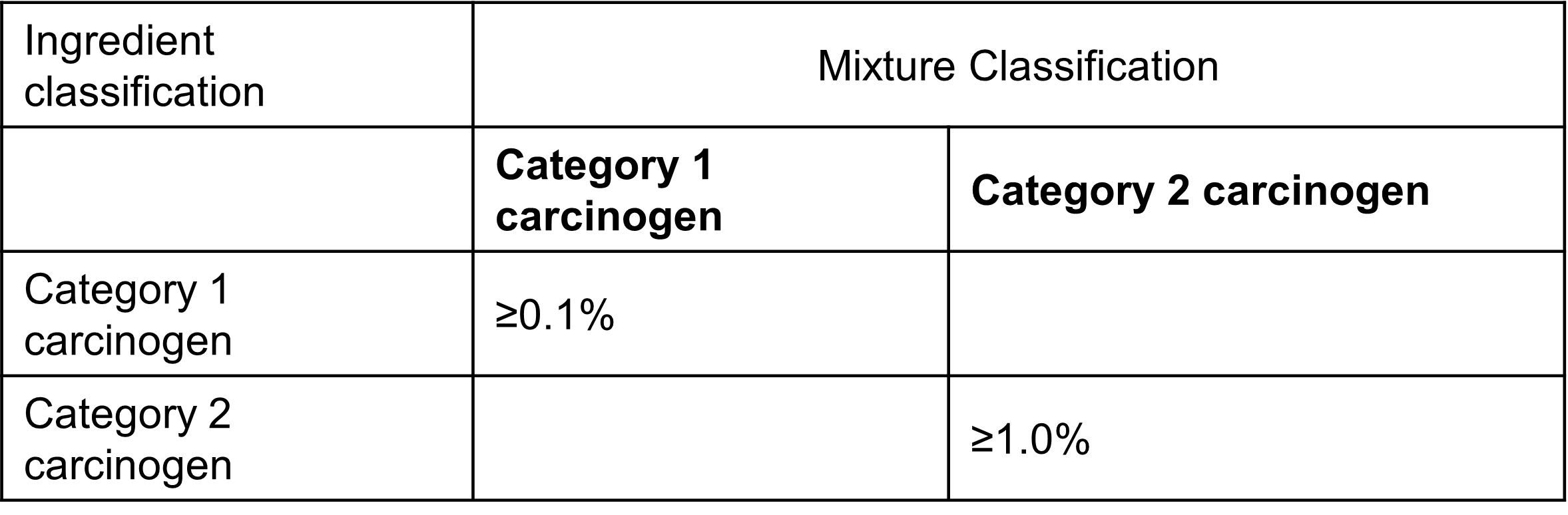 ¶ Reproductive Toxicity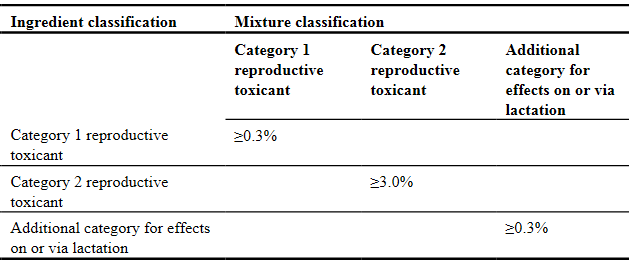 ¶ Specific Target Organ Toxicity - Single Exposure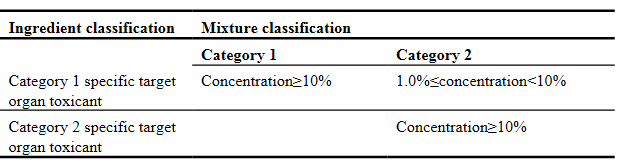 ¶ Specific Target Organ Toxicity - Repeated Exposure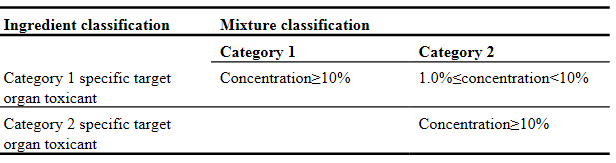 |
Sources |
¶ Safety Data SheetA supplier of a GHS classified chemical shall prepare an SDS in accordance with the approved Code of Practice - Preparation of Safety Data Sheets for Hazardous Chemicals. The latest version of Code of Practice was published by Safe Work Australia in June 2023. Australia started to move from the 3rd revised edition of the GHS (GHS 3) to the 7th revised edition of the GHS (GHS 7) on January 1, 2021, with a 2 year transition period. The latest version of the Code of Practice has adopted GHS 7. ¶ Model Code of Practice - Preparation of Safety Data Sheets for Hazardous Chemicals (GHS)A manufacturer and importer of a hazardous chemical is responsible for preparing an SDS for the hazardous chemical before the first manufacture or import of the hazardous chemical or if that is not practicable, as soon as practicable after the first manufacture or import of the hazardous chemical. SDS in both paper copies and electronic versions are acceptable. They must review the SDS at least once every 5 years and amend the SDS whenever any new information about the hazardous chemical is known or when the formulation changes. A current SDS is required to be provided to any person who is likely to be affected by the chemical or who asks for the SDS. A manufacturer and importer is not required to prepare an SDS for any of the following chemicals:
An SDS must be in English. It should include a version number, superseded date or some other indication of what version is replaced. All pages of an SDS should be numbered and include an indication whether there is a page following. Prescribed Sections of the Safety Data Sheet A safety data sheet from overseas is not acceptable unless it complies with the Australian WHS Regulations. Information specific to the chemical's use in Australia is required. Overseas SDS must provide the contact details for the Australian manufacturer or importer. |
Sources |
¶ LabelUnder the Work Health and Safety Regulations (WHS Regulations), manufacturers and importers have the responsibility to provide safety data sheets and to ensure the hazardous chemical is correctly labelled. People conducting a business or undertaking (PCBU) that uses, handles or stores hazardous chemicals shall also ensure the correct labelling of the hazardous chemicals. Suppliers of hazardous chemicals can only supply a hazardous chemical to the workplace that is labelled in accordance with the Code of Practice - Labelling of Workplace Hazardous Chemicals. ¶ Code of Practice - Labelling of Workplace Hazardous Chemicals (GHS)The Code of Practice - Labelling of Workplace Hazardous Chemicals was revised and republished in June, 2023. Australia started to move from the 3rd revised edition of the GHS (GHS 3) to the 7th revised edition of the GHS (GHS 7) on January 1, 2021, with a 2 year transition period. The latest version of the Code of Practice has adopted GHS 7. The Code applies to substances, mixtures and articles used, handled or stored at a workplace and defined as hazardous chemicals under the WHS Regulations. ¶ Required Label ElementsThe label should be written in English. The size of a label should be large enough to contain all required information and be easily visible in the workplace. Colors for labels must have a high contrast between the information and hazard pictograms and background. The label should be firmly secured to the outside of the container and be durable. Required label information
* Based on the nature and severity of the hazards, a maximum of between six and ten precautionary statements should be included on the label. Required label information for small containers
¶ Use of Generic NamesGeneric names may be used to disclose identity of ingredients if the following conditions are met:
¶ Proportions of IngredientsWhen the exact concentration of an ingredient is commercially confidential, the concentration of the ingredient can be disclosed using the following ranges or a narrower range, expressed as a percentage by weight or volume:
¶ Small ContainersRequired label information for small containers
|
Sources |
¶ Trade SecretsWith certain limitations, generic names and concentration ranges can be used to protect trade secret information in Australia. According to Schedule 8 of the Work Health and Safety Regulations 2011, a commercially confidential ingredient may be disclosed by its generic name if:
An exposure standard for the ingredient has not been established;
If the exact proportion of the ingredient is commercially confidential, one of the following ranges within which the exact proportion fits or a narrower range should be used, and expressed as a percentage by weight or volume:
|
Sources |
¶ Occupational Exposure Limits¶¶ Workplace Exposure Standards (WES)Safe Work Australia, a replacement body for the Office of the Australian Safety and Compensation Council (ASCC), provides leadership and coordination for national efforts to prevent workplace death, injury and disease. Workplace Exposure Standards (WES) for Airborne Contaminants contains a list of workplace exposure standards for airborne contaminants and how to comply with duties prescribed under the Work Health and Safety (WHS) Act and the WHS Regulations. Exposure standard represents the airborne concentration of a particular substance or mixture that must not be exceeded. The exposure standard can be any of the following:
The WHS Regulations requires a person conducting a business or undertaking at a workplace to ensure that no person at the workplace is exposed to a substance or mixture in an airborne concentration that exceeds the exposure standard for the substance or mixture. Exposure to any hazardous chemical, or any substance with an exposure standard should be kept as low as reasonably practicable. In June 2016, the Safe Work Australia released a new searchable database - Hazardous Chemical Information System (HCIS) which contains a current list of workplace exposure standards. The Guidance on the Interpretation of Workplace Exposure Standards for Airborne Contaminants should be read before the Safe Work Australia’s Workplace Exposure Standards are applied.
¶ Transitioning to Workplace Exposure Limits (WEL)In July 2025, Australia published the Workplace Exposure Limits (WEL) for Airborne Contaminants. The WEL will replace the current Workplace Exposure Standards (WES) for airborne contaminants on December 1, 2026. Key changes in the new document include: new and modified WEL for some airborne contaminants, removal of WEL for banned airborne contaminants and for non-threshold genotoxic carcinogens, and a new notation for ototoxic substances. Persons conducting a business or undertaking must still comply with the WES list and prepare for the adoption of the WEL list during the transition period.
|
Sources
Resources |
¶ Transport |
|
|
The National Transport Commission (NTC) of Australia is responsible for the Australian Dangerous Goods Code (ADG). ADG 7.9 Edition is based on the 23rd Revision of the United Nations Recommendations on the Transport of Dangerous Goods. |
Sources Resources |