¶ Recent Updates2026
|
|
¶ Background |
|
|
The Republic of Chile is located in the southwest of the Southern Cone of South America. Chile is a unitary state and its highest authority is the President of the Republic. Chile's territory is divided into 15 regions. Chile is a member of the Permanent Commission for the South Pacific (CPPS), along with Colombia, Ecuador and Peru for the preservation of natural resources and maritime trade within the South Pacific region. In addition, Chile is an associate member of MERCOSUR, the Andean Community and a North America Free Trade Agreement (NAFTA) member. Chile's legislative structure is:
Chile's chemical control system originated in 1955 under the Ministry of Interior Standards 383, 385 and 387 regarding storage, transport and workplace handling of flammable and explosive chemicals. Requirements for manufacture, import, distribution, transport, sale and disposal of chemical and chemical waste products were regulated under the Ministry of Health Sanitary Decree-Law 725 of 1968. Regulatory requirements for employee safety and industrial hygiene in the work environment started under the Supreme Decree 655 of 1940. Today, workplace safety and hygiene regarding chemical exposure is regulated under Decree 594 of 1999 with its latest update occurring in April 2019. From 1994 to the present, Chile has enacted numerous Chemical Control regulations to cover the entire territory. These include a 2008 National Chemical Safety Policy developed by the Environmental National Council, CONAMA, of the Environmental Ministry. This National Chemical Safety Policy set the tone for more comprehensive and robust chemical control programs such as Responsible Care, SAICM, and the future implementation of GHS.
|
Chemical Control Regulations Publications |
¶ Inventories |
|
¶ Dangerous Substances subject to Import ProcessChile has had a List of Substances Hazardous to Health through Resolution 408/2016 initially published on May 2, 2016, which became effective on June 10, 2016. However, with the new chemical management system, which was defined through Decree 57 of November 26, 2019, the Ministry of Health issued Resolution 15 of January 11, 2023 which replaced the existing standard and adopted the List of Classified Substances and the substances and mixtures that meet the new GHS classification system for purposes of import control of hazardous substances. The List of Classified Substances was implemented through Exempt Resolution 777 of 2021 and was updated in August 2026 . The link to the list can be found under the Sources box. Any substance that is present in the list and therefore has a classification is subject to the import process, however, as seen further, a few classifications and categories have a review process only. To obtain the Customs Destination Certificate (known by the acronym CDA in Spanish) and Import Authorization or Use and Disposal Authorization (known by the acronym UyD in Spanish), importers must request them online through the digital platform provided under the Resources box. The Health agencies will review the information provided and authorize or reject the request. A prior inspection visit may occur in order to verify the conditions of the product and storage conditions, according to Article 4. For substances with a lower risk to health, according to the criteria established in Supreme Decree No. 57 of 2019 there will be a document-only review process, according to Article 5. The table below provides the lower risk hazard classes and categories. 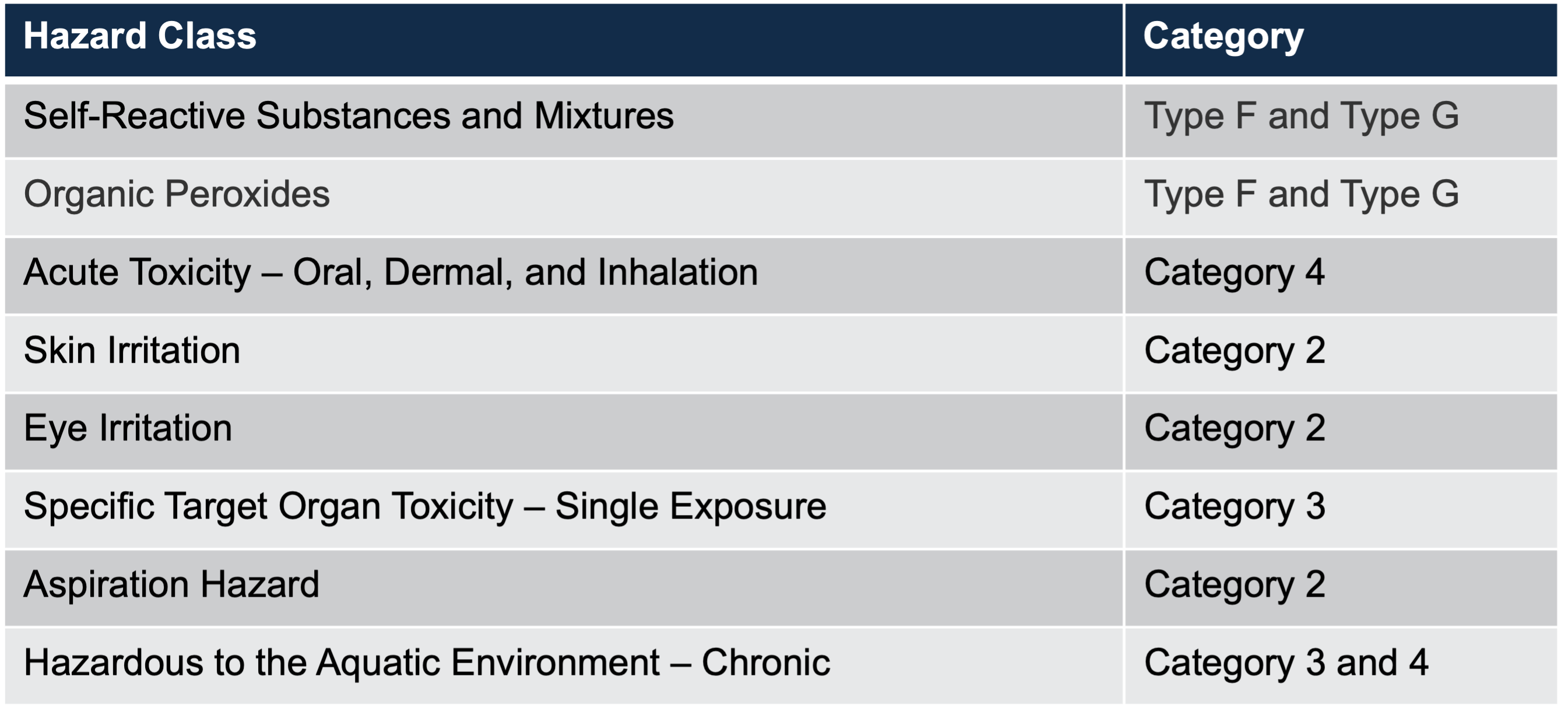
¶ Transition PeriodThe transition period for Resolution 15/2023 to enter into force varies and is determined from the date of when Decree 57/2019 was published, which was February 9, 2021. The table below shows the dates for entry into force, according to each category:  The import of pharmaceuticals, cosmetics, and most biological and bio-chemical preparations requires a prior sanitary registration with the Institute of Public Health (Instituto de Salud Pública) (www.ispch.cl). These also may be subject to special labeling and other requirements, depending on the nature of the product.
¶ Chemical Substances and Mixtures Classified as HazardousOn February 9, 2021, the Ministry of Health and of the Environment published a Regulation on the Classification, Labelling, and Notification of Chemical Substances and Mixtures, through Decree 57 of November 26, 2019. This Regulation establishes that manufacturers and importers must notify the Ministry of Health of substances and mixtures classified as hazardous for industrial use, in quantities equal to or greater than 1 ton per year. Any manufacturer of a substance or mixture that has any of the following hazard categories: carcinogenicity, mutagenicity, and reproductive toxicity, must notify independently of the quantity imported or manufactured. The Ministry of the Environment will then issue a Resolution with all the notified substances, until December 31 of that same year. In case a substance is not found in this Resolution, it will be considered a new substance and must be notified prior to its commercialization.
Exemptions The following exemptions applies to the List of Classified Substances:
|
Sources
Resources *Not available in English |
¶ Substance Registration |
|
|
There are no formal registration requirements for importers of chemicals or chemical substances in Chile.
|
|
¶ Product Registration |
|
|
In addition to requirements for general industrial chemicals, Navigator currently covers requirements for pesticides, biocides/biocidal products, and cosmetics. This means that requirements that pertain specifically to food contact materials, pharmaceuticals, etc., are not covered here. ¶ PesticidesThe Institute of Public Health of the Ministry of Health of Chile, under Supreme Decree 157 of 2005 and Circular 20 of 2008, regulates the control and registration of chemical pesticides for domestic and phytosanitary use. The Agricultural and Livestock Service of the Ministry of Agriculture also establishes requirements for pesticides through Resolution 1557 of March 10, 2014, last updated by Resolution 14 of January 21, 2019.
|
|
¶ Pesticides for Sanitary and Domestic Use
¶ DefinitionPesticides for sanitary and domestic use are defined as those used against sanitary vectors and pests whether indoor or outdoor environments of buildings, industries, warehouses, containers, educational spaces, commercial parks, gardens and cemeteries and in means of land, sea or air transportation, as well as repellents or attractants not applied directly to human or animal skin and those contained in commercial products such as paints, varnishes, cleaning products, among others. Types of Pesticides for Domestic Use
¶ RegistrationUnder Decree 157 of 2005 and Circular 20 of 2008, the Ministry of Health evaluates the technical and scientific information required for the registration of chemical pesticides provided by manufacturers, distributors, importers, exporters, and formulators for commercial purposes. Pesticide registration is divided into 4 categories. These categories and their corresponding codes used during the registration process are as follows: 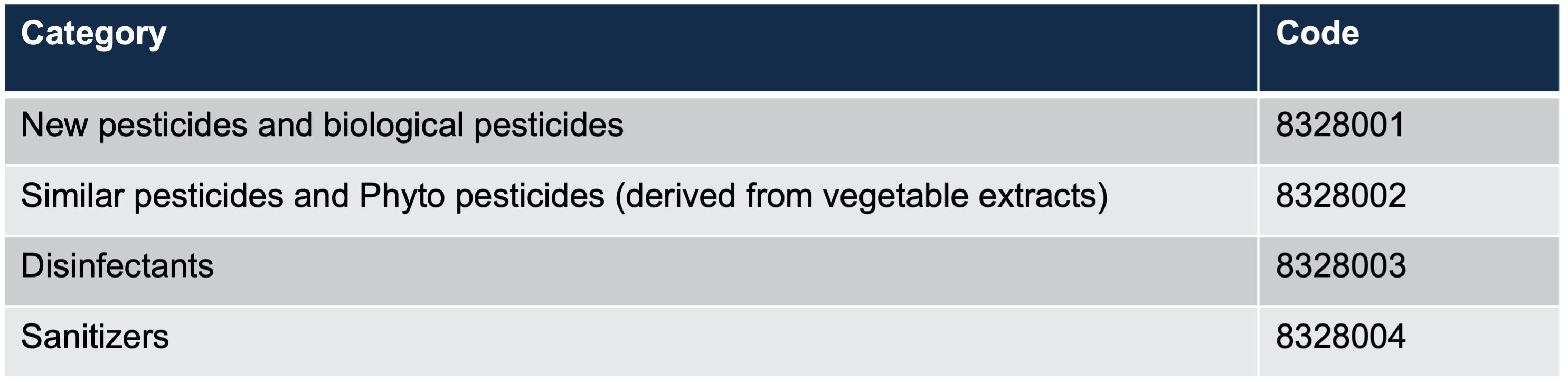 The registration process can be done electronically in the Institute of Public Health (ISP) website through the GICONA platform, which is available year round. It can be done by the importer or a person responsible who has a Chilean tax ID number (known as RUT). They must have the GICONA key to access the system. The technical and scientific information must show evidence of efficacy of the formulated product to be registered and must stipulate that laboratory and field applications of the product were done under specific protocols established by the Institute of Public Health. The Institute of Public Health can order that certain products may be exempt of some requirements or testing, as stipulated in the registration process, when these are not necessary for the product evaluation due to its characteristics, manufacturer background, available scientific information, or other scientific reason that makes it unnecessary. If the Institute requires laboratory checks during the registration process, the Institute may request product samples and analytical standards, or, authorized active substances, or which registration is requested. All technical and scientific information will be handled in a confidential manner. Production and import sanitary authorization will be provided by the Ministry of Health of Chile and an authorization request can be submitted via web at the Institute of Public Health website.
Information Required for Registration
¶ FeesUpon completion of the request process, the user will be provided the fees for the request, which is 574.771 Chilean pesos.
¶ TimelineAccording to Article 20, the Institute of Public Health should approve or reject the registration within a period not exceeding six months. In the first month of the authorization request, the Institute will verify if the documentation is complete and correct and the registrant will have 60 days to correct or complete any information necessary.
¶ ValiditySanitary authorizations are valid for 5 (five) years.
¶ LabellingThe labels should be in Spanish, with titles printed in bold and texts with black letters must be arranged horizontally when the container is in its normal position. The label must be white without any other color appearing on it, except for the company logo and the part corresponding to the toxicological category. They must also indicate:
The label must have a strip with a minimum height of 15% of its height at the bottom, which should include the symbol, color and corresponding words that indicate the toxicity that the product represents for people, according to what was provided in the registration.
¶ ImportationFor import process, a Free Sale Certificate is required, which must mention the product being imported, the complete formula (when possible) and the manufacturer, with his address, which must be authenticated and legalized before the Ministry of Foreign Affairs of Chile; or in its defect, the country must be in the Apostille Convention. In the absence of a Free Sale Certificate, a Manufacturing agreement signed with the foreign manufacturer and the Official Certificate that certifies that the foreign manufacturer is authorized to manufacture these products is required. It should be issued by the competent authority of that country, both documents must be authenticated and legalized before the Ministry of Foreign Affairs.
|
Sources
Resources
*Not available in English |
¶ Pesticides for Agriculture UseFor pesticides used in agriculture, Resolution 1557 of March 6, 2014, which was last amended by Resolution 6152 of October 2, 2023, establishes the requirements for their authorization. This authorization should be requested from the Agricultural and Livestock Service (SAG), providing the following information:
To manufacture, import, export or apply pesticides for use in agriculture an authorization has to be granted by the SAG. This authorization is also ratified by Law 18164 of 1982, which states that Chilean Customs Service will require the certificate issued by SAG to indicate the conditions of transport that must be used to carry out the transfer from the customs premises to the place where it will be deposited and also the route and storage place. The report granting approval, denial or requesting more information shall be issued within a period of 3 business days, counted from the date on which the interested party communicates to the respective services the arrival of the merchandise at the place of deposit. In October 2023, Chile implemented Resolution 6152, establishing new conditions and requirements for the authorization of natural chemical pesticides derived from plant, animal, microbial, mineral, or biological fermentation extracts. This resolution applies to the control of agricultural and forestry pests, and others under the jurisdiction of the Agricultural and Livestock Service (SAG). The resolution covers various aspects, including: 1. Prerequisites: Sets basic conditions that the applicant must meet to initiate the authorization process. 2. Administrative requirements and documentation: Details the documentation needed to submit the application, such as information about the applicant, the product, and the origin of the natural extract. 3. Technical requirements and documentation: Specifies the technical requirements and documentation required for the main substance of the extract (SPE) and for the low-risk natural extract (EN). 4. Evaluation of formulated products: Establishes the technical criteria for evaluating products formulated based on low-risk natural extracts. 5. Authorization based on external schemes: Allows for the authorization of natural pesticides following the registration or authorization schemes for active substances in the United States or the European Union.
¶ DocumentsThe documentation required electronically includes:
In the case of documents issued abroad, they must comply with the formalities established in the current legislation so that they are valid in Chile:
An orientation guide providing support for the application submission process can be found on the SAG website and referred to in this page under Resources.
Steps of Evaluation for Pesticide Authorization by SAG Stage I - Document and analytical verification The application must be requested by a person who has his domicile in the country. Documentation must have the required technical background. In addition, an excerpt must be published in the Official Gazette previously endorsed by the SAG, containing the commercial name of the pesticide, aptitude, composition, type of formulation, formulator of the pesticide, its intended uses and toxicological classification. Any interested party may make observations during 45 business days from the date of publication. Stage II - Technical evaluation of the information presented With the information delivered, the SAG will verify and make the pertinent observations. These will be communicated in writing, and their oppositions must be presented within a period of no more than 30 business days. In the case of additional studies requested by the SAG, the period corresponding to that required for the study will be granted. The SAG will have a period of nine months to give feedback regarding the authorization. This period begins when the service has all the necessary information for the technical evaluation. Stage III - Label revision and authorization resolution. If the pesticide is effective for its intended purposes and does not show any risks to human, animal or environmental health, a resolution will be issued with a correlative number that must be present on the label. Validity Under item 7 of Resolution 1557, which was amended by Resolution 14 of 2019, a validity of 10 years was established for specific pest-crop combinations, which may be renewable, for the same period, if it complies with the established provisions of the regulation.
¶ LabellingAccording to Resolution 2195 of August 31, 2000, the label should be in Spanish and text with black letters must be arranged horizontally when the container is in its normal position. The label must be white without any other color appearing on it, except for the company logo and the part corresponding to the toxicological category. The information required is separated in 3 different categories: A, B and C, and depending on the number of columns in the label, the categories are distributed in different forms - this information can be found under item D of this Resolution and colors, pictograms and symbols can be found under item E. For category A, product identification information should contain:
For category B, the use recommendation requirements:
For category C, precautions and warnings requirements:
¶ ImportationOnly those pesticides that were authorized by the SAG can enter the country. To request authorization to import a pesticide, the importer must submit the following documentation to the SAG Office corresponding to the port of entry:
¶ Other Norms for PesticidesPesticide toxicological classification is described under Resolution 2196 of August 31, 2000 and must be in accordance with the criteria of the World Health Organization (WHO). Name and codes of pesticide formulations, aiming to have a uniform list of names and codes, is described under Resolution 5392 of September 15, 2009. A list of authorized, restricted and prohibited pesticides can be found under Resources or in the Agricultural and Livestock Service (SAG) website. It should be noted that the sale of pesticides to people under 18 is prohibited, according to article 5 of Decree 158/2015 published by the Ministry of Health. Likewise, the Institute of Public Safety tracks the testing of safety and efficacy of chemical pesticides for agricultural use pre- and post-registration, pursuant to Circular 20 of 2008, Paragraph V using government certified laboratories or laboratories approved during the registration process.
¶ Occupational Exposure to PesticidesOn March 2014, the Occupational Health Department of the Ministry of Labor of Chile published the Epidemiological Pesticide Surveillance Workplace Protocol for the control of occupational pesticide exposure. The objectives of the protocol are to identify exposed workers, high risk work environments, monitor exposed workers, identify overexposed or poisoned workers and provide action measures, implement preventive measures, and use epidemiological information to update pesticide regulations and to implement preventive actions.
|
Sources
Resources
*Not available in English |
¶ Precursors, Narcotics, and Psychotropic DrugsThe government of Chile published Decree 1358 of December 22, 2006 to create the regulatory framework to control the illicit production, manufacture, export, import, distribution, sale, use, and possession of chemical precursors for the manufacturing of narcotics and psychotropic drugs under Law 20.000 of 2006. The Ministry of Health sets specific regulations for Narcotic Drugs through Decree 404 of November 2, 1983 and for Psychotropic Products, through Decree 404 of November 2, 1983. |
|
¶ Controlled Chemical SubstancesUnder the provisions of Decree 1358 of 2006, it shall be understood that:
The controlled chemical substances, listed in Article II of this Decree, are identified by their chemical names and the numeric codes listed on the Harmonized Commodity Description and Coding System (HS) of the World Customs Organization (WCO) and by their CAS numbers. These are classified into three lists, taking into account the provisions of the UN Convention against Illicit Traffic in Narcotic Drugs and Psychotropic Substances of 1988. Decree 40 of February 4, 2021, introduced modifications to Decree 1358 of 2006, updating control measures for precursors and essential chemicals in the fight against illicit drug trafficking and psychotropic substances. Among the most relevant changes is the update of Lists I, II, and III, which classify substances according to their risk potential for drug production.
¶ RegistrationArticle 3 of the Decree requires that all natural or legal persons that produce, manufacture, prepare, import or export substances labeled as precursors or essential chemicals as defined in Article 2 of the Decree and listed in Schedules I, II, and III must register in the Users of Controlled Chemicals Special Registry. This Registry will be administered by the Ministry of Interior with the assistance of the National Council of Controlled Narcotics. Documents to be Submitted for Registration Natural person:
Legal person:
Each registration will be evaluated by the Ministry of Interior and the National Council of Controlled Narcotics. Registrants will be notified via certified mail 60 business days from its submission if the registration has been accepted or rejected. The registration must be updated bi-annually between the months of May and June of the corresponding year. All registrants must maintain an inventory of substances including volume, concentrations, and control movement if these are listed in Schedules I, II, or III of the Decree. Additionally, the inventory will include the total use and application of the controlled substances and any monetary transaction in national or foreign currencies. The Ministry of Interior and the National Council of Controlled Narcotics will conduct unannounced inspections of natural and legal registrants to verify if all provided information is in compliance with Article 11 of the Decree.
¶ Import ProcessIn the event that natural or legal registrants wish to import or export controlled substances listed in Schedules I and II of the Decree, these will need to be notified to the Ministry of Interior with the corresponding forms. In the event of an import, the substance(s) requires import notification to the Ministry of Interior of Chile and the competent authority of the exporting country. In the event of import or export of substances listed in Schedule III of the Decree, it is required that importers or exporters be registered in the Users of Controlled Chemicals Special Registry, only.
¶ Mixture Classification CriteriaIf a component of a mixture is a controlled substance subject to the requirements of this Decree, the following criteria will apply:
The Ministry of Interior will impose fines for non-compliance to the Decree 1358 of 2006 based on the gravity of the infraction. |
Sources
*Not available in English |
¶ Narcotic Drugs and Psychotropic SubstancesNarcotic Drugs and Psychotropic Substances are also regulated under the Ministry of health by specific regulations for Narcotic Drugs through Decree 404 of November 2, 1983 and for Psychotropic Substances, through Decree 405 of November 2, 1983, which provides procedures for manufacture, transport, use and import of controlled substances, as well as prohibited substances. There are 2 lists published for Narcotic Drugs and 4 lists for Psychotropic Substances, which follow criteria classification from the International Narcotics Control Board (known as JIFE in Chile). Both Decrees were last updated on November 19, 2020. Establishments that elaborate or commercialize any Narcotic or Psychotropic product must communicate to the Institute of Public Health of Chile regarding the beginning, suspension or termination of those activities within the following thirty days. There are 2 types of prescription required for substances included on these lists: a Special Prescription, called "receta cheque" and a Retained Medical Prescription, called "Receta Médica Retenida." The difference is that the first may only be issued on the official forms that are part of checkbooks that the Health Services will provide to surgeons after accreditation of their professional quality, and the second requires the prescription to be on file at the establishment where it was sold. Both prescriptions are valid for thirty days from the date they are issued. The following table shows the activity and substances that are prohibited under the Narcotics and Psychotropic Substance Decrees, however in qualified cases and for scientific research purposes, the use of these substances may be authorized by the Institute of Public Health of Chile. 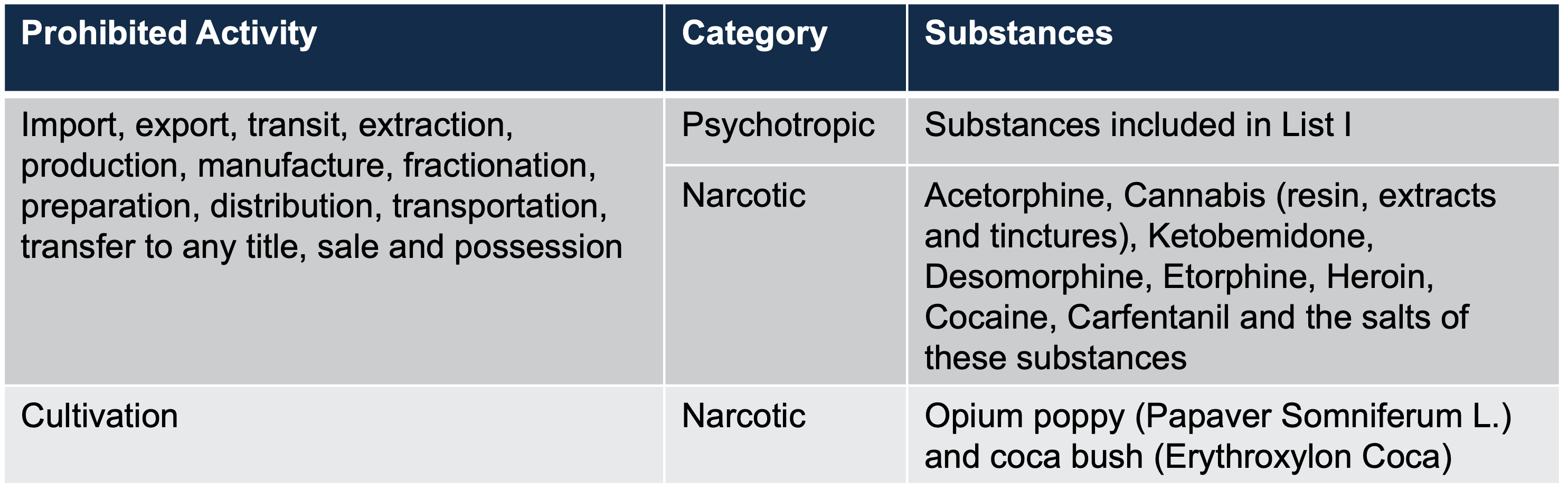
¶ Psychotropic substancesPsychotropic substances included in List I are prohibited to be imported, manufactured, distributed, sold or in possession as well as any preparations which contain them. However, the use of these substances may be authorized by the Institute of Public Health of Chile, under the conditions determined by the corresponding resolution, in qualified cases and for scientific research purposes. In the case of products contained in Lists II and III, a Special Prescription is required for them to be sold to the public in pharmacies or laboratories, or a Retained Medical Prescription in the case of products contained in List IV, according to their respective condition of sale. Both prescriptions should have formats established by the Ministry of Health. In the case of drugs and active principles contained in psychotropic products that are included in Lists II and III, if presented in a pharmaceutical form which prove that the risk of abuse is negligible or null, the health authority may determine or replace their condition of sale to that of "Retained Medical Prescription."
Package and Labelling Psychotropic product containers may not have more than thirty dosage units, except in the case of clinical containers. The labels of the containers must express the condition of sale of the product and the caption in black letters on a white background: "Subject to Psychotropic Control." They should include a green five-pointed star, the size of which may not be less than one sixth of the surface of the main face of the container.
¶ Narcotic DrugsFor products that contain narcotics from List I and II, a Special Prescription or Retained Medical Prescription is required, according to their respective condition of sale.
Package and Labelling Narcotic product containers may not have more than twelve dosage units and they should not be fractioned in their sale. In the case of clinical containers, the content may be higher. The labels of the containers must express the condition of sale of the product and the caption in black letters on a white background: "Subject to Narcotic Control." They should include a red five-pointed star, the size of which may not be less than one sixth of the surface of the main face of the container.
¶ Import ProcessTo import substances included in the terms of Article 8 of both Decrees, each establishment must communicate in the month of October of each year, their import forecasts for the following calendar year and request authorization from the Institute of Public Health of Chile for each substance. The authorization will be granted by means of an Official Import Certificate, which must be issued within thirty days from the date of the request. The validity of the Import Certificate is 4 months from the date of issuance and the respective admission, as appropriate, must be carried out, within a maximum period of 6 months from the same date. The Chilean Customs Service will require the certificate issued by the Ministry of Health to indicate the conditions of transport that must be used to carry out the transfer from the customs premises to the place where it will be deposited and also the route and storage place. Information Required for the Import Request
|
Sources
*Not available in English |
¶ CosmeticsCosmetic products are regulated under Supreme Decree 239 of September 20, 2002, which establishes registration, importation and labelling requirements, last amended by Decree 41 of March 4, 2010. ¶ DefinitionAccording to Article 5 of Decree 239/2002, cosmetic products are defined as any preparation that is intended to be applied externally to the human body for the purpose of beautification, changing their appearance or preservation of the normal physical-chemical conditions of the skin and its annexes. ¶ RegistrationProducts must have a sanitary registration before the Institute of Public Health (ISP) to be marketed and distributed in Chile, in compliance with Decree with force of Law 725 of December 11, 1967. The registration process is done through the Institute of Public Health website and is available throughout the whole year. It can be done by the importer or a person responsible who has a Chilean tax ID number (known in Chile as RUT), and they must have a key to access GICONA, the information management system of the ISP. Information such as name, cosmetic purpose, formula and legal status of the applicants as well as submitted documentation (further detailed below) are the basis for the Institute's evaluation. The registration must be approved or denied within 5 business days from the ISP's receipt of the request. It is possible to verify if the product has been registered through the Registration Product Query website. According to articles 31 and 44, all cosmetic ingredients must meet the quality specifications defined in the following lists, which are updated by the Institute of Public Health, and in the absence of these, the lists of the European Union contained in Regulation (EC) No 1223/2009 of the European Parliament and of the Council of 30 November 2009 and its subsequent amendments, and the lists approved by the Food and Drug Administration of the United States of America should be used as a reference:
¶ DocumentationAccording to articles 25 and 26 of Supreme Decree 239/2002, an application form for registration of cosmetic products must be filled out with the requested information:
The following statements must be accompanied:
Validity The registration of cosmetics is valid for 5 years, counted from the date of its approval.
¶ NotificationProducts classified as low risk and hygiene products require notification to ISP only, as established in article 20 of Supreme Decree 239 of September 20, 2002. No documentation is required, besides the information requested when filling out the form in the GICONA system. Information regarding process time and length of validity can be found on the Platform for Fee Verification of Cosmetic Product Registration. For the notification process, it usually takes 50 days to be completed after first request and the notification is valid indefinitely, unless there is a request for cancellation. Low risk products:
Hygiene products:
¶ FeesA fee of 609.884 Chilean pesos is required to be paid for the registration process and for the notification process, the fee is 38.598 Chilean pesos. After the payment and process evaluation is completed, a notification will be sent via email indicating that the process has been concluded. ¶ Importing Cosmetic ProductsThere must be a legal representative of the company domiciled in Chile. Prior to importing, products must have a sanitary registration with the respective importer's information declared. After the product goes through customs, the interested party should communicate to ISP the entry of the products to their place of deposit, attaching a copy of the Health Service certificate that allowed their transfer to that establishment. Within 3 days from that date, ISP must issue an authorization. ¶ LabellingA Technical Guide for Cosmetic Labelling was published through Resolution 01020 of April 21, 2023. The labeling of cosmetic products packaging should be in Spanish language, with the following information:
Foreign languages may additionally be used in the labeling or in the text of the annexes of an imported cosmetic product. Specific statements according to the product category are also required and can be found on Resolution 01020 of 2023. According to Article 40 of Supreme Decree 239 of 2002, a leaflet that includes indications, warnings and precautions must be attached to the same product container when it is not possible to include all indications on the label due to the size of the product container or when the use of the cosmetic may impose a risk to the individual's health. ¶ Additional requirements for...Products Intended for Children
Sunscreens
¶ Special CosmeticUnder Article 5 of Decree 239/2002, item kk) defines a special cosmetic as those that carry a risk in their use due to their formulation, concentration of active ingredients or their purpose and therefore, require a special indication for use. On March 10, 2021, the Ministry of Health published Resolution 199 of 2021 establishing that products intended for hand hygiene with antibacterial action ingredients correspond to a special cosmetic with sanitary registration. It includes the ingredients with antibacterial action and their concentration allowed on the product formulation. The inclusion of expressions such as "sanitizer", "helps to eliminate bacteria", "reduces the bacterial load" and "antibacterial without therapeutic action" will be accepted. |
Sources
Resources
*Not available in English Information regarding forms and fees for the process can be found on the document through the different codes: 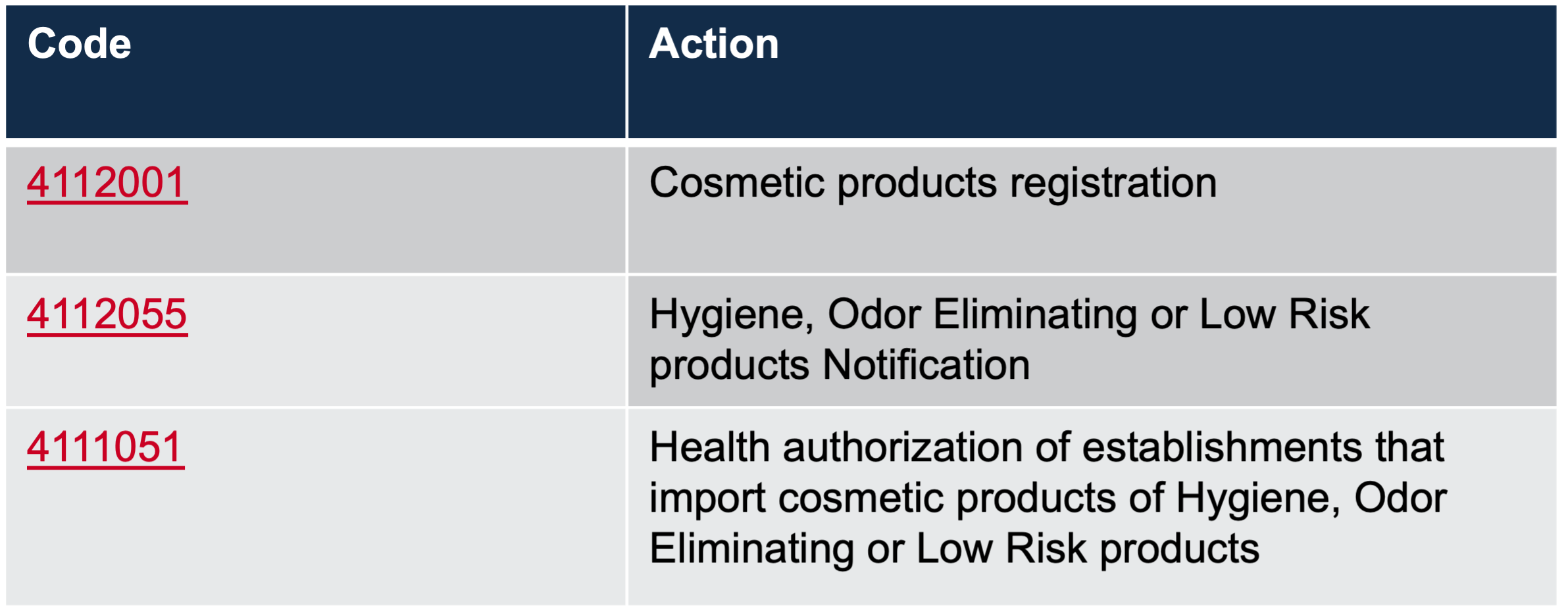 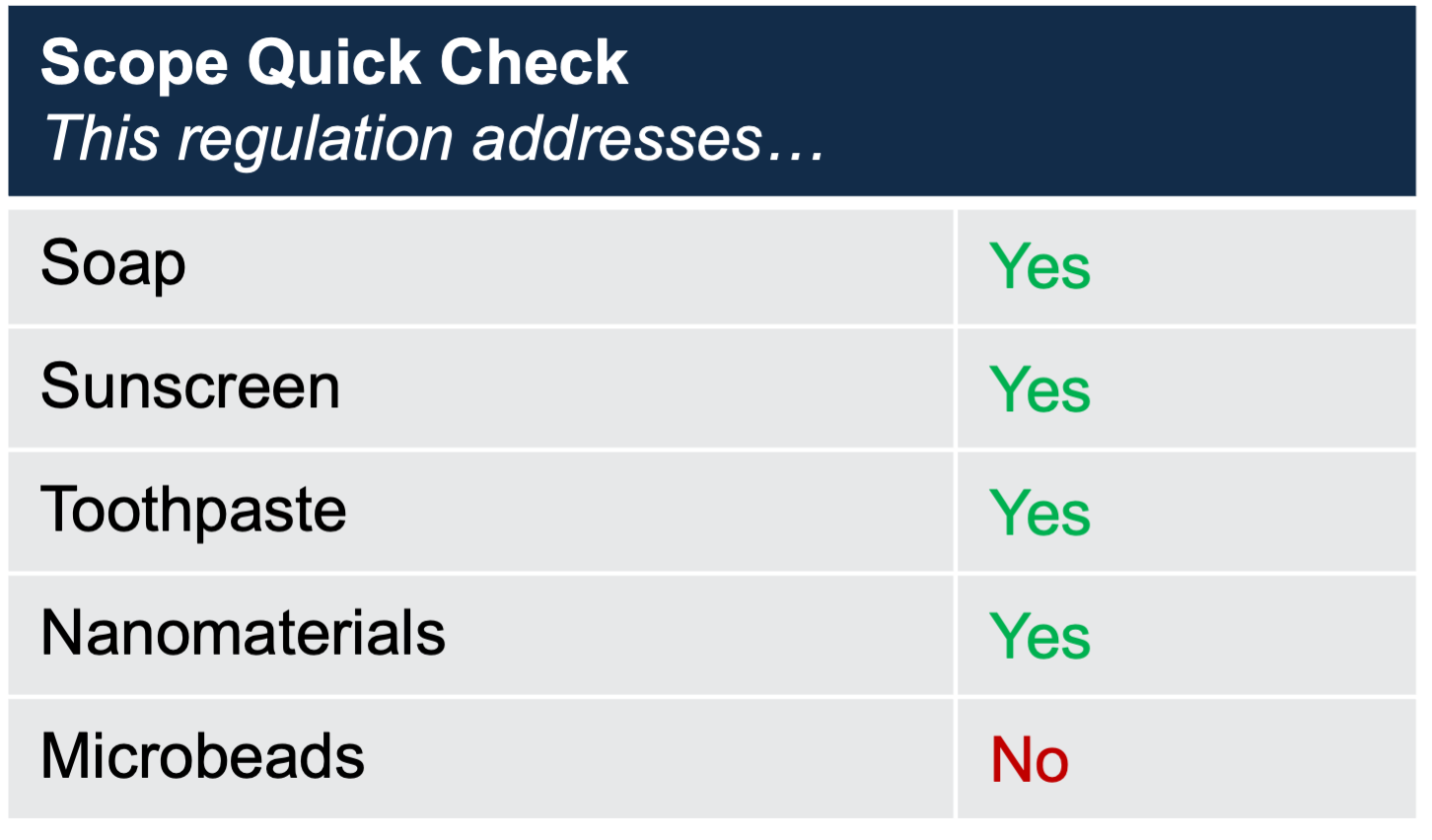 Scope The regulation applies to cosmetics with the following purposes
|
¶ Notifications |
|
¶ Chemical Substances and MixturesOn February 9, 2021, the Ministry of Health and of the Environment published a Regulation on the Classification, Labelling, and Notification of Chemical Substances and Mixtures, through Decree 57 of November 26, 2019. This Regulation establishes the criteria that manufacturers and importers must meet for the classification, labelling, and notification of substances and mixtures classified as dangerous for human health and the environment. Decree 57/2019 provides information regarding the notification of substances and mixtures to the Ministry of Health under Title IV, Notification of Substances and Mixtures. Manufacturers of a substance or mixture classified as hazardous for industrial use - according to Title III of this regulation - in quantities equal to or greater than 1 ton per year, must notify to authority. Also, any manufacturer of a substance or mixture that has any of the following hazard categories: carcinogenicity, mutagenicity, and reproductive toxicity, must notify the information independently of the quantity imported or manufactured. Substances considered new, as further outline below, must also be notified. ¶ Notification ProcessThe notification must be done in the Notification System for the manufacture of substances and mixtures through the electronic portal Single Window of the Environmental Authority. Frequency: must be completed every two years, with a due date of August 30, with respect to what was manufactured and/or imported in the previous two calendar years. The Notification System will deliver the corresponding notification number. The information that must be submitted electronically, according to Article 316, is as provided below:
The Ministry of Environment will issue a Resolution with all the notified substances, until December 31 of that same year. In case a substance is not found in this Resolution, it will be considered a new substance and must be notified before being marketed. ¶ New substancesAny substance manufactured for the first time for industrial use in the country, should be considered as a new substance and should be notified prior to its commercialization, providing the information described above. For new substances, the following information must be incorporated to the notification:
Therefore, new substances that have a notification number will be subject to notification every two years. ¶ ImportationIn the case of importation of new substances, the Health Authority will grant the respective import authorization only if the notification process has been previously verified.
¶ Transition PeriodThe transition period for Decree 57/2019 to enter into force varies and is determined from the date of when this regulation was published, which was February 9, 2021. The notification process will enter into force 2 years after the established for the classification and labelling. The table below shows the dates for entry into force of the notification process, according to each category:
 Article 2 specifies the exemptions to Decree 57/2019, such as:
Food products for human consumption (as defined by Supreme Decree 977 approving the Food Sanitary Regulation of the Ministry of Health); Animal consumption food products;
|
Sources
Resources *Not available in English |
¶ Prior Informed ConsentChile ratified the Rotterdam Convention concerning the Prior Informed Consent (PIC) Procedure for Certain Hazardous Chemicals and Pesticides through Decree 37 of March 2, 2005. It came into force on April 20, 2005. The PIC procedure applies to pesticides and industrial chemicals which are listed in Annex III to the Rotterdam Convention that have been banned or severely restricted for health and environmental reasons. The Convention also contains provisions for the exchange of information among Parties about potentially hazardous chemicals that can be exported and imported covering pesticides and industrial chemicals that have been banned or severely restricted for health or environmental reasons and which have been notified for inclusion in the PIC procedure. ¶ Addition of Chemicals into Annex IIITwo reports, each arising from a different region of the areas determined by the Conference of Members during its first meeting lead to considering the possibility of chemicals in the PIC procedure. It was propose the inclusion in the process of severely hazardous pesticide formulations that present a danger under the conditions of use in developing countries or countries with economies in transition, like Chile. The Convention requirements applies to chemicals listed in Annex III, which currently contains 52 chemicals, but is expected to include many more in the future. The Conference of Members should decide on the inclusion of more chemicals during their Meeting of the Parties for the Rotterdam Convention. Once a chemical is included in Annex III, a “decision guidance document” (DGD) containing information concerning the chemical and the regulatory decisions to ban or severely restrict the chemical for health or environmental reasons, is circulated to all Member countries. ¶ Import and Export ResponsesCountries have a nine-month period to prepare a response regarding future import of the chemical in question. The response can consist of either a final decision (to allow import of the chemical, not to allow import, or to allow import subject to specified conditions) or an interim response. Decisions by importing countries should dispense with any consideration of trade (that is applied equally to domestic production and imports). The import decisions are circulated and exporting country members are obligated under the Convention to take appropriate measures to ensure that exporters within its jurisdiction comply with the decisions. 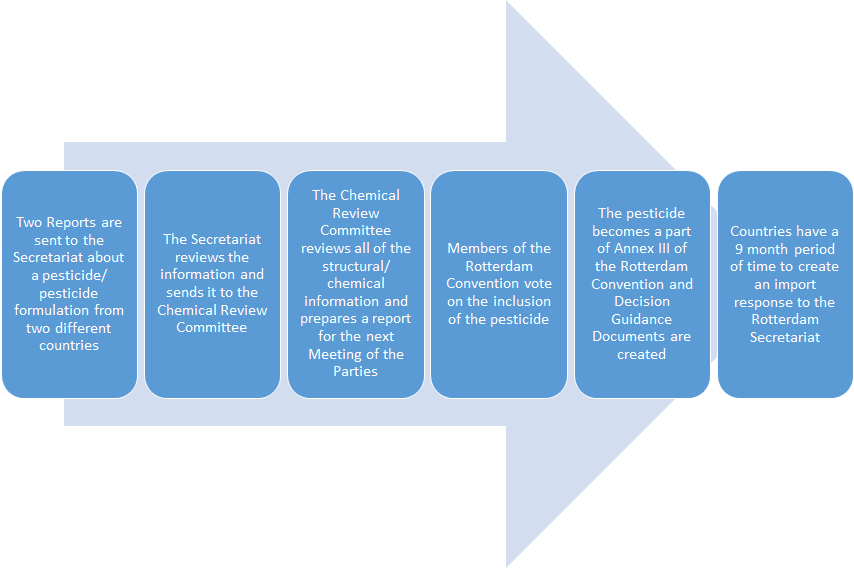 |
Sources
*Not available in English |
¶ Restrictions and Bans |
|
¶ Ozone Depleting Substances
¶ HCFC RegistrationThe National Customs Service created an online registration process for HCFCs as detailed in Resolution 5630 of 2007, which can only be done by individuals registered in the customs registry. Individuals wanting to use the online system can request to register by completing an application form located in the National Customs Service web page and providing verification documents. It also states that import or export quantities of Methyl bromide intended for quarantine and pre-shipment applications of recovered controlled substances, recycled and reclaimed materials should not be counted towards the ozone depleting substance total. Import or export of ozone depleting substances can only be done by valid registrants, and free trade zone users must register as well. The maximum import volume assigned per importer will be determined by multiplying the total maximum import volume of historically imported group of substances, providing the corresponding quota for each importer of the substance group. ¶ Annual ReportingAccording to Article 8 of Decree 7/2026, manufacturers, importers and exporters of controlled products must report annually to the Ministry of Environment, through the Pollutant Release and Transfer Registry, at least the following:
¶ Prohibited substancesProhibited controlled substances are those controlled substances listed in the Montreal Protocol under Annex A (Groups I and II), Annex B (Groups I, II, and III), Annex C (Groups II and III), and Annex E (Group I), as well as those under Annex C (Group I) and Annex F (Group I). There is an exemption from the prohibition for imports of methyl bromide intended for quarantine and pre-shipment applications. As of January 1, 2030, the substances listed in Annex C, Group I—whether in pure form or contained in mixtures, such as formulated polyols—shall be classified as "prohibited controlled substances." For Annex F substances (HFCs), trade restrictions with countries that are not parties to the Kigali Amendment become effective on January 1, 2033.
|
Sources
Resources
*Not available in English |
¶ Persistent Organic Pollutants (POPs)
In 2005 the Ministry of Environment established a National Implementation Plan for the Management of Persistent Organic Pollutants (POPs) for the years of 2006 to 2010. In 2016, a United Nations Environment Programme for revision of this plan was initiated. In 2017 an updated version for years 2018 to 2022 was released, incorporating new information regarding the institutional framework and regulations related to the management of these compounds nationwide. However this new plan, has not yet been approved by the Council of Ministers for Sustainability. Therefore, actions or dates presented in this document could be slightly modified. The Plan exposes a diagnosis of POPs in the country through inventories and other studies about the effects in health and environment, as well as the objectives of POPs management and steps to implement and therefore comply with the provisions of the Stockholm Convention.
|
Source
*Not available in English |
¶ Restriction of Hazardous Substances (RoHS)
However, a waste management regulation was published through Law 20.920 on May 17, 2016, prioritizing electronic and electric devices as a category which is subject to the requirements of the principle of extended producer responsibility. The principle of extended producer responsibility appoints the producer as the responsible for the product’s lifecycle and for organizing and financing any waste management systems for such products. Other responsibility of the producer is to submit to the Pollutant Release and Transfer Register (PRTR) which will require information about themselves, reception and storage facilities, collection, and recovery goals, according to article 37.
|
Source
Resources *Not available in English |
¶ SDS + Label |
|
¶ ClassificationThe current regulation regarding the Hazard Classification of Chemical Substances and Mixtures is NCh 382 which was last updated in 2021. This norm provides guidelines for the classification of a dangerous substance based on the United Nations Recommendations on the Transport of Dangerous Goods - revision 21st - that identifies nine classes of danger.
¶ GHS Implementation
The regulation establishes the criteria that manufacturers and importers must meet for the classification, labelling, and notification of substances and mixtures classified as dangerous for humans, health, and the environment. Title III of the regulation provides the characteristics and hazard criteria for the classification of substances and mixtures, but does not provide an exemption from other applicable sanitary regulations related to chemical control or sanitary authorizations.
GHS building blocks excluded from the regulation:
The terminology to be used for the classification, labelling, and notification of substances and mixtures can be found under Article 3 of this regulation. Article 4 requires that manufacturers or importers of chemical substances and mixtures identify the hazards of the substances and mixtures, and classify and label them according to the regulation prior to sale or use of these substances regardless of the quantity manufactured or imported.
¶ Official List of Substance ClassificationTo facilitate a substance or mixture classification, an official GHS List of classified substances was provided, (referred to as the List), through Resolution 777 of August 23, 2021, approved by the Ministry of Health. The List was last updated in August 2026. It contains classes and hazard categories of substances, as well as specific concentration limits, M-factors, and acute toxicity estimates (ATEs) values. The list is the minimum reference for the classification, however, when manufacturers or importers wish to apply other classifications less restrictive to those indicated in the list, they must submit these for approval before the commercialization of substances and mixtures, with the technical background and/or tests, according to the methodologies referred in the regulation, before the Ministry of Health, who will evaluate and make a determination. If the manufacturer or importer applies classes or categories more restrictive or additional to those indicated in the List, it will not be necessary to send or request a formal approval by the Ministry of Health, however, the Health Authority may request the respective background. If a substance is not included on the reference list, manufacturers and importers must classify their products according to the criteria established in Supreme Decree 57/19, Titles II and III, implementing GHS classification criteria. The hazard classification section is found in Title II, Hazard Classification, Paragraph I: "substance and mixture classification". Important points of the classification section of the Decree are: Article 5 - Manufacturers or importers of chemical substances or mixtures will have to determine if these are classified as hazardous to health and/or the environment, according to Title III regarding the hazard characteristics and criteria for the classification of substances and mixtures under the regulation. Article 7 - In the event that the substances are not in the official List, the manufacturers or importers must evaluate if the substance has any physical, health or environmental hazard, as established in Title III, considering the following information:
Article 9 - When evaluating the information available for classification purposes, the manufacturer and importer of substances or mixtures should consider the forms or physical states in which the substance or mixture is marketed or used. Article 11 - When test data on certain types of mixtures is not available, or data is inadequate, other available information on similar substances and mixtures tested may be used, according to the principles of extrapolation indicated in Title III as indicated, which can be considered relevant to determine if the mixture is dangerous. Article 16 - When a manufacturer and/or importer introduces a change in the composition of a substance or mixture, they must carry out a new classification evaluation and adapt the classification of the substance or mixture to the results of the new evaluation, when this change is referring to:
¶ Transition PeriodThe transition period for this regulation to enter into force varies for substances, mixtures, and use cases. Entry into force is determined from the publication date of this regulation, February 9, 2021, and is as follows:

Article 2 specifies the exemptions to Decree 57/2019, such as:
|
Sources
Resources *Not available in English |
¶ Cut-off values/Concentration LimitsNCh 382:2021, under the National Institute for Standardization, establishes general classification criteria for hazardous substances according to risk they impose during transport activities, and also in handling and storage activities related to transport. Decree 408 of May 2, 2016, under Article 5, determines the thresholds for the case of mixtures that have one or more components with chronic health danger, such as germ cell mutagenicity, carcinogenicity, reproductive toxicity and specific toxicity in certain organs, by single or repeated exposure depending on the concentration of the substance present in the mixture. Decree 57 of February 2019 updated some of the concentration limits for certain hazards, however, because there is a transition period for the entry into force of this Regulation, the updated value is provided as a note under each table of the following hazards:
¶ Germ cell Mutagenicity 1≥1.0% is the value in Decree 57/2019
¶ Carcinogenicity 1≥1.0% is the value in Decree 57/2019
¶ Reproductive Toxicity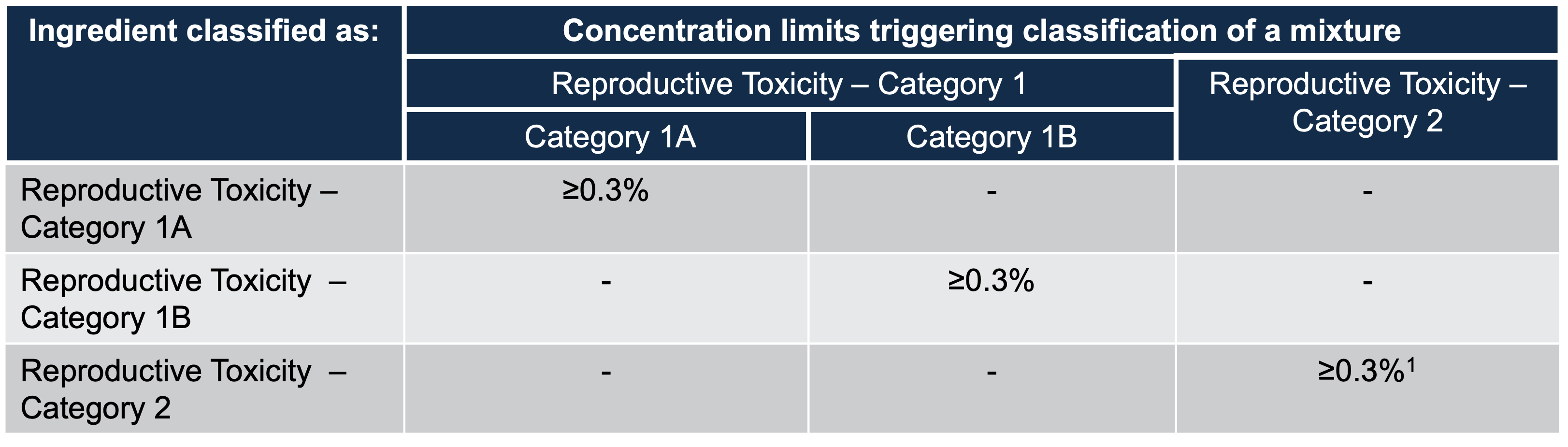 1≥3.0% is the value in Decree 57/2019 and a new category is added for effects on or through lactation which is ≥0.3%
¶ Specific Target Organ Toxicity - Single or Repeated Exposure ¶ Respiratory and Skin SensitizerUnder Decree 57/2019, the cut-off values and concentration limits for mixtures for Respiratory and Skin Sensitizer is implemented as follows: 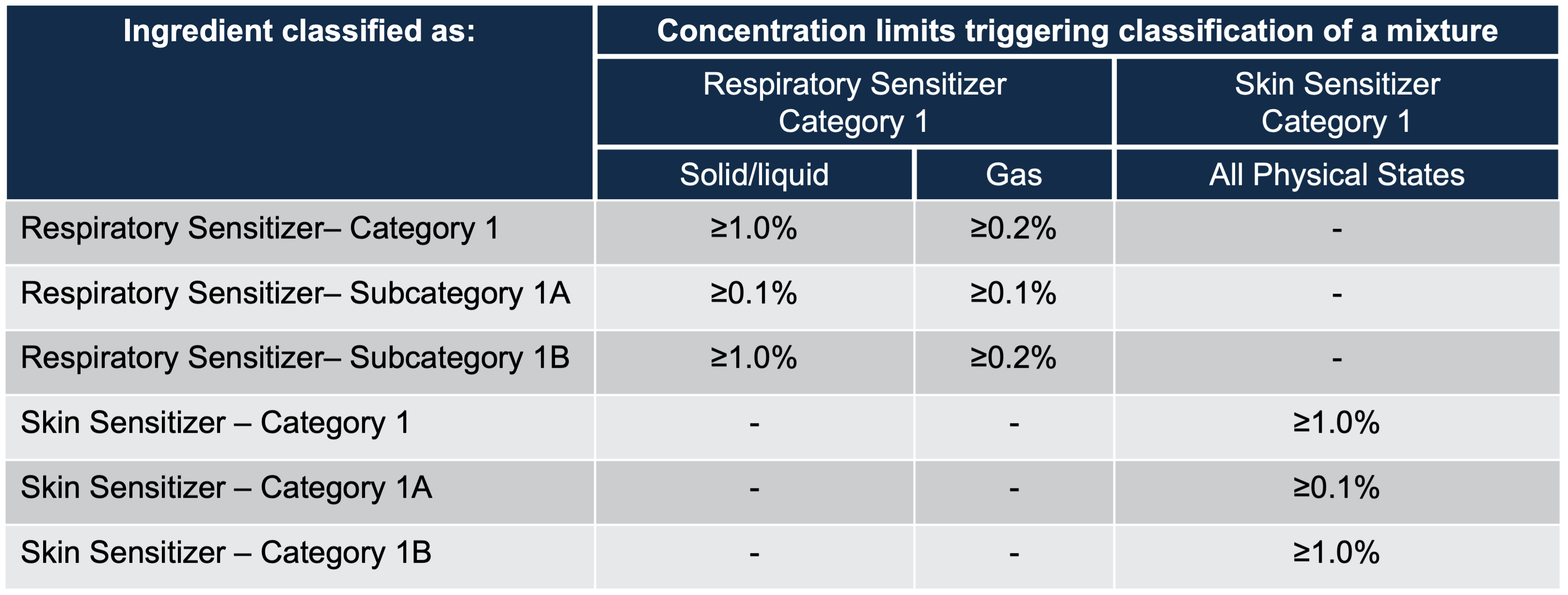 |
Sources
*Not available in English
Transition Period for Decree 57 of February 2019 The transition period for this regulation to enter into force varies for substances, mixtures, and use cases. Entry into force is determined from the publication date of this regulation, February 9, 2021, and is as follows: |
¶ Safety Data SheetsThe Chilean Ministry of Health under Decree 594 of September 15, 1999, requires Safety Data Sheets (known in Chile as Hoja de Datos de Seguridad) to be maintained where hazardous substances are stored. Manufacturers, distributors, and importers are required to provide a SDS for all substances and mixtures. The National Institute of Standardization (INN) prepared Standard NCh 2245:2003 for the authoring of SDSs in Chile. On August 27, 2015, the INN updated NCh 2245:2003 to NCh 2245:2015 under revision 5 of GHS. This update became mandatory in June of 2016 under Decree 43 of July 27, 2015, which simultaneously repealed Decree 78 of 2009 Dangerous Substances Storage Regulation. On September 29, 2021, NCh 2245 was updated, considering the 8th revision of GHS. The SDS format is provided in Annex A of NCh 2245:2021. A few of the differences compared to the prior version are that the name of the substance or mixture as shown on the label and the date of the updated version must appear on each page of the SDS. The version number should be included on the first page. A single safety data sheet may be provided to cover more than one substance or mixture as long as they meet the same classification criteria and contain the same ingredients as described in section 3 of the SDS. However, the update on NCh 2245 did not modify requirements on Decree 43/2015, which still required the use of NCh2245:2015. Later, on August 17, 2022, Decree 60/2022 updated Decree 43 of July 27, 2015 to reflect the most current changes regarding GHS implementation. ¶ GHS ImplementationOn February 9, 2021, Decree 57/2019 was published providing the requirements for SDS preparation, described under Title V of this regulation, which adopted revision 7 of the GHS. It includes 16 sections and sub-sections and states that the SDS should be written in Spanish.Suppliers must update it within a period of no more than 6 months from:
In consumer products intended for the general public the supplier must also deliver the safety data sheet to the Toxicological Center indicated on the label. |
Sources
Resources *Not available in English |
¶ LabelChilean standard (NCh) 2190:2003 from the Chilean National Standards Institute (INN) established standards for the mandatory labeling requirement in Chile. The standard became effective on September 25, 2016 under Decree 43 of July 27, 2015. It was last updated on August 17, 2022, through Supreme Decree 60 of June 3, 2022. Chile has added GHS elements based on the 7th revision of the UN GHS Purple Book. It mandates that labelling information must match the SDS. Except formulations of pesticides, drugs and cosmetic products - which will be governed by their respective specific regulations - the information below must be contained on the front panel label of the substances or mixtures classified according to NCh 382:2021:
Without prejudice to the provisions of this Article, it is accepted that the packaging of hazardous substances or products are labeled in Spanish under GHS, as long as the danger pictogram of the corresponding standard NCH 2190:2019 is added to the label. *Article 187 of Decree 43/2015 provides the following restrictions: The labeling and/or packaging of controlled substances may not be labeled as 'non-toxic', 'harmless' or any other erroneous analogous statement misleading with respect to the hazardousness of the product. The Chilean Supreme Decree 60 of June 3, 2022, requires companies to have SDS for hazardous substances they store. SDS must be available in printed or digital format and must comply with the requirements established in the regulation on the classification, labeling, and notification of chemicals and hazardous mixtures.
¶ Imported Substances or ProductsArticle 188 of Decree 43/2015 defines that in the event that the containers containing imported dangerous substances or products do not comply with the labeling requirements set forth in this regulation, but are packaged and are not intended to be unpacked during storage, it will be the responsibility of the importer or distributors that the safety labels are available in printed form and distributed together with the respective substances or products to their customers.
|
Sources
Resources *Not available in English |
¶ GHS ImplementationDecree 57 of February 2019 established labelling requirements according to GHS criteria for Chemical Substances and Mixtures. There is however a transition period for substances and mixtures to adopt those requirements, and once it is over, title XII of Decree 43/2015 will be repealed. According to Decree 57/2019, the following information is required on labels: Product identification: CAS number is required (if existent). In the case of mixtures, the identity of all substances in the mixture that contribute to its hazard classification. Hazard pictogram(s) Warning word: Danger (in Spanish Peligro) or Warning (in Spanish Atención) should be included on the label according to the classification for each substance or mixture. Hazard statement(s) Precautionary statements: should reflect the nature and severity of the hazards of the substance or mixtures and should not exceed 6, unless additional inclusions are required. Supplementary information: For consumer products available to the general public, an emergency telephone number in Chile of a toxicological center, with 24-hour service every day of the year, which must have at least the product safety data sheet. Additionally, information related to how to use the product should be indicated. Name, address and telephone number of national supplier and net content of substance or mixture.
¶ Rules of PrecedencePictograms For health hazards, the following priority criteria apply: 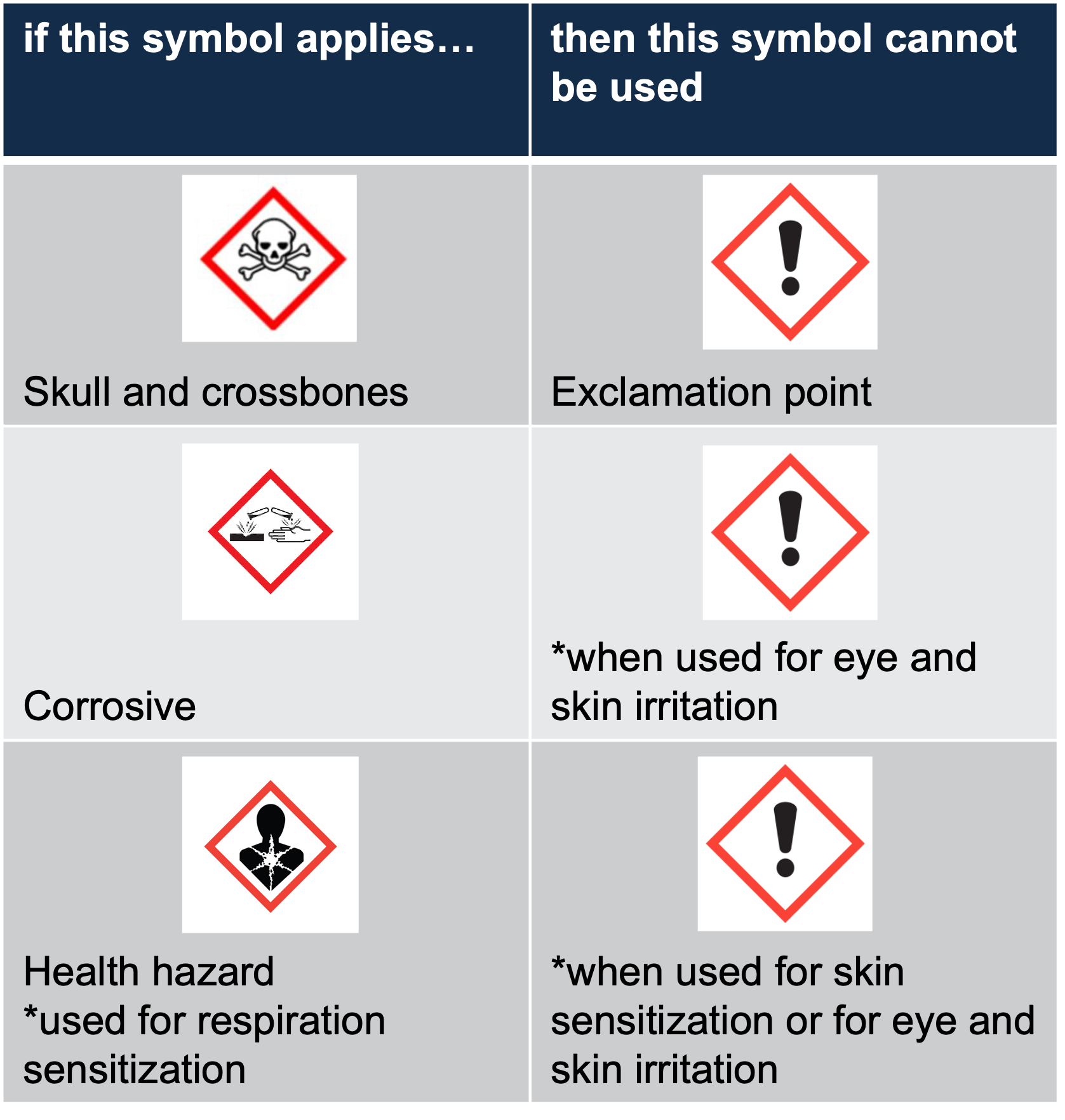 When the classification of a substance or mixture results in the inclusion of more than one hazard pictogram for the same hazard class, the pictogram corresponding to the category of greatest hazard for each class should appear on the label.
Hazard statements To avoid duplication or redundancy of information, the following rules of precedence can be applied: 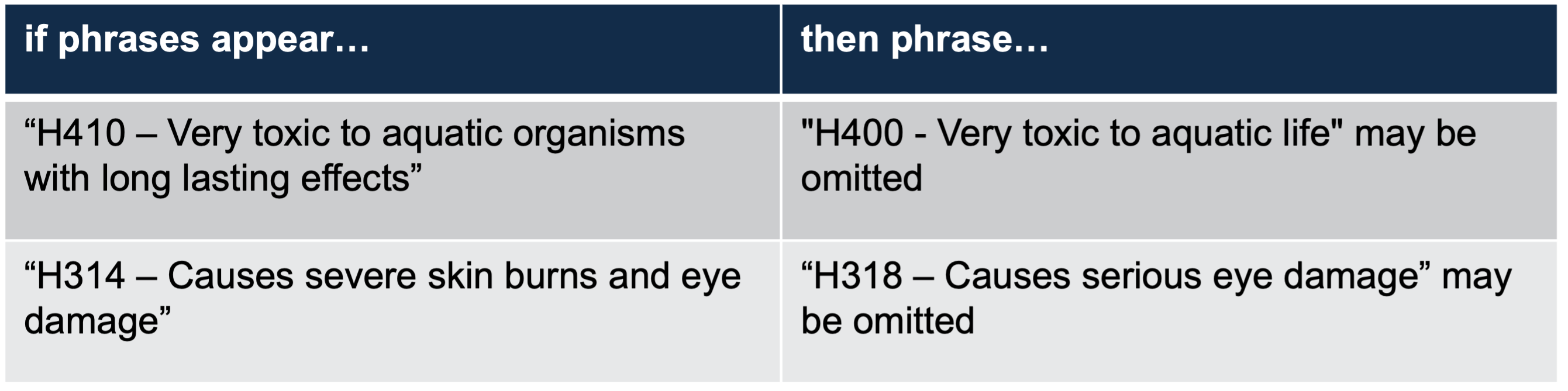 Precautionary statements The label must contain a maximum of six precautionary statements, unless it is necessary to describe the nature and severity of the hazards. The selection of precautionary advice will obey the severity of the hazards and the use of the substance or mixture.
¶ Label sizes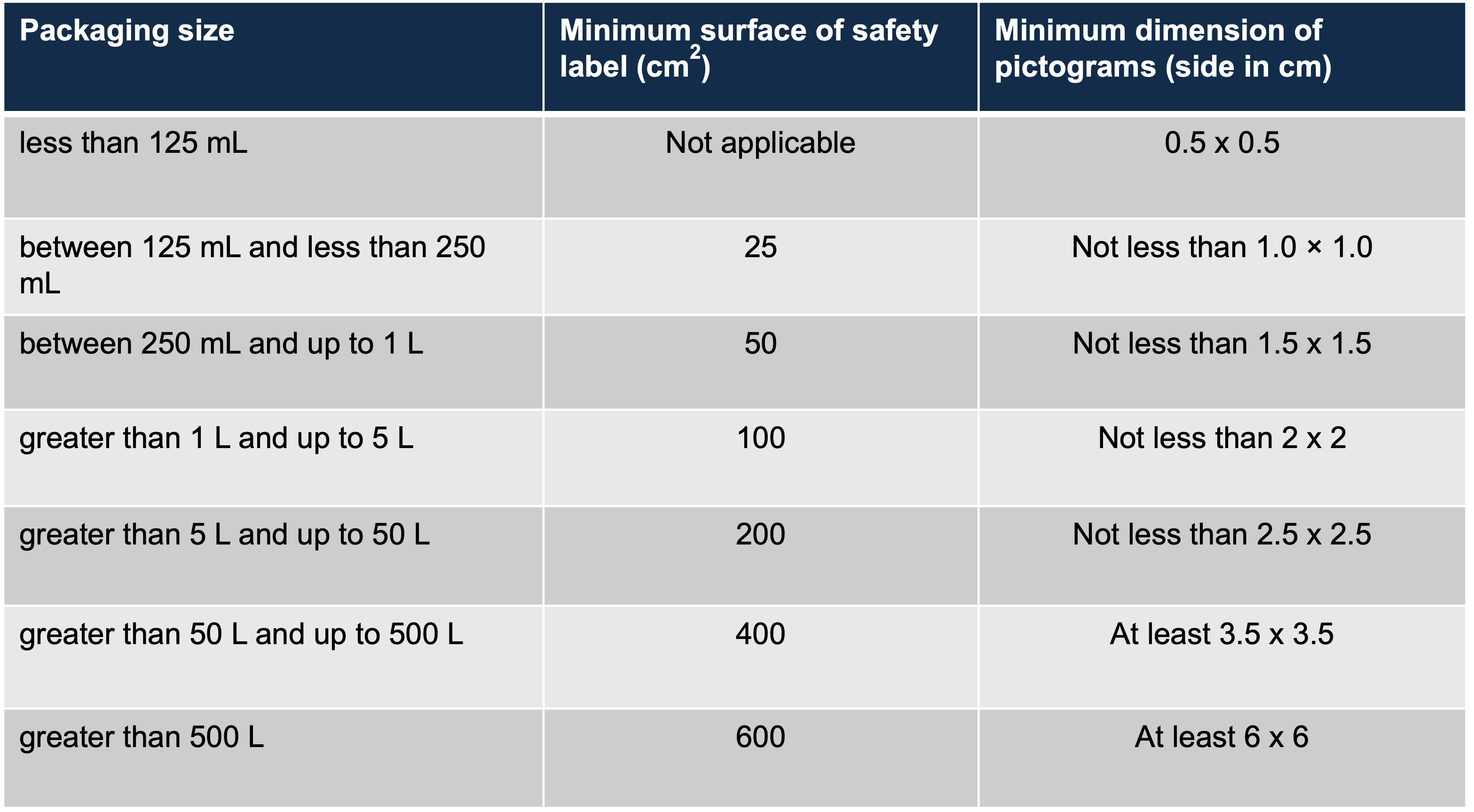 For imported substances or mixtures, labels with different dimensions will be accepted, as long as the classification of the substance or mixture matches the criteria established in this regulation and is in Spanish.
¶ Specific Hazard StatementsHazard statements can be found under Article 260, Tables 55 to 57 of Decree 57/2019. Under Article 261, additional hazard statements are provided to be included, according to their characteristics. 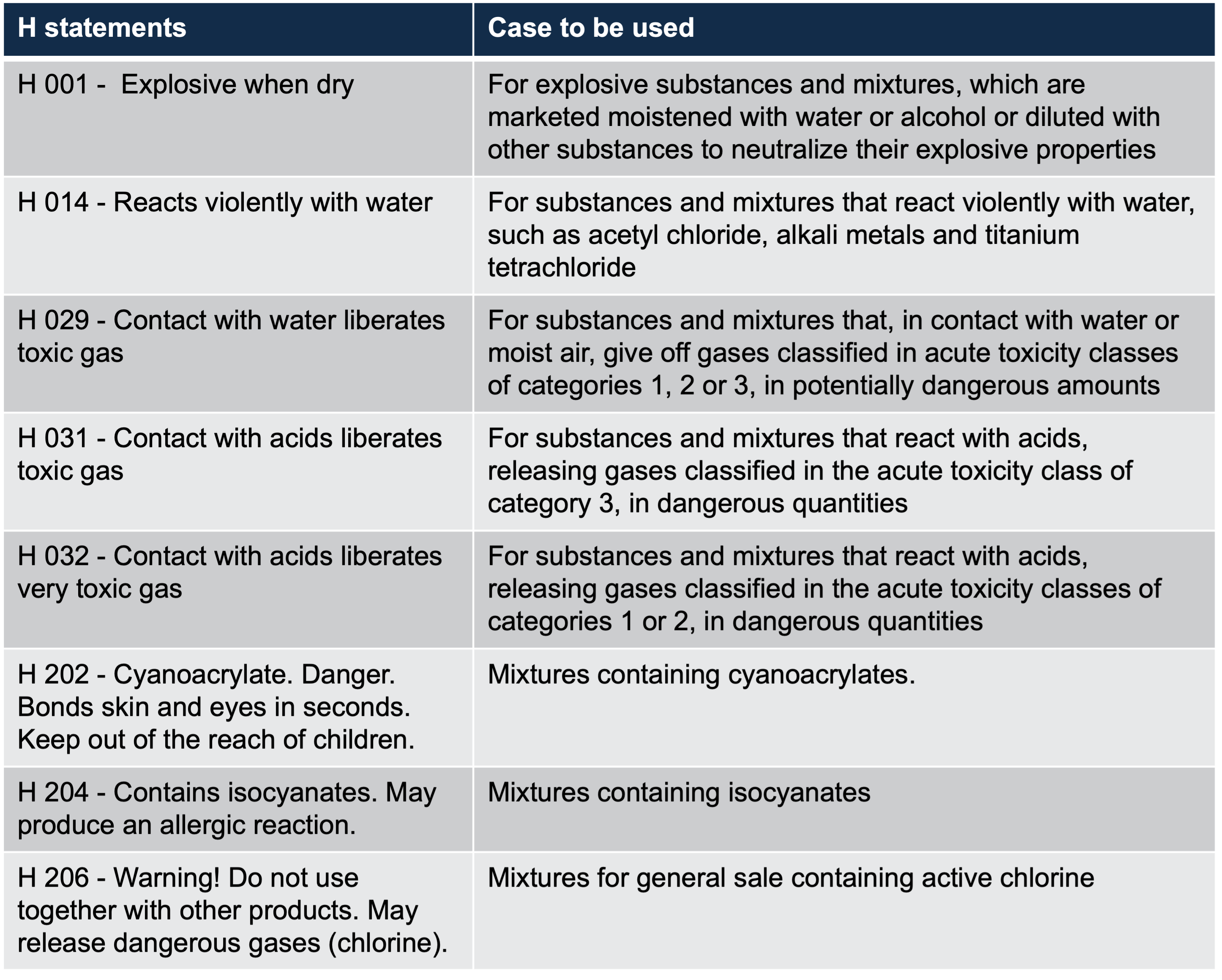
¶ Small LabelsFor containers smaller than 50 ml, only the danger pictograms will be required. For containers between 50mL and 125 ml, the pictograms and the hazard statements corresponding to health hazards will be required. For containers greater than or equal to 125 ml and smaller than 250 ml, if they contain substances that have more than two classes of danger, only the pictograms, signal word and hazard statements will be required.
¶ Label UpdateThe safety label must be updated each time there is a change to a more severe hazard category or a new hazard class.
¶ Transition PeriodThe transition period for Decree 57/2019 to enter into force varies for substances, mixtures, and use cases. Entry into force is determined from the publication date of this regulation, February 9, 2021, and is as follows:
|
Sources
*Not available in English |
¶ Trade SecretsIndustrial Property Law 19,039 of 2005, which was rewritten through Decree with Force of Law 3 on March 9, 2006 provides for the protection of trade secrets under Title VIII. However, Title VIII was modified through Law 21355 in June 22, 2021. As defined in Law 21355, a commercial secret is undisclosed information in the owner's possession that due to it's value and/or competitive advantage, requires to be kept as a secret. Penalties for the violation of commercial secrecy can be found on Title X of this Decree. Under NCh 2245:2015 Safety Data Sheet for Chemical Products, Content and Section Order, paragraph 4.2 establishes that the information included in an SDS is not confidential, however, the supporting documents of the SDS can be confidential.
|
Sources
*Not available in English |
¶ Occupational Exposure LimitsThe Ministry of Health of Chile regulates Articles 2 and 82 of the Health Code, which are approved by Decree Law No. 725 of 1967, through Supreme Decree No. 594 of September 15, 1999. Its objective is to establish basic health and environmental conditions that ensure the workers' well-being. Decree 594 of 1999 Sanitary and Environmental Workplace Conditions (OEL and BEI standard), was last updated by Decree 10 of June 20, 2019. A list of definitions, substances and values regarding TWAs, STELs, Ceilings, Sensitizers, Carcinogens can be found under Article 66, and Biological Exposure Indices under Article 113 of Decree 594 of 1999. This was last updated through Decree 123 of July 3, 2014. If any of the above limits is exceeded, the employer is required to implement the necessary corrective measures immediately and make the necessary changes to avoid damage to the workers' health. In addition, the employer is liable to fines and charges for non-compliance with the corrective action obligations. In paragraph 6.9.1 of Section 8 Exposure Controls/Personal Protection of NCh 2245:2015, Safety Data Sheet for Chemical Products, mandates that maximum allowable concentration limits with annotations for each substance and each components of a mixture referred in Section 3 of the SDS as occupational exposure limit values or biological exposure indices, of the current Chilean Decree 123 of 2014, must be provided in Section 8 of the SDS. Additionally, if in the current Decree there are no occupational exposure limits for a given chemical, then, provide, if possible, those from international agencies citing the source. The enforcement and auditing of compliance with the Decree, its modifications and the Health Code falls under the responsibility of the Health Services and the Environmental Health Services of Chile. |
Sources
*Not available in English
|
¶ Transport |
|
|
The Ministry of Transportation and Telecommunication is responsible for regulating transportation of dangerous goods in Chile. On November 25, 1994, they published Decree 298 establishing the conditions, rules and procedures applicable to freight transport of substances classified as dangerous by streets and roads. The Classification of these Dangerous Goods can be found under Chilean Standard NCh 382:2021, which is available for purchase from INN, National Standardization Institute of Chile. NCh 382:2021 is based on the 21st Revision of the United Nations Recommendations on the Transport of Dangerous Goods. For safety identification of dangerous substances being transported, marks and labels indicating appropriate classification should be placed in the transport units in which they are being carried, as well as shipper and carrier information. The requirements for identification regarding symbols, sizes, words and colors can be found in Standard NCh 2190:2019, which is regulated under Decree 43 of April 23, 2004. The pictograms for transportation according to GHS can be used with the current norm and can be found under the Resources tab. The transport of dangerous substances together with animals, food, medicines or products with which there is incompatibility and may cause reaction is prohibited. Vehicles used in transport of dangerous goods must have a maximum age of 15 years. During the transportation of goods, they must carry the labels referred to in the Chilean Standard NCh 2190:2019 above and must be equipped with a tachograph or other electronic device that records, at least in time, the speed and distance traveled. These records must be at the disposal of the Ministry of Transport and Telecommunications, of the Chilean Police, the shipper and the recipient, for a period of thirty (30) days. |
Sources
Resources *Not available in English |