¶ Recent Updates2026 The Drug registration and licensing requirements were updated in accordance with “Guidance Notes on Registration of Pharmaceutical Products/Substances” (Version 31 March 2026) and “Guidance on Application for License for Manufacturer of Pharmaceutical Products (Version May 2025)”. ¶ Background |
|
|
Hong Kong is an autonomous Special Administrative Region of the People's Republic of China. Following British rule from 1842 to 1997, China assumed sovereignty under the 'one country, two systems' principle. The Hong Kong Special Administrative Region (HKSAR)'s constitutional document, the Basic Law, ensures that the current political situation will remain in effect for 50 years. As a result Hong Kong maintains its own Chemical control regulatory system. Chinese and English are the official languages of Hong Kong. Three main languages are spoken by the people in Hong Kong: Cantonese (89.5%), English (3.5%) and Mandarin (1.4%). Hong Kong designates a system of governance led by a Chief Executive and an Executive Council, with a two-tiered system of representative government and an independent judiciary. The main administrative and executive functions of government are carried out by 15 policy bureaus and about 70 departments and agencies. Bilingual texts of Ordinances and subsidiary legislation in force on or after June 30, 1997 (over 1100 principal Ordinances) are collected into the Bilingual Laws Information System (BLIS) and available from the Department of Justice website (https://www.elegislation.gov.hk/). The Hong Kong Government Gazette is the official publication of the Government of Hong Kong (in Chinese and English): https://egazette.gld.gov.hk/en/. |
Official Gazette |
¶ Inventories |
|
| Hong Kong does not currently have a chemical inventory. | |
¶ Substance Registration |
|
|
Hong Kong does not have specific legislation requiring substance registrations. However, the following Ordinances require manufacturers, importers, exporters, or transporters of hazardous chemicals to apply for a compulsory permit or license: |
|
¶ Hazardous Chemicals Control Ordinance¶ Chapter 595In order to comply with the Stockholm Convention and the Rotterdam Convention, Hong Kong introduced the Hazardous Chemicals Control Ordinance (Chapter 595) to regulate the manufacture, export, import and use of chemicals that are not pesticides and have potentially harmful or adverse effects on human health or the environment. The Ordinance was promulgated in the Gazette on July 20, 2007. The Environmental Protection Department (EPD) of Hong Kong is responsible for processing applications for the issuance or renewal of permits and related matters. The Ordinance only regulates non-pesticide hazardous chemicals, and applies to a Type 1 or a Type 2 chemical specified in the Schedule 1 or Schedule 2 of the Hazardous Chemicals Control Ordinance (Chapter 595), whether or not the chemical exists alone or is a part of any preparation or product. ¶ PermitUnder the Ordinance, anyone wishing to import, export, manufacture or use any scheduled chemicals subject to control needs to apply for a permit from EPD. The manufacture of any Type 1 chemical is not allowed, except where the chemical is for use for laboratory-scale research purpose or as a reference standard, and the manufacture of the chemical is carried out under and in accordance with a permit issued under the Ordinance. The import/export or the use of any Type 1 chemical is not allowed except where it is carried out under and in accordance with a permit issued under the Ordinance. The import/export, manufacture or use of any Type 2 chemical is not allowed except where it is carried out under and in accordance with a permit issued under the Ordinance. There are five types of permits, including:
Applicants should submit a completed application form and all relevant information no less than 15 working days before starting the operation of the proposed activity. ¶ Permit feeThe application fee for a permit to import/export/ manufacture/use scheduled chemicals is HK$ 1280 for a new application and HK$ 710 for the renewal of an existing permit. ¶ Application documentsThe completed form should be submitted by hand or by post along with copies of the following documents:
Application documents should also include a brief description of facility operation related to the manufacture of the scheduled chemical for manufacturers and the use of the scheduled chemical for users. Every permit is generally valid for 12 months from the date of issue. The permit holder may apply to the EPD for renewal one month before the date of expiration. ¶ Chapter 60In addition to the permit requirement, each consignment of scheduled chemical(s) entering/leaving Hong Kong must also be covered by a consignment-based import/export license issued under Chapter 60 - Import and Export Ordinance. The import/export license requirements also apply to scheduled chemicals in transshipment. Such licenses are issued by the EPD under the delegated authorities from the Director-General of Trade and Industry. |
Sources
Resources Contact Information Permit applications should be sent to the following address: Territorial Control Office (Hazardous Chemicals Control Section) |
¶ Control of Chemicals OrdinanceTo fulfill an international obligation under the ''United Nations Convention Against Illicit Traffic in Narcotic Drugs And Psychotropic Substances, 1988'', the HKSAR introduced control on chemicals under Chapter 145 - Control of Chemicals Ordinance, which separates controlled chemicals into three schedules with different levels of control. The three schedules contain 29 chemicals including their salts that can be used for the manufacture of dangerous drugs or psychotropic substances. The HKSAR Controlled Chemicals Group of the Customs and Excise Department is responsible for issuing licenses, removal permits and import or export authorizations, and storage authorizations under the Control of Chemicals Ordinance. ¶ Application for LicenseA license is required to:
Applicants must submit an Application for License Form, together with supporting documents including:
The license fee is HK$ 1530 / year and must be renewed annually. ¶ Authorization to Import or ExportThe applicant must submit an application form for Authorization to import or export controlled chemicals, together with supporting documents including:
The application for the authorization is free of charge and shall be sent to the Customs and Excise Department. Four working days before the arrival of the ship or aircraft carrying a controlled chemical, the importer shall give notice in writing to the Commissioner of Customs and Excise of:
Four working days before exporting a controlled chemical, the exporter shall give notice in writing to the Commissioner of Customs and Excise of:
|
Sources Resources
Contact Information Application documents should be submitted in person or by registered post to: Customs and Excise Department, Customs Drugs Investigation Bureau |
¶ Product Registration |
|
¶ PesticidesChapter 133 - Pesticides Ordinance regulates the import, manufacture, formulation, distribution, sale and supply of pesticides in Hong Kong. Pesticides are controlled by the Agriculture, Fisheries and Conservation Department, through registration of pesticides, requiring license for manufacturers and traders of registered pesticides and permit for manufacturers, traders and users of unregistered pesticides as well as the scheduled pesticides under the Ordinance. ¶ Pesticide RegistrationThe Director of Agriculture, Fisheries and Conservation maintains a register of pesticides with two parts. Part I contains a list of ready-to-use household pesticides. Part II of the register contains a list of all other pesticides. The Pesticides Register contain information on the active ingredient(s), concentration limit and permitted formulations. Pesticides that contain unregistered active ingredient or don’t conform to the concentration limit and permitted formulations need to be registered. Who can apply Any person may apply to the Director for registration of a pesticide. Application fees The application fee for pesticide registration is HK$2,880 and should be paid when the application is made. Required information for pesticide registration A. Information on the active ingredient(s) The information shall be provided in Traditional Chinese or English. Postal application should be addressed to the Director of Agriculture, Fisheries and Conservation (DAFC) and mentioned with "Application for Pesticide Registration". Once the application is approved, the information on the pesticide will be added into the Register. ¶ Pesticide LicenseWho shall apply Pesticide manufacturers, importers, suppliers and sellers of registered pesticides shall apply for the pesticide license. Application fees and timeline There are two parts of fees. The non-refundable application fee of HK$ 140 shall be paid at the time of application. The license issue fee (for Part I pesticides: HK$ 435; for Part II or both Part I and Part II pesticides: HK$ 880) shall be paid upon approval of the application. The processing of the application will take 2 working day after the required application documents are received. Application document
License renewal Every license shall expire 12 months after the date of issue but may be renewed 2 months before the expiration date. ¶ Pesticide PermitWho shall apply Pesticide manufacturers, importers, suppliers, sellers and possessor/user of the scheduled pesticides or unregistered pesticides for re-export, laboratory research, or supply to other permit holders etc., shall apply for the pesticide permit. Application fees and timeline There are two parts of fees. The application fee of HK$ 180 shall be paid at the time of application. The permit issue fee (to import or possess a scheduled pesticide or an unregistered pesticide for re-export only: HK$ 805, for other purposes HK$ 1470) shall be paid upon approval of the application. The processing of the application will take 2-4 working days after all assessments and inspections have completed. Required information for pesticide permit A. Information on toxicity of the pesticide License renewal Every permit shall expire 6 months after the date of issue but may be renewed 1 months before the expiration date. In addition, each shipment of registered or unregistered pesticides entering/leaving Hong Kong must also be covered by an import/export license issued under Chapter 60 - Import and Export Ordinance. |
Sources Resources
Contact Information Application for Pesticide Registration/License/Permit should be sent to: 5/F., Cheung Sha Wan E-mail application for Permit: pestpmt@afcd.gov.hk |
¶ Drugs
|
Sources Resources
Contact Information Application for Licenses should be sent to: Manufacturers Regulatory Unit
|
¶ CosmeticsHong Kong doesn't have any regulations specifically on cosmetics. Cosmetics are considered consumer products and shall comply with the Chapter 456 Consumer Good Safety Ordinance. There are no mandatory registration requirements, ingredient restrictions or labelling requirements specifically for cosmetics in Hong Kong, as long as the cosmetic product meets the general safety requirements for consumer products. According to Chapter 456 Consumer Good Safety Ordinance, the general safety requirement means "reasonably safe" in all circumstances, including the following:
Chapter 456A Consumer Goods Safety Regulation requires bilingual warning or caution for consumer goods. Any warning or caution with respect to the safe keeping, use, consumption or disposal of the consumer goods must be given in both Chinese and English. Also, the warning or caution shall be legible and placed in a conspicuous position on the consumer goods, on any package containing the consumer goods, or on a label securely affixed to the package, or on a document enclosed within the package. |
Sources |
¶ Notifications |
|
| Currently, there are no notification requirements in Hong Kong. | |
¶ Restrictions and Bans |
|
¶ Ozone Depleting SubstancesThe Ozone Layer Protection Ordinance was enacted in July 1989, fulfilling Hong Kong's international obligations under the Montreal Protocol. The Ordinance applies to the production, import and export of ozone depleting substances in Hong Kong. Instead of directly adopting and duplicating the Montreal Protocol annexes, Hong Kong published a schedule of ozone depleting substances divided into 9 parts: Part 1: Chlorofluorocarbons (CFCs) Manufacturing listed ozone depleting substances is prohibited in Hong Kong under Section 3 of the Ordinance, except for the purpose of research or academic instruction and in quantities of no more than 1 kg of the substance in a 12 month period. Importing and exporting a scheduled substance is permitted only with a valid license and registration granted under Section 5 of the Ordinance by the Director of Environmental Protection. |
Sources Resources |
¶ Persistent Organic Pollutants (POPs)The People's Republic of China ratified the Stockholm Convention on Persistent Organic Pollutants (POPs) in June 2004 and has set out the National Implementation Plan (NIP) to reduce the presence of POPs and to meet the obligations under the convention. The NIP also covers the implementation of the convention by Hong Kong Special Administrative Region. There are several Ordinances controlling POPs, including:
|
Sources
|
¶ Restriction of Hazardous Substances (RoHS)Currently, Hong Kong does not have any requirements for EEE similar to the EU Restriction of Hazardous Substances (RoHS). |
|
¶ SDS + Label |
|
| In addition to the below requirements, under Chapter 59AB, proprietors are required to provide employee safety information, training, and precautions, and protective clothing and equipment. Employees are required to follow safety instructions, procedures, and precautions set by the proprietor of the industrial undertaking regarding that substance, and use proper protective clothing and equipment. Proprietors or employees who violate parts of the Ordinance may be subject to fines | |
¶ ClassificationChapter 59 - Factories and Industrial Undertakings Ordinance contains 30 sets of subsidiary regulations covering various aspects of hazardous work activities in factories, building and engineering construction sites, catering establishments, cargo and container handling undertakings, and other industrial workplaces. The Labour Department of the Hong Kong Special Administrative Region Government (HKSARG) is the authority to ensure that workplace safety and health are properly managed by the legislation. Enacted in 1988, the classification scheme adopted by Chapter 59AB -Factories and Industrial Undertakings (Dangerous Substances) Regulations is similar to the chemical legislation in the European Union of that time (Dangerous Substances/Products Directive) in that certain dangerous substances are classified based on their physical and health properties. The Regulations define a dangerous substance as any substance that is a listed substance in Schedule 1 or a dangerous mixture. A 'dangerous mixture' is any mixture or preparation containing:
|
Sources
Resources |
¶ SDSCurrently there are no requirements on Safety Data Sheets in Hong Kong. Regulation 11 of Chapter 59AB - Factories and Industrial Undertakings (Dangerous Substances) Regulations requires that the proprietor of a specified industrial undertaking shall make adequate information available about any necessary conditions to ensure that the substance will be safe and without risk to the health of persons employed in the undertaking, to every person employed in the undertaking who works with or is likely to come into contact with a dangerous substance . According to the Labour Department of Hong Kong, an MSDS that is GHS compliant is acceptable for fulfilling the requirements stipulated in Factories and Industrial Undertakings (Dangerous Substances) Regulations. The MSDS or relevant information made available to concerned workers for hazard communication purpose should be provided in English and traditional Chinese in such a way that its contents can be read easily and be understandable to employees. |
Sources |
¶ LabelChapter 59AB of the Factories and Industrial Undertakings (Dangerous Substances) Regulations specifies that proprietors must adhere to specific labeling requirements including label size and form, and indications of Particular Risks and Safety Precautions. Every container holding a listed substance specified in the First Schedule of Chapter 59AB shall be labelled as follows:
Every container holding a dangerous mixture to which these regulations apply shall be labelled with the trade name of that mixture and
The container shall be labelled in English and Traditional Chinese and in a font size that can be read easily when the container is placed as it may normally be expected to be placed. Symbols prescribed by the Second Schedule shall be adopted. The label content shall be clearly and indelibly marked and shall stand out sharply from their background on a label that is securely fixed to the container with its entire back in contact with the container; or on a label attached in some other suitable manner. The dimensions of the label shall be as follows: 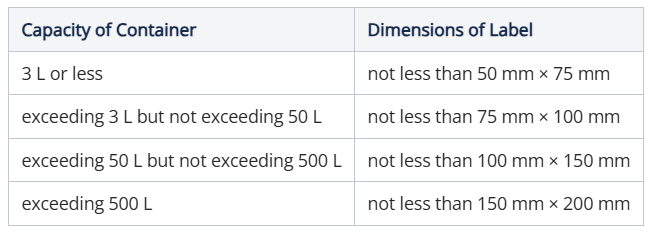 The size of any symbol required to be shown on the label shall be not less than one-tenth of the area of the label and shall not in any case be less than 100 mm2. |
Sources |
¶ Trade SecretsCurrently there are no rules addressing trade secrets for hazardous chemicals in Hong Kong. |
|
¶ Occupational Exposure LimitsHong Kong's Occupational Exposure Limits (OELs) are based on the 2001 American Conference of Governmental Industrial Hygienists' (ACGIH®) Threshold Limit Values (TLVs®), as well as standards from other overseas organizations. OELs apply only to workplace operations covered by Section 7A(1) of the Factories and Industrial Undertakings Ordinance (FIUO) (Chapter 59) and are incorporated into the Code of Practice, Control of Air Impurities (Chemical Substances) in the Workplace, Annex 1, issued by the Commissioner for the Labour Department. The Labour Department has the authority to adjust the OELs based upon new health hazard information. The OELs take the forms of TWA (time-weighted average), STEL (short-term exposure limit) or ceiling values:
Under Section 6A of the FIUO, Hong Kong proprietors' responsibilities include, ''providing appropriate measures for preventing the entry and accumulation of impurities in the workplace and taking steps to protect workers against inhaling impurities that may be injurious to health.'' Although failure to observe any provision of the Code of Practice is not considered directly to be an offense, ''that failure may be taken by a court in criminal proceeding as a factor in determining whether or not a person has breached the relevant safety and health provisions under the legislation,'' and may be found liable to a fine and imprisonment. As Hong Kong has no specific requirements for the Safety Data Sheet, there is not a requirement to list these OELs on the SDS. |
Sources |
¶ Transport |
|
|
In Hong Kong, the Fire Services Department regulates land transport of dangerous goods under the Dangerous Goods Ordinance (Cap 295) and its subsidiary legislation. The Marine Department regulates transport of dangerous goods at sea in Hong Kong and enforces compliance with applicable requirements, including the Dangerous Goods Ordinance (Cap 295) and the IMDG Code. The Civil Aviation Department regulates the air transport of dangerous goods in Hong Kong and enforces the Dangerous Goods (Consignment by Air) (Safety) Regulations (Cap 384) and the ICAO Technical Instructions.
|
Sources
Resources |