¶ Background |
|
|
The Knesset, Israel's unicameral parliament, is the country's legislative body. Israel's national legislation is complemented by a wide range of environmental laws at both the local and international levels. The legal authority for environmental issues is the Ministry of Environmental Protection.
|
|
¶ Inventories |
|
|
Israel’s Ministry of Environmental Protection published a proposal to establish an industrial chemical registration scheme that will apply to all Israeli manufacturers and importers of chemicals and chemical mixtures. The law was proposed by the Israeli Ministry of Environmental Protection and was open for public consultation until October 22, 2020. The proposed law has three major components:
Similar to the Toxic Substances Control Act of the US, there will be two sets of chemicals: existing and new. For new chemicals that are manufactured or imported into Israel, the Israeli entity that will be responsible for handling said chemical will have to register it 30 days prior to its manufacture or importation. The threshold for exemption from registration is 10 tonnes per year. A list of exceptions to the registration obligation will be established and specified in the definition for "a chemical must be registered." The exceptions are divided into four main groups:
The proposed effective date was March 1, 2023, and if enacted, manufacturers and importers would have had until September 1, 2024 to submit the required data and register the substances. However, as of October 2024 this proposal has not yet been enacted. |
Sources *Not available in English |
¶ Substance Registration |
|
¶ Hazardous Material PermitBased on the Hazardous Substances Law (1993), a Hazardous Materials Permit is required for the holder of any chemical listed in Appendix B of the law, whether the substance is in its simple form, mixed, or blended. This gives the MoEP the authority to control hazardous substances, including licenses, transport, import and export.The MoEP usually delegates authority to approve the permit to a supervisor. The permit will then only be approved if that supervisor is satisfied with the applicant's familiarity with the hazardous substances in his possession, including their safety requirements. Such permits specify the types, quantities, and compositions of chemical substances. The permit holder should maintain a register of the hazardous substances (according to the template in Schedule 3 of the Law), in which the details of all sales and purchases of chemicals are recorded. These record books track the movement of the hazardous substances throughout Israel. The Hazardous Substances Law of 1993 was last amended on August 11, 2008 and is available on the MoEP's website, along with the amended list of hazardous substances. The MoEP grants hazardous material permits to different sectors that deal with hazardous substances above a certain concentration (Class A) and/or quantity (Class B) in accordance with Schedule 2 of the Hazardous Substances Regulations (Classification and Exemption) of 5756-1996. Based on these regulations, permits are granted for different activities including export, import, storage, and transport as well as different sectors, including petrochemical plants, pesticide manufacturers, pharmaceutical industry, farms, swimming pools, printing houses, and laundromats. The validity of the permit may vary from one year to three years. This is determined by criteria established in the Hazardous Substances Regulations (Criteria for Determining the Validity of Permits), 2003, which was later updated in December 2015. Factors considered include type of plant and type and quantity of the hazardous substance in its possession. Permit holders can be classified into three risk categories (A, B, and C) according to the following parameters:

|
Sources
Resources *Not available in English MoEP Support |
¶ Business Licenses
Business licenses are granted by the Ministry of the Interior, using the input by the local authorities, and in consultation with relevant ministries - Ministry of Environmental Protection, Public Security, Ministry of Economy and Industry, Ministry of Agriculture, and Ministry of Health. ¶ Business License ProcedureThe business owner must apply for and receive approval from several ministries and government authorities, and often from different units within those entities. The current process to receive business license approval from the MoEP:
Special environmental conditions, stipulated by the MoEP, relating to either infrastructure or operation, may be imposed within the framework of the license with regard to air quality, solid waste, hazardous substances management and water and sewage (including industrial effluents). All businesses appearing in the Business Licensing Order are classified into three levels (A to C) according to their potential environmental risk, where level A represents industrial plants with the greatest potential for environmental pollution. Local environmental units and associations of towns for the environment are authorized to deal with level C businesses, including preparation of conditions and enforcement of their implementation. More information about the environmental conditions required for business licensing is available from the MoEP's website. However, the publication of the law and its amendments are only available in Hebrew. |
Sources
Resources
*Not available in English |
¶ Narcotics/Dangerous DrugsIsrael's Dangerous Drugs Ordinance [New Version], 5733-1973 is the main vehicle for regulation of dangerous drugs and dangerous drug precursors in Israel. The law falls under the jurisdiction of the Ministry of Health (MoH) and outlines the requirements for import and export permits of Dangerous Drugs into and out of Israel. The law contains appendices listing the regulated substances, and the Fight Against the Phenonmenon of the Use of Dangerous Substances Law, 5773-2013 provides for the passage of urgent declarations adding temporary entries to the list. One can request an import permit for a dangerous drug from the MoH through their online portal. Additionally, one may not possess, transfer, own, grow, manufacture, or derive a dangerous drug from another drug without permission from the MoH.Forms for these purposes may be found at the link provided. |
Sources
*Not available in English |
¶ Product Registration |
|
¶ Pesticides |
|
|
In Israel, registration procedures for pesticides vary depending on whether the product is an agricultural pesticide, organic pesticide, or non-agricultural pesticide. ¶ Agricultural PesticidesThe criteria for placing plant protection products on the Israeli market is mostly based on the EU Directive 91/414/EEC on the placing of plant protection products on the market. However, there are currently 60 chemicals not included in Annex 1 of the EU Directive that are used in Israel. The registration process of pesticides intended for agricultural use takes about two years. That time period includes the testing and the investigation process. The process requires a wide array of toxicity tests, including acute and chronic toxicity, carcinogenicity, and metabolic tests for the active ingredient(s), as well as investigating their effect on the surrounding environment, including birds, aquatic organisms, soil, etc. The investigative committee who decides to approve the product for final registration has representatives from several ministries, including Ministry of Environmental Protection (MoEP), Ministry of Health (MoH), Ministry of Economy and Industry, and consumer representatives. At the beginning of every year, the regulator typically publishes a list of all registered pesticides in Israel. The General Director of the Plant Protection and Inspection Services (PPIS) is the official authority for the registration of pesticides for agricultural use. The pesticide for agricultural use should be registered and licensed prior to sale or use in Israel. The registration and licensing procedure includes the following phases:
Application forms for the different phases are available on the MoAg website. |
Sources
Resources
MoAg Contacts Ricky Kettner rickym@moag.gov.il Ethel Shaprut ethels@moag.gov.il Roza Vaynstein rozav@moag.gov.il
|
¶ Organic PesticidesWithin the Ministry of Agriculture, the PPIS are the authority for the supervision of organic produce and products intended for export to EU countries. As of September 1, 2008, the Organic Produce Law became effective, which only encompasses organic foods derived from plant sources. The Law established a uniform and official organic symbol or logo on organic products that consumers can search for. The Organic Produce Law was last amended on February 10, 2014 regarding the labeling of organic produce in Israel. PPIS publishes 'Yeruka' annually, which provides information about the permitted substances for organic agricultural use, such as plant protection products and fertilizers. The PPIS is in charge of granting the approval and the registrations of the organic pesticides. This requires verifying the formulation adheres to the Israeli standard of fresh and processed organic produce from plant origin, and the EU council Regulation EEC No. 2092/91. The advisory committee for organic agriculture requires the following documents:
The registration procedure for Organic Pesticides it the same as the procedure mentioned below for Non-Agricultural Pesticides. |
Sources
Resources
*Not available in English |
¶ Non-Agricultural PesticidesBased on the Hazardous Substances Regulations 5754-1994 regarding Pesticides for Public Health, Israel regulates pesticides for public health purposes (non-agricultural pesticides) and wood preservatives separately. The complete regulatory text is only available in Hebrew on the MoEP website. The Regulations require the office responsible for pesticide registration to consult with an inter-ministerial professional committee, which is formed with representatives of the Environmental Protection and Health Ministries. The application for the registration process must be accompanied by the pesticide composition, a copy of the proposed label, and an impact study on human health and the environment. To submit a registration dossier, scheduling an appointment with Pest Control department at the MoEP is recommended. Appointments may be scheduled via the following telephone number: +972-6495877-02. Several pesticides intended for public health have been banned or restricted in Israel. The full list of registered pesticides is available in both English and Hebrew via the MoEP website. Additionally, this website provides the complete registration procedure for public health pesticides, in English and Hebrew. |
Sources Resources
*Not available in English |
¶ Cosmetics
Additionally, for foreign-made cosmetic products to be imported legally into Israel, a GMP (Good Manufacturing Process) approval and a CFS (Certificate of Free Sale) approval from the importing country where the products are being manufactured is required. Only EU countries or countries with trade agreements with Israel can import cosmetic products. 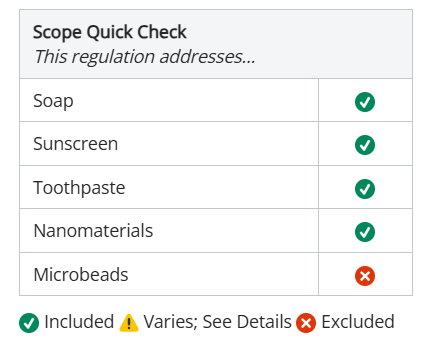
¶ DefinitionsCosmetics are divided into 2 categories: general cosmetic products and designated (dedicated) cosmetic products. The government's webpage for Cosmetics Licensing defines these categories as follows: A general cosmetic product Any substance intended to be applied to the external parts of the human body with a view to clean, perfume, beautify, alter appearance, protect, guard, or improve body odors This definition applies to products intended for hair and nails A designated cosmetic product is a product that is:

|
Sources Resources *Not available in English |
¶ Notifications |
|
¶ Prior Informed ConsentIsrael signed the Rotterdam Convention on the Prior Informed Consent Procedure for Certain Hazardous Chemical and Pesticides in International Trade in May 1999 and Ratified the Convention in October 2011. Though there is no formal legal instrument for the implementation of the convention, the Ministry of Environmental Protection and Ministry of Agriculture are responsible for its enforcement. |
Sources |
¶ Restrictions and Bans |
|
¶ Ozone Depleting SubstancesIsrael signed the Montreal Protocol in 1988. In 1992 Israel ascended to the Vienna Convention and ratified both the Montreal Protocol as well as the London Amendment to the protocol. Since then Israel has ratified the Copenhagen (1995), Montreal (2003), and Beijing (2004) Amendments. Legal enforcement of the Montreal Protocol is overseen by The Ministry of Environmental Protection as laid out in the 2004 law "Hazardous Substances Regulations (Implementation of the Montreal Protocol on Substances that Deplete the Ozone Layer), 5764-2004," which was most recently updated in 2009. |
Sources *Link to the unofficial English translation of the law, the binding Hebrew text of the law can be found here |
¶ Persistent Organic Pollutants (POPs)Israel signed the Stockholm Convention in May 2001 and the Ministry of Environmental Protection organized a meeting to begin the ratification process in 2011. Despite the fact that Israel has not yet ratified the convention, the chemicals listed in Appendix A of the convention are nonetheless banned in Israel. |
|
¶ Restriction of Hazardous Substances (RoHS)Israel does not have any requirements for EEE similar to the EU Restriction of Hazardous Substances (RoHS) Directive. |
|
¶ SDS + Label |
|
¶ ClassificationThe Israeli Standard 2302 (SI 2302) defines the system that regulates Classification, Packaging, Labeling and Marking of Dangerous Substances and Preparations. The Standard is comprised of two parts: Part 1: Dangerous Substances and Preparations: Classification, packaging, labeling and marking Part 2: Dangerous Substances and Preparations: Transportation – Classification, packaging, labeling and marking. On May 12, 2019, Israel published its implementation of the Globally Harmonized System (GHS), SI 2302 Parts 1 and 2 in its Gazette. The new requirement will take effect 90 days from the anticipated publication in the gazette on August 9, 2019, with a 3-year transition period until August 9, 2022. SI 2302 Part 1 – Dangerous Substances and Mixtures: Classification, Labeling, Marking and Packaging and SI 2302 Part 2 – Transportation: Classification, Labeling, Marking and Packaging underwent a comment period in 2019. Compared to the existing standards on hazard communication in Israel, under the GHS implementation more products are expected to be classified as hazardous, in addition to the labeling changes necessary to implement GHS-style labels. Since it is not stated, it is unclear which version of the GHS these standards are based on.
|
Sources Currently, the new editions of the Standards (SI 2302 Parts 1 and 2), announced May 2019, are not available. When published they will be available in the Hebrew language only, at The Standards Institution Of Israel. Israeli Standard for Labeling and Marking of Dangerous Substances, Preparations *Not available in English
|
¶ Safety Data SheetsThe Labor Inspection Service of the Ministry of Industry is responsible for supervising the safety regulations and the health and safety of workers in all workplaces. The Work Safety Regulations (Safety Data Sheets, Classification, Packing, Labeling and Marking) is one of the issued Regulations by the former Ministry of Industry, Trade and Labor, now the Ministry of Economy and Industry. The purpose of this Regulation is to maintain the safety and health of workers as well as the surrounding environment. According to this regulation, a Safety Data Sheet is mandatory for producers, importers, distributors, and sellers in Israel. The Regulation obliges any manufacturer, importer, agent or seller of hazardous/dangerous chemicals to follow the packaging instructions and rules in accordance with the Israeli Standard 2302 and that the SDS be attached. The SDS must be submitted to the Environmental Emergency Center. Article 5 of the Regulation states that an SDS should be updated when there is new relevant information available, and should be sent to anyone who purchased the substance within the 12 months prior to the update. This update must additionally be shared with the Environmental Emergency Center. The format and type of information required in the SDS follows the EU style: EU CLP is acceptable. The SDS must be available in Hebrew or English. The Regulation requires the following statement to appear at the end of every SDS: ''the information in the sheet was written based on the best knowledge and experience currently available.'' |
Sources Read more about the Israeli Standard for Labeling and Marking of Dangerous Substances, Preparations (SI 2302) in the Classification section. *Not available in English |
¶ Submission of SDSIn 1993, the MoEP established the Information and Response Center for Hazardous Substances, which collects information on hazardous substances that are used, produced, imported, exported, transported and disposed of in Israel. In the event that a chemical accident should occur, the Center is able to provide important emergency response information. The Center is open 24 hours a day. To facilitate the Center's activities, the manufacturer, distributor or importer must submit their most recent SDS to the center via their website. This must be updated when the formulation changes or the SDS is updated. Information maintained by the Center via this submission:
|
Sources *Not available in English Environmental Emergency Center of the Ministry of Environmental Protection (MoEP) Telephone: *6911 or 073-273-3200 For emergencies related to Hazardous Substances including poisoning (this information should be included on the SDS: For inquiries on working with Hazardous Substances: |
¶ Sections of the Safety Data Sheet |
|
¶ LabelOn May 12, 2019 GHS was implemented, the new requirement will take effect 90 days from the anticipated publication in the gazette on August 9, 2019, with a 3-year transition period until August 9, 2022. Further details are available in the Classification section. EU CLP format is currently accepted on a voluntary basis. The labels should be in Hebrew and the information on the label should match the information on the SDS. |
Sources Read more about the Israeli Standard for Labeling and Marking of Dangerous Substances, Preparations (SI 2302) in the Classification section. *Not available in English |
¶ Trade SecretsComposition information may be kept confidential with a few provisions. These are:
Kept secret through certain steps taken by the manufacturer (documentation of these steps is recommended). |
|
¶ Occupational Exposure LimitsRegulations for the Labor Inspection Organization (Environmental Monitoring and Biological Monitoring of Employees for Harmful Agents), 5751-1990, sets limits on the exposure to workers of several substances directly under Israeli law and adopts ACGIH values for all other regulated substances. The latest amendment was made in July 2011 and was published on August 29, 2011. The amended Regulations became effective 60 days after the publication date. The Israeli occupational safety regulations require facilities where workers are exposed to harmful agents delineated in Addendum A of the Regulations to conduct ''Occupational-Environmental Examinations'' to determine the risk to workers. These examinations are required annually otherwise determined by the Regional Labor Inspector. They must be carried out by a Certified Laboratory Tester working through a laboratory certified by the Chief Labor Inspector. The results of the examination must be retained by the laboratory for at least 20 years and posted in a visible and accessible area at the workplace in order to inform workers. In addition, ''Toxicological-biological examinations'' are required for all workers exposed to or potentially exposed to chemical and physical agents. Because Israel regulates occupational exposure limits for chemical substances through a coordination of ACGIH recommendations and governmental law, careful consideration of all available sources is necessary. In August 2015, the ministry of Economy issued a new draft concerning Work Safety Regulations (Environmental Monitoring and Biological Monitoring of Workers Exposed to Harmful Factors). The updated exposure values were drafted following the recommendations of ACGIH and the examination committee of safety and occupational health at the OSH (Israel Institute for Occupation Safety and Hygiene). They have not been finalized into law. |
Sources
*Not available in English |
¶ Transport |
|
| The Standards Institution of Israel is responsible for SI 2302 Part 2 Dangerous Substances and Preparations: Transportation – Classification, packaging, labeling and marking. This standard is based on the 13th Revision of the United Nations Recommendations on the Transport of Dangerous Goods. |
Sources *Not available in English |