¶ Recent Updates2025
¶ Background |
|
|
Navigator Newsfeed The United States is a Federal constitutional Republic with 50 states and a government structure consisting of three branches: the Legislative, the Executive and the Judicial branches. In the United States of America, the head of government, the President (Executive), shares his powers with Congress (the Legislative branch is made up of two bodies – Senate and House of Representatives) and the Judiciary system which are independent of each other but at the same time depend on each other's decisions to function correctly. Congress is charged with making the laws that are enforced at a national level with the states having the authority to enact laws that can augment and provide more strict requirements. State laws cannot contradict or override Federal law. The US Federal Register is the official daily publication for final rules, proposed rules, and notices of Federal agencies and organizations. Twice a year, the Office of Information and Regulatory Affairs publishes a Unified Agenda and Regulatory Plan. In the United States the production, use, and disposal of chemicals found in drugs, food, consumer products, and the workplace is primarily controlled at the federal level. Four major chemical control laws have been enacted to address the scope of chemical use and its management: OSHA: The Occupational Safety and Health Act 29 USC §651 et seq. • 29 CFR Parts 1900 to 2400
FIFRA: The Federal Insecticide, Fungicide, and Rodenticide Act 7 U.S.C. §136 et seq. • CFR
FFDCA: The Federal Food, Drug, and Cosmetic Act 21 U.S.C. §301 et seq.
TSCA: The Toxic Substances Control Act 15 U.S.C. §2601 et seq. • 40 CFR
|
|
¶ Inventories |
|
¶ TSCA InventoryIn Section 8(b) of the Toxic Substances Control Act (TSCA), the Environmental Protection Agency (EPA) was authorized to compile, keep current and publish a list of chemical substances which are manufactured or imported into the United States for commercial purposes. This list is known as the TSCA Inventory. The initial reporting period by manufacturers, processors and importers was January to May of 1978 for chemical substances that had been in commerce since January of 1975. The Inventory was initially published in 1979, and a second version, containing about 62,000 chemical substances, was published in 1982. Since the initial publication, the Inventory has been continually updated with deletions, corrections, and, most importantly, additions. There are now more than 86,000 substances on the Inventory. For the first time ever, in February 2019, EPA released an updated version of the Inventory on which all substances were designated as Active or Inactive. Please see TSCA Inventory Reset for more information. ¶ Searching the InventoryThe Master Inventory File, which is maintained by the EPA, consists of two parts:
The most direct way to search the Inventory is by CASRN; however, such searches are not always conclusive. That’s because the absence of a particular CASRN doesn’t necessarily mean that the corresponding substance is not on the Inventory. Consider, for example, naturally-occurring substances. If a chemical meets the definition of a naturally-occurring substance, it’s considered to be on the Inventory even if its CASRN is not listed. Conversely, the fact that a substance has a CASRN does not imply that it’s on the Inventory. CASRNs have been assigned to more than 100 million substances. As noted above, there are more than 86,000 substances on the Inventory. So, the vast majority of substances to which CASRNs have been assigned are not on the Inventory. Also, the fact that a substance is in commerce elsewhere in the world does not imply that it’s on the U.S. TSCA Inventory. One can also search the Inventory by chemical name or name fragment. But, there are drawbacks to this approach, as well. For example, most substances are known by two or more different names. But, only one name appears on the Inventory. To effectively and efficiently search the Inventory, one should understand how various types of substances are listed on the Inventory. EPA has developed Inventory listing guidance documents for various categories of substances, including:
A person who intends to manufacture or import a chemical substance not listed by specific chemical name on the public Inventory may ask EPA whether the substance is included on the confidential Inventory. EPA will answer such an inquiry only if the person has established a bona fide intent to manufacture or import the chemical substance for commercial purposes. In a bona fide notice, a submitter must provide specific chemical identification data including:
EPA will consider the information submitted in a bona fide notice and, if the Agency believes that the submitter has demonstrated a genuine intent to manufacture or import, search the full TSCA Inventory master file and provide a written determination to the submitter on the TSCA Inventory status of the chemical substance. Substances found on the TSCA Inventory are regulated as existing chemicals. All other substances are considered new substances and must be placed on the TSCA Inventory prior to non-exempt commercial manufacture or import. Chemicals are added to the Inventory through the Pre-Manufacturing Notice (PMN) process ¶ ExemptionsThe TSCA statute in general and the TSCA Inventory in particular were intended to fill gaps between existing laws that regulated the use of chemicals. As such, there are a number of categories of chemicals that are not subject to the Inventory requirements of TSCA. These exceptions are based on the substance use and, in general, are cases where the use is subject to regulation under a different statute. Exemptions
|
Sources Substances on the TSCA Inventory By Activity Designation 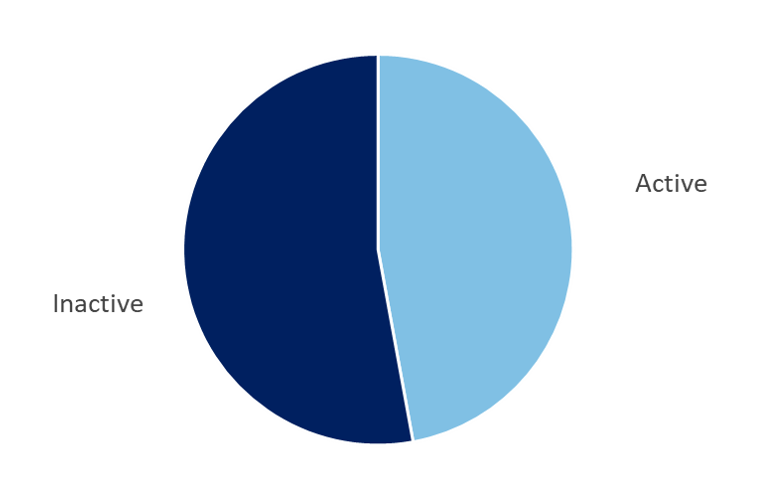 By Date Added 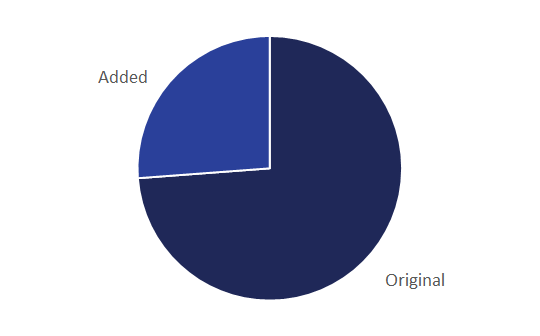 By Confidentiality Status 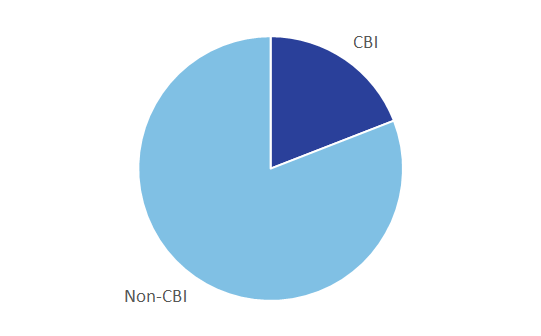 |
¶ Substance Registration |
|
|
There is no substance registration in the United States for general industrial chemicals, but there are many potential notifications, including those required by TSCA, as well as product registrations. In addition to requirements for general industrial chemicals, Navigator currently covers requirements for pesticides, biocides/biocidal products, and cosmetics. |
|
¶ Product Registration |
|
¶ Cosmetics Registration¶ FederalManufacturers or importers of cosmetics in the United States must first verify that their product is regulated as a cosmetic and not as a drug. Products marketed as cosmetics are often regulated as drugs in the United States. This frequently occurs when products make claims to alter the human body, such as healing or revitalizing. In certain cases, products may meet the definition of both cosmetics and drugs and must follow all requirements for both in order to ensure compliance. Any cosmetic introduced into the U.S. market, whether manufactured domestically or imported, must comply with requirements in the Food Drug and Cosmetic Act and the Fair Packaging and Labeling Act. Under these laws there is no requirement for pre-market approval of cosmetics or cosmetic ingredients, with the exception of color additives. All color additives must be approved by the FDA for their intended use. Additionally, some additives may require batch certifications to confirm purity or have a restriction on the maximum concentration allowed in the final product. There are no requirements for import notification or registration in the United States. However, cosmetic companies may elect to participate in the Voluntary Cosmetic Registration Program (VCRP). This program assists the FDA in regulating cosmetics as well as assessing the safety of products and ingredients. Participation in the VCRP includes registering establishments where products are manufactured or packaged, filing Cosmetic Product Ingredient Statements (CPIS), and altering or removing CPIS as appropriate. Any imported cosmetic may be inspected by U.S. Customs and Border Protection (CBP) upon entry into the United States. Entry may be denied if the product is non-compliant. Common reasons for denial are using restricted ingredients, attempting to regulate a drug as a cosmetic, using color additives in a non-compliant manner, and improper labeling. For more information on labeling, please see the label section on cosmetics. |
Sources Resources
Notice of Availability Final Rules
|
¶ CaliforniaThe California Safe Cosmetics Program (CSCP) collects information about hazardous chemicals that are known or suspected to cause cancer in cosmetics products, and requires companies to report products sold within the state that contain a hazardous ingredient(s), as a result of concerns about product safety from consumer and worker advocacy groups. The CSCP's primary function is to collect this hazard data and make this list available to the public in the form of a searchable database (California Safe Cosmetics Program Product Database) and it includes chemicals from Proposition 65, the U.S. Environmental Protection Agency (EPA), the Center for Evaluation of Risks to Human Reproduction (CERHR), the National Toxicology Program (NTP), and the International Agency for Research on Cancer (IARC). If a company (that is not a government agency) with 10 or more employees and over one million dollars in cosmetic product sales uses a chemical in their product which is on the California Safe Cosmetics Program's chemical list, they must submit information on the affected products via the California Department of Public Health's (CDPH) online reporting system. This list (California Safe Cosmetics Program Product Database) was established by the CDPH following the criteria in California Health and Safety Code Section 111791.5. The California Safe Cosmetics Program released an updated Reportable Ingredients List June 2018 that includes chemicals newly identified by California Proposition 65 and other authoritative bodies as causing cancer or developmental or other reproductive harm.
¶ Proposition 65 Effect on CosmeticsCosmetics must also comply with requirements set forth in Proposition 65.To comply with California’s Proposition 65 requirements, you must provide a "clear and reasonable warning" before exposing anyone to chemicals on the Proposition 65 list, unless the exposures are so low as to create "no significant risk of cancer, or are significantly below levels observed to cause birth defects or other reproductive harm." If a business determines exposure by operations of its products after review of Proposition 65 listed chemicals, it may be required to provide a warning. Businesses may be able to consult Safe harbor levels to determine whether such warnings are necessary. A business has "safe harbor" from Proposition 65 warning requirements or discharge prohibitions if exposure to a chemical occurs at or below the listed levels. In the event that no Safe Harbor level is listed for a particular chemical, California's Office of Environmental Health Hazard Assessment (OEHHA) adopted regulations that provides guidance in calculating Safe Harbor levels (as provided in Article 7 and Article 8 of Title 27, California Code of Regulations). It is the responsibility of each business to determine if it is causing exposure to a listed chemical that would require a warning under Proposition 65. Businesses likewise have the burden of providing proof that a warning is NOT required. |
Sources
Resources |
¶ Pesticides¶ FIFRAThe Federal Insecticide, Fungicide, and Rodenticide Act (FIFRA) and the regulations promulgated under that statute, Title 40 of the Code of Federal Regulations (40 CFR) Parts 150-189, require that all products that claim any kind of pesticidal activity must be registered with the Environmental Protection Agency (EPA). Periodic reregistration of products is also required on a cycle that varies from 5 to 15 years.The purpose of such pesticide review, called a Re-registration Eligibility Decision (known as RED), is to ensure that, as the continued ability to assess risk evolves and as policies and practice change, all registered pesticides continue to meet FIFRA's statutory standard of no unreasonable adverse effects. As part of the registration process, EPA has broad authority to place limits on the sale and distribution of pesticides, place limits on the use of pesticides and place requirements for the testing of pesticides. For all registered pesticides, there are specific requirements for product labeling. In particular, labels for registered pesticides must contain the following as approved by the EPA:
Pesticide Registration applications have specific requirements with respect to the information that must be provided. Specifically registrants must provide the following, at a minimum:
The EPA publishes guidelines detailing specific test protocols that must be followed for all required tests. The Pesticide Registration Improvement Extension Act (PRIA 3) has reauthorized PRIA fees, which are registration service fees for applications for specific types of pesticide registration, amended registration, and related tolerance actions. EPA recently launched a new Pesticide Worker Protection Dashboard as part of EPA's overall efforts to increase protection from pesticide exposure of farmworkers. The interactive tool provides charts and graphs that present certain key enforcement and compliance information related to the Worker Protection Standard (WPS) program under FIFRA. The WPS dashboard presents information such as:
The information will allow the public and regulators to monitor types of worker protection violations in their state so that they can adjust compliance assistance and education efforts or target inspections to increase compliance. Increased compliance will mean better protection for agricultural workers along with fewer pesticide exposure incidents. A hyperlink to access the Pesticide Worker Protection Dashboard is available in the Resource panel. Please be advised that the US EPA's Civil Monetary Penalty Inflation Adjustment Final Rule is in effect (Jan. 15, 2017). All new statutory civil penalties for violations of FIFRA apply. ¶ Violations of FIFRAFor violations against the FIFRA statute by any registrant, commercial applicator, wholesaler, dealer, retailer, or other distributor, statutory civil penalties are enacted for each offence. NOTE: Each statutory civil penalty amount will be subsequently adjusted every year to reflect inflation. The Civil Monetary Penalty Inflation Adjustment Rule may be found here: https://www.gpo.gov/fdsys/pkg/FR-2017-01-12/pdf/2017-00160.pdf |
Sources Resources
Notices
|
¶ States Requiring Registration of the Following:
The below table provides a quick summary of which states require product registration of the above special products prior to sale in their respective state. Additionally, these products MUST meet the respective requirements under FIFRA, such as, labeling, composition, end use, etc., whether a state registration is required or not. NOTE: All states require registration of all Section 3 (24c) pesticide products prior to sale in the respective state and are not represented here. Timelines represent typical processing time not initiated during high volume renewal periods. DISCLAIMER: This table last updated September 2022. Contact state pesticide regulatory agencies directly via the source link to the right. 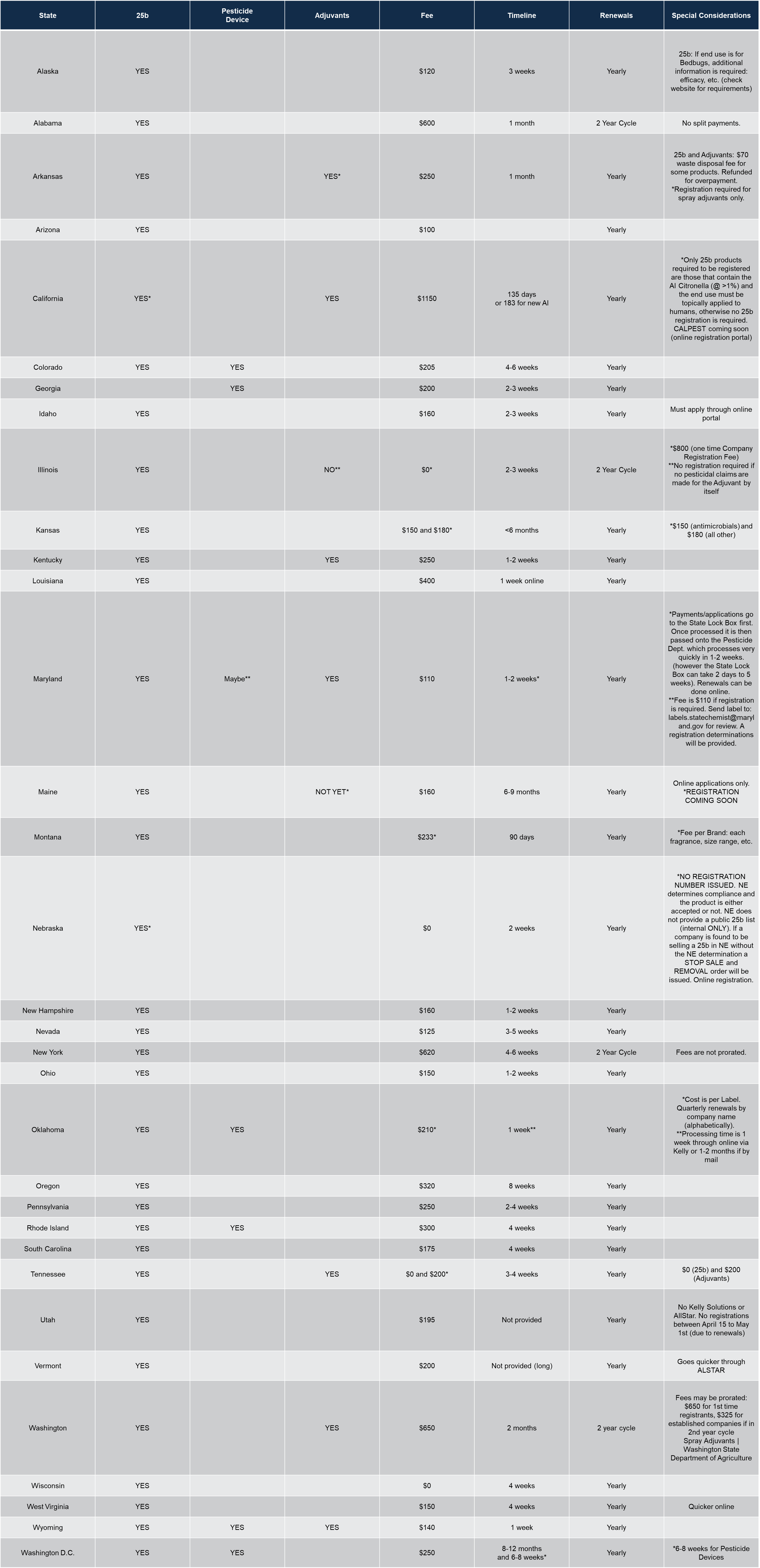 |
Sources
|
¶ Antimicrobials (Food Contact Substances)The U.S. Food and Drug Administration under the Federal Food, Drug and Cosmetic Act (FFDCA) regulates certain antimicrobial products when used as either indirect or secondary direct food additives. In addition, the U.S. Environmental Protection Agency (EPA) regulates these same antimicrobial uses pursuant to the Federal Insecticide, Fungicide and Rodenticide Act (FIFRA). The antimicrobial product may not be marketed for the FDA-approved use until EPA registers the antimicrobial for the same use. Uses that may be subject to dual FDA/EPA regulation are:
Food contact substances that are subject to both EPA and FDA authority must submit and gain approval with both a Pesticide Registration to EPA and a Food Contact Notification (FCN) to FDA. |
Sources Resources To determine whether an antimicrobial is subject to FDA or EPA: To obtain approval:
Final Rules
Notices
|
¶ Notifications |
|
¶ TSCA Inventory ResetOn August 11, 2017, the U.S. Environmental Protection Agency (EPA or the Agency) published a final rule, under Sections 8(a) and 8(b) of the Toxic Substances Control Act (TSCA), to establish retrospective electronic notification requirements for chemical substances on the TSCA Inventory that were manufactured or imported for non-exempt commercial purposes during the 10-year time period ending on June 21, 2016.The final rule also included a provision to allow voluntary notification by processors. The submission period for manufacturers and importers began on August 11, 2017 and ended on February 7, 2018. On April 12, 2018, EPA released a draft Inventory with active designations based upon the Notice of Activity (NOA) Form A's received through the February 7, 2018 deadline for manufacturers and importers. Processors then had the opportunity to report those substances not already designated as active that they processed during the lookback period, for non-exempt commercial purposes, no later than October 5, 2018. While processors were not required to report, they were permitted to do so in order to ensure that the substances that they processed would be designated as active. More than 90,000 individual notices were submitted during the retrospective reporting period. After processing those notices, the Agency released, on February 19, 2019, an updated version of the Inventory on which all substances were designated as active or identified as inactive. That version of the Inventory included more than 86,000 substances, of which less than half were designated as active. On May 15, 2019, EPA announced the availability of a signed action identifying chemical substances for inactive designation under TSCA Section 8(b). The signed action is a companion to the updated version of the TSCA Inventory on which all listings were designated as active or identified as inactive. EPA regulations at 40 CFR §710.23 provide that the Agency’s designation of a chemical substance as inactive becomes effective 90 days after it identifies the chemical substance for such designation. The signed action initiates the 90-day transition period. Because it was signed on May 6, 2019, inactive designations became effective on August 5, 2019.
¶ Forward-looking notificationsAs of August 5, 2019, manufacturers, importers, and processors that intend to reintroduce substances designated as inactive into U.S. commerce, for non-exempt commercial purposes, must notify EPA not more than 90 days before the anticipated date of manufacturing or processing. The NOA Form B is to be used for this forward-looking reporting. Agency regulations also allow an NOA Form B to be submitted during the 90-day transition period between EPA’s identification of a chemical substance for inactive designation and the effective date for such designation. Upon receiving a forward-looking notification, the Agency will change the designation of the subject chemical substance on the TSCA Inventory from inactive to active. The designation of substances as active or inactive in U.S. commerce will be relevant to EPA’s prioritization of substances under TSCA Section 6(b).
¶ Regulatory BasisThe Frank R. Lautenberg Chemical Safety for the 21st Century Act (LCSA), was signed into law on June 22, 2016. It amended TSCA Section 8(b) so as to require a reset of the TSCA Inventory. Under Section 8(b), as amended, EPA was required to promulgate a rule to require industry to report on the chemicals that they manufactured or processed in the 10 years prior to enactment of the LCSA. The purpose of the rule is to determine which chemicals are currently “active” in commerce. Under the rule:
While the EPA was required to publish a final rule no later than one year after the date of enactment of the LCSA, the final rule was not published until August 11, 2017. In the interim, the Agency published a proposed rule on January 13, 2017 and accepted comments until March 14, 2017; and, the EPA Administrator signed a final rule, on June 22, 2017, which was based upon the proposed rule and the comments received.
¶ Supply Chain ConsiderationsJoint submissions How can a company who imports products with confidential ingredients remain in compliance?
Processors Are processors subject to the reporting requirements? Retrospective reporting by processors was voluntary. But, forward-looking reporting is mandatory. Non-US Manufacturer How can a company based outside the United States guarantee the exported products remain listed as active substances in the new TSCA inventory? If your company is not the US importer you have no legal authority to report. It would be best to contact those companies/importers that import your materials to verify that they have reported them or will report them. They are required to do so. Co-Manufacturers and Co-processors Who, among prospective co-manufacturers or co-processors is subject to the notification requirement? If two or more persons intend to manufacture, import, or process a particular volume of an inactive substance, such that multiple persons would qualify as the manufacturer, importer, or processor of that volume, they may determine among themselves who will submit the required notice under 40 CFR 710.25(c). If no notice is submitted as required under this subpart, all of the persons remain subject to the reporting requirements, and EPA will hold each such person liable for a failure to submit a notice prior to the date of manufacturing, importing, or processing. |
Sources
Resources Key definitions Manufacture means to manufacture, produce, or import, for commercial purposes. Manufacture includes the extraction, for commercial purposes, of a component chemical substance from a previously existing chemical substance or complex combination of chemical substances. Process means to process for commercial purposes. Process includes the preparation of a chemical substance or mixture, after its manufacture, (1) in the same form or physical state as, or in a different form or physical state from, that in which it was received by the person so preparing such substance or mixture, or (2) as part of a mixture or article containing the chemical substance or mixture. Process for commercial purposes means the preparation of a chemical substance or mixture after its manufacture for distribution in commerce with the purpose of obtaining an immediate or eventual commercial advantage for the processor. Processing of any amount of a chemical substance or mixture is included in this definition. If a chemical substance or mixture containing impurities is processed for commercial purposes, then the impurities also are processed for commercial purposes.
TSCA Inventory Notification (Active-Inactive) Requirements; Availability of a Signed Action Identifying Chemical Substances for Inactive Designation |
¶ TSCA PMNThe only method for adding a new chemical to the TSCA Inventory is called a Pre-Manufacturing Notification (PMN). The PMN is the primary notification used to gain approval for commercial manufacture, import or use of a "new" chemical in the United States. Regulations promulgated by EPA under Section 5 of TSCA require anyone who intends to manufacture or import a "new" chemical substance for commercial purposes to submit a PMN at least 90 days prior to the activity. The PMN allows the EPA to evaluate whether the new chemical substance may pose an unreasonable risk to human health or the environment. PMNs must be submitted electronically using EPA's Central Data Exchange (CDX). On January 6, 2010, EPA issued a final rule requiring:
On July 20, 2015, EPA issued a final rule requiring the use of a new, cloud-based version of the e-PMN software to prepare and electronically submit all PMNs. Each person who submits a PMN must include the information specified in the notice form to the extent that it is known to or reasonably ascertainable by the submitter. However, no person is required to include information which relates solely to exposure of human or ecological populations outside of the United States. The notice form requires the following information relating to the manufacture, processing, distribution in commerce, use, and disposal of the new chemical substance:
On December 18, 2024, EPA finalized amendments to the regulations that govern the Agency’s review of new chemicals to improve efficiency and align with the 2016 amendments to TSCA. This rule amended the regulations by specifying that EPA must make one of five statutory determinations for each PMN before the submitter may commence manufacturing or importing the new chemical substance: i. The chemical substance presents an unreasonable risk of injury to health or the environment, as set forth in Section 5(a)(3)(A) of TSCA; ii. Information available to EPA is insufficient to permit a reasoned evaluation of the health and environmental effects of the relevant chemical substance, as set forth in Section 5(a)(3)(B)(i) of TSCA; iii. In the absence of sufficient information to permit EPA to make such an evaluation, the chemical substance may present an unreasonable risk of injury to health or the environment, as set forth in Section 5(a)(3)(B)(ii)(I) of TSCA; iv. The chemical substance is or will be produced in substantial quantities, and such substance either enters or may reasonably be anticipated to enter the environment in substantial quantities or there is or may be significant or substantial human exposure to the substance, as set forth in Section 5(a)(3)(B)(ii)(II) of TSCA; or v. The chemical substance is not likely to present an unreasonable risk of injury to health or the environment, as set forth in Section 5(a)(3)(C) of TSCA. It also updated the regulations to list the actions required in association with each of the determinations above:
The rule also made several other changes to add efficiencies to the new chemicals review process, including clarifying the level of detail needed in new chemical notices and amending the procedures for EPA’s review of notices that have errors or are incomplete. Fees are charged for PMN submissions. The fees have been updated as of February 21, 2024. The filing fee for PMNs is $37,000 ($6,480 for small businesses). *See side panel for additional information regarding the final TSCA Fees rule. TSCA Section 5(e) and 5(f) orders are only binding on the original PMN submitters. Thus, after signing a Section 5(e) or 5(f) order, EPA may issue a Significant New Use Rule (SNUR) under TSCA Section 5(a)(2) to bind all other manufacturers and processors of former new chemicals to the terms and conditions contained in the Section 5(e) or 5(f) order. SNURs without a Section 5(e) or 5(f) order can occur when EPA determines that a use of a chemical not contemplated by the original submitter may pose an unreasonable risk to human health or the environment. SNURs require manufacturers, importers and processors of certain substances to notify EPA before beginning any activity that the Agency has designated as a “significant new use.” The notification required by a SNUR allows EPA to prevent or limit potentially adverse exposure to, or effects from, the significant new use of the substance. Each SNUR applies to one or more substances that are specifically or generically identified within the SNUR. A SNUR for a given substance requires the preparation and submission of a Significant New Use Notice (SNUN) at least 90 days prior to any commercial use of the substance that doesn’t conform to the conditions of the SNUR. SNUNs are:
The submitter of a SNUN should also include a cover letter that identifies the applicable SNUR and the new use for which the SNUN is being submitted. |
Sources
Resources Exemptions Certain new substances are eligible for limited exemptions from the PMN requirements that would otherwise apply. These exemptions include:
Read more about this in the TSCA Exemptions section. *Final TSCA Fees Rule: On October 17, 2018, the U.S. Environmental Protection Agency (EPA or the Agency) published a final fees rule under Section 26(b) of the Toxic Substances Control Act (TSCA). The purpose of the final rule is to establish and collect fees from certain manufacturers (including importers) and processors to defray some of EPA’s costs related to activities under TSCA Sections 4, 5, 6, and 14. The Agency also finalized reduced fee amounts for small businesses. In addition, EPA finalized a revision to the size standard used to identify businesses that can qualify as a ‘‘small business concern’’ under TSCA for the purposes of fee collection. Under the final rule, ‘‘small business concern’’ means a manufacturer or processor who meets the revised size standard based upon its North American Industry Classification System (NAICS) code and number of employees, as set forth at 40 CFR §700.43. The final rule, which took effect on October 18, 2018, applies to all submissions received by the Agency starting October 1, 2018. The fees have since been updated, most recently on February 21, 2024, to account for inflation, using the formula at 40 CFR §700.45 paragraph D. |
¶ TSCA NOCThe PMN submitter must submit a Notice of Commencement of Manufacture or Import (NOC) within 30 calendar days of manufacturing or importing their new chemical substance for a non-exempt commercial purpose. Following receipt of the NOC, EPA will add the substance to the Inventory.
Furthermore, as stated above, it must be submitted within 30 days of the first commercial manufacture (date of completion of production lot) or import (date new chemical substance clears U.S. Customs). |
Sources |
¶ TSCA ExemptionsCertain new substances are eligible for limited exemptions from the PMN requirements that would otherwise apply. These exemptions include:
¶ Research and Development ExemptionChemical substances manufactured or imported only in small quantities solely for research and development (R&D) are exempt from PMN requirements. The R&D exemption requires no application. But, the burden of proving eligibility for the exemption is entirely with the person claiming the exemption. In addition, substances manufactured under the R&D exemption are subject to a number of procedural and recordkeeping requirements. EPA has not attempted to define "small quantities" quantitatively. Rather, the Agency's definition recognizes that the quantity of a substance needed for legitimate R&D varies considerably with the category of substance, the use of the substance, and the nature and stage of R&D. ¶ Polymer ExemptionThe Polymer Exemption applies to polymers that meet specific criteria for: composition; molecular weight; and degradation potential. Manufacturers of exempted polymers are not required to submit exemption notices or NOCs. But, they are required to keep certain records to verify their eligibility for, and compliance with, the polymer exemption and to report, by January 31st of each year, on the number of polymers manufactured under the exemption for the first time during the preceding calendar year. This annual exemption reporting is a one-time requirement for any particular polymer. To manufacture a new substance under the polymer exemption, a manufacturer must:
¶ Instant Film ExemptionThe Instant Film Exemption applies to chemical substances used in or for the manufacture or processing of instant photographic and peel-apart film articles. We include it here for completeness. It obviously has a very narrow applicability. The following exemptions require prior application to EPA
¶ Test Marketing ExemptionThe test marketing exemption (TME) permits manufacture or import of a new substance for the purposes of determining the market potential of the substance. The new substance may be distributed in commerce up to a specified amount and for a specified period of time. TMEs must be applied for and approved by EPA before test marketing may commence. The application for a TME must specify the total amount of material to be distributed, the total number of potential customers and the time period over which the test marketing will be conducted. TME applications must be generated and completed on EPA Form 7710-25 using the e-PMN software and submitted electronically via CDX. In approving TME applications, EPA may impose whatever restrictions they deem necessary to ensure that the new substance will not pose an unreasonable risk of harm to human health or the environment. ¶ Low Volume ExemptionThe Low Volume Exemption (LVE) provides a limited exemption from PMN requirements for new substances manufactured in quantities of 10,000 kilograms or less per year. LVE applications must be:
They are subject to a filing fee of $10,870 ($2,180 for small business). EPA will review an LVE application to determine whether manufacture or import of the new chemical substance is eligible for the exemption. The review period will run for 30 days from the date EPA receives a complete application. No person submitting an LVE application may manufacture or import the new chemical substance until EPA notifies the submitter that the new chemical substance meets the terms of the LVE. More than one manufacturer may hold an LVE for the same substance. If a second notice causes EPA to find that the cumulative effects of the substance may present an unreasonable risk, EPA may ask the first submitter to: verify that manufacture has commenced; re-certify their intent to manufacture; or withdraw their LVE. In addition, certain conditions and controls must be maintained throughout the duration of the LVE: Use; Site of manufacture (except under certain circumstances); Exposure and release controls (including physical form, if pertinent to exposure or release levels); Importation only, if so specified; and a production volume of less than 10,000 kilograms per year, if so specified. Furthermore, an LVE holder must notify processors and industrial users of the limitations on the use of the LVE substance and any exposure and environmental release controls identified in the notice. The notification may be by label, written communication, or other method that adequately informs of the restrictions and controls. On December 18, 2024, EPA published a final rule to amend the LVE regulations. The final rule eliminated eligibility for the LVE for new per- and polyfluoroalkyl substances (PFAS) and other persistent, bioaccumulative, and toxic (PBT) chemicals. ¶ Low Release and Exposure ExemptionSubstances may qualify for the Low Release and Exposure (LoREX) exemption, regardless of their production volume, if they meet certain release and exposure criteria. To apply for an exemption, manufacturers must submit an exemption notice at least 30 days before beginning production. LoREX exemption applications must be generated and completed on EPA Form 7710–25 using the e-PMN reporting software and submitted electronically to EPA via CDX. They are subject to a filing fee of $10,870 ($2,180 for small business). EPA will review a LoREX exemption application to determine whether manufacture or import of the new chemical substance is eligible for the exemption. The review period will run for 30 days from the date EPA receives a complete application. No person submitting a LoREX exemption application may manufacture or import the new chemical substance until EPA notifies the submitter that the new chemical substance meets the terms of the exemption. As with the LVE: the uses of the new chemical substance are restricted to those approved in the exemption notice; submitters must maintain any exposure or release controls throughout the period of the exemption; and manufacturing sites identified in the exemption notice are binding unless specified conditions are satisfied. Furthermore, a LoREX exemption holder must notify processors and industrial users of the limitations on the use of the substance and any exposure and environmental release controls identified in the notice. The notification may be by label, written communication, or other method that adequately informs of the restrictions and controls. In addition, a manufacturer of a LoREX substance may distribute the substance only to other persons who agree, in writing, not to further distribute the substance until it has been reacted, incorporated into an article, or otherwise rendered into a physical form or state in which environmental releases and human exposures above the eligibility criteria are not likely to occur. On December 18, 2024, EPA published a final rule to amend the LoREX exemption regulations. The final rule eliminated eligibility for the LoREX exemption for new PFAS and other PBT chemicals. |
Sources 40 CFR: § 720.36 | § 720.78 | § 723.250 | § 720.38 | § 723.50 Fee Changes Affecting TME, LVE, and LoREX Applications: On October 17, 2018, EPA published a final TSCA Fees rule under TSCA Section 26(b), as amended. As of February 21, 2024 the updated fees for TME, LVE, LoREX and Film Article applications are $10,870 and $2,180 for small businesses. |
¶ TSCA Import CertificationTSCA Section 13 requires that any chemical substance, mixture, or article containing a chemical substance or mixture be refused entry into the customs territory of the United States if it fails to comply with any rule in effect under TSCA or is offered for entry in violation of Section 5, 6, or 7 of TSCA. Note that Section 4 and Section 8 rules do not pertain to Section 13 import certification requirements. Although importers must comply with all applicable requirements under Sections 4 and 8, compliance with those requirements is not related to individual chemical shipments and therefore does not affect import certification. Under the TSCA import requirements, importers must certify that imported chemicals either comply with TSCA (Positive Certification Statement) or are not subject to TSCA (Negative Certification Statement). However, certain imported chemicals require no certification. U.S. Customs and Border Protection (CBP) administers the import requirements under TSCA Section 13 in consultation with EPA. CBP can refuse entry of any shipment that does not have a TSCA certification. An importer provides the certification by signing one of the following statements:
The appropriate statement can be typed, preprinted on the invoice, or otherwise included in the entry documentation. But, the exact wording, as shown within the quotation marks, must be used. For further information see the following:
The TSCA Import Compliance Checklist consists of a series of questions divided into three sections corresponding to the three certification options:
By answering these questions, an importer can determine:
Note, however, that use of the checklist is voluntary, as there is no requirement that chemical importers use this document or submit it to the government. Rather, EPA developed the checklist as a compliance assistance tool. On December 27, 2016, CBP published a final rule to amend the import certification requirements under TSCA Section 13. The final rule amended the regulations at 19 CFR Parts 12 and 127 by:
Note that the final rule established an effective date of January 26, 2017. However, a presidential directive released on January 20, 2017 delayed the effective date until March 21, 2017 in order to allow for a review by the new Administration. Given that there were no additional delays, the final rule is now in effect. |
Sources |
¶ TSCA Export NotificationsSection 12(b) of TSCA requires any person who exports or intends to export a chemical substance or mixture to notify EPA of such exportation, to a particular country, if:
With respect to Section 12(b), these actions are referred to as triggering actions. No notice of export will be required for articles, except PCB articles, unless EPA so requires in the context of individual Section 5, 6, or 7 actions. Any person who exports or intends to export PCBs or PCB articles, for any purpose other than disposal, shall notify EPA of such intent or exportation. No notice of export is required for the export of a chemical substance or mixture for which export notification would otherwise be required, if such chemical substance or mixture is present in a concentration of less than:
These concentrations are referred to as de minimus concentrations. Known or potential human carcinogens include:
The notice must be for the first export or intended export by an exporter to a particular country in a calendar year when:
The notice must only be for the first export or intended export by an exporter to a particular country when:
Therefore, this is a one time per chemical per country or one time per chemical per country per calendar year requirement, depending upon the triggering action. The export notice must be submitted to EPA within seven days of forming the intent to export or on the date of export, whichever is earlier. A notice of intent to export must be based on a definite contractual obligation, or an equivalent intra-company agreement, to export the regulated chemical. Export notices must be submitted electronically via CDX, using the TSCA Section 12(b) Export Notification Application or its successor. Finally, they must contain the following information:
EPA will notify the importing country within five working days after they receive notification from an exporter by sending a notice to the importing country's ambassador in Washington, DC, or other official designated by the foreign government, and to the U.S. State Department. EPA's notice to the foreign government will:
|
Sources |
¶ TSCA NanomaterialsTo ensure that nanoscale materials are manufactured and used in a manner that protects against unreasonable risks to human health and the environment, the U.S. Environmental Protection Agency (EPA) is pursuing a comprehensive regulatory approach under the Toxic Substances Control Act (TSCA) including:
As explained in the PMN section of this report, the TSCA requires manufacturers and importers of new chemical substances to submit PMNs prior to manufacturing or importing them for non-exempt commercial purposes. EPA has developed guidance regarding the TSCA Inventory Status of Nanoscale Substances. Since 2005, EPA has received and reviewed over 160 new chemical notices under TSCA Section 5 for nanoscale materials, including carbon nanotubes, and that number will increase over time. The Agency has taken a number of actions to control and limit exposures to these chemicals, including:
On January 12, 2017, EPA published a final rule under TSCA Section 8(a) to establish reporting and recordkeeping requirements for certain chemical substances manufactured or processed at the nanoscale. This final rule, codified at 40 CFR § 704.20, was to have taken effect on May 12, 2017. However, on that day, the Agency extended the effective date of the final rule to August 14, 2017. This rule requires one-time reporting for existing forms of certain nanoscale materials and a standing one-time reporting requirement for new forms of certain nanoscale materials before those new forms are manufactured or processed. However, persons that manufacture or process, or intend to manufacture or process, these chemical substances as part of articles, as impurities, or in small quantities solely for research and development will not be subject to this rule. The final rule requires one-time reporting of certain information, including specific chemical identity, production volume, methods of manufacture and processing, use, exposure and release information, and available health and safety information; as well as keeping records of this information for three years. |
Sources |
¶ Food Contact NotificationsThe Food and Drug Administration (FDA) regulates components of food contact materials, including packaging. Formerly known as indirect food additives, FDA now refers to these materials as food contact substances (FCS). FDA has established a Food Contact Notification Program within the Center for Food Safety and Applied Nutrition's (CFSAN) Office of Food Additive Safety. For substances not generally recognized as safe (GRAS) or sanctioned prior to 1958, Section 201(s) of the Federal Food, Drug, and Cosmetic Act (FD&C Act) defines a "food additive" as any substance the intended use of which results or may reasonably be expected to result, directly or indirectly, in its becoming a component or otherwise affecting the characteristic of any food (including any substance intended for use in producing, manufacturing, packing, processing, preparing, treating, packaging, transporting, or holding food; and including any source of radiation intended for such use). Section 409 of the statute defines a "food contact substance" as any substance that is intended for use as a component of materials used in manufacturing, packing, packaging, transporting, or holding food provided such use of the substance is not intended to have any technical effect in such food. Food contact substances include coatings, plastics, paper, adhesives, colorants, antimicrobials, and antioxidants found in packaging. FDA must approve new food contact substances before they can be used in foods. Requests for this approval is done through the Food Contact Notification process. Required Information FCS notifications must contain sufficient scientific information demonstrating its safety for its intended use. The following information will need to be submitted with the FCN:
Food contact notifications are required only for new uses of FCSs that are food additives. Notification is not required for a food contact substance that is GRAS or “prior sanctioned” for its intended use in contact with food. However, manufacturers may optionally use FCNs to notify the FDA of new uses. NOTE: FDA's guidance (recommended in the notification) on chemistry, toxicology and environmental information should be consulted. Who May Use the Food Contact Notification (FCN) FCNs are strictly proprietary and are effective only for the manufacturer and substance identified in the notification. When relying on an FCN, individuals will need to demonstrate that the Food Contact Substance being marketed has been manufactured or supplied by the manufacturer identified in the Food Contact Notification and is being used under the conditions outlined in the FCN. NOTE: The manufacturer for which the FCN is effective need not be the actual manufacturer of the Food Contact Substance, but can alternately be a supplier who is purchasing the substance and distributing it for the intended use. The Notification Process Anyone may submit a food contact notification. The FCN process is initiated when a submission, prepared by the notifier, arrives at the Office of Food Additive Safety. Once received, the submission is assigned a notification number where a review team will then assess the submission (the review team consists of a consumer safety officer, a chemist, a toxicologist and an environmental scientist). The notifier is free to contact the assigned consumer safety officer during the initial month of the review period. 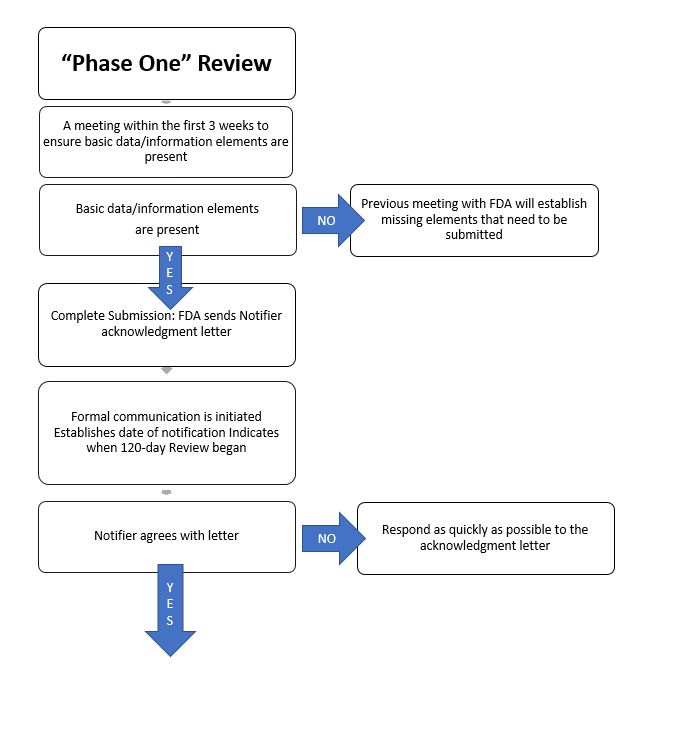 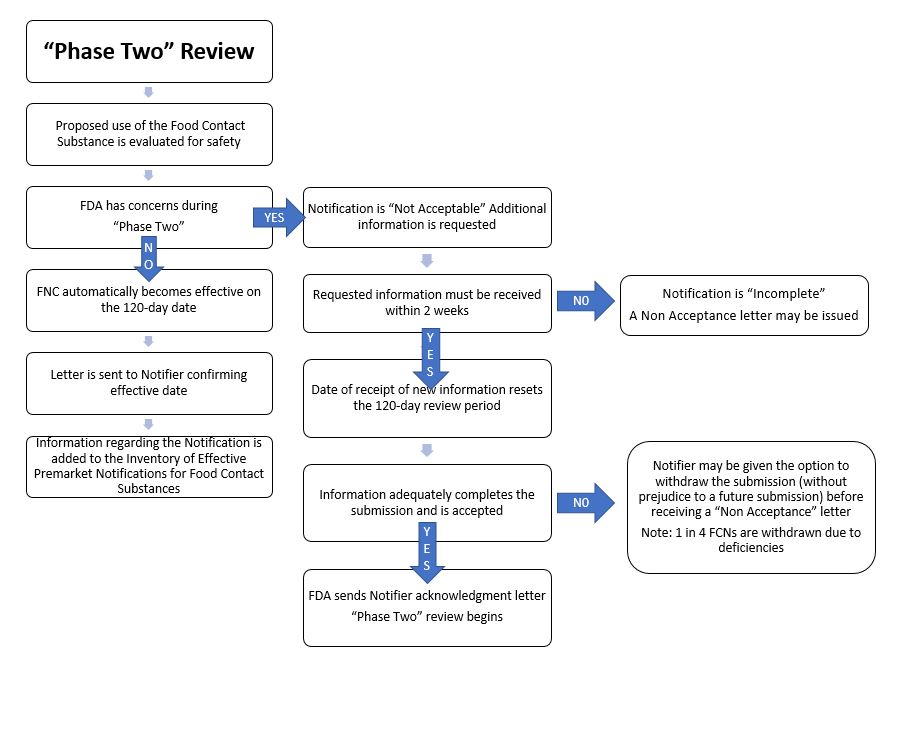 FDA non-acceptance letters may be issued in cases where:
Threshold of Regulation Some FCN uses qualify for review under FDA's "threshold of regulation" process. The threshold of regulation process (TOR) is an abbreviated review process for uses of indirect food additives, specifically substances used in food-contact articles (food packaging or food processing equipment) that may migrate into food at negligible levels (exposures below 1.5 micrograms per person per day). The TOR process can result in faster approvals, however, these types of approval are not proprietary. See CFR 170.39. Confidentiality
Food Additive Petitions Food additive petitions are used when requesting issuance of a regulation allowing new uses of the additive. As with Food Contact Notifications, the petition must contain necessary supporting data and information.
NOTE: Before submitting a petition, one should verify that the additive in question is not already regulated for the intended use by consulting CFR 170-199 for food additives, and parts 73 and 74 for color additives. Food Contact Formulation (FCF) Notifications As an additional option, individuals may wish to verify compliance of their components of a particular food contact material. This can be done by submitting a notification for a food contact substance formulation, the purpose of which, is to verify that components of a food contact material may legally be used and not to authorize a new food contact substance. The purpose of these notifications are to confirm regulatory status and not safety assessments, and therefore do not require re-submission of supporting information for safety of the intended use for each food contact substance in the formulation. Notifiers shall submit FDA Form 3479 along with any additional documentation required to establish that each of the components of the formulation is authorized for its intended use.
|
Is Your Food Contact Article Compliant: Steps You Can Take To Determine Compliance of the Components of a Food Contact Article Consult one or more of the following:
If not covered under any of the above, the following options are available:
Sources
Resources
Federal Register |
¶ Restrictions and Bans |
|
¶ Ozone Depleting SubstancesFormer president Ronald Reagan signed the instrument of ratification for the Montreal Protocol on April 5, 1988. In 1990, the Clean Air Act was modified to add details on the United States implementation of the Montreal Protocol. Among the ozone depleting substances programs in the Clean Air Act are the ODS Phaseout Program, the ODS Destruction Program, the Imports and Exports Program, and others that can be found on the EPA website. |
Sources
|
¶ Persistent Organic Pollutants (POPs)The United States has not ratified the Stockholm Convention, although it was signed in 2001. The US Congress mirrors the regulations set forth in the Stockholm Convention by restricting the sale and distribution of POP pesticides and prohibiting the manufacture of PCBs. The Federal EPA and US states work to control the release of dioxins and furans into the air, water, and soil through the Clean Water Act. |
Sources |
¶ Restriction of Hazardous Substances (RoHS)The Federal Government of the United States does not have a regulation specifically for restricting hazardous substances in electrical and electronic equipment similar to the EU Restriction of Hazardous Substances (RoHS). |
|
¶ SDS + Label |
|
¶ ClassificationThe OSHA Hazard Communication Standard (HCS) is aligned with Revision 7 of the GHS. The HCS is written into the Code of Federal Regulations (CFR) in Chapter 29 – Labor, 1910.1200 (29CFR1910.1200). The final rule came into effect July 19, 2024, superseding the HazCom 2012. Under HCS 2024, there remains no requirement to conduct testing. The criteria for evaluating Health Hazards is in Appendix A to 29CFR1910.1200 and additional guidance on evaluating Carcinogenicity including approximate equivalences among classification schemes is in Appendix F. The criteria for evaluating Physical Hazards is in Appendix B. OSHA does not perform nor approve of classifications for manufacturers, importers and distributors. GHS building blocks excluded from Hazcom 2024:
HCS 2024 added additional building blocks for the following:
OSHA allows for GHS building blocks they did not adopt to be used to classify products, e.g. environmental hazards, but these are not considered HNOCs. The HCS applies to all chemicals present in the workplace in a manner that employees may be exposed to them in normal conditions of use and/or foreseeable emergencies. Exempt from the requirements of 29 CFR 1910.1200:
(29 CFR 1910.1200 (b)(6)) The HCS applies with limitations to laboratories, see 29 CFR 1910.1200(b)(3)). ¶ Timeline and Deadlines1983: HCS initially adopted, provides the major requirements for communicating the hazards of chemical substances and mixtures to workers through:
1994: OSHA made minor changes and technical amendments to the HSC to help ensure full compliance and achieve better protection of employees - referred to as HazCom 1994. 2012: OSHA revised the Hazard Communication Standard (HCS) to align with the United Nations Globally Harmonized System (GHS) - referred to as HazCom 2012. 2013: OSHA issued minor corrections to HazCom 2012 on February 8, 2013. The conversion to GHS occurred in a series of deadlines. December 1, 2013: Training A first priority for OSHA because GHS-formatted documents were already making their way into U.S. workplaces from across the globe and were different from what workers are used to seeing at that time. HazCom 2012 requires that employers must train their employees on how to read GHS-formatted Safety Data Sheets and labels; June 1, 2015: Compliance with GHS. Compliance with all modified provisions of this final rule:
NOTE: This date coincided with the EU date for GHS compliance. December 1, 2015: Distributor Compliance Distributor shall not ship containers labeled by the chemical manufacturer or importer unless it is a GHS label June 1, 2016: Workplace HazCom Compliance Update alternative workplace labeling and hazard communication program as necessary, and provide additional employee training for newly identified physical or health hazards. February 5, 2021: OSHA published proposed updates to the HCS to align the 7th revision of GHS. Comments were accepted until May 19th, 2021. July 19, 2024: OSHA published final rule, superseding HazCom 2012. January 19, 2026: Manufacturers, importers, and distributors evaluating substances shall comply with HCS 2024. July 20, 2026: employers shall update all labeling, hazard communication programs, and provide additional training for substances for newly identified physical, health hazards, or other hazards for substances. July 19, 2027: Manufacturers, importers, and distributors evaluating mixtures shall comply with HCS 2024. January 19, 2028: employers shall update all labeling, hazard communication programs, and provide additional training for substances for newly identified physical, health hazards, or other hazards for mixtures.
|
Sources OSHA provides letters of interpretation regarding the Hazard Communication Standard, which are all made available on their website Letters of Interpretation (LOI) on 1910.1200. Those relevant to classification, labeling and safety data sheets are summarized by UL here. Resources
|
¶ Letters of InterpretationA full list of Letters of Interpretation (LOI) on 1910.1200 is available from OSHA. The below are letters of interpretation UL frequently finds useful in the course of classification, labelling and authoring Safety Data Sheets.  |
|
¶ Cut-off Values/Concentration LimitsWhere test data is not available for a mixture, for health and environmental endpoints, the GHS allows for classification based on the hazards of the substances in the mixture. The GHS usually defines the concentration at which a hazardous substance causes a mixture containing that substance to be classified, for most hazards. These are known as Concentration limits / Cut-off values. Countries must additionally set the thresholds for mixture classification for certain hazards:
The Unites States is implementing specific classification cut-off values and concentration limits for mixtures for certain hazard classes, prescribed in 29 CFR 1910.1200.
Sensitization 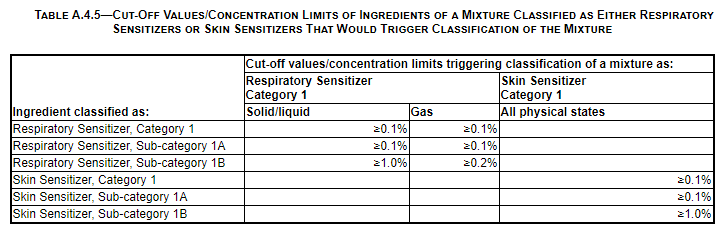 Carcinogenicity  Reproductive Toxicity 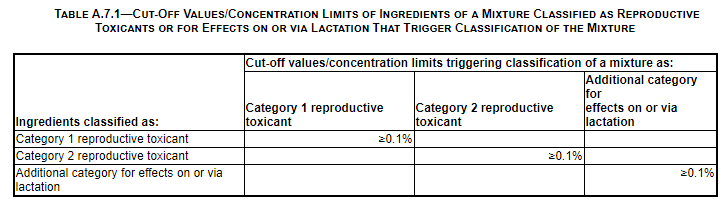 Specific Target Organ Toxicity - Single Exposure  Specific Target Organ Toxicity - Repeated Exposure 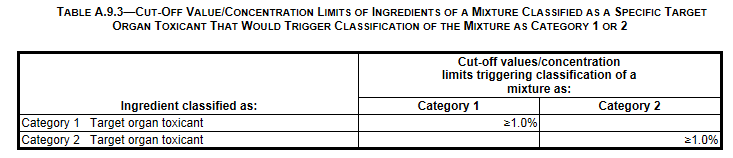 |
|
¶ Other ClassificationsIn addition to the mandatory HCS classification information, other classification systems may be used on SDSs or in the workplace. While not an HCS regulatory requirement, these other classifications are commonly seen and frequently included in safety documentation to assist in conveying hazards, with reporting requirements under other legislation, or in developing safety plans. These systems include: The hazard rating scales for NFPA and HMIS are opposite to the scale for GHS hazard classification categories. For GHS, a 1 is the most severe category and hazards decrease as you count higher. For NFPA and HMIS, a 4 is the most severe hazard rating, and hazards decrease as you count down. 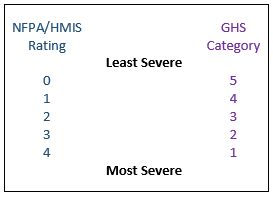 |
Sources |
¶ National Fire Protection Association (NFPA)The NFPA rating system addresses short-term exposure to materials under emergency situations, such as fires or spills. NFPA address four hazard categories: Health, Fire, Instability/Reactivity, and Special Hazards (water reactivity, oxidizer, simple asphyxiant). NFPA uses a 0-4 ratings scale, with 0 representing minimal hazard and 4 representing severe hazard. These ratings are most frequently displayed in a "hazard diamond" where different colors represent the different hazards. Ratings are located in colored diamonds:
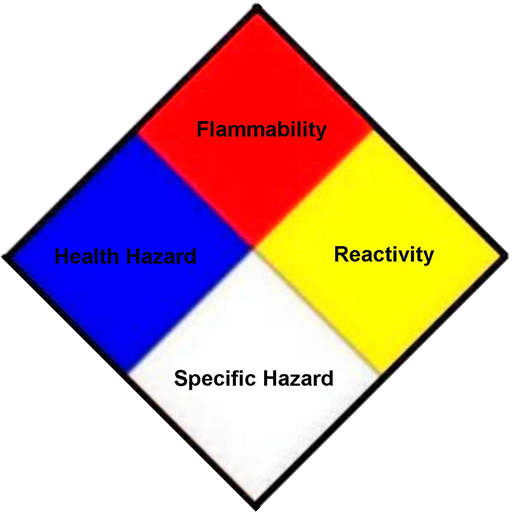 Rating Scale Health 0 - Materials that, under emergency conditions, would offer no hazard beyond that of ordinary combustible materials 1 - Materials that, under emergency conditions, can cause significant irritation 2 - Materials that, under emergency conditions, can cause temporary incapaciation or residual injury 3 - Materials that, under emergency conditions, can cause serious or permanent injury 4 - Materials that, under emergency conditions, can be lethal Flammability 0 - Materials that will not burn under typical fire conditions, including intrinsically noncombustible materials such as concrete, stone, and sand 1 - Materials that must be pre-heated before ignition can occur. Materials in this degree require considerable pre-heating, under all ambient temperature conditions, before ignition and combustion can occur 2 - Materials that must be moderately heated or exposed to relatively high ambient temperature conditions before ignition can occur 3 - Liquids that can be ignited under almost all ambient temperature conditions 4 - Materials that rapidly or completely vaporize at atmospheric pressure and normal ambient temperature or are readily dispersed in air and burn rapidly Instability/Reactivity 0 - Materials that in themselves are normally stable, even under fire conditions 1 - Materials that in themselves are normally stable but that can become unstable at elevated temperatures and pressures 2 - Materials that readily undergo violent chemical change at elevated temperatures and pressures 3 - Materials that in themselves are capable of detonation or explosive decomposition or reaction but require a strong initiating force or must be heated under confinement before initiation 4 - Materials that in themselves are readily capable of detonation or explosive decomposition or explosive reaction at normal temperatures and pressures Special Hazards
OX - Oxidizer SA - Simple Asphyxiant
A full list of the specific criteria for each hazard rating can be found in NFPA 704. |
Resources |
¶ Hazardous Material Information System (HMIS®)The HMIS® hazard scheme was developed by the American Coatings Association as part of an entire system aimed at helping employers meet the requirements of the OSHA HCS. OSHA confirmed in its Brief on labels and pictograms that HMIS® workplace labels may continue to be used as long as they are consistent with the HCS. HMIS® utilizes a rating system, hazard symbols, color coding, and Personal Protective Equipment (PPE) codes to communicate hazards. HMIS® uses a 0-4 ratings scale, with 0 representing minimal hazard and 4 representing severe hazard. Ratings are located in colored bands:
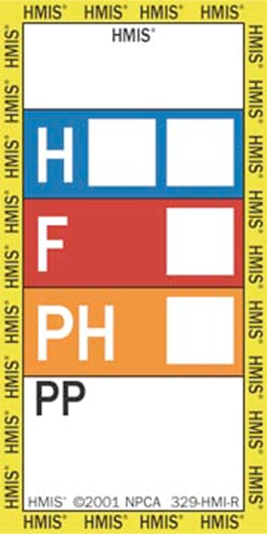
Rating Scale Health 0 - Minimal hazard, No significant risk to health 1 - Slight hazard, minor reversible injury may occur, may defat skin or cause dermatitis, may irritate stomach 2 - Moderate hazard, temporary or transient injury may occur, may cause central nervous system effects 3 - Serious hazard, Major injury likely unless prompt action is taken and medical treatment is given 4 - Severe hazard, Life-threatening, major or permanent damage may result from single or repeated over-exposures * - Indicates chronic health hazard when included after the health rating number Flammability 0 - Minimal hazard, Materials that will not burn 1 - Slight hazard, materials which must be pre-heated before ignition can occur 2 - Moderate hazard, materials which must be moderately heated or exposed to relatively high temperatures before ignition occurs 3 - Serious hazard, materials which can be ignited under almost all temperature conditions 4 - Severe hazard, materials that rapidly or totally vaporize at ambient temperatures or are readily dispersed in air and which burn readily Physical Physical hazards are split into six subcategories: water reactivity, organic peroxides, explosives, compressed gas, oxidizers, unstable reactives. 0 - Normally stable materials, do not fall into any of the six subcategories 1-4 - Each subcategory has different criteria for the 1-4 ratings* Equipment Letters are used to indicate appropriate PPE or a combination of PPE 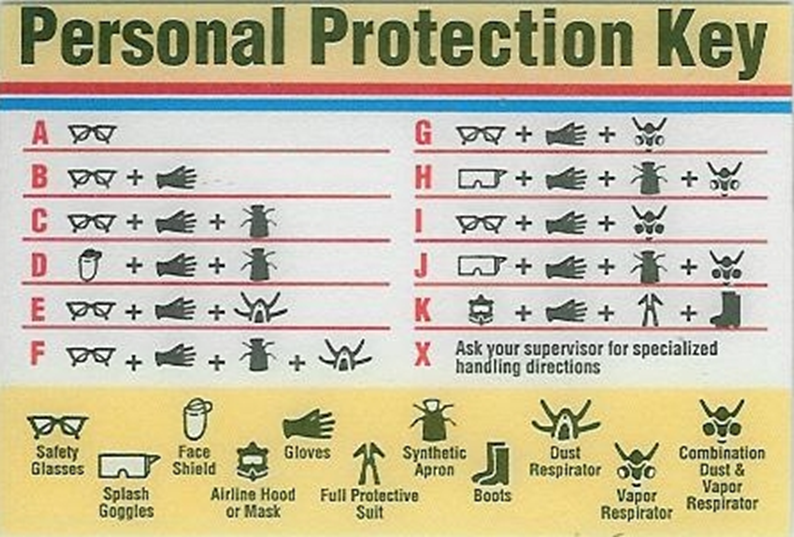
*A full list of the specific criteria for each hazard rating can be found in the HMIS® Manual. |
Resources |
¶ Superfund Amendments and Reauthorization Act of 1986 (SARA)SARA Title III contains four parts. The focus of this information is on Sections 311-312, Hazardous Chemical Storage Reporting Requirements. Under SARA Section 311 owners and operators of facilities must submit an SDS for each hazardous chemical at its facility if above the Threshold Planning Quantity (TPQ) to emergency planning agencies and local fire departments. Under SARA Section 312, owners and operators must submit an annual Emergency and Hazardous Chemical Inventory form on or before March 1 of each year. On June 13, 2016 the EPA amended the Emergency Planning and Community Right-To-Know Act of 1986 (EPCRA), which aligned the reporting requirements under SARA Sections 311 and 312 with OSHA HCS classification criteria. The hazard categories align with the OSHA HCS, as of the 2017 reporting year: 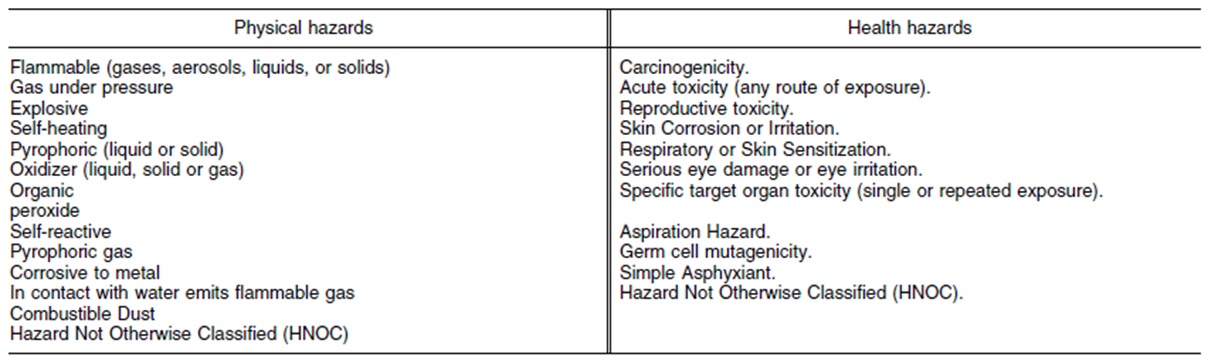 |
Sources Resources |
¶ SDSThe requirements for the SDS are set out in 29CFR1910.1200(g). The format is prescribed in Table D.1, Minimum Information for an SDS, and these sections and subsections are summarized here. The basic requirements are as follows:
Sections 12-15 are NOT mandatory but must be consistent with GHS, however, OSHA will not enforce the content of these four sections because these sections are within other agencies' jurisdictions.
HCS Update Changes to Appendix D of HCS include:
Toll Manufacturing In a toll manufacturing arrangement, who is responsible for SDS preparation?
|
Sources |
¶ Sections of the Safety Data Sheet |
|
¶ Label |
|
¶ Hazard LabelThe label is regulated by 29 CFR 1910.1200 (f) and Appendix C. The label must be in English though other languages can be included. The label must be updated within 6 months of becoming aware of new, significant information. The label must contain the following information: Product Identifier As it appears on the SDS. Name, U.S. address, U.S. telephone number of the chemical manufacturer, importer, or responsible party On shipped containers. Pictogram
The following information must appear together on the label, tag or mark: Signal word The signal words used are "danger" and "warning." "Danger" is used for the more severe hazards, while "warning" is used for less severe hazards. Hazard Statement(s) If all or part of a hazard statement can be demonstrated to be inappropriate to a specific substance or mixture, it may be omitted from the label. HNOCs do not need to be addressed on the label. Precautionary Statement(s) If all or part of a precautionary statement can be demonstrated to be inappropriate to a specific substance or mixture, it may be omitted from the label. Supplementary Information may also be included in a way that does not impede identification of required information. If a product contains an ingredient with unknown acute toxicity at a concentration ≥ 1%, and the mixture is not classified based on product testing, a statement that X% of the mixture consists of ingredients unknown acute toxicity is required on the label.
¶ HCS UpdateThe label must receive the label within 6 months of new hazard information. Manufacturers, importers, distributors or employers may choose not to relabel containers released for shipment for chemicals. If the manufacturers, importers, distributors or employers chooses not to relabel, then they must provide an updated label for each container with each shipment or electronically or other technological means with the agreement of the receiving entity. Released for shipment is defined as a chemical that has been packaged and labeled in the manner in which it will be distributed or sold by the HCS. ¶ Small ContainersSmall container requirements are provided for containers less than or equal to 100 ml capacity and less than or equal to 3 mL capacity. Pull-out labels, fold-back labels, tags, or other methods may be used to capture the required label information. When pull-out labels, fold-back labels, tags, or other methods are not feasible the label at a minimum, must contain the following:
Additionally, the outside packaging, at a minimum, must comply with the following:
¶ Bulk ShipmentsBulk shipments may bear both an HCS 2012 compliant label and a DOT Hazardous Materials Regulation (HMR) compliant label or marking without being in violation of either regulation. Note on Bulk Shipments Bearing Both DOT and OSHA HCS 2012 Labels: The HMR prohibits the display on a package of any marking or label that could be confused or conflict with a label required by the HMR. Specifically, 49 CFR § 172.401(b) states:
However, the prohibition in 49 CFR § 172.401(b) does not apply to packages labeled in conformance with certain international standards, including the UN Globally Harmonized System of Classification and Labelling of Chemicals (GHS) (see 49 CFR § 172.401(c)). The provisions of 49 CFR § 172.401(c) apply only to labeling in accordance with the GHS, and subsequently in accordance with OSHA 29 CFR § 1910.1200(f). The GHS labeling provisions, including as implemented by OSHA, require all hazard communication elements to be located on the label and these hazard communication elements must only appear as part of a complete GHS label. As such, the display of a marking or label not required by DOT's HMR, but conforming to OSHA's HCS 2012 and consistent with the GHS is not a violation of the HMR. This includes packages meeting the definition of a "bulk package" as defined by the HMR. In other words, an HCS 2012-compliant OSHA label and a DOT HMR label or marking may both appear on the same package. Labeling of Hazardous Chemicals for Bulk Shipments, Joint Guidance Memorandum, September 19, 2016 ¶ Workplace labelingShipped containers require the full set of information listed above. However, workplace labelling may use the GHS label elements described above or a reduced labeling arrangement as described in 29 CFR 1910.1200 (f)(6). Alternate Workplace Label Elements The container shall be labeled/tagged/marked with: "Product identifier and words, pictures, symbols, or combination thereof, which provide at least general information regarding the hazards of the chemicals, and which, in conjunction with the other information immediately available to employees under the hazard communication program, will provide employees with the specific information regarding the physical and health hazards of the hazardous chemical." 29 CFR 1910.1200 (f)(6)(ii) Alternate Labeling via Placard or Sign "The employer may use signs, placards, process sheets, batch tickets, operating procedures, or other such written materials in lieu of affixing labels to individual stationary process containers, as long as the alternative method identifies the containers to which it is applicable and conveys the information required by paragraph (f)(6) of this section to be on a label. The employer shall ensure the written materials are readily accessible to the employees in their work area throughout each work shift." 29 CFR 1910.1200 (f)(7) Portable Containers "The employer is not required to label portable containers into which hazardous chemicals are transferred from labeled containers, and which are intended only for the immediate use of the employee who performs the transfer." 29 CFR 1910.1200 (f)(8) |
Sources Resources Exempt from the labelling requirements of 29 CFR 1910.1200:
(29 CFR 1910.1200 (b)(5)) |
¶ California Proposition 65 Labeling¶ OverviewCalifornia's Safe Drinking Water and Toxic Enforcement Act (Proposition 65) was enacted to protect citizens and the state's drinking water sources from chemicals known to cause cancer, birth defects, or other reproductive harm, according to California's Office of Environmental Health Hazard Assessment (OEHHA). The state of California is required to review and update the list of substances identified as harmful under Proposition 65 at least yearly, but there are usually multiple updates per year. After a chemical is listed, businesses have one year to comply with warning requirements. Title 27 of the California Code of Regulations, Sections 25705, 25709, and 25805 "prohibits companies that do business within California from knowingly discharging listed chemicals into sources of drinking water."
¶ Safe Harbor levelsSafe Harbor levels are levels of exposure that trigger the warning requirements. Note that the Safe Harbor Levels are for exposure and do not correspond directly to concentration in a product. Businesses that cause exposure greater than the Safe Harbor Level must provide Proposition 65 warnings. However, there are not safe harbor levels available for all listed chemicals. If there is not a Safe Harbor Level, the warnings are required unless the business can show that the anticipated exposure level will not pose a significant risk of cancer or reproductive harm. The regulations that dictate this are Article 7 and 8 of Title 27, California Code of Regulations. Proposition 65 safe harbor levels include "no significant risk levels" (NSRLs) for carcinogens and "maximum allowable daily levels" (MADLs) for chemicals that cause reproductive toxicity. An MADL represents the "no observable effect level" (NOEL) for each chemical, divided by 1,000. When no human studies are available, a NOEL is calculated as the highest dose level that results in no observable reproductive effect, expressed in milligrams of chemical per kilogram of body weight per day. The animal NOEL can then be converted into a human oral, inhalation, or dermal dose depending on the type of relevant animal study that it is derived from.
¶ Recent developments and future trendsOn August 30, 2016 the Office of Environmental Health Hazard Assessment (OEHHA) approved amendments to Article 6, Proposition 65 Clear and Reasonable Warnings, in Title 27 of the California Code of Regulations. These amendments took effect August 30, 2018. New Safe Harbor Language General requirements for new labels:

The adoption on January 19, 2016 of a new Section 25205, Proposition 65 Lead Agency website established a framework for a website operated by the OEHHA that will provide supplemental information to the public regarding warnings for exposures to Proposition 65 listed chemicals. This adoption was made effective 1 April, 2016. Manufacturers, producers, distributors or importers of a product(s) giving a Proposition 65 warning must provide the following within 90 days of the Agency's request:
The California Safe Cosmetics Program released an updated Reportable Ingredients List June 2018, that includes chemicals newly identified by California Proposition 65 and other authoritative bodies as causing cancer or developmental or other reproductive harm. On December 6, 2017, OEHHA announced amendments to the "Clear and Reasonable Warnings" section (Title 27, Article 6) of the CCR which are meant to clarify existing regulations.
¶ Proposition 65 ViolationsPenalties for failure in providing required notices can be assessed as high as $2,500 per violation/day. |
Sources
Resources |
¶ Cosmetics LabelingManufacturers or importers of cosmetics in the United States must first verify that their product is regulated as a cosmetic and not as a drug. Products marketed as cosmetics are often regulated as drugs in the United States. This frequently occurs when products make claims to alter the human body, such as healing or revitalizing. In certain cases, products may meet the definition of both cosmetics and drugs and must follow all requirements for both in order to ensure compliance. Any cosmetic introduced into the U.S. market, whether manufactured domestically or imported, must comply with requirements in the Food Drug and Cosmetic Act and the Fair Packaging and Labeling Act. Specific labeling requirements are mandated by the FDA:
Cosmetics exported from the United States are not required to comply with the regulations of the Food Drug and Cosmetic Act and the Fair Packaging and Labeling Act, as long as the exported products are not for sale in the United States. Exported products must be compliant with the laws of the country they are being exported to and all shipping packages should indicate on the outside label that the package is for export. |
Resources
|
¶ Occupational Exposure LimitsOSHA's Permissible Exposure Limits (PELs) were published in the 1970s and have mostly not been updated since that time despite new information demonstrating that in many cases they are inadequate to ensure protection of worker health. The OSHA PELs are published in Z-Tables, but since December 19, 2013, alongside the mandatory PELs, OSHA has published alternative exposure limits. These alternative exposure limits do not carry the weight of law. They consist of:
It is mandatory to list the ACGIH TLVs along with OSHA PELs in Section 8 of the Safety Data Sheet. In October 2014, OSHA published a Request for Information for the purpose of obtaining comments on approaches to manage chemical exposures in the workplace. Comments were also sought on how to efficiently update the current PELs. The comment period was extended twice but finally closed in October 2015. Submitted comments are in the process of being reviewed, with the expectation that OSHA will publish a rulemaking to obtain comments on deletion of obsolete PELs. |
Sources |
¶ Trade SecretsThere is no application process to claim a trade secret in the US. Where a trade secret is claimed in accordance with paragraph ( i ) of 1910.1200, a statement that the specific chemical identity and/or exact percentage (concentration) of composition has been withheld as a trade secret is required. The HCS has added prescribed concentration ranges when claiming trade secrets that align with Canada. The prescribed ranges are described below:
The narrowest range possible must be used. A combination of two ranges may be used if the exact concentration does not fit the prescribed concentrations. Items to consider when evaluating if a claim is a bona fide trade secret claim:
Letter of Interpretation, October 23, 2001 |
Resources
|
¶ Transport |
|
|
The Department of Transport (DOT) Pipeline and Hazardous Materials Safety Administration (PHMSA) is responsible for the Hazardous Materials Regulations, published in Title 49 of the Code of Federal Regulations (CFR). The Hazardous Materials Regulations are based on the 19th Revision of the United Nations Recommendations on the Transport of Dangerous Goods. |
Sources Resources |