¶ Background |
|
|
As a member of the Commonwealth of Nations, Malaysia shares similar characteristics in its regulatory system as some European Union countries, such as the United Kingdom. Following the path of the European Union's REACH Regulation, Malaysia has recently introduced an Environmentally Hazardous Substances (EHS) Notification and Registration scheme to identify hazardous chemicals on the Malaysian market. To implement GHS, the Malaysian Department of Occupational, Safety and Health (DOSH) published the Occupational Safety and Health Chemicals Classification, Labeling and Safety Data Sheet (CLASS) Regulations on October 11, 2013. The CLASS regulation replaces the Occupational Safety and Health (Classification, Packaging and Labeling of Hazardous Chemicals) Regulations 1997. More information about the CLASS regulation can be found in the SDS + Label section. Fees disclosed in this report are in local Malaysian currency (Ringgit Malaysia, RM). Currently there are several pieces of chemical legislation that are governed by different ministries in Malaysia. These include:
The official federal gazette for Malaysia can be found at: https://lom.agc.gov.my/ GHS implementation in Malaysia will be administered by different agencies depending on the sector of use:
|
|
¶ Inventories |
|
| Currently, a national chemical inventory is not available in Malaysia. | |
¶ Substance Registration |
|
| Currently, there are no substance registration requirements in Malaysia. However, there are Product Registrations and Notification requirements. |
|
¶ Product Registration |
|
¶ Pesticides |
|
|
In 1974, the Government of Malaysia passed the Pesticides Act to control pesticide manufacture, import, sale, storage and transport. This Act is regulated by the Malaysian Department of Agriculture and was last amended on April 14, 2021. Under this Act, a pesticide is defined as:
An active ingredient is defined as "an ingredient listed in the First Schedule of the Pesticides Act, which has pesticidal properties and gives pesticidal properties to a substance, material, preparation or mixture, of which the ingredient is one of the constituents of the substance, material, preparation or mixture." The most recent amendment to the schedule was published through the Pesticides (Amendment of First Schedule) Order 2021. ¶ Registering a PesticideA person desiring to import or manufacture a pesticide shall apply to the Pesticide Board for registration of the pesticide. The registration will be valid for five years, but the pesticide may be re-registered at the end of every five-year period by the person who originally registered the pesticide. This person must submit an application along with payment of the prescribed fee. An application for re-registration of a pesticide will be made and dealt with in the same manner as an application for registration. The application form for registration/re-registration of a pesticide (Form A) can be found in the schedule of the Pesticides (Registration) Rules 2005. The application fee for registration or re-registration of a pesticide is RM 1500. It is non-refundable and should be paid during submission. Once the application is approved, there is an additional registration or re-registration fee that must be paid prior to the issuance of the certificate of registration. The fees are applied according to the class specified in subparagraph 4(j)( i ) of the Pesticide (Labelling) Regulation 1984, as below:

|
Sources
Resources |
¶ Cosmetics |
|
¶ ASEAN Cosmetics DirectiveAs a member of the Association of Southeast Asian Nations (ASEAN), Malaysia bases its cosmetics regulatory framework on the ASEAN Cosmetics Directive. 
|
Sources
Resources
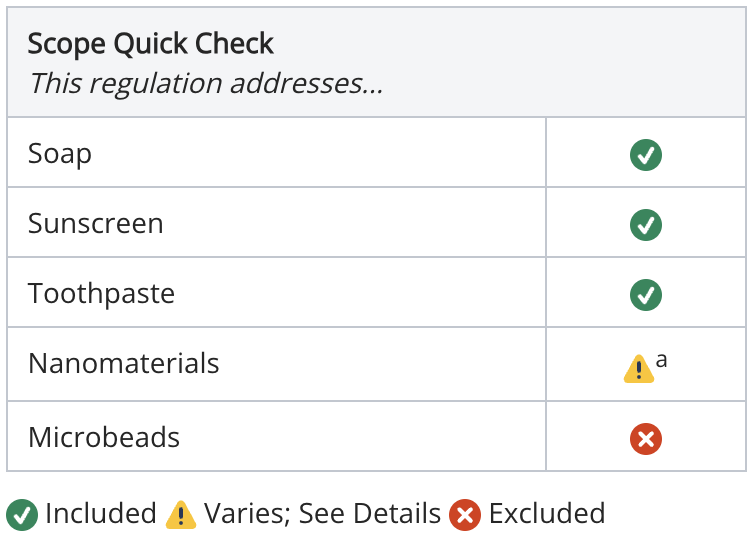 (a) Not directly addressed in ACD but a number of nanomaterials are restricted in Annex VII of ACD |
¶ Product Information FileThe Product Information File (PIF) requirements in Malaysia is in alignment with those specified by the ACD. The CNH is responsible for providing all information, certificates/documents and data requested by the NPRA. The PIF can be either in the form of a “dossier” (i.e. an extensive collection of paper records stored in a specific location) or in electronic format (i.e. soft copy). It should be readily available and accessible upon request by the NPRA within an agreed upon time frame: within 15 or 60 calendar days or shorter, depending on the urgency of the audit. The PIF shall be in Bahasa Malaysia or English. It is recommended that the PIF is kept for a minimum of 3 years after the product is last placed on the market. The PIF shall be kept updated for all changes made to the notified product such as new ingredients, manufacturers, raw material suppliers and production process. Date of document revision, where appropriate, shall be stated for verification. Please refer to Annex I, part 13 - Guideline for Product Information File (PIF) for detailed information. |
Sources
|
¶ LabellingThe labelling requirements including those for sunscreen products promulgated by ACD are fully adopted by the Malaysian cosmetics guidelines, with the following specialties:
Please refer to Annex I, part 7 - Cosmetic Labeling Requirements and Annex I, part 9(i) - Guideline for Sunscreen Product for detailed information. Halal logo Halal logo may be used voluntarily on a notified cosmetic product, for both local and export market, provided that the product has been certified and approved Halal by the Malaysia Department of Islamic Development (Jabatan Kemajuan Islam Malaysia, JAKIM) or any Islamic Body recognized by JAKIM. |
Sources |
¶ Notifications |
|
¶ Environmentally Hazardous SubstancesNotification applies to industries that are manufacturing or importing Environmentally Hazardous Substances (EHSs) or chemical mixtures or finished products containing EHS constituents. Based on information collected through Malaysian industries, the Department of Environment (DOE) publishes the EHS Register on its website. EHSs are defined as:
They include substances listed on the EHS Reference list which is published on the DOE website and on the CMR (Carcinogenic, Mutagenic and Reprotoxic) Reference List. The CMR Reference list is currently not available. EHS Notification and Registration Scheme (EHSNR) is implemented in phases based on the annual tonnage band. EHSs manufactured or imported in the quantity of more than 100 metric tons, and substances classified as aquatic chronic 1 and CMR in the quantity of more than 1 metric ton are required to notify DOE. There are two types of notifications:
Notification is not required for non-EHS. For substances that are not classified as hazardous under GHS, proof is required for the non-classification. A Safety Data Sheet (SDS) showing that a substance is not classified would be sufficient proof. DOE will check the substance classification data submitted by the manufacturer/importer. Once the classification is accepted, the substance and its associated date will be entered into the Register of Notified Substances (EHS Register). The EHS Register is currently not available. Currently, the EHSNR is on a voluntary basis. The Malaysian government is working on drafting the necessary regulations to make it mandatory in the future. The regulations are expected to be published in 2020 - 2022. The EHS website under Department of Environment has been migrated to a new site: https://myehs.doe.gov.my/portal/myehs/ with limited information. More information is expected to be available on the website when the related regulations are published. |
Resources The EHS website under Department of Environment has been migrated to a new site: https://myehs.doe.gov.my/portal/myehs/. The EHS Register is not available currently. Contact information Department of Environment General line: +6-03-88712000 / 2200 |
¶ CLASS NotificationThe Occupational Safety and Health (Classification, Labeling and Safety Data Sheet) (CLASS) Regulation replaced the Occupational Safety and Health (Classification, Packaging and Labelling of Hazardous Chemicals) Regulations 1997 (CPL) to align with the United Nations Globally Harmonized System of Classification and Labelling of Chemicals (GHS). The regulation was published on October 11, 2013 in the government gazette. The key difference between CPL and CLASS is the preparation of a chemicals inventory. Importers or manufacturers of hazardous chemicals of one metric ton or more per year must prepare an inventory of chemicals. This inventory must be submitted to the Director General no later than March 31 of the year following the activity. The first submission deadline was March 31, 2016 for inventories prepared in 2015. The submission to the inventory must include the following information:
The name, composition and ingredients of a hazardous chemical can be claimed as confidential business information in the SDS and in the chemicals inventory. In this case, a generic name of the chemical or the allowable concentration range of the ingredients shall be used as replacements. The Malaysian Industry Code of Practice on Chemical Classification and Hazard Communication (ICOP) is a mandatory guidance to chemical suppliers to comply with the provisions of the CLASS Regulations and guides industries on chemical classification and hazard communication for chemicals used in the workplace. The ICOP consists of four parts:
Hazardous chemicals are:
The Industry Code of Practice on Chemicals Classification and Hazard Communication (Amendment) 2019 was approved on October 11, 2019, updating Part 1: List of Classified Chemicals according to the Globally Harmonized System of Classification and Labelling of Chemicals (GHS). The 2019 Amendment only affects the List of Classified Chemicals in Part 1. The classifications of previously classified chemicals were reviewed and modified based on the most recently available information and data. The updated list contains the GHS classifications for 662 substances. This represents an addition of more than 400 substances when compared to the previously classified 229 substances. The implementation date of the 2019 Amendment is January 1, 2021. Onwards, the submission of the inventory of chemicals should use the new classifications specified in the amendment. |
Sources Resources |
¶ Restrictions and Bans |
|
¶ Ozone Depleting SubstancesMalaysia is a party to Montreal Protocol since August 29, 1989. In accordance with the Montreal Protocol, Malaysia is committed to phase out the consumption of Ozone Depleting Substances (ODS). Chlorofluorocarbons (CFCs) and Halon were phased out by the year 2010, while other ODS will be phased out no later than the timelines specified in the Montreal Protocol and its amendments. The Department of Environment (DOE) is the responsible party for coordination of measures to phase out ODS consumption. It coordinates, monitors and implements all Montreal Protocol activities including ODS phaseout investment projects. The Ozone Protection Section (OPS), previously known as the Project Management Office (PMO), was established under DOE to assist industries in phasing out ODS through the adaption of policies, strategies, technological monitoring procedures, and programs specified in the National CFC Phase-Out Plan 2002-2010 (NCFCP). OPS also functions as a secretariat which monitors the implementation of the plans outlined in the National Action Plan and Strategy for Ozone Layer Protection. OPS prepares regular progress reports for the National Steering Committee (NSC) for the Ozone Layer Protection, the World Bank, and the Montreal Protocol Multilateral Fund Secretariat. ¶ Regulatory Status of ODS
|
Sources
|
¶ Persistent Organic Pollutants (POPs)On May 16, 2002, Malaysia signed the Stockholm Convention on Persistent Organic Pollutants (POPs). To date, there is no specific legislation implemented in Malaysia to enforce the control on the listed POPs. However, many of these POPs, which are commonly used as pesticides, have been banned in Malaysia. The Environmental Quality (Dioxin and Furan) Regulations 2004 was enacted in the year 2004 to control the emission of dioxins and furans into the atmosphere from selected facilities. |
Sources |
¶ Restriction of Hazardous Substances (RoHS)Malaysia does not have any requirements for EEE similar to the EU Restriction of Hazardous Substances (RoHS). |
|
¶ SDS + Label |
|
¶ Classification |
|
|
The Occupational Safety and Health (Classification, Labeling and Safety Data Sheet) (CLASS) Regulation replaced the Occupational Safety and Health (Classification, Packaging and Labelling of Hazardous Chemicals) Regulations 1997 (CPL) to align with the United Nations Globally Harmonized System of Classification and Labelling of Chemicals (GHS). The regulation was published on October 11, 2013 in the government gazette. The transition period for the implementation of CLASS was from April 17, 2014 until April 16, 2015. The CLASS Regulations apply to manufacturers, suppliers, and importers of hazardous chemicals for use in the workplace. On April 16, 2014, the Industry Code of Practice on Chemical Classification and Hazard Communication (ICOP) was gazetted. The ICOP provides guidance to industries for chemical classification and hazard communication of workplace chemicals. The ICOP is promulgated under Section 37 of the Occupational Safety and Health Act (OSH) 1994. It is a mandatory guide to comply with the Occupational Safety and Health (Classification, Labelling and Safety Data Sheet of Hazardous Chemicals) Regulations (CLASS) 2013 [P.U. (A) 310/2013]. The ICOP consists of four parts:
The ICOP (Amendment) 2019 was approved on October 11, 2019, updating Part 1: List of Classified Chemicals according to GHS. The 2019 Amendment only affects the List of Classified Chemicals in Part 1. The classification of previously classified chemicals were reviewed and modified based on the most recently available information and data. The updated list contains the GHS classifications for 662 substances. This represents an addition of more than 400 substances when compared to the previously classified 229 substances. The 2019 Amendment will be implemented January 1, 2021 and the new classifications shall be used onwards. Listed chemicals shall be classified according to the classification specified in the list. It is a minimum classification. If the supplier has data or other information that leads to additional hazard class or more severe category, then such classification is acceptable. If the classification provided by the supplier excludes any hazard class or adopts a less severe category compared to the minimum classification, the relevant information and data to support such classification need to be submitted to Director General of the DOSH. Chemicals not listed in Part 1 of the ICOP shall be classified according to the classification criteria prescribed in Part 2 (Chemical Classification) of the ICOP. There are 16 physical hazard classes, 13 health hazard classes and 3 environmental hazard classes under ICOP. The following GHS hazard classes/categories were not adopted:
According to Part II, Regulation 5(1) of the CLASS, classification records shall be available upon inspection. The records include the identification of chemicals and their classification results with justification and source references. The format for maintaining classification records is provided in Part 2 of ICOP. |
Sources
Resources The following are exempt from the CLASS regulations as they are controlled under other existing regulations:
The CLASS Regulations consist of eight Parts and five Schedules. They include detailed requirements for classification, packaging, labelling, safety data sheets, inventory of hazardous chemicals, and confidential business information in Parts II, III, IV, V, VI and VII respectively. The First Schedule indicates hazard classifications with their corresponding hazard pictograms, signal words and hazard statements. The Second, Third, Fourth and Fifth Schedules provide references of hazard pictograms, combined hazard statements, dimensions of labels and the cut-off concentration values in mixtures, respectively. |
¶ Proposed Amendments to the CLASS Regulations 2013The Malaysian DOSH published the proposed amendments to the CLASS Regulations 2013 on June 13, 2022. The CLASS Regulations 2013 were enacted to align with GHS Revision 3. With the 2022 amendments, Malaysia is moving to adopt GHS Revision 8. The proposed amendments are focused on the following items:
The draft was published only in Malay, but once the official amendments are issued on the gazette, there will also be an English version available. The proposed amendments are open to public comments from June 13, 2022 to August 15, 2022. |
Resources |
¶ Cut-off Values/Concentration LimitsWhere test data is not available for a mixture, for health and environmental endpoints, the GHS allows for classification based on the hazards of the substances in the mixture. The GHS usually defines the concentration at which a hazardous substance causes a mixture containing that substance to be classified, for most hazards. These are known as Concentration limits / Cut-off values. Countries must additionally set the thresholds for mixture classification for certain hazards:
Malaysia implements specific classification cut-off values and concentration limits for mixtures for certain hazard classes, prescribed in the Industry Code of Practice on Chemical Classification and Hazard Communication (ICOP). ¶ Respiratory Sensitization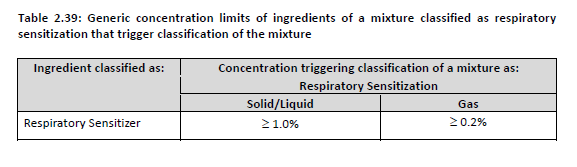 ¶ Skin Sensitization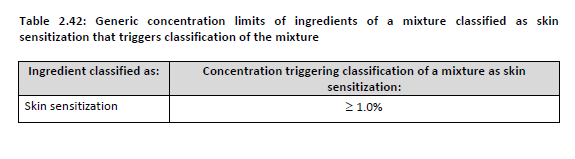 ¶ Carcinogenicity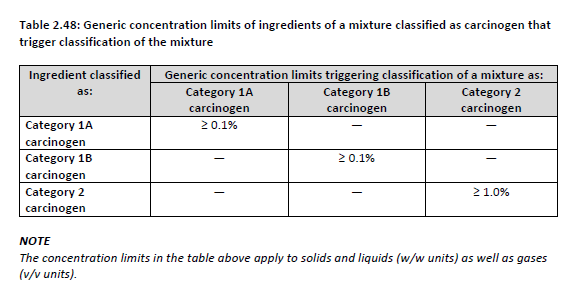 ¶ Reproductive Toxicity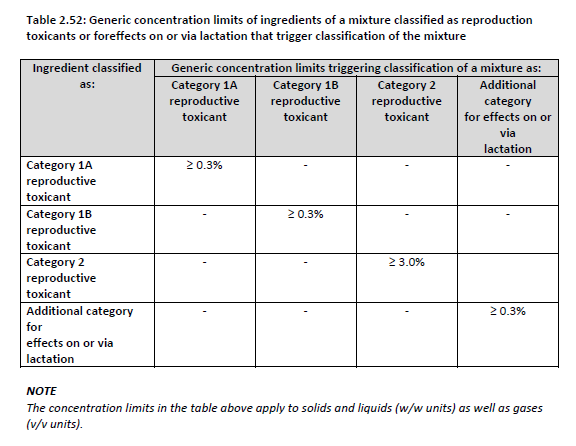 ¶ Specific Target Organ Toxicity - Single Exposure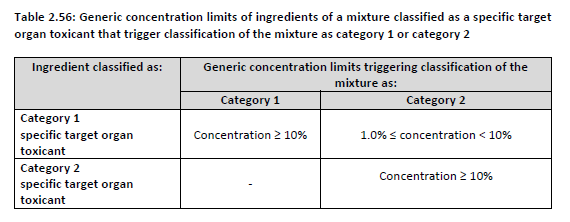 ¶ Specific Target Organ Toxicity - Repeated Exposure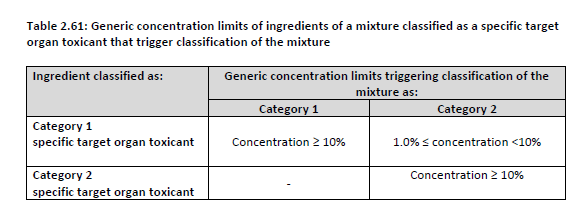
|
|
¶ SDSPart 3 of Industry Code of Practice on Chemical Classification and Hazard Communication (ICOP) consists of information regarding hazard communication, i.e., labelling and safety data sheet (SDS) requirements. For substances classified with multiple hazard classes, resulting in multiple hazard pictogram and/or hazard statements, the rules of precedence to allocate hazard pictogram and/or hazard statements can be found in Part 3, Section 3.2.2 in ICOP. It is the duty of manufacturers, suppliers and importers of hazardous chemicals to prepare labels and safety data sheets (SDS). The SDS shall be prepared in both Malay and English. The requirements for SDSs can be found in regulation 13 of the CLASS Regulations. The sections and subsections are prescribed as translated here. Other than the requirements explained in each section, ICOP also specifies the following requirements for the SDS:
An SDS shall be revised if new information on a particular hazardous chemical becomes available or if it has been five years since last revised. A revised SDS shall be provided to its recipients as soon as practicable. The use of a local emergency contact is encouraged, but is not mandatory. The contact information of the Malaysian Poison Center can be included in SDSs with no fee applied. |
Sources
National Poison Centre Universiti Sains Malaysia 11800 Penang Malaysia Tel: +604-657 0099 Emergency number: Fax: +604-656 8417 Email: prnnet@usm.my |
¶ Sections of the Safety Data Sheet |
|
¶ LabelPart 3 of Industry Code of Practice on Chemical Classification and Hazard Communication (ICOP) consists of information regarding hazard communication, i.e., labelling and safety data sheet (SDS) requirements. Considering various circumstances in preparing the label, ICOP provides guidance for precedence of information, the allocation of label elements and special labelling arrangements. For substances classified with multiple hazard classes, resulting in multiple hazard pictogram and/or hazard statements, the rules of precedence to allocate hazard pictogram and/or hazard statements can be found in Part 3, Section 3.2.2 in ICOP. Information required on a label for Malaysia is aligned with GHS but with some specific requirements.
In the event that an ingredient without any useable information at all is used in a mixture at a concentration of >=1%, it is concluded that the mixture cannot be attributed a definitive acute toxicity estimate. In this situation the mixture shall be classified based on the known ingredients only, with the additional statement on the label that “x% of the mixture consists of ingredient(s) of unknown toxicity”. The font size of letters and numbers used on a label shall not be smaller than 7 points and they shall be black in color. Background color of a label is either white or a light color which will not camouflage the text. In addition, according to the requirements specified in part 8 of the CLASS Regulations, the label shall be prepared in both Malay and English. A label shall be firmly affixed to one or more surfaces of the container so that the label can be read horizontally when the container is set down in its normal position. A label can be tagged to the packaging if it is not practicable to affix a label due to the nature of the container. If the packaging is a container with a size of 125 mL or smaller, a label shall be affixed in such manner deemed reasonable by the supplier. Small containers with a size of 125 mL or smaller may have a label for which the hazard statements and precautionary statements are replaced with the statement "read Safety Data Sheet before use." The label dimensions for different packaging sizes can be found in the Fourth Schedule of the CLASS Regulations. 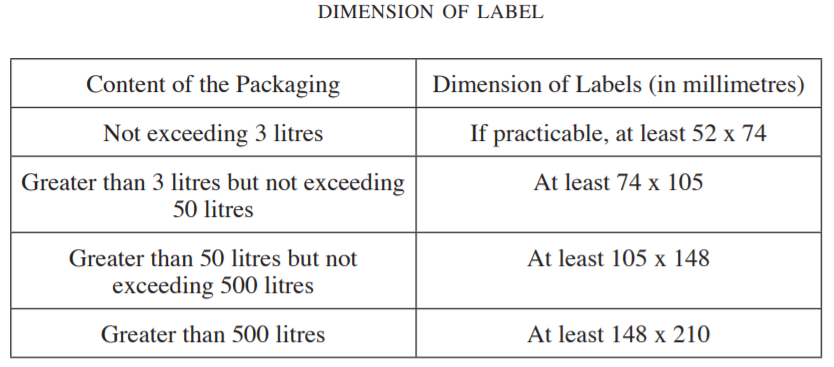 |
Sources
|
¶ Proposed Amendments to the CLASS Regulations 2013The Malaysian DOSH published the proposed amendments to the CLASS Regulations 2013 on June 13, 2022. The CLASS Regulations 2013 were enacted to align with GHS Revision 3. With the 2022 amendments, Malaysia is moving to adopt GHS Revision 8. The proposed amendments contain the following items regarding labelling:
The drafted label sizes and pictogram dimensions are summarized in the table below: 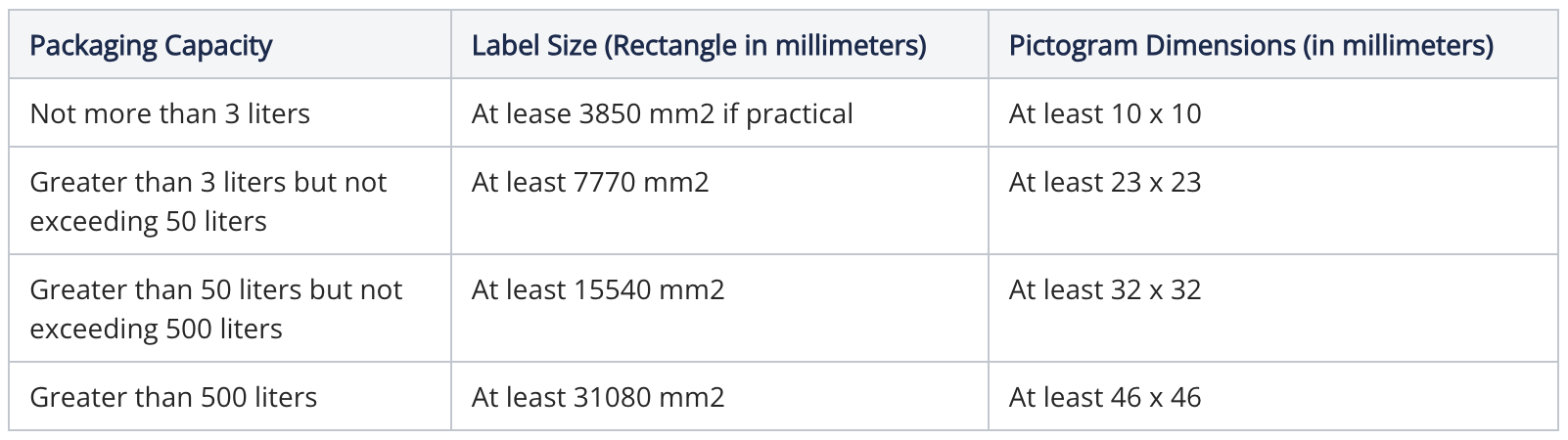 The draft was published only in Malay, but once the official amendments are issued on the gazette, there will also be an English version available. The proposed amendments are open to public comments from June 13, 2022 to August 15, 2022. |
Resources |
¶ Trade SecretsPart 4 of the Industry Code of Practice on Chemical Classification and Hazard Communication (ICOP) provides guidelines on the usage of Confidential Business Information (CBI). For the information on chemical inventory and SDS, only chemical names, their identifiers and their concentrations in mixtures can be claimed confidential. Upon request, CBI has to be disclosed to the Director-General of Occupational Safety and Health. A generic chemical name may be used for a commercially confidential hazardous ingredient. The method of selecting generic chemical names can be found in Section 4.3 of the ICOP. For confidential purposes, the concentrations of ingredients in mixtures can be provided in percent ranges. The allowable concentration ranges are available in Section 4.2 of the ICOP. However, a narrower range may also be used. 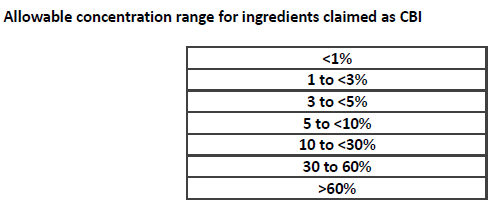 |
Sources |
¶ Occupational Exposure LimitsThe Government of Malaysia has adopted permissible exposure values for protection of workers. The Department of Occupational Safety and Health (DOSH) is responsible for occupational safety, health and welfare, i.e. the safety, health and welfare of persons at work and of other persons affected by the activities of persons at work. The Occupational Safety and Health (Use and Standards of Exposure of Chemicals Hazardous to Health Regulations) 2000 was published on March 29, 2000 in accordance with Section 66 of the Occupational Safety and Health Act. The list of permissible exposure limits is provided in Schedule I of the regulation. Article 25 of the regulation requires a Safety Data Sheet to be provided in the workplace in which the chemicals are being used. |
Sources
Resources |
¶ Transport |
|
|
The Ministry of Transport Malaysia is responsible for Malaysian Standard MS1990-1:2015. MS1990-1:2015 is based on the 18th Revision of the United Nations Recommendations on the Transport of Dangerous Goods. |
Sources
Resources |