¶ ASEAN Cosmetics DirectiveThe Association of Southeast Asian Nations (ASEAN) is an intergovernmental organization of ten South Asian countries with the purpose of promoting cooperation and facilitating economic, political, security, education and cultural integration among its members and the rest of the countries in Asia. The country members are: Brunei, Cambodia, Indonesia, Laos, Malaysia, Myanmar, Philippines, Singapore, Thailand, and Vietnam. Aiming to harmonize cosmetic product regulations in the ASEAN region, Member States agreed on a Harmonized Cosmetic Regulatory Scheme. The Scheme covered the Mutual Recognition Arrangement of Product Registration Approvals (Schedule A - no longer applicable) and the ASEAN Cosmetics Directive (ACD) (Schedule B). The ASEAN Cosmetic Committe (ACC) was established with the mission of coordinating the implementation of ACD in the member states. The harmonization has an objective to enhance the safety and quality of cosmetic products marketed in the region, while at the same time eliminating technical barriers in trading of the products. The ACD is modeled after Directive 76/768/EC and Regulation Regulation (EC) N° 1223/2009. As this is a Directive, Member States are responsible for transposing the requirements and amendments of the Directive and its Technical Documents (Annexes and Appendices) into national legislation. For this reason, possible existing differences within the Member States need to be identified and considered before entering a particular Member market. Differences can include additional restrictions in ingredients (e.g. halal/non-halal ingredients), notification discrepancies, and cultural considerations (e.g. label depictions). 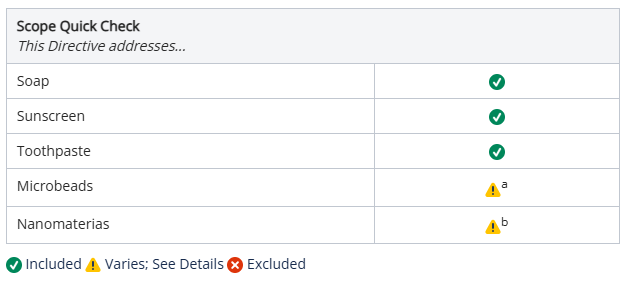
¶ Definition of Cosmetic ProductACD defines a cosmetic product as:
Annex I of the Directive contains a non-exhaustive illustrative list of cosmetic product categories. Products for which it is not clear whether they fall under the scope of the Cosmetics Directive or other legislation (e.g. denture cleansers intended for use outside the mouth) are considered borderline products. For such products, a decision is made on a case-by-case basis during the ACC meetings. Appendix III of the ASEAN Cosmetic Claim Guidelines provides some additional guidance with respect to the cosmetic/drug determination based on composition and proposed use and benefits. The Decision History List on these products is updated after the meetings.
¶ Cosmetic IngredientsManufacturers and/or importers are responsible for the safety of the substances used in cosmetic products. To support the use of safe substances, the Directive sets restrictions and authorizations for certain ingredients, as presented in Annexes II - IV, VI and VII. Annex II - Substances that are prohibited from being used as ingredients Annex III - Part 1 - Substances that can only be used if all the restrictions set in the Annex are met (e.g. concentration, type of product, area of use) Annex IV - Part 1 - Substances that are authorized to be used as colorants in cosmetic products Annex VI - Substances authorized to be used as preservatives Annex VII - Substances authorized to be used as UV-filters Possible additional ingredient restrictions or differences may exist in individual Member States.In Indonesia, cosmetics shall be notified before circulated on the market. The notification process is regulated by National Agency of Food and Drug Control, also called by BPOM which is administered under the Indonesian Ministry of Health. 
|
Sources Resources
|
¶ Product Notification InformationThe ASEAN cosmetics regulatory framework has transitioned from pre-market approval (registration) to post-market surveillance (notification). The company/person responsible for placing the product on the market must be registered to operate in an ASEAN Member state. They should notify the cosmetics regulatory authority of each Member State where the product will be marketed, using the Product Notification Form prescribed by the authority. Only upon acknowledgement by the regulatory authority that notification has been received can the product be placed in the market. This acknowledgement usually occurs within a week, and may for example, be the assignment of a notification number. An authority's acceptance of a notification does not represent agreement by the authority that the product is compliant. Information that should be submitted for the notification, as per the Notification template includes:
Product notifications can be amended or a new notification may be required depending on product changes (e.g. change in intended use, formulation etc). Products that are either imported for direct re-export or manufactured solely for export are exempted from notification as they do not impact the safety of local consumers. Proper records should be kept for proof that exemption is applicable in case of inspection. Depending on the Member State, there may be additional information to be supplied as part of the notification procedure, and method of submission (electronically or per mail etc). |
Resources |
¶ Product Information FileArticle 8 of the ACD sets the requirement for a Product Information File (PIF) for cosmetic products. The PIF should be at the address of the company/responsible person (manufacturer/importer/distributor) which is specified on the label, and should be kept up to date and readily accessible to regulatory authorities. The file should include the following:
It is further recommended for ease of use to separate the PIF in 4 parts as shown:
|
Resources |
¶ LabellingAccording to Article 6 of the ASEAN Cosmetics Directive, Member States should take all necessary measures to ensure that cosmetic products are only allowed to be on the market if they comply with the ASEAN Cosmetic Labeling Requirements as they appear in Appendix II of the Technical Documents associated with the Directive. Attention should be given to any particular Member State requirements. Labels should have legible and visible lettering. They can be in English and/or National Language and/or language understood by consumers in the area the product is marketed. Labeling requirements include:
In case of container size constraints, the minimum that should be listed is the name of the product and the manufacturer's batch number. The rest of the required information can be listed on additional item such as tags, leaflets etc.
¶ Sunscreen Labeling GuidelineProducts for which the primary function is UV protection have specific labeling requirements as per the ASEAN Sunscreen Labeling Guideline. This involves ensuring that no misleading claims are made on the label (e.g. 100% protection against UV A & B). In addition to labeling phrases mandated by the ACD (e.g. Do not stay too long in the sun, even while using a sunscreen product as per Annex VII of the Directive), the Guideline also strongly recommends use of other warnings such as e.g. ''Over-exposure to the sun is a serious health threat'. Claims should be clear and unambiguous and claims of UV protection should not be made if SPF<6. Classifications of protection based on SPF are included in the Guideline.
|
Resources |
¶ Serious Adverse ReactionsAccording to the ASEAN Consumer Information Handbook on Cosmetic Products, consumers are encouraged to report any serious adverse reaction to the cosmetic product to the national regulatory authority and company and provide details of the product and type of reaction occurred for further investigation. Companies should also report to national regulatory authorities of any serious adverse reactions as soon as they become aware of any.
|
Resources |