¶ Background |
|
|
Kazakhstan is located in central Asia, bordering Russia, China, and few smaller central Asian countries. It was a part of Soviet Union until 1991 and gained independence since then. After the initial political volatility, Kazakhstan managed to establish a relatively stable political climate and take the course of economic reforms. Large areas of the country still lack development. To encourage development, the national capital was moved in 1997 from the city of Almaty, located in the historically more developed far south, to the city of Astana, which is located much closer to the geographical center of the country. Significant economic development has been achieved in the past decade, due in part to the presence of natural resources such as oil and gas. Much of regulations are based on the GOST standards (abbreviation for GOsudarstvennyj STandard, meaning State Standard in Russian), which have been in existence since the times of the Soviet Union . The country actively participates in the development and adoption of new international GOST standards along with other former Soviet Union republics. Kazakhstan is one of the three founding members of the Customs Union, an organization that aims at facilitating trade and economic cooperation between neighboring countries. Besides Kazakhstan, present members of the Customs Union include Armenia, Belarus, Russia, and Kyrgyzstan. In addition to the membership in the Customs Union, Kazakhstan participates in the Shanghai Cooperation Organization (SCO). Even though the major goals of the SCO are security related issues such as combating terrorism in the region, the organization also introduces economic policies. The Agreement on International Road Transportation Facilitation (in force since 20 January 2017) is one of the recent examples. Official publication of legal acts is implemented by gazettes of each branch of the government (printed versions) and electronically in an official database maintained by the Ministry of Justice: http://zan.gov.kz/# and http://adilet.zan.kz/eng The Parliament, President and the Government publish information on their websites as well: Parliament - http://www.parlam.kz/en/legislative/1 |
|
¶ Inventories |
|
|
Kazakhstan does not have a chemical inventory similar to those of other industrialized countries, but the government aims at keeping track of chemicals used in various industries. The Ministry for Investment and Development maintains a registry of chemical products that have been registered with the government. The same registry includes information on the products' Safety Passports, which are also registered as a part of the product registration process. The Registry can be accessed on a page of the Industrial Development and Industrial Safety Committee. 
|
Resources |
¶ Substance RegistrationSubstance registration is performed by the government when the Safety Passport (SDS) and all related information is submitted for the product registration. There is no separate registration process for substances. The government maintains a registry of substances used in the country, but this registry is not currently available to the public. However, the list of registered products and their Safety Passports is available. |
|
¶ Product RegistrationThe National Law "On Safety of Chemical Products" requires registration of chemical products prior to their release on the market (Article 12, Chapter 4). One of the registration requirements is to perform risk assessment of a product. What is included in the risk assessment According to Chapter 13 of the Law "the applicant indicates:
On June 16, 2015, the Ministry for Investments and Development issued Decree № 694 establishing a registration procedure. The procedure for registration of chemical products includes the following: ¶ 1. Necessary documentation is submitted by an applicant.An applicant could be a manufacturer or importer, Kazakh or foreign entity. The following documentation is required for the registration:
¶ 2. Documents are reviewed and a decision is made to approve or decline the petition.A decision on registration is made in 5 days. Registration can be denied in the following circumstances:
If an application is denied, an applicant can appeal the decision according to the Law "On Licensing and Notifications", Article 20, item 1. For approved petitions... ¶ 3. Information on the chemical product is entered into the Substance Registry and a Certificate of Registration is issued.The substance registry is not publicly available. However, a list of registered products and their Safety Passports is avaliable. A Certificate of Registration is valid for 5 years. |
Sources
*Not available in English |
¶ PesticidesPesticides are regulated by the National law "On protection of plants" and by the National technical regulation "Requirements for pesticide safety". The Ministry of Agriculture maintains and publishes the National Pesticide Registry, which is a list of pesticides approved for use in the country. The list contains chemicals under trade names and includes information on manufacturers and importers. The majority of pesticides used in Kazakhstan are imported from Russia, China, Europe and the USA. Few manufacturing facilities exist in Kazakhstan that formulate products using imported chemicals. Manufacture, import or any use of pesticides not included in the National Pesticide Registry is prohibited. 
|
Sources
Resources
*Not available in English |
¶ Notifications |
|
| Presently there is no separate notification process for new substances. A registry of chemical substances is updated once an application for a new chemical product is received by the government. The registry is not open to the public. | |
¶ Restrictions and Bans |
|
|
Ban Under Development The Ministry of National Economy issued a Decree № 406 on May 27, 2015 with the intent to establish a registry of potentially hazardous chemical and biological substances which will be prohibited in the country. However, the development of the registry did not go much beyond the announcement. Many government agencies face periodic reorganizations, which likely slows the work. The latest reorganization occurred on February 17, 2017 following the governmental decree № 71. This reorganization transferred jurisdiction over the registry to the Ministry of Health. No further information on the existence of such a registry is available yet. |
Sources
*Not available in English |
¶ Restrictions in the Customs UnionKazakhstan, being a part of the Customs Union along with Armenia, Belarus, Russia and Kyrgyzstan follows restrictions and bans on import and export established by the legislation of the Customs Union. The list of restricted substances and goods is published on Eurasian Economic Commission web site. Relevant groups include the following:
|
Sources
*Not available in English |
¶ Restriction of Hazardous Substances (RoHS)Kazakhstan has an equivalent to the RoHS Directive, which was introduced at the level of the Eurasian Economic Union. Customs Union Technical Regulation "On restriction of hazardous substances in electronics" was published in August 2016 and became effective on March 1, 2018. The regulation was modeled after the EU RoHS 2 Directive (2011/65/EU) and is aimed at improving trade between countries of the Customs Union and the European Union. The regulation limits content of certain elements and compounds in electronics, household appliances and certain industrial products. The substances and their limits are listed in Annex 2 of the Technical Regulation and follow that of Annex II of 2011/65/EU: 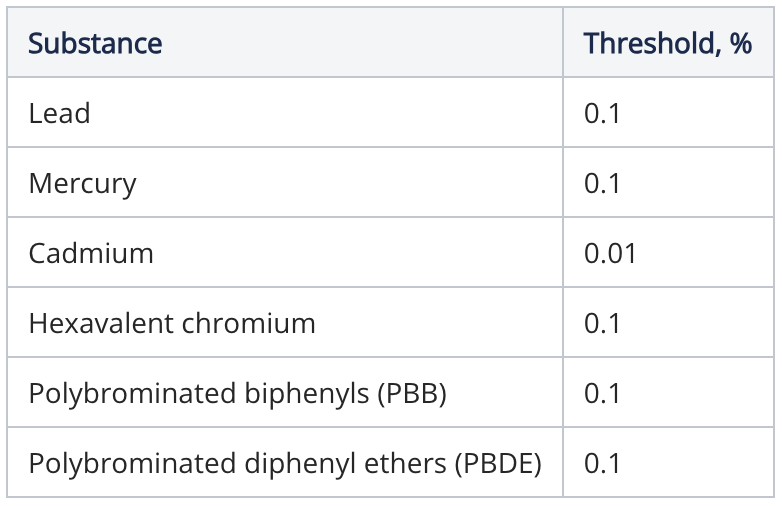 Products and devices covered by the restrictions are listed in the Annex 1 of the regulation. The list is more detailed and contains more specific descriptions of products than those in the corresponding Annex I of the EU Directive. Annex 3 of the Technical Regulation, describing specific exemptions to the requirements, is largely similar to the corresponding Annex III of the EU Directive. However, a few additional items are introduced and time limits for most of the items are not established. |
Sources
*Not available in English
|
¶ Ozone Depleting SubstancesKazakhstan joined the United Nations Montreal Protocol on Ozone Depleting Substances in 1998. Measures on regulating ozone depleting substances are included in the Environmental Code of the Republic of Kazakhstan of 2007. Additionally, more recent regulations on ozone depleting substances were established by the Customs Union. The countries participating in the Eurasian Economic Community agreed to certain control measures when transporting ozone depleting substances between the countries and in trade with the third parties. The rules are described in the Customs Union Agreement "On movement of ozone depleting substances within the Eurasian Economic Community". They mostly deal with accounting and informing of quantities of the substances. A separate decision of the Eurasian Economic Commission lists procedures for import and export ozone depleting substances as well as substances, import and export of which is prohibited. The regulation can be accessed on the Eurasian Commission website (Customs Union Decision N 99). Specific substances and products containing those substances are also included in the single list of goods subject to prohibitions or restrictions on import or export by the Customs Union member states (chapters 1.1 and 2.1). |
Resources
*Source not available in English |
¶ Persistent Organic Pollutants (POPs)Kazakhstan became a signatory to the Stockholm Convention on Persistent Organic Pollutants in 2001. It ratified the Convention by the Law of the Republic of Kazakhstan № 259-III "On ratification of the Stockholm Convention on Persistent Organic Pollutants," issued on June 7, 2007. The country has been a party to the convention since September 9, 2007. Measures for the control of POPs are also included in Kazakhstan's Environmental Code of 2007. |
Sources
*Not available in English |
¶ SDS + Label |
|
|
Presently (Fall 2018) no official publications on adoption of GHS in Kazakhstan are available. No information on Kazakhstan is present in UN status report on GHS implementation in the world either. Classification, SDS and labeling are largely regulated by national standards and to a lesser extent by international GOST standards and Technical Regulations of the Customs Union. Normally, the scope of a regulation is defined in a regulation itself or in an accompanying technical letter, however, confusions may arise due to frequent reorganizations of ministries with overlapping jurisdictions. When national and international regulations covering the same area exit, preference is given to a national regulation. A technical regulation of Eurasian Economic Commission (a legislative body of Customs Union) "On Safety of Chemical Products" was signed on March 3, 2017. The document aims at creating unified requirements for classification and labeling of chemical products, mandatory in all participating countries. The regulation will enter in force on June 2, 2021. A number of steps is scheduled to prior to that date, such as creating national registries of chemical compounds by March 1, 2021 and establishing procedures for designing the registries and notification of new chemical compounds by December 1, 2018 . |
Resources
*Not available in English |
¶ ClassificationPresently, no official publications on adoption of GHS in Kazakhstan are available. No information on Kazakhstan is present in UN status report on GHS implementation in the world either. However, Kazakh standards have some similarity with GHS requirements on classification. Although Kazakhstan adopted the international GOST 30333-2007 for Safety Passports of Chemical Products, it did not accept GOSTs on classification. The only adopted classification standard is GOST 32421-2013 "Classification of chemicals which hazard is caused by physical and chemical properties. Test methods of explosives." Thus, classification of chemicals is described in the Law № 302 "On Safety of Chemicals." The law establishes classification of chemical products based on their hazard and based on types of chemical substances composing a product: The following hazards are recognized by the law:
The following classes of substances are recognized by the law:
According to the law, classification by hazard type should follow a specific technical regulation pertaining to safety of chemicals (such as National Technical Regulation or Customs Union Technical Regulation). Annex V (Приложение В) of the National Standard CT PK 1185-2006 provides example classification criteria, which are modeled after GHS. Classification by types of chemicals should be performed by a manufacturer or importer during a registration process. |
|
¶ SDSIn Kazakhstan, Safety Data Sheets are referred to as Safety Passports, similar to the term used in Russia. Although Kazakhstan voted for adoption of the International Standard GOST 30333-2007 for Safety Passports, it hasn't implemented the standard. Currently the Ministry for Investments and Development requires using the national standard CT PK 1185-2006 for creating a Safety Passport. The standard requires 16 sections in the Safety Passport, which are largely in line with UN GHS. Each page must be numbered and indicated the total page count (i.e. page 2 out of 10). The title page is reserved for registering the Safety Passport with a government organization. Number 1 is not listed on the title page. Blanks in sections are not allowed. If no information is available, this should be indicated. Sources of information must be included in section 16 and referenced throughout the document in square brackets. Annex B of the standard describes the sections of a Safety Passport and requirements to their content. The Annex B (Приложение Б) is available for free download from the Ministry for Investment and Development, while the full text of the standard can only be purchased from the National Bank of Regulatory Documents. Each Safety Passport must be written in at least 2 languages - Kazakh and Russian. Additional languages may be used at manufacturer's discretion, for example, if a product is exported to other countries besides Kazakhstan. A Safety Passport is one of the required documents for registering a chemical product. A product's Safety Passport is registered with the government during this product's registration. Currently the agency responsible for the registration of Safety Passports is the Industrial Development and Industrial Safety Committee of the Ministry for Investment and Development. |
Sources Resources
*Not available in English |
¶ Sections of the Safety Data Sheet |
|
¶ LabelArticle 18 of the law "On Safety of Chemical Products" requires that all hazardous chemical products be labeled, informing users of the product's hazards. According to the law, labels are approved by an official government agency and should be aligned with international requirements. The following label components are listed in the law:
Label should be made with legible non-washable letters and symbols. Chemical products without labels are not allowed in the market. The Ministry of Industry and Trade was in charge of drafting a regulation regarding labels in 2008. It issued a decree containing approved labeling symbols on April 2, 2008. The ministry has been reorganized since then, and presently chemical regulations fall under jurisdiction of the Ministry for Investment and Development. |
Sources
*Not available in English |
¶ Trade SecretsThe National Standard of the Republic of Kazakhstan CT PK 1185-2006 contains provisions on trade secrets regarding product components. It is allowed to list component concentration as a range or omit mentioning components in the SDS if those components are not regulated by the legislation. However, it is then required to include a statement that confidential information is omitted. If concentrations are stated as a range, then the product's hazard should be assessed based on the highest value of the indicated range. Consumers must be provided with enough information to ensure their safety, whether or not information on trade secrets is withheld. |
Sources
*Not available in English |
¶ Occupational Exposure LimitsLimits of exposure to harmful substances in the workplace are regulated by a Soviet era standard GOST 12.1.005-88: "Occupational safely standards system. General sanitary requirements for working zone air." The standard was amended by the Russian standardization agency in 2000. The amendment mostly deals with measurement methods and is in force only in Russia. The standard was reissued in 2005 as an international standard. The document lists maximum allowable concentrations (MAC) for 1307 harmful substances, their hazard classes and specific effects on human body, if any exist. Methods of measurement are also described as well as other requirements for the air in the workplace. Kazakh sources provide access to the full text of this document for a fee. However, since the same standard is used in Russian Federation, it can be accessed from various Russian sources free of charge. |
Sources GOST 12.1.005-88. General sanitary requirements for working zone air* *Not available in English |
¶ Transport |
|
|
See European Union - Transport section
|
|